
The numbers make the case better than any argument can. The global AI in education market was valued at $9.58 billion in 2026 and is projected to reach $57.2 billion by 2033 at a compound annual growth rate of roughly 26% (Grand View Research / Precedence Research). More than 86% of education organisations now use generative AI — the highest adoption rate of any industry (Engageli 2026).
And from the job market side, the data is equally direct: the average salary for a Generative AI Engineer in the United States is $145,112 per year (Glassdoor), rising to a median of $198,000 based on analysis of 1.9 million real job postings (Recruiting from Scratch 2026), with senior specialists in Silicon Valley earning $180,000 to $300,000+ and top performers breaking $300,000 once equity is factored in (KORE1 2026).
LinkedIn's 2026 Skills on the Rise report lists Generative AI as one of the fastest-growing skills in demand globally. The IBM Generative AI Engineering Professional Certificate on Coursera itself cites that the generative AI job market is expected to grow at a 46% CAGR to 2030 (Statista). Over 7 million people have already enrolled in DeepLearning.AI courses alone. The signal is clear: this is not a niche skill for researchers — it is rapidly becoming a baseline workplace competency.
This article walks through the nine best generative AI courses available in 2026, evaluating each on curriculum depth, instructor quality, hands-on value, cost, and who it is best suited for. Direct links to each course are included.
Best Generative AI Courses in 2026
#1. DataCamp — Generative AI Concepts
🔗 https://www.datacamp.com/courses/generative-ai-concepts
Duration: 2 hours | Enrolments: 105,100+ | Rating: 4.8+ (8,200+ reviews)
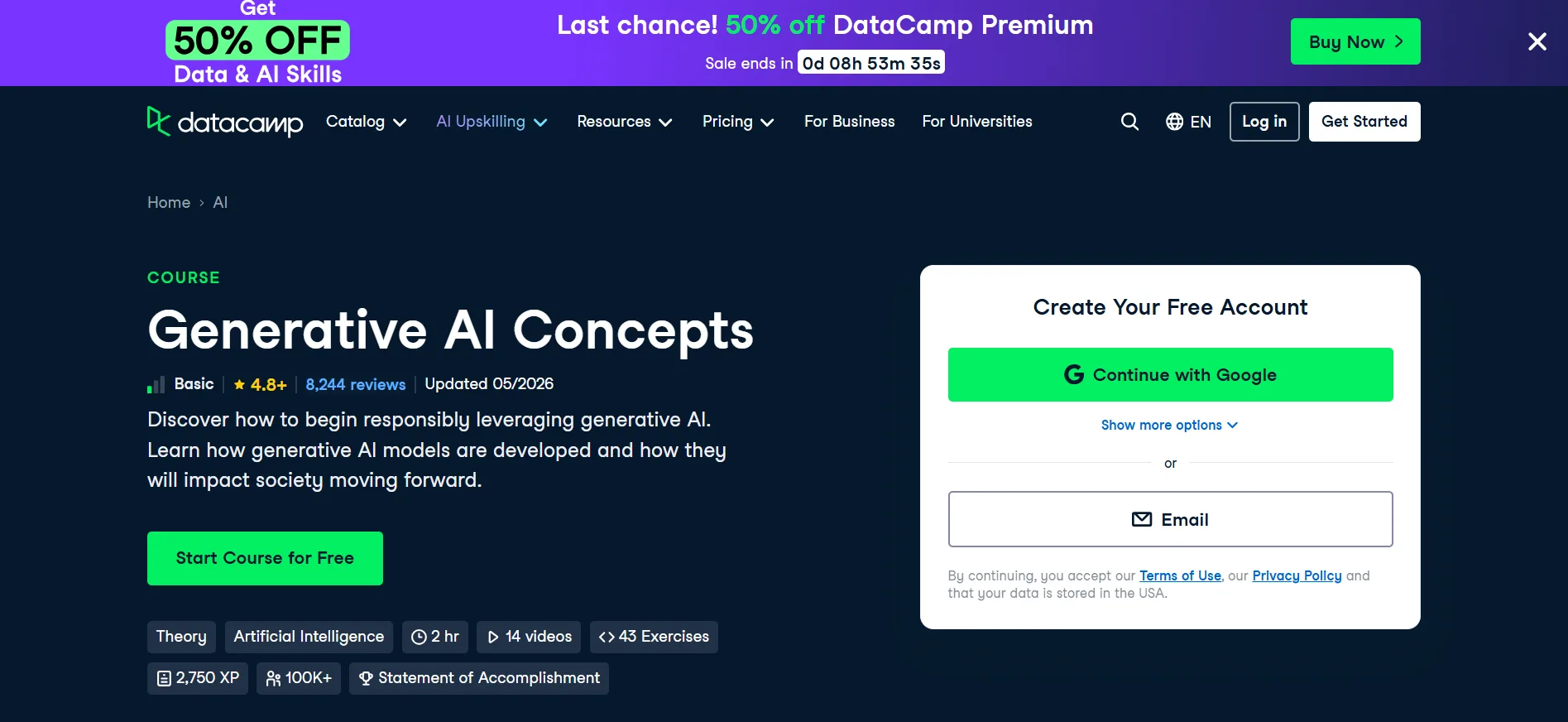
DataCamp's Generative AI Concepts course takes the top spot on the 2026 ranking because it does something rare: it explains what generative AI actually is without demanding any technical background, while still being rigorous enough to be genuinely useful for professional learners. The course is structured around three broad sections.
The first covers Understanding AI — what it is, how it works mechanically, and exactly where generative AI sits within the wider AI landscape. The second section focuses on the Value of AI for Work, showing real-world examples of how generative AI is already changing productivity across roles.
The third section addresses responsible use and societal impact, covering bias, hallucination, and ethical deployment — topics that are increasingly required knowledge for anyone using these tools in a professional context.
With over 105,000 enrolments and a rating of 4.8 out of 5, it is one of the most-reviewed AI courses on DataCamp. It sits inside the broader AI Fundamentals skill track, which gives learners a clear pathway to go deeper after completing this foundation. The course is non-technical, which means no coding is required and no prior data science knowledge is assumed.
For managers, analysts, marketers, and any professional who needs to understand what generative AI is and how to use it responsibly, this is the single most efficient starting point available today.
#2. DataCamp — Generative AI for Business
🔗 https://www.datacamp.com/courses/generative-ai-for-business
Duration: 1 hour | Enrolments: 58,600+
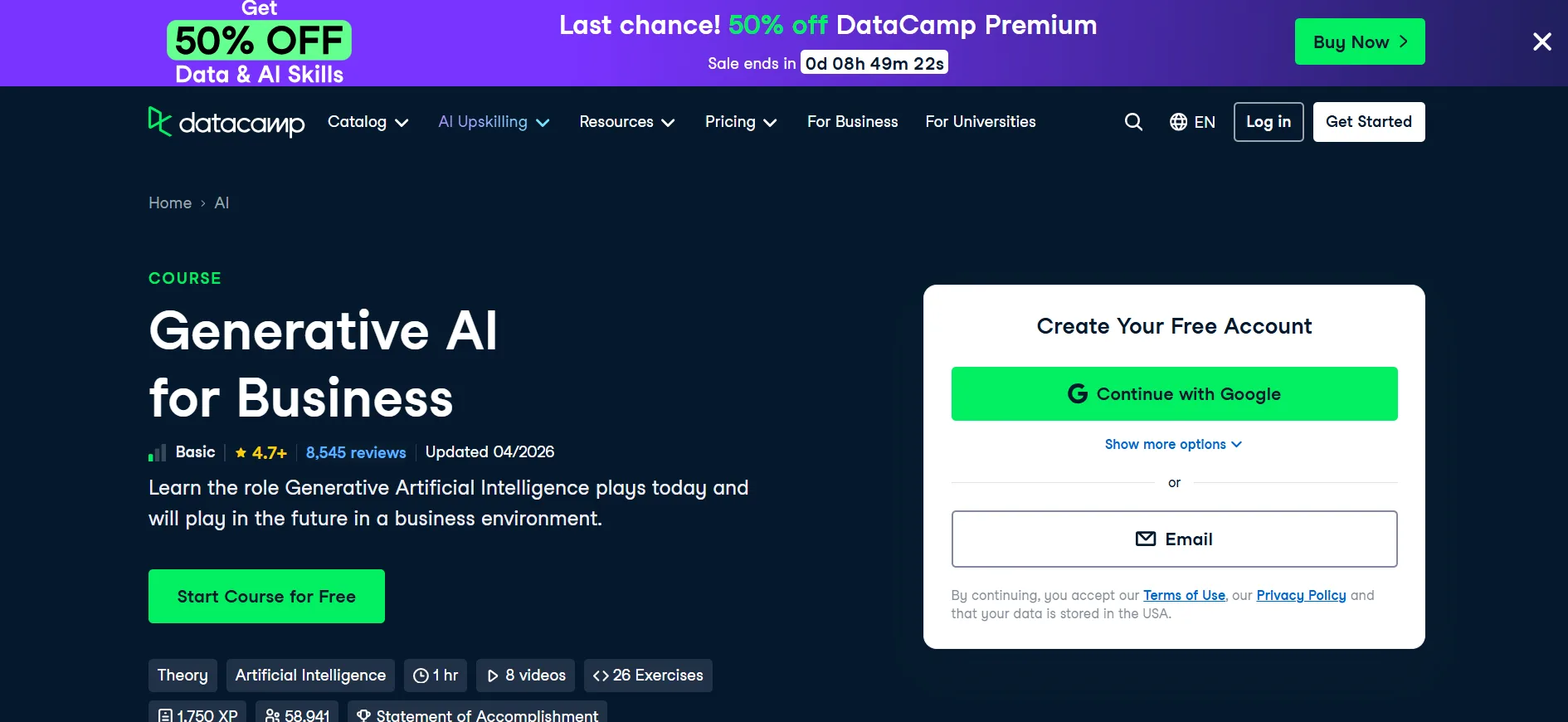
While the Generative AI Concepts course gives you the foundational understanding of how the technology works, the Generative AI for Business course is specifically designed for people who need to understand the commercial and strategic implications.
It covers the role generative AI plays today in business environments and makes the case for how that role is expected to deepen through the rest of the decade. It looks at real business use cases — content generation, customer service automation, code assistance, product development, internal knowledge management — and examines both the opportunities and the risks that come with each.
With nearly 59,000 enrolments, this is a course that has clearly resonated with the audience it targets: business professionals, team leaders, and executives who need to make informed decisions about AI adoption without necessarily writing a line of code. The one-hour format means it fits into any schedule, and DataCamp's interactive platform means there are practical exercises woven throughout rather than passive video watching.
#3. DeepLearning.AI — Generative AI for Everyone
🔗 https://www.deeplearning.ai/courses/generative-ai-for-everyone
Also on Coursera: https://www.coursera.org/learn/generative-ai-for-everyone
Instructor: Andrew Ng | Platform: DeepLearning.AI / Coursera | Audience: Beginner | Cost: Free to audit on Coursera
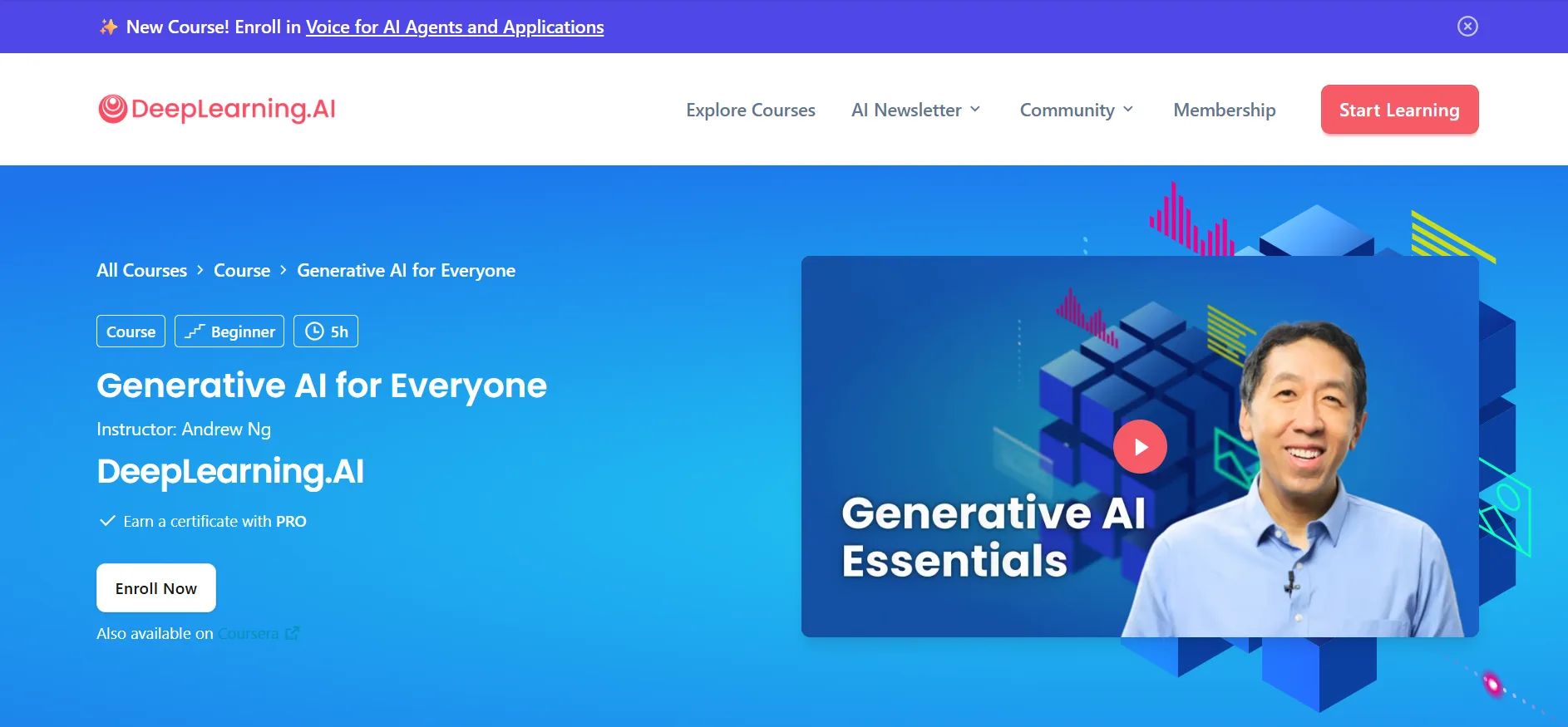
Andrew Ng is arguably the single most trusted name in AI education globally. His original Stanford machine learning course enrolled over 100,000 students when it launched — one of the first massive open online courses in history. DeepLearning.AI, which he founded to scale that mission, now has over 7 million learners across its platform.
Generative AI for Everyone is his direct response to the wave of non-technical professionals who need to understand this technology but do not have a computer science background.
The course teaches how generative AI works at a conceptual level, what it can and genuinely cannot do, and how to use it effectively and ethically in practice. Andrew Ng brings hands-on exercises into what is fundamentally a conceptual course — you are not just watching explanations, you are practising prompt construction and evaluating outputs.
The course is available on Coursera where it can be audited for free, with a paid certificate option. For anyone who has heard of Andrew Ng and wants to learn directly from him, this is the most accessible entry point he has created to date.
#4. Google Cloud — Introduction to Generative AI
🔗 https://cloud.google.com/learn/training/machinelearning-ai
Also on Coursera: https://www.coursera.org/learn/introduction-to-generative-ai
Provider: Google Cloud | Level: Beginner (microlearning format) | Cost: Free
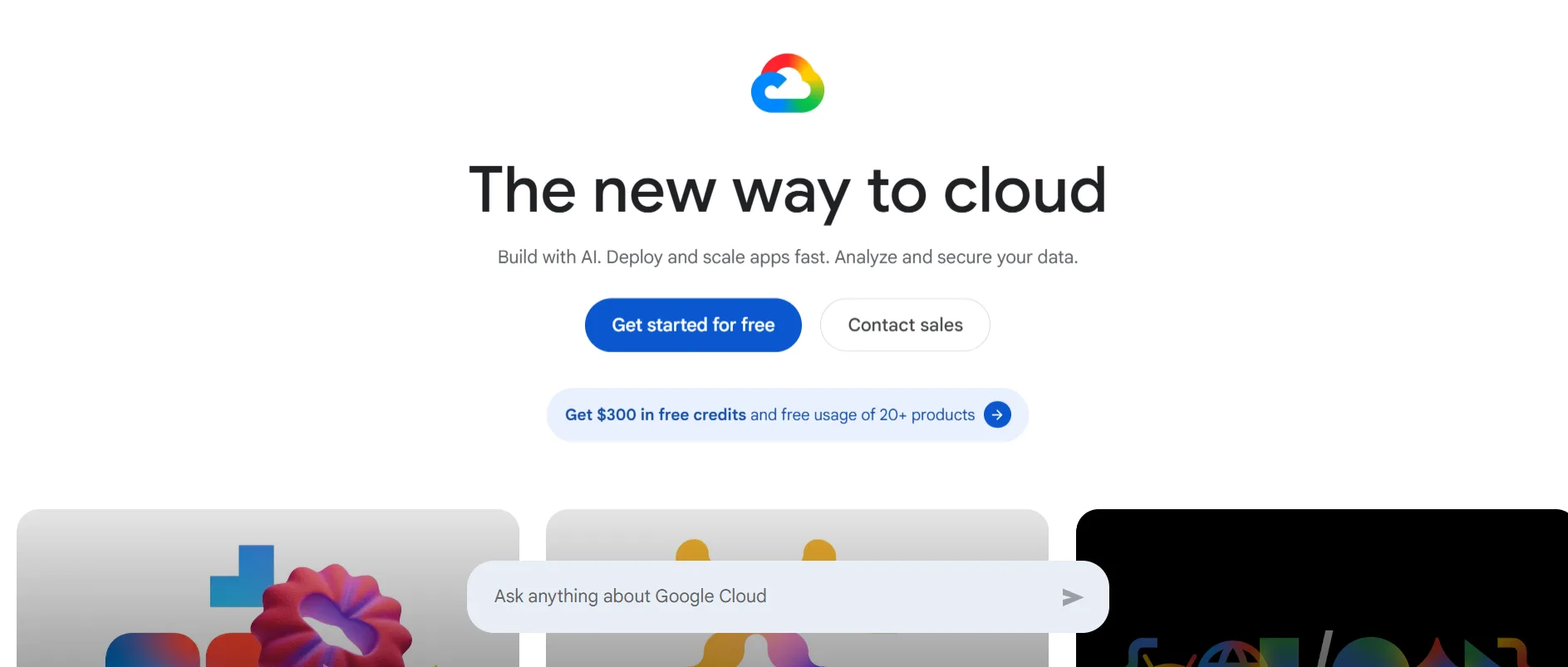
Google Cloud's Introduction to Generative AI is a short, introductory microlearning course designed to explain what generative AI is, how it differs from traditional machine learning, and how it is used across products and services in the real world. Google offers a full learning path for generative AI that extends from beginner level through to an advanced track covering deployment and management of generative AI models on Google Cloud infrastructure.
What makes Google's offering particularly valuable in 2026 is that it is deeply integrated with Gemini and Google's own AI ecosystem, meaning the examples and tools used throughout are live, production-grade products rather than theoretical constructs. For developers and data practitioners who work in or plan to work with Google Cloud, this path provides both conceptual grounding and practical, platform-specific skills. The introductory course is free and available on both Google Cloud's own training portal and on Coursera.
#5. IBM — Generative AI Engineering Professional Certificate
🔗 https://www.coursera.org/professional-certificates/ibm-generative-ai-engineering
Platform: Coursera | Format: 16-course professional certificate series | Estimated Time: 6 months at 6 hours/week | Rating: 4.7 from 99,996 reviews | Cost: Coursera subscription (~$49/month)
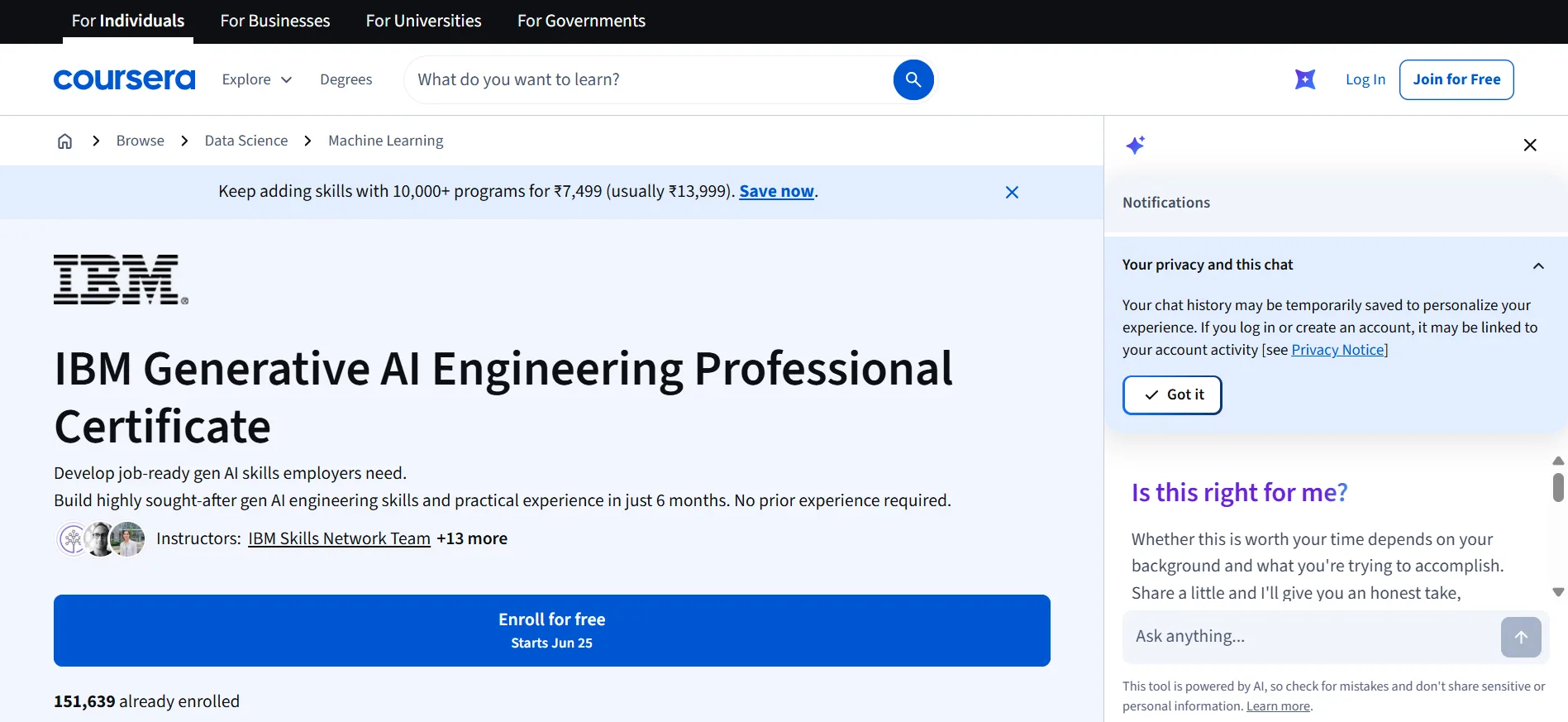
IBM's Generative AI Engineering Professional Certificate is one of the most comprehensive and highly reviewed generative AI programmes available anywhere online. With nearly 100,000 reviews at a rating of 4.7 out of 5, the scale of validation behind this certificate is almost unmatched in the field.
Across 16 courses, it covers generating text, images, and code through generative AI; applying prompt engineering techniques and best practices; building and fine-tuning large language models; working with retrieval-augmented generation (RAG); and deploying AI models using IBM's Watson and cloud infrastructure.
IBM cites the generative AI engineering job market growing at a 46% CAGR to 2030 (Statista) as the market backdrop for this certificate, and the curriculum is designed to be directly employment-relevant rather than academically abstract.
The 6-month, 6-hours-per-week commitment makes it a meaningful investment, but it is a professional credential that carries IBM's institutional backing and is recognised by employers globally.
For working professionals looking to transition into or deepen a generative AI engineering role, this is one of the most respected and comprehensive paths currently available.
#6. Microsoft — Generative AI for Beginners
🔗 https://learn.microsoft.com/en-us/shows/generative-ai-for-beginners/
Provider: Microsoft (GitHub/Microsoft Learn) | Format: 18-lesson free course | Cost: Free, no registration required
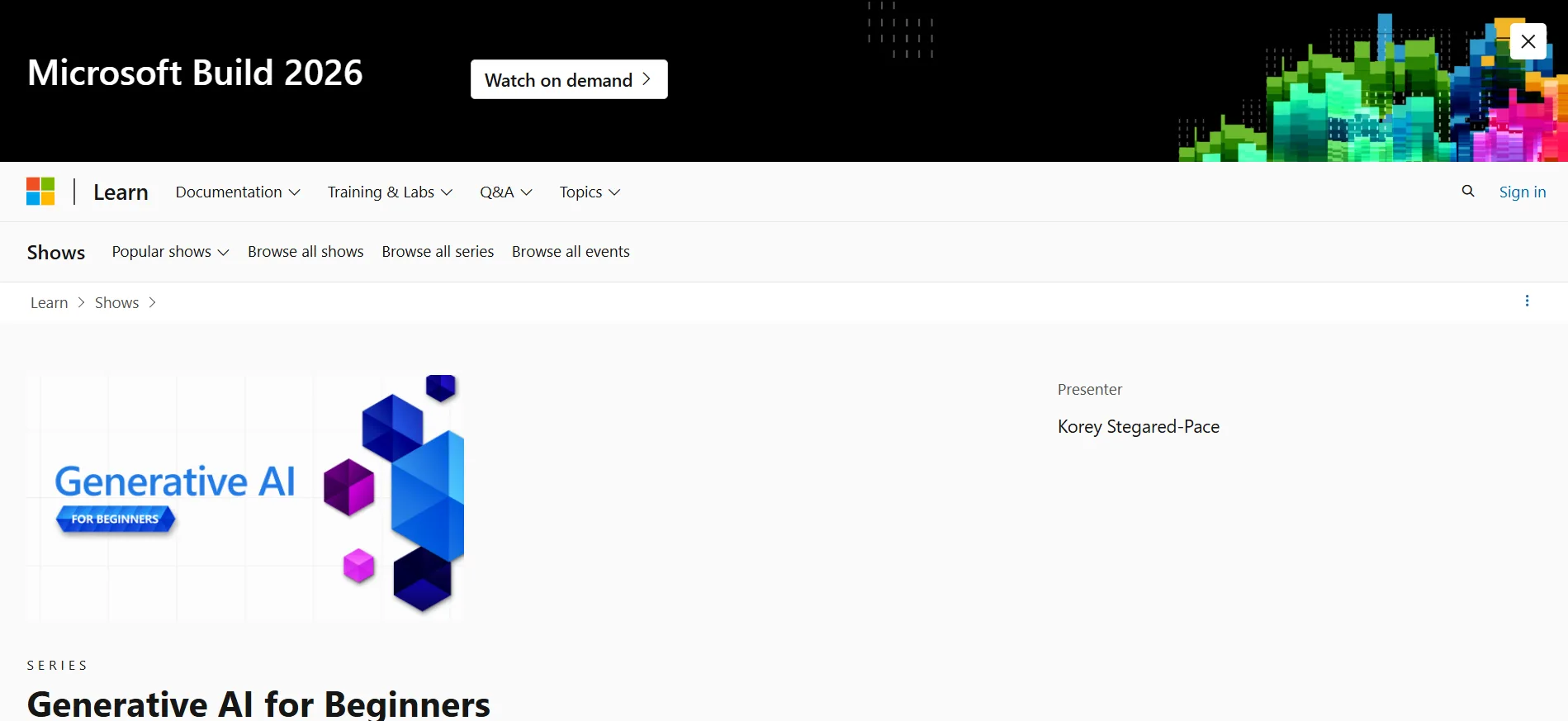
Microsoft's Generative AI for Beginners is an 18-lesson comprehensive curriculum developed by Microsoft Cloud Advocates and published openly on GitHub and Microsoft Learn. Unlike most beginner courses, this one does not shy away from technical content — it goes into how large language models work, how to build generative AI applications step by step, and how to apply responsible AI principles in practice.
Code examples are included throughout in Python, and the full course content is available publicly on GitHub with no paywall and no registration requirement.
Microsoft also offers free AI courses with certificates through Microsoft Learn and Azure AI Fundamentals certification — the latter being an official Microsoft credential that validates foundational AI and machine learning knowledge.
The Azure AI Fundamentals certification (AI-900) is a widely recognised entry-level qualification that many enterprises now look for in technical candidates. The Generative AI for Beginners course is an ideal primer before sitting the AI-900 exam. For developers who learn best by reading and coding rather than watching videos, the GitHub-hosted format is particularly well-suited.
#7. Stanford Online — Technical Fundamentals of Generative AI (XFM110)
🔗 https://online.stanford.edu/courses/xfm110-technical-fundamentals-generative-ai
Format: 100% online, on-demand | Duration: 9 hours | Cost: $995 | Access period: 60 days | Credits: 0.5 CEU-equivalent
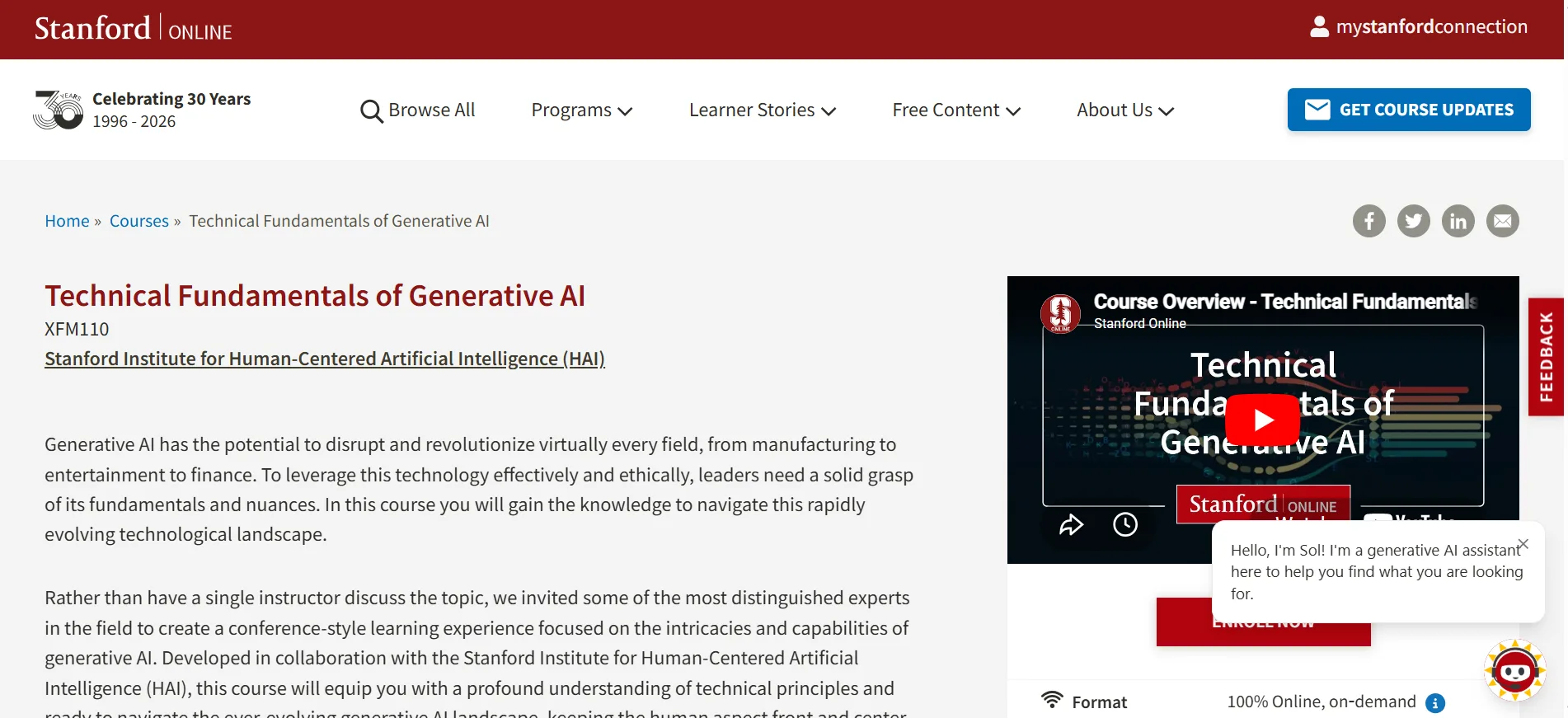
Stanford's Technical Fundamentals of Generative AI is the premium, institutional end of the generative AI education market. At $995 for a 9-hour, 60-day access course, it is priced for professionals whose employers are sponsoring their learning — it is not the budget choice.
What it offers in return is Stanford's academic authority, a rigorous technical curriculum that covers the history of AI and machine learning, the fundamental principles of generative AI architecture, and the practical skills needed to apply these technologies in professional contexts.
Stanford also offers a free 2-hour programme preview (Generative AI: Technology, Business, and Society) at zero cost, available at https://online.stanford.edu/courses/xfm100-generative-ai-technology-business-and-society-program-preview, which is worth taking before committing to the full paid course.
There is also a companion course, Human-Centered Generative AI (XFM112), which focuses on ethical strategies and stakeholder-centred implementation — available at https://online.stanford.edu/courses/xfm112-human-centered-generative-ai. For executives, senior engineers, and professionals who need a credential carrying Stanford's name, the XFM110 course is the most prestigious option on this list.
#8. DataCamp — Cleaning Data with Generative AI
🔗https://www.datacamp.com/courses/cleaning-data-with-generative-ai
Duration: 1 hour | Enrolments: 12,900+
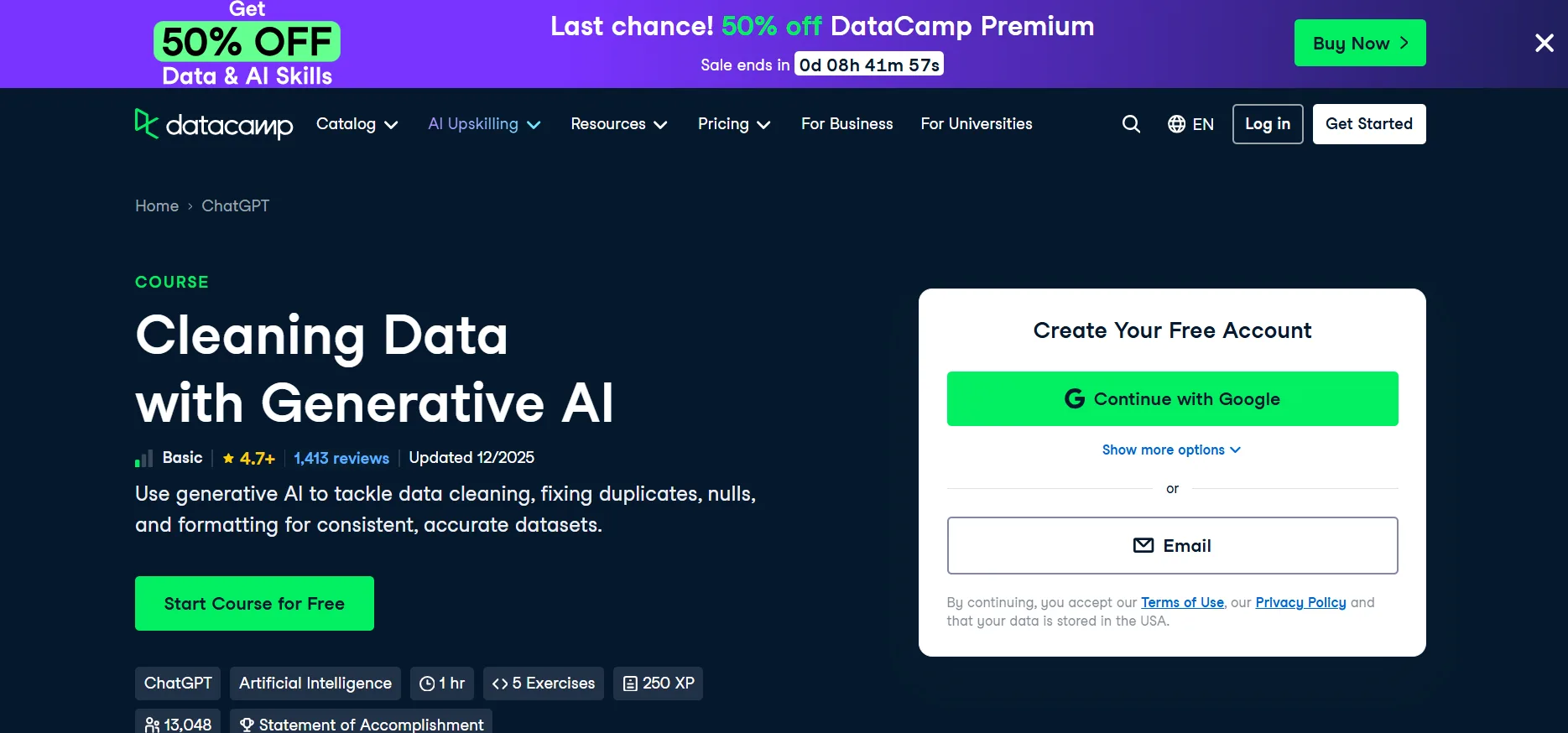
This course occupies a niche that very few other programmes address: the practical application of generative AI to one of the most time-consuming, unglamorous but genuinely important tasks in any data workflow — cleaning data. The course teaches how to use generative AI tools to fix duplicate records, handle null values, standardise formatting inconsistencies, and produce consistent, accurate datasets ready for analysis or model training.
With nearly 13,000 enrolments, it has clearly found a real audience among data analysts, data engineers, and anyone who regularly works with messy real-world data.
The one-hour format is tightly focused on practical application rather than theory. For data professionals who already understand the basics of generative AI and want to immediately apply those skills to reduce the most tedious part of their workload, this is one of the highest return-on-time courses on this entire list.
#9. DataCamp — AI Fundamentals Skill Track
🔗https://www.datacamp.com/tracks/ai-fundamentals
Format: Multi-course skill track | Includes: Generative AI Concepts and multiple related courses
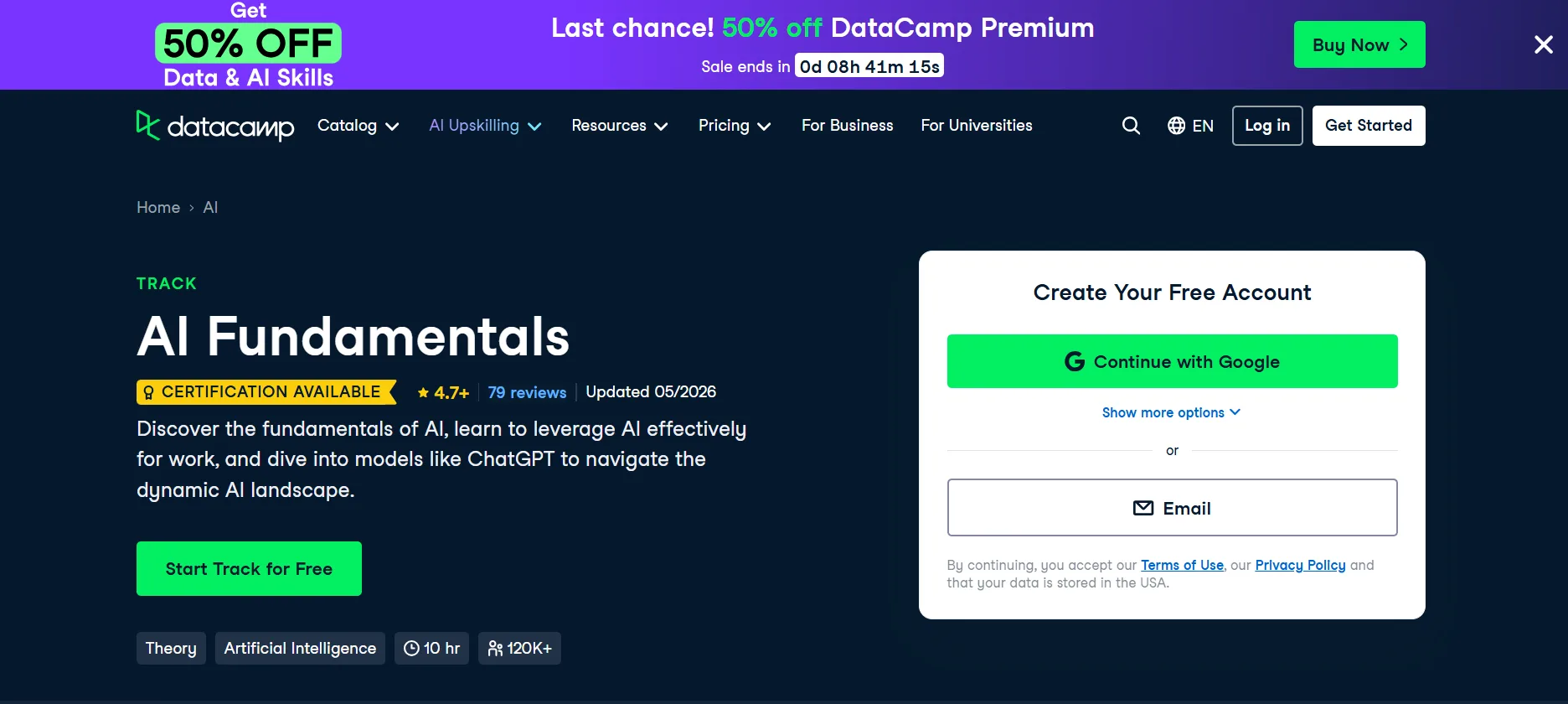
For learners who want a structured, progressive path rather than a single standalone course, DataCamp's AI Fundamentals skill track packages the Generative AI Concepts course alongside several related courses covering AI broadly — understanding machine learning, working with large language models, and applying AI tools across different professional contexts.
The skill track format gives learners a clear roadmap from zero to a functioning understanding of the AI landscape, with completion certificates at each stage and a skill track certificate at the end.
This is the best entry point for professionals who are starting with no AI background and want to build a solid, comprehensive foundation rather than jumping straight into a specialised topic.
The Market Context: Why These Courses Matter Right Now
Learning generative AI in 2026 is not just about personal development — it is about responding to a labour market that is restructuring around AI skills faster than educational institutions can keep pace with.
LinkedIn's 2026 Talent Velocity Advantage Report notes that in the past two years alone, employers have created at least 1.3 million new roles requiring hybrid skills that include AI fluency. PwC's AI Jobs Barometer found that jobs professionalised by AI are growing twice as fast as jobs disrupted by it, with 42% faster wage growth since 2021 for workers who integrate AI into their existing professional roles.
The salary data makes the return on investment calculation straightforward. The average Generative AI Engineer earns $145,112 (Glassdoor), the median from real job postings is $198,000 (Recruiting from Scratch), and senior roles at top companies exceed $300,000 in total compensation.
Even non-engineering roles that add generative AI fluency — in marketing, operations, product management, and finance — command premium salaries compared to equivalents without those skills. The most in-demand single role per Kaggle's 2025–2026 AI jobs dataset is LLM Engineer with a demand score of 98 out of 100, with an average salary of $251,577.
Across all nine courses on this list, the combined investment in learning time ranges from 1 hour (DataCamp's shortest courses) to 6 months at 6 hours per week (IBM's professional certificate), and the cost ranges from completely free (Microsoft, Google, DeepLearning.AI audit track) to $995 (Stanford XFM110).
For most learners, the rational starting point is one of the free beginner options — DataCamp's Generative AI Concepts, DeepLearning.AI‘s Generative AI for Everyone, or Microsoft's Generative AI for Beginners — before investing in a paid credential once the direction is clear.
Quick Course Comparison Summary: Best Generative AI Courses
Course | Provider | Duration | Cost | Best For |
Generative AI Concepts | DataCamp | 2 hrs | Subscription | Beginners, all backgrounds |
Generative AI for Business | DataCamp | 1 hr | Subscription | Business professionals |
Generative AI for Everyone | ~6 hrs | Free audit | All non-technical learners | |
Intro to Generative AI | Google Cloud | Short | Free | Google Cloud users |
Generative AI Engineering | IBM/Coursera | 6 months | ~$49/mo | Career changers, engineers |
Generative AI for Beginners | Microsoft | 18 lessons | Free | Developers, coders |
Technical Fundamentals GenAI | Stanford Online | 9 hrs | $995 | Senior professionals |
Cleaning Data with GenAI | DataCamp | 1 hr | Subscription | Data analysts, engineers |
AI Fundamentals Track | DataCamp | Multi-course | Subscription | Structured beginners' path |
Quick Links: