
President Lee Jae-myung committed roughly 1,350 trillion won across chips, data centres and robots.
That is close to 5% of the country's entire 2024 economic output, mostly corporate money.
The catch nobody is pricing in: the power and water needed do not exist yet.
While everyone argues about which model is smartest, South Korea placed the largest hardware bet in the AI era.
The numbers
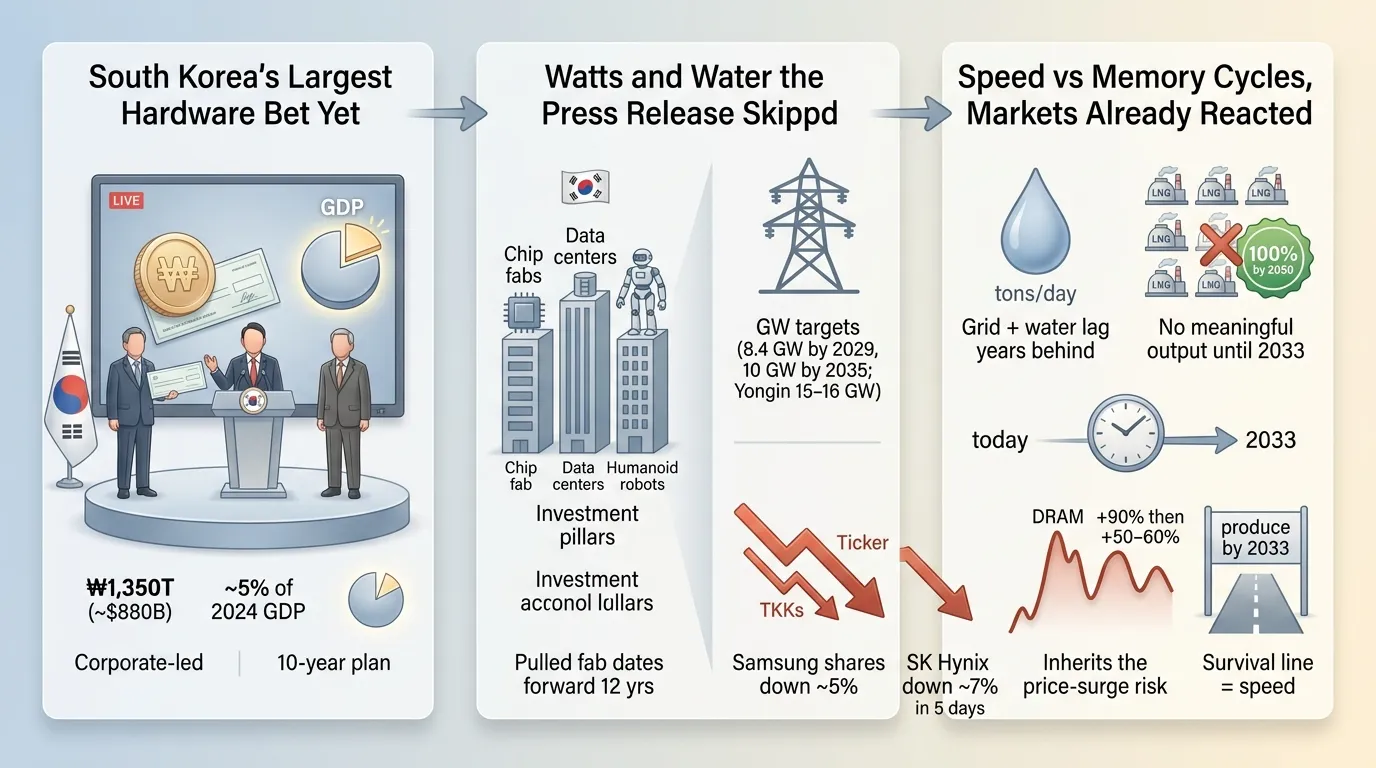
On June 29, President Lee Jae-myung announced a ten-year plan at a televised event, flanked by the heads of Samsung and SK Group, whom he called national heroes. The total runs to roughly 1,350 trillion won, about $880 billion, which is close to five percent of the nation's entire 2024 economic output.
It splits three ways. Samsung Group and SK Group will each build two chipmaking plants in the southwest, with total investment of 800 trillion won, to double memory output within five years.
SK Group, GS Group and Naver will spend 550 trillion won on AI data centres, targeting 8.4 gigawatts of capacity by 2029 and another 10 gigawatts by 2035. The third pillar is physical AI, with a goal to grow South Korea's share of the global humanoid market from 1% to 20% by 2028.
Bloomberg's coverage of the announcement:
The problem underneath the press release
Here is what the celebration skipped. Samsung and SK hynix have pulled fab completion dates forward by as much as 12 years, while the transmission lines and water pipelines that those fabs depend on remain years behind. The Yongin megacluster alone is estimated to require 15 to 16 GW at full operation.
Water is worse. A large memory fab consumes upwards of 100,000 tons of water per day, and the Yongin national complex is projected to need around 800,000 tons per day once fully built. The stopgap is six LNG plants inside the complex, which the ruling party's own carbon-neutrality committee wants cancelled, since both chipmakers hold commitments to reach 100% renewable electricity by 2050.
The financing carries its own risk. The plan rides a price surge, with commodity DRAM up around 90% in the first quarter and 50% to 60% in the second. A plan financed by a price surge inherits the risk that the surge does not last until the fabs it funds come online, and Bank of America notes the cluster will not produce meaningful output until 2033 at the earliest.
Markets noticed. Samsung shares fell around 5% after the announcement and SK Hynix dropped over 7% in five days on oversupply worries. Lee's line was simple: speed is the only way to survive.
Quick Links: