
AI moves too fast to follow on social feeds alone. By the time a big model launch reaches your timeline, it is buried under ten hot takes and three ads. A good newsletter fixes that. Ten minutes of curated email does what an hour of scrolling cannot, which is tell you what changed, why it matters, and what to do about it.
I ranked these on four things: signal-to-noise ratio, editorial perspective (real framing, not rephrased press releases), publishing consistency, and audience fit. One honest note up front.
Some “best newsletter” lists put the publisher's own newsletter at number one. I have ranked best AI newsletters to subscribe by genuine usefulness and reach instead, and flagged any house publication so you know what you are reading.
Here is the short version. If you want one daily, start with The Rundown AI or TLDR AI. If you want one weekly anchor, The Batch is hard to beat. Everything else on this list earns its place for a specific kind of reader.
Best AI newsletters to Subscribe: The big daily briefings
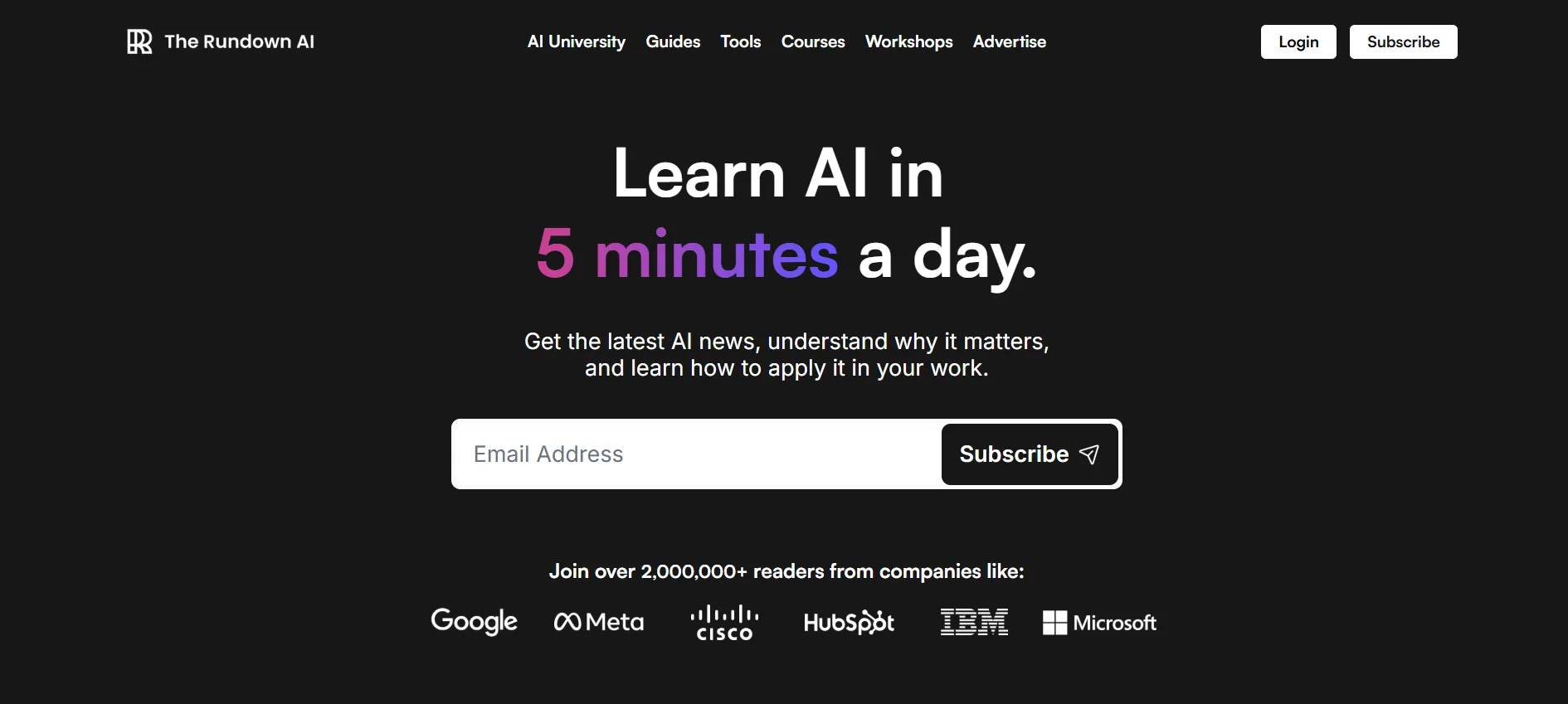
#1. The Rundown AI
Frequency: Daily
Time: about 5 minutes
Cost: Free, with a paid tier
Best for: operators, founders, PMs, and the AI-curious who want the whole day in one pass
The Rundown is the largest dedicated AI newsletter in the world, with more than two million subscribers as of 2026. Each issue boils the day's model releases, product launches, and research into a clean, scannable format with a friendly tone. If you only read one daily, this is the safe default.
Honest note: at this scale the coverage is broad rather than deep. Pair it with a specialist if your work needs depth.
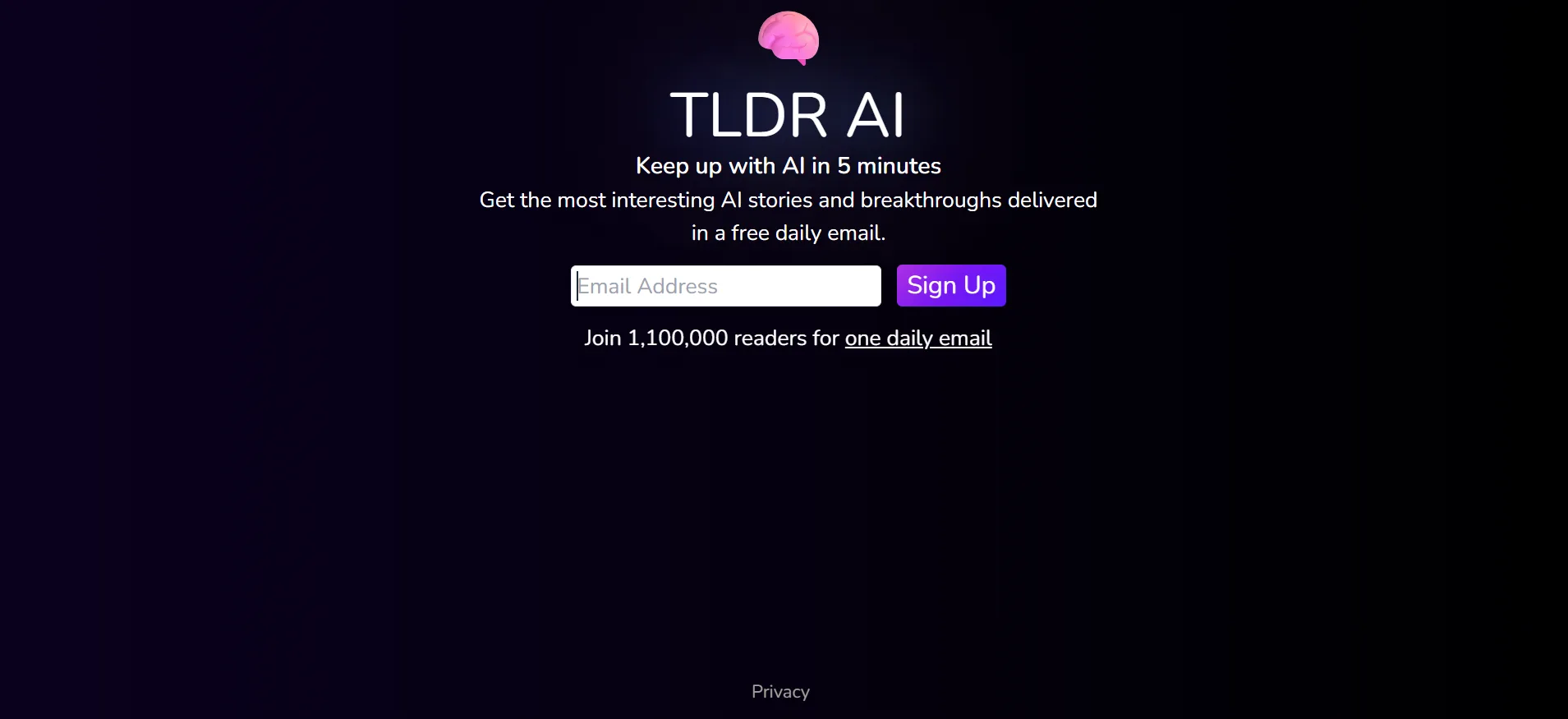
#2. TLDR AI
Frequency: Weekdays
Time: about 5 minutes
Cost: Free
Best for: developers and ML engineers who want links and one-line summaries, not narrative
Part of the wider TLDR family, TLDR AI leans technical. Research papers, GitHub repos, and engineering posts sit next to the day's headlines. The format is ruthless: headline, two sentences, link. That makes it the fastest way to triage what deserves a real read. With well over a million subscribers, it is the default daily for working engineers.
#3. Superhuman AI
Frequency: Daily
Time: about 5 minutes
Cost: Free
Best for: knowledge workers, marketers, and executives who use AI at work but do not build it
Superhuman focuses on application over architecture: tool roundups, prompt tips, and workplace use cases next to the day's news. With more than a million subscribers, it is the daily for people who want to apply AI, not study it.
#4. The Neuron
Frequency: Daily
Time: about 5 minutes
Cost: Free
Best for: non-technical readers who want to stay current without the jargon
The Neuron explains the day with humor and plain language, plus a steady stream of tool recommendations. It covers the same launches as the other big dailies, but the voice is the difference. For many readers it is simply the one they do not skip.
A quick rule: pick only one daily from this group. They cover the same stories, so reading all four is just repetition.
Best AI newsletters to Subscribe: The respected weeklies
#5. The Batch (DeepLearning.AI)
🔗 https://www.deeplearning.ai/the-batch
Frequency: Weekly
Time: about 10 minutes
Cost: Free
Best for: learners and practitioners who want research explained with care
Published by Andrew Ng's DeepLearning.AI, The Batch pairs curated research and news with “Letters from Andrew Ng,” one of the most-cited recurring columns in the field. The tone is measured and educational, which is a useful counterweight to hype cycles. If you want one weekly anchor, start here.
#6. Import AI (Jack Clark)
🔗 https://importai.substack.com/
Frequency: Weekly
Time: about 15 minutes
Cost: Free
Best for: researchers, policy people, and anyone tracking the strategic side of AI
Written by Anthropic co-founder Jack Clark since 2016, Import AI is one of the longest-running newsletters in the field. Each issue mixes paper summaries with original analysis of compute trends, governance, and national AI strategy, and famously ends with a short piece of AI-themed fiction. Nothing else combines this much technical literacy with policy depth.
#7. Last Week in AI
Frequency: Weekly
Time: about 15 minutes
Cost: Free
Best for: readers who skip the dailies and want one thorough weekly pass
Paired with a long-running podcast, Last Week in AI sorts the week into clear sections: tools, research, policy, business, each with short summaries and links. Pick this if you value completeness over tight curation.
#8. The Algorithm (MIT Technology Review)
🔗 https://forms.technologyreview.com/newsletters/ai-demystified-the-algorithm/
Frequency: Weekly
Time: about 10 minutes
Cost: Free newsletter, full articles may need a subscription
Best for: readers who want real journalism, not just aggregation
Written by MIT Technology Review's AI reporters, The Algorithm brings newsroom resources to the beat: investigations, interviews, and critical coverage of AI's impact on society. It does the accountability reporting most independents cannot.
Best AI newsletters to Subscribe: For engineers and researchers
#9. Interconnects (Nathan Lambert)
🔗 https://www.interconnects.ai/
Frequency: Roughly weekly
Time: about 15 minutes
Cost: Free, with a paid tier
Best for: practitioners tracking post-training, open weights, and lab strategy
Nathan Lambert writes from direct experience training open models, and it shows. Interconnects covers reinforcement learning from human feedback, reasoning models, and open-source releases with a depth that general newsletters cannot match.
#10. Latent Space
Frequency: Weekly-ish, plus a podcast
Time: about 15 to 20 minutes
Cost: Free, with a paid tier
Best for: AI engineers making production calls on models, agents, and infrastructure
Run by swyx and Alessio Fanelli, Latent Space pairs a widely followed podcast with written deep dives on inference economics, agent frameworks, and the tooling between models and shipped products. If your job is choosing models or building LLM apps, this is the synthesis layer.
#11. Ahead of AI (Sebastian Raschka)
🔗 https://magazine.sebastianraschka.com/
Frequency: Roughly monthly
Time: about 20 to 30 minutes
Cost: Free, with a paid tier
Best for: engineers who want architecture and training methods explained properly
Sebastian Raschka, author of widely used ML textbooks, writes long technical explainers on attention variants, fine-tuning, and reasoning-model training. Each issue reads more like a tutorial than a digest. Lower frequency, much higher density, which is the trade most technical readers actually want.
Best AI newsletters to Subscribe: For builders and founders
#12. Ben's Bites
Frequency: Several times a week
Time: about 5 to 10 minutes
Cost: Free, with a paid tier
Best for: founders and indie builders turning AI releases into product decisions
Ben Tossell launched it in 2022, weeks before ChatGPT, and it has grown with his shift from exited founder to active AI investor. It blends hands-on tool tests and mini-tutorials with company deep dives, founder stories, and a look behind early-stage AI investing.
Best AI newsletters to Subscribe: For leaders, policy, and the big picture
#13. One Useful Thing (Ethan Mollick)
🔗 https://www.oneusefulthing.org/
Frequency: Irregular, a few times a month
Time: about 10 to 15 minutes
Cost: Free
Best for: leaders and educators thinking about adoption rather than internals
Wharton professor Ethan Mollick writes grounded, experiment-driven essays on using frontier models in real work. His pieces routinely shape how organizations talk about AI, and his “always invite AI to the table” line has become standard advice.
#14. Exponential View (Azeem Azhar)
🔗 https://www.exponentialview.co/
Frequency: Weekly, plus member content
Time: about 15 minutes
Cost: Free tier with paid membership
Best for: strategists and generalists who want AI placed in broader change
Azeem Azhar has covered exponential technologies for over a decade, and AI now sits at the center of that lens. Expect chart-driven analysis linking model progress to electricity demand, labor markets, and geopolitics. Less about this week's release, more about the decade it belongs to.
#15. ChinAI (Jeffrey Ding)
🔗 https://chinai.substack.com/
Frequency: Weekly
Time: about 10 minutes
Cost: Free
Best for: anyone tracking China's AI ecosystem from primary sources
Jeffrey Ding translates and analyzes Chinese-language writing on AI, including corporate strategy, academic debate, and policy commentary that would never otherwise reach English readers. Nothing else on this list offers that window.
Best AI newsletters to Subscribe: The house publication to know
#16. The Median (DataCamp)
🔗 https://dcthemedian.substack.com/
Frequency: Weekly
Time: about 10 minutes
Cost: Free
Best for: data professionals and people upskilling into AI
The Median is DataCamp's own newsletter, so treat its frequent number-one placement on DataCamp's lists with that in mind. On merit it is a solid weekly that ties the week's AI and data news to skills and learning resources. If you are actively studying, the link from news to tutorials is genuinely useful.
Comparison: Best AI newsletters to Subscribe
Newsletter | Frequency | Lane | Best for |
The Rundown AI | Daily | General briefing | One daily for everyone |
TLDR AI | Weekdays | Technical scan | Engineers triaging fast |
Superhuman AI | Daily | AI at work | Applying AI day to day |
The Neuron | Daily | Accessible news | Non-technical readers |
The Batch | Weekly | Research framing | A weekly anchor |
Import AI | Weekly | Research and policy | Strategy and governance |
Last Week in AI | Weekly | Full roundup | Completeness over curation |
The Algorithm | Weekly | Journalism | Accountability reporting |
Interconnects | ~Weekly | Open models | Post-training depth |
Latent Space | ~Weekly | AI engineering | Production decisions |
Ahead of AI | ~Monthly | Deep dives | Architecture and training |
Ben's Bites | Several/week | Builder ecosystem | Founders and indie hackers |
One Useful Thing | Irregular | Adoption essays | Leaders and educators |
Exponential View | Weekly | Big-picture strategy | Strategists and generalists |
ChinAI | Weekly | China's AI scene | Policy and analysts |
The Median | Weekly | News plus skills | People upskilling |
How many should you actually subscribe to
Two or three is the sweet spot. Take one weekly anchor like The Batch, one daily briefing (pick a single one from The Rundown, TLDR AI, Superhuman, or The Neuron, since they overlap), and one specialist matched to your role.
If you are an engineer, add Interconnects or Ahead of AI, and Latent Space if you build LLM apps. If you lead a team, add One Useful Thing or Exponential View. If you watch policy, add Import AI and ChinAI.
Are free newsletters good enough
For daily news, yes. The best dailies are free. Paid tiers earn their cost on analysis, not headlines, so the depth from Interconnects, Latent Space, or Exponential View is where a subscription pays off.
Do you still need newsletters if you follow AI on social media
Yes. Feeds optimize for engagement, newsletters for editorial judgment. Ten minutes of curated email reliably surfaces what an algorithm buries.
FAQs: Best AI Newsletters to Subscribe
The Neuron for a plain-language daily, plus The Batch as an easy weekly.
TLDR AI for daily triage, then Interconnects or Ahead of AI for depth, and Latent Space if you ship LLM apps.
Import AI, with ChinAI for the international angle and The Algorithm for accountability journalism.
Ben's Bites, for the "what does this mean for what I am shipping" layer.
Two or three. More than that and you are just reading the same launch story four times.
Quick Links: