
Google Gemini, running Nano Banana 2, is now the best free AI image generator for most users.
DALL-E 3 has been retired, replaced inside ChatGPT by the new GPT Image 2 model.
Ideogram went open-weight, and Grok dropped its free image generation entirely.
The free AI image space did not just grow in 2026. It reshuffled. New models landed, old ones retired, and the tool you reached for last year may not be the right pick now.
Google takes the top spot
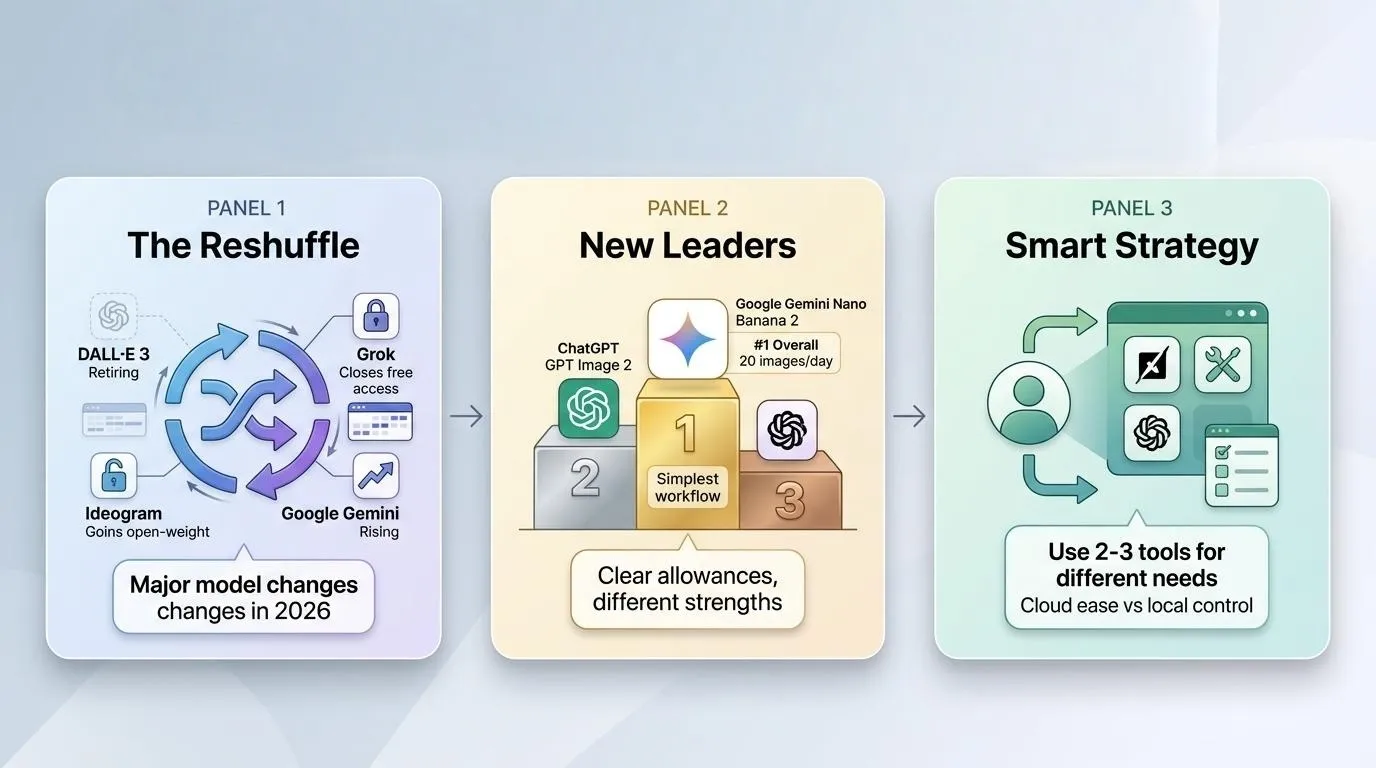
Google released Nano Banana 2, officially Gemini 3.1 Flash Image, on February 26, 2026. It earns the overall lead for a simple reason: the free allowance is easy to understand. Gemini app users get about 20 images a day at up to 1K resolution, with no token math. Every output carries Google's invisible SynthID watermark and C2PA content credentials. The higher quality Nano Banana Pro model sits behind a much tighter free cap.
OpenAI swaps in GPT Image 2
OpenAI launched ChatGPT Images 2.0, powered by the gpt-image-2 model, on April 21, 2026, and retired DALL-E 3 on May 12. Any guide still naming DALL-E 3 as the current ChatGPT image model is out of date. The free tier is tight at roughly 2 to 3 images a day, but the workflow is the simplest around. You describe what you want in plain words, then refine it in the same chat. Text rendering is a clear strength.
Ideogram opens up, Grok closes off
On June 3, 2026, Ideogram released Ideogram 4.0 as an open-weight model, now available on Hugging Face, ComfyUI, and Replicate for local or API use. It remains the go-to for readable text inside images, though the free tier runs on slow weekly credits. Moving the other way, xAI removed free image generation from Grok in March 2026, so it now needs a paid SuperGrok plan. Microsoft also added its own MAI-Image-2e model to Bing Image Creator in March.
What it means for users
The headline shift is the split between capped cloud tools and open or local options. Cloud tools like Gemini, ChatGPT, and Ideogram are easy to start but come with daily limits, slow queues, or public galleries. Open-weight options like Stable Diffusion 3.5 and the FLUX.2 family drop the platform cap, but make your hardware the limit and your setup the cost.
Commercial rights stay the quiet catch. Leonardo and Ideogram make free output public by default, Bing free use is non-commercial, and Adobe Firefly only extends legal indemnification to paid users. Reading the terms before publishing is no longer a formality.
For most people the practical move is not one tool but two or three. Start with Gemini for general work, add Ideogram when words inside the image matter, and keep ChatGPT for quick conversational edits. The same-prompt test still sorts ties fast: run one prompt through two tools and keep the one that gets closest without a fight.
Quick Links: