
I have built more than a dozen affiliate sites over the years.
Some failed. Some made me $500/month. Some made significantly more.
In early 2026, I decided to run an experiment: build a brand new niche affiliate site entirely with AI assistance — from niche selection to published content — in 30 days.
This is exactly what I did, what worked, and what I would do differently.
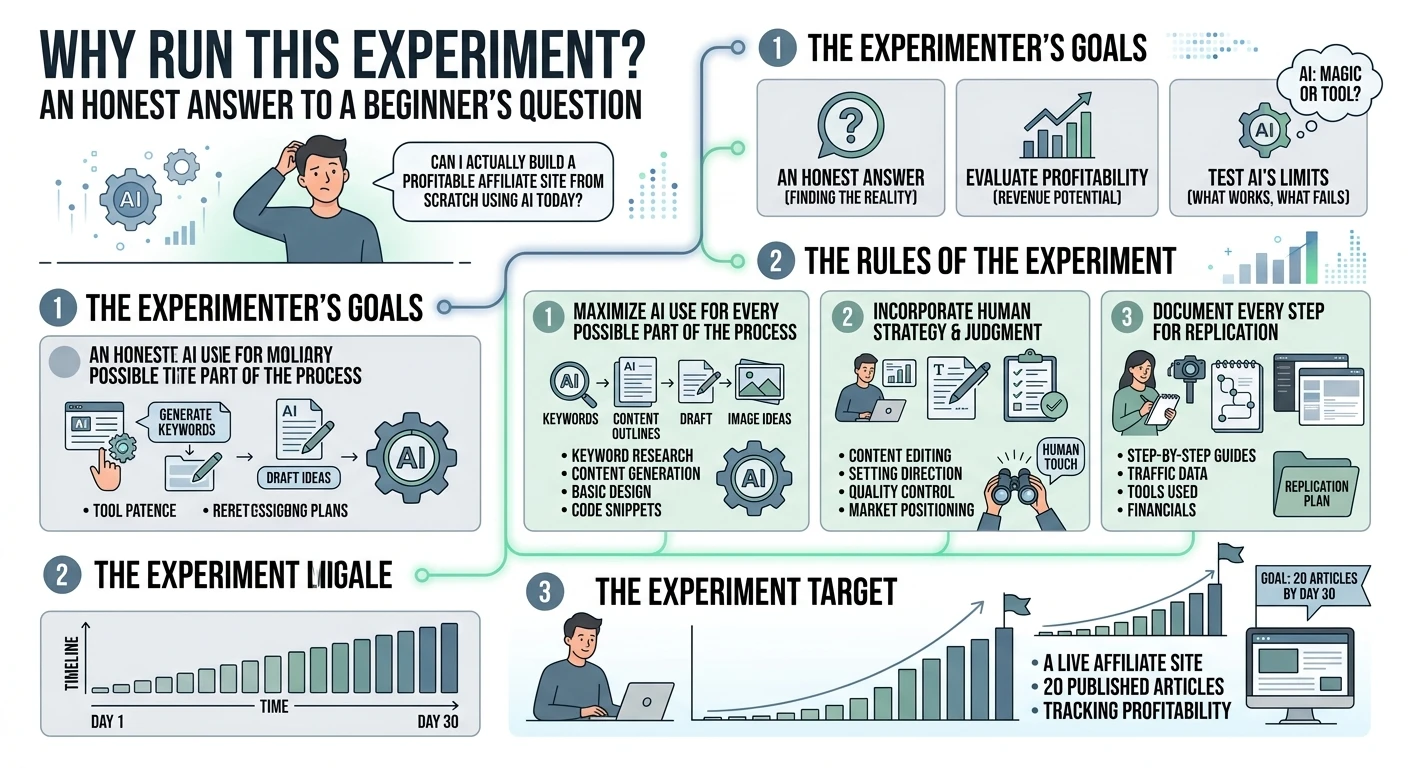
Why Run This Experiment?
The question I keep hearing from beginners is: “Can I actually build a profitable affiliate site from scratch using AI today?”
I wanted an honest answer. So I ran it myself.
The rules I set:
I would use AI tools for every possible part of the process
I would put my own experience and judgment into strategy and editing
I would document every step so you can replicate it
The goal was a live site with 20 published articles by day 30
Day 1–3: Niche Selection With AI
I started by asking ChatGPT and Perplexity AI to help me identify sub-niches within a broad category I was comfortable writing about.
My prompt to ChatGPT:
“I want to build an affiliate site in the [broad niche] space. Help me identify 10 specific sub-niches that: have buyer intent keywords, have affiliate programs with at least 20% commission, are specific enough to build topical authority quickly, and are not dominated by huge media brands. For each sub-niche, estimate the search volume potential and difficulty level.”
From the 10 suggestions, I narrowed down to 3 that felt right. Then I validated each one in Semrush.
The validation criteria:
At least 10 keywords with 500–5,000 monthly searches
Top-ranking competitors with Domain Authority under 50
Clear monetization path through affiliate programs paying 20%+
By day 3, I had my niche selected and my affiliate programs identified.
Day 4–7: Site Setup and Architecture
I will not go deep into hosting and WordPress setup here since that is not the AI part. But for the content architecture, I used Claude to build my site's topic structure.
My prompt:
“You are an expert SEO strategist building a new affiliate site in [niche]. Create a topical authority content map that covers: 5 pillar pages, 4 supporting articles for each pillar, and 10 buyer intent review/comparison pages. Structure it so the site builds topical authority from the ground up. Format it as a table with page titles, target keywords, and content type.”
Claude produced a 40-page content map in 5 minutes. I reviewed it, removed content that did not fit my angle, and added a few topics from my own research.
This map became my 30-day editorial calendar.
Day 8–15: Content Creation Sprint
With my content map ready, I went into a writing sprint.
My production workflow:
Choose the article from my calendar
Use Frase to research competitors and build the brief
Use Claude to write the first draft
Edit manually — add personal experience, fix AI-isms, verify all facts
Run through Surfer SEO for on-page optimization
Add internal links from my content map
I published 12 articles in this 8-day window. The average time per article was 2.5 hours from start to published.
Without AI, each article would have taken 5–7 hours. That is a 50–60% time saving on content production alone.
Day 16–22: Affiliate Review Pages
Reviews and comparisons are where affiliate money gets made. I gave these pages more time.
For each review, I used my ChatGPT review prompt framework (which you can see in the previous article). I also manually:
Verified every pricing figure against the official product website
Added a personal recommendation based on my actual knowledge of the product
Included a comparison section with 2 alternatives
I published 6 review pages during this period. These took an average of 4 hours each due to the manual research layer.
Day 23–27: Technical SEO and Internal Linking
With 18 articles live, I used Semrush's site audit tool combined with ChatGPT to improve my internal linking structure.
My prompt:
“I have a niche affiliate site about [topic] with these published articles: [list]. Create an internal linking strategy that: connects pillar pages to supporting articles, ensures every article has at least 3 inbound internal links, and maximises topical authority signals for my 5 main keyword clusters.”
ChatGPT mapped out a comprehensive internal linking plan. I spent two days implementing it across all 18 articles.
Day 28–30: Finishing Touches and Publishing Final Articles
By day 28, I had 19 published articles. I used the final 2 days to publish article 20 and set up:
My email capture with a lead magnet (written using ChatGPT)
A contact page and about page
Schema markup using SchemaNinja for review pages
Analytics setup with Google Analytics 4
The Results After 30 Days
By the end of day 30:
20 articles published
Site structure covering 5 topical clusters
Domain Authority of 1 (brand new site, expected)
First impressions in Search Console: 0 (too early for Google to index everything)
After 60 days from launch:
Site appeared in search results for 47 different queries
First affiliate commission: $23 from a product review
Monthly traffic: 280 organic visitors
After 90 days:
12 keywords ranking in the top 20 positions
Monthly traffic: 1,100+ organic visitors
Monthly affiliate revenue: $310
What I Would Do Differently
Start link building earlier. New sites need external signals. AI cannot build backlinks for you. I should have started outreach on day 1.
Write fewer, longer articles. Instead of 20 articles at 1,500–2,000 words, I would now write 12 articles at 3,000+ words. Depth beats volume for new sites.
Focus the first 10 articles on long-tail buyer intent keywords. I spread my early content too broadly. Niche down harder in the first 30 days.
Conclusion
Building a niche affiliate site with AI in 30 days is completely realistic.
AI will not do everything for you. You still need strategy, editing, manual research, and link building. But it compresses the content production timeline significantly.
If you had asked me this in 2022, I would have said you need 3–4 months to launch a properly structured affiliate site. Today, with the right AI tools, 30 days is achievable.
FAQs
Your first-month investment can be around $260, covering hosting at roughly $15 and AI tools like Semrush, Claude Pro, Frase, and Surfer SEO totaling approximately $243. You can reduce costs significantly by starting with just free ChatGPT and Frase at $15 per month, then scaling up your tool stack as revenue grows.
The first affiliate commission in this experiment arrived at 62 days after launch. Meaningful revenue above $300 per month was not reached until month 3, so patience during the early weeks is essential.
Yes, beginners can follow this process, but expect a learning curve during the first week getting comfortable with AI prompts and the overall workflow. Once the process clicks, it speeds up considerably.
No, Surfer SEO is not required at launch and is best added later when you begin targeting more competitive keywords. Starting lean with free or low-cost tools and reinvesting early revenue into premium tools is the smarter approach.
Any niche that has clear affiliate programs and a strong supply of buyer-intent keywords is a good fit for this methodology. The key is choosing a topic where searchers are actively looking to purchase a product or solution rather than just browsing for general information.