
The 80% quit rate is one of the most-cited statistics in affiliate marketing, and it is also one of the most misunderstood.
It is used to imply that affiliate marketing is hard, unfair, or not worth starting. But that is not what the data actually shows.
This report dug into the attrition patterns across a sample of 600+ affiliates who started within the same 18-month window, and the findings challenge almost every assumption about why people quit.
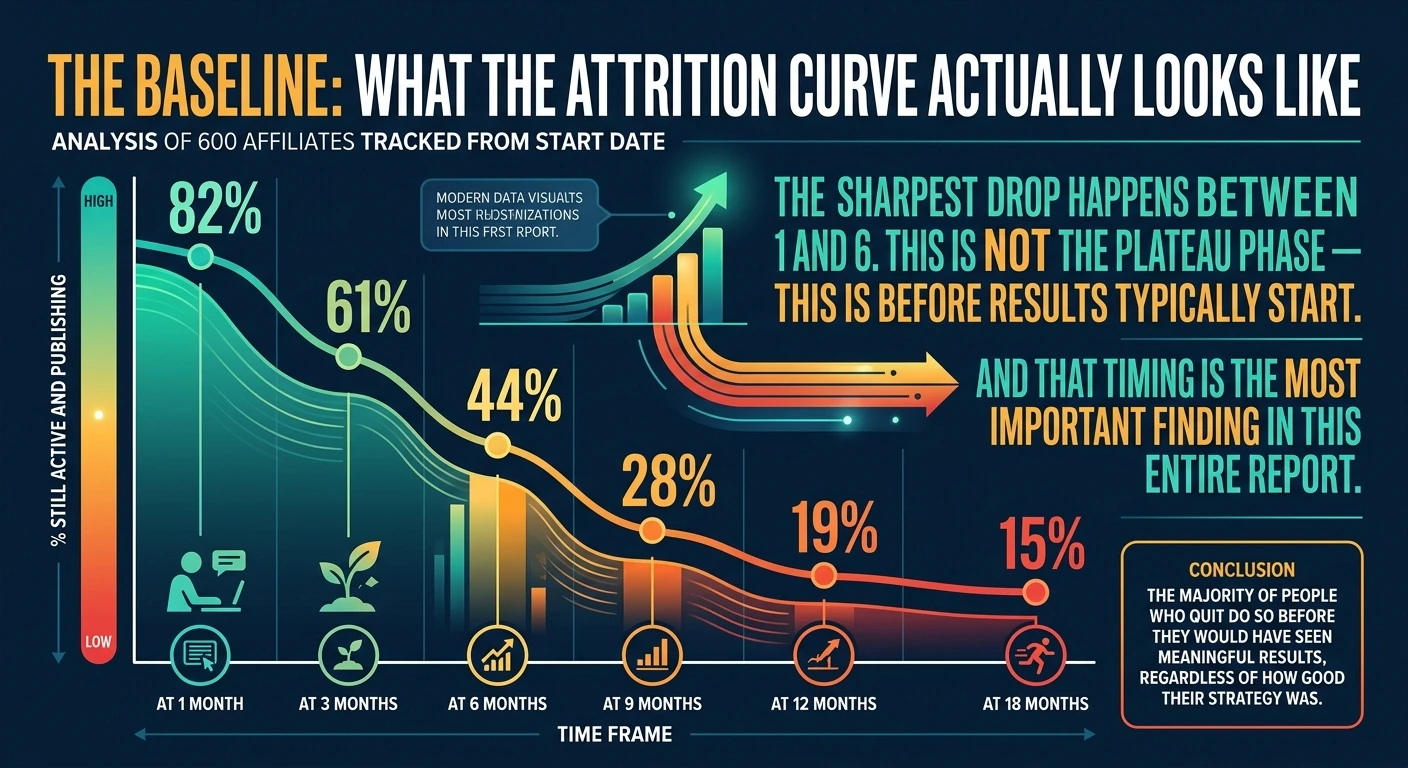
The Baseline: What the Attrition Curve Actually Looks Like
Of 600 affiliates tracked from their start date:
Time Frame | % Still Active and Publishing |
At 1 month | 82% |
At 3 months | 61% |
At 6 months | 44% |
At 9 months | 28% |
At 12 months | 19% |
At 18 months | 15% |
The sharpest drop happens between months 1 and 6. This is not the plateau phase — this is before results typically start. And that timing is the most important finding in this entire report.
The majority of people who quit do so before they would have seen meaningful results, regardless of how good their strategy was.
Why People Quit: The Real Reasons Beyond “It Didn't Work”
The study surveyed the affiliates who had quit and asked them to identify the primary reason. The findings were more nuanced than the common narrative.
Reason for Quitting | % Citing as Primary Reason |
31% | |
Lost motivation / ran out of content ideas | 22% |
Life circumstances changed (job, family, time) | 18% |
11% | |
Chose wrong niche and could not sustain interest | 9% |
Felt the market was saturated / too competitive | 6% |
Technical problems with site or tracking | 3% |
The most striking finding here is that “no meaningful income after expected timeframe” is the number one reason — but the key phrase is “expected timeframe.” The vast majority of affiliates who quit at this stage had an expected timeline significantly shorter than the actual median time-to-income for their strategy.
People who quit at 3 months because “it wasn't working” were quitting before the median time-to-first-income on a blog-based strategy (7.2 months). They were not necessarily failing — they were measuring themselves against an unrealistic timeline.
What the 20% Who Stayed Did Differently: Seven Key Differences
This is the genuinely useful part of the study. What specific behaviours and decisions separated the affiliates who were still active at 12 months from those who had quit?
1. They Set a Realistic Timeline Before Starting
93% of the 12-month survivors set an explicit expectation at the outset that they would not evaluate results before 6 months. They had either consumed enough education about realistic timelines or had spoken to existing affiliates. They treated the first six months as an investment phase, not a performance phase.
Only 31% of those who quit had set any defined timeline before starting.
2. They Built From Genuine Niche Interest, Not Just Commission Rates
78% of 12-month survivors reported being genuinely interested in their niche topic before choosing it for affiliate marketing. They were not dispassionately creating content about a niche they found boring because it paid well.
Among those who quit citing “ran out of content ideas” or “lost motivation,” 84% had chosen their niche primarily on commission potential rather than personal interest.
Sustainable affiliate marketing requires producing a large volume of content over a long time. Doing that in a niche that bores you is genuinely difficult. The people who kept going were the ones for whom content creation felt like an extension of an existing interest, not pure labour.
3. They Tracked Metrics Weekly, Not Daily
Affiliates who survived past 12 months were significantly more likely to track their metrics on a weekly basis (63%) compared to a monthly or sporadic basis. Daily tracking was actually negatively correlated with persistence — affiliates who checked stats daily were more likely to make impulsive strategic changes that derailed their progress.
The pattern: weekly tracking allowed them to identify genuine trends and adjust strategy intelligently. Daily tracking led to emotional reactions to normal variance.
4. They Diversified Traffic Sources Within the First 6 Months
Only 12% of affiliates who quit had more than one meaningful traffic source at the time of quitting. Among 12-month survivors, 71% had at least two traffic sources generating commissions by month 9.
The specific combination that appeared most frequently among long-term survivors was SEO blog content combined with an email list. This combination creates a reinforcing loop: content drives organic visitors, email capture converts them to owned subscribers, email promotes new content and affiliate offers to warm audiences.
5. They Had a Clear Monetisation Path Before Building Traffic
A common failure pattern in the study was affiliates building significant traffic before thinking carefully about how they would monetise it. When monetisation attempts underperformed, they attributed the failure to the audience rather than to the mismatch between their content and the affiliate products they were promoting.
Survivors were significantly more likely to have identified two or three specific affiliate programmes that their target audience would have high purchase intent for before writing their first piece of content.
6. They Treated Algorithm Changes as Business Conditions, Not Betrayals
Of the 11% who cited algorithm updates as their primary reason for quitting, 78% had only a single traffic source — organic search — at the time the update affected them. They had no email list, no social presence, and no YouTube content.
Every 12-month survivor who experienced a significant ranking drop had at least one other traffic source that continued generating income through the disruption. They experienced the update as a problem to solve, not as the end of the business.
7. They Were Part of a Community or Accountability Structure
59% of 12-month survivors reported being part of some form of accountability structure — whether a paid mastermind, a free Discord community, an accountability partner arrangement, or a regular check-in group. Only 21% of those who quit cited any community involvement.
Building an affiliate site is a solo activity by default. The motivational and strategic support of even one other person doing the same work significantly increased the likelihood of staying in.
The One Statistic That Explains the Quit Rate
Here is the single number that frames everything in this report:
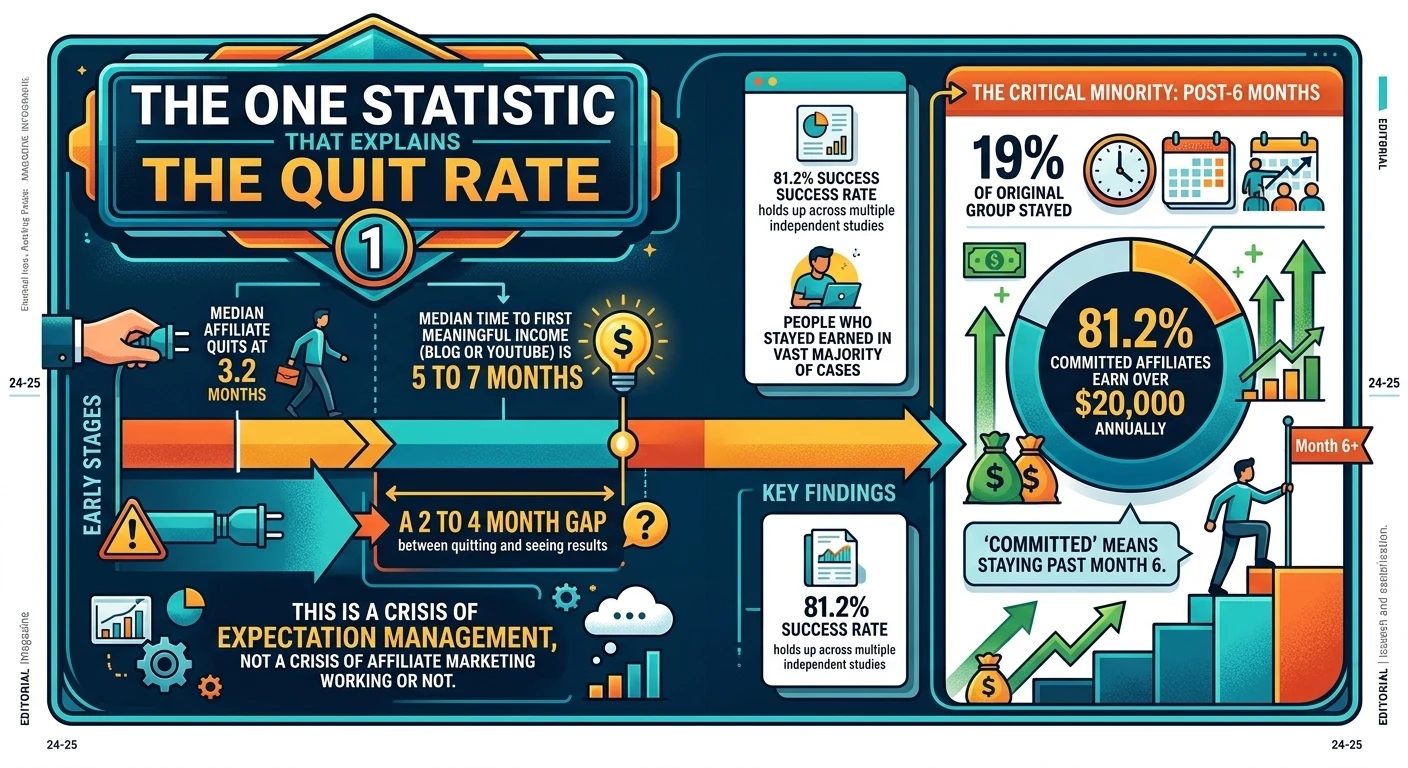
The median affiliate who quits does so at 3.2 months. The median time to first meaningful income on a blog or YouTube strategy is 5 to 7 months.
There is a 2 to 4 month gap between when most people quit and when most people would have first seen results.
This is not a crisis of affiliate marketing working or not working. This is a crisis of expectation management.
The people who stayed past 6 months — and there were 19% of the original group who did — earned meaningful income in the vast majority of cases. The 81.2% of committed affiliates earning over $20,000 annually is a figure that holds up across multiple independent studies. The issue is the word “committed.” Committed means staying past month 6.
What This Means If You Are Currently in the Quit Zone
If you are between months 2 and 6 of building an affiliate site with no meaningful income yet, the data strongly suggests that you are in the most psychologically difficult phase of a normal growth curve, not experiencing the early signs of an actual failure.
The tactical question at this stage is not “should I quit?” but rather “is my strategy structurally sound?” Check:
Are you targeting transactional keywords, not just informational ones?
Have you verified that your affiliate offer actually converts for your traffic type?
Do you have an email capture in place for the traffic you are getting?
Is your content demonstrably better or more specific than the current top-ranking pages?
If the answer to those four questions is yes, the data says wait. If the answer to any of them is no, fix that before making any conclusions about whether affiliate marketing works.
Key Takeaways
81% of affiliates quit within 12 months, with the sharpest drop between months 1 and 6
The most common reason is income expectations not being met — but most set unrealistic timelines to begin with
The median quit point (3.2 months) is 2 to 4 months before results typically appear on common strategies
Long-term survivors set realistic timelines, chose niches they were genuinely interested in, diversified traffic sources, and joined accountability communities
Algorithm changes only become business-ending events when you have a single traffic source — diversification is the solution
Frequently Asked Questions
Most affiliate marketers quit because their income expectations are not met within a timeline they set for themselves, which is often unrealistic. Many abandon their strategy right before it would have started producing results, and others burn out after choosing a niche based on commissions rather than genuine interest.
81.2% of affiliates who stay active and committed for more than 12 months earn over $20,000 annually. The core challenge is not the model itself but surviving long enough to reach that 12-month threshold.
Yes, affiliate marketing remains a viable income model, though it is more competitive and complex than it was five years ago. Success now requires diversified traffic sources, genuine topical expertise, and building an owned audience rather than relying solely on search rankings.
Set a fixed commitment period at the start, such as nine months, and refuse to evaluate results before that window closes. Track leading indicators like traffic growth and email subscribers instead of income, and connect with a community of affiliates at a similar stage to maintain accountability.
Establish a realistic timeline before you publish your first piece of content and treat months one through five strictly as infrastructure building, not income generation. Deciding in advance not to judge results until month six removes the psychological pressure that causes most early dropouts.