

Google connected Street View to its Project Genie world model, so you can turn real US places into interactive AI scenes.
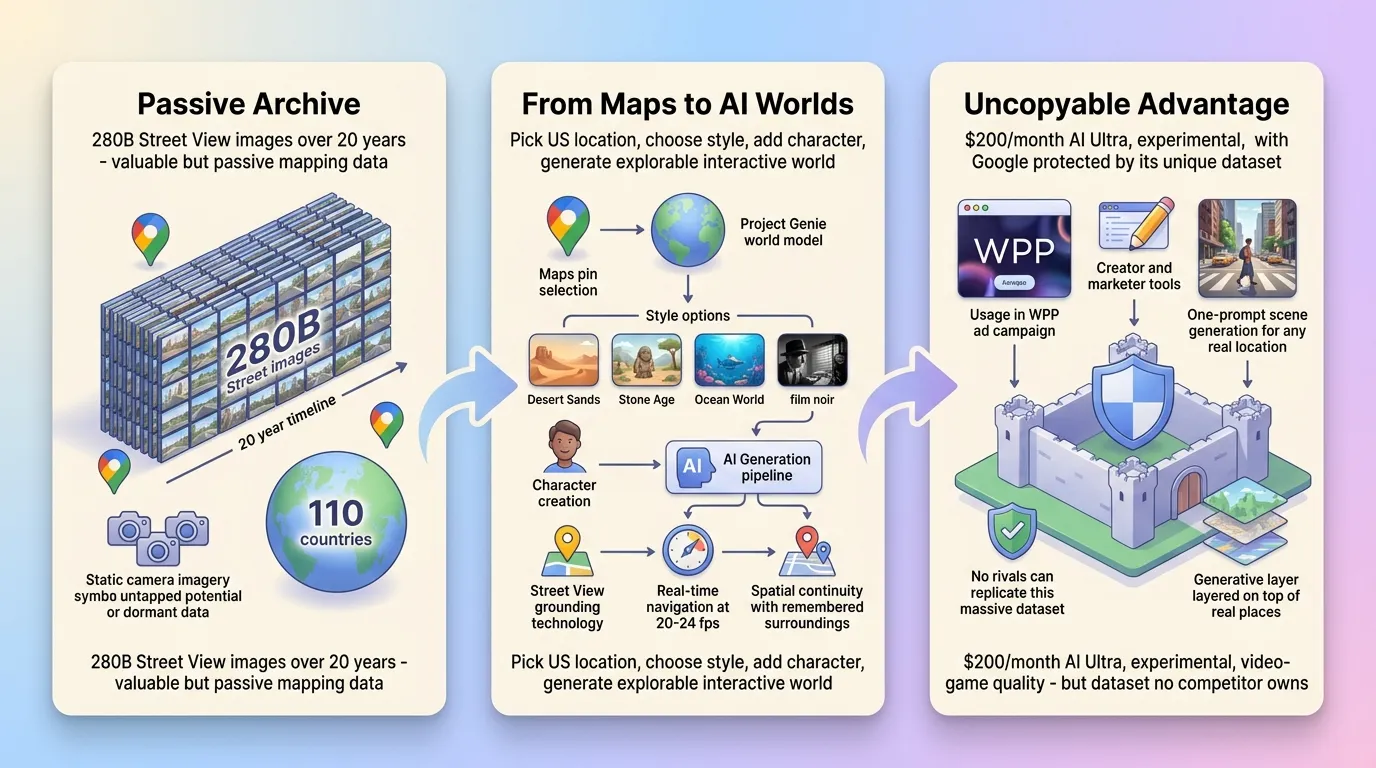
Pick a spot on the map, choose a style, add a character, and walk through a generated version of it.
It is real but limited: $200 AI Ultra only, US places, experimental, and video-game quality rather than photorealistic.
Google has quietly turned its biggest mapping asset into a creative AI playground. At Google I/O on May 19, 2026, DeepMind connected Street View to Project Genie, its world model, letting users generate interactive, explorable worlds based on real places. The screenshot going around calls it a tool that makes images and videos from Street View. That is close, but the full picture is more interesting.
What Google launched
There are two connected pieces. Project Genie now lets you pick a real US location from a Maps pin, choose a style like Desert Sands, Stone Age, Ocean World, or black-and-white film, describe a character, and generate a navigable world anchored to that spot. Underneath it sits Maps Imagery Grounding, the same technology that lets developers and brands generate AI images grounded in Street View, such as a spaceship over a real city arch. WPP is already testing it for ad campaigns.
How it works
Genie draws on roughly 280 billion Street View images captured over 20 years across 110 countries. You explore the result in real time at 20 to 24 frames per second, and it has real spatial continuity, so turn around and the AI remembers what was behind you. Google also uses the same engine to train Waymo self-driving cars on rare road scenarios.
The part the post gets wrong
A few corrections worth making. It was not a stealth drop, it was an I/O keynote announcement, though it got overshadowed by the Gemini news. It is not a simple consumer image and video maker either.
Access is gated behind the Google AI Ultra plan at $200 a month, the place selection is US-only for now, and it is an experimental Google Labs prototype. The output is video-game quality, not photorealistic, and it is not physics-aware, so in one demo a character ran straight through cacti.
Why it matters
The bigger story is the moat. Street View was a passive archive for two decades. Turning it into a generative, explorable layer is something no rival can easily copy, because no one else owns that dataset. For creators and marketers, it points to a near future where any real location becomes a one-prompt scene for ads, previews, or concepts.
Embeds:
X (official Google DeepMind announcement):
https://x.com/GoogleDeepMind/status/2057842131142590512
Quick Links: