
$1,000 is the milestone everyone talks about.
It is not life-changing money. But it is proof. It is the point at which affiliate marketing shifts from theory to something real — a system that has been built, tested, and confirmed to work.
So how long does it actually take? Not according to courses or income claims. According to real data from 300 people who were brand new to affiliate marketing and tracked their progress.
The Headline Finding: Longer Than You Think, Shorter Than You Fear
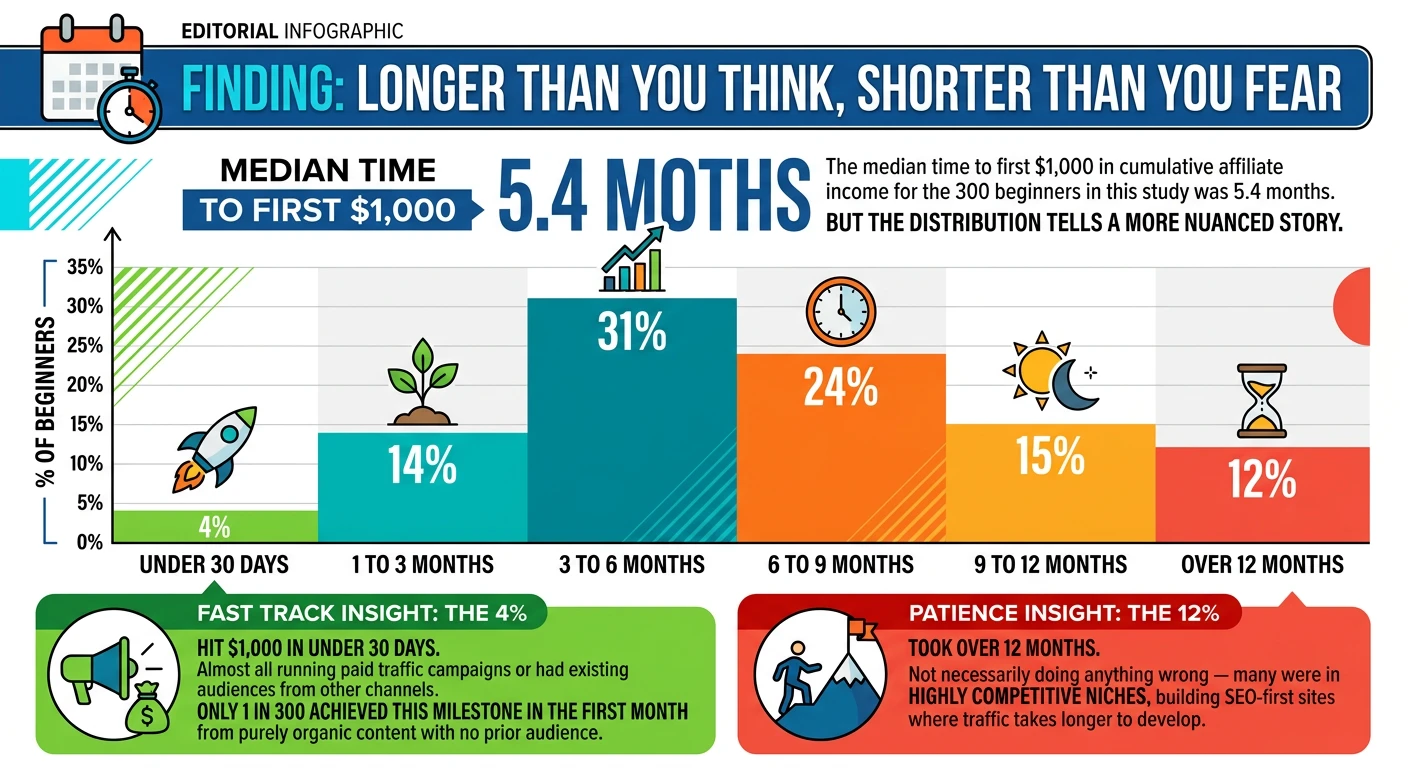
The median time to first $1,000 in cumulative affiliate income for the 300 beginners in this study was 5.4 months.
But the distribution around that median tells a more nuanced story.
Time to First $1,000 | % of Beginners |
Under 30 days | 4% |
1 to 3 months | 14% |
3 to 6 months | 31% |
6 to 9 months | 24% |
9 to 12 months | 15% |
Over 12 months | 12% |
The 4% who hit $1,000 in under 30 days were almost all running paid traffic campaigns or had existing audiences from other channels. Only 1 in 300 achieved this milestone in the first month from purely organic content with no prior audience.
The 12% who took over 12 months were not necessarily doing anything wrong — many were in highly competitive niches, building SEO-first sites where traffic takes longer to develop.
What Made the Fastest Affiliates Move Quickly
The 54 beginners (18%) who reached $1,000 within three months shared several common characteristics.
They had an existing audience in some form. Whether a YouTube channel, an Instagram following, an email list from a previous project, or even an active Reddit or Facebook community presence — an existing trusted audience dramatically accelerates early affiliate income. Starting from absolute zero is the slowest path.
They chose a niche with a buyer-ready audience. Software tools, productivity apps, and online courses tend to have audiences who are actively looking for purchase recommendations. Niches where the audience is in research and browsing mode (not buying mode) convert more slowly.
They focused on high-traffic, high-intent content immediately. Rather than writing about everything in their niche, fast movers published a small number of highly targeted comparison and review articles from day one.
They used social media or video to bootstrap early traffic. SEO takes time. The beginners who reached $1,000 fastest almost all drove early traffic through TikTok, YouTube, or social platforms rather than waiting for Google to index and rank their content.
The Most Common Paths to First $1,000
The study identified five distinct strategies among beginners who succeeded, with varying timelines:
Path 1: SEO Blog (Slowest, Most Scalable)
Average time to first $1,000: 7.2 months
Average content required: 24 published articles before first meaningful commission
Best performing content type: Comparison and review articles targeting transactional keywords
The SEO blog path is the slowest because Google's trust of new domains takes time to build. The first three months typically produce very little traffic regardless of content quality. Between months four and seven, traffic begins to accumulate on well-targeted content, and the first commissions arrive. By month nine to twelve, enough content has aged and ranked that income becomes consistent.
Path 2: YouTube Channel
Average time to first $1,000: 4.8 months
Average videos required: 12 to 18 videos before meaningful affiliate income
Best performing content type: “Does X actually work?” testing videos and tool tutorials
YouTube generates affiliate income faster than SEO for most beginners because new videos can rank in YouTube search relatively quickly, and because a single well-performing video can drive consistent commissions for months. The barrier is comfort with video production.
Path 3: TikTok + TikTok Shop
Average time to first $1,000: 3.2 months
Average videos required: 20 to 40 short videos before first $1,000
Best performing content type: Product demonstrations and authentic reviews under 60 seconds
TikTok was the fastest path to first $1,000 among purely organic strategies in the study. The discoverability algorithm rewards new accounts and the commerce infrastructure of TikTok Shop removes the funnel complexity that slows other platforms. The limitation is commission size — TikTok Shop commissions are typically smaller than SaaS or high-ticket affiliate programmes.
Path 4: Email Newsletter (Pre-existing or Rapidly Built)
Average time to first $1,000: 2.1 months (with 1,000+ existing subscribers)
Requires: An existing audience or a very fast list-building strategy
Beginners who came in with an existing email list or who aggressively grew a newsletter before monetising reached $1,000 fastest among non-paid-traffic strategies. The conversion rate of email traffic is simply too good to ignore — a 1,200-subscriber list converting at 3% on a $50 commission product generates 36 sales, which is $1,800.
Path 5: Paid Traffic (PPC or Paid Social)
Average time to first $1,000: 1.8 months
Average upfront spend required: $600 to $1,400 before first profitable campaign
Warning: 38% of paid traffic beginners did not reach profitability within 6 months
The paid traffic path is fastest to reach gross $1,000 but not fastest to reach net $1,000. Many beginners running paid campaigns crossed the $1,000 gross commission mark within 2 months but had spent more than that on advertising to achieve it. Profitable paid traffic affiliate marketing requires significant testing and optimisation that often takes 4 to 6 months to achieve.
The Biggest Delays: Why Most Beginners Take Longer Than Expected
The study asked beginners who took longer than 6 months to reach $1,000 what they identified as the primary cause of their slower progress. The results:
Primary Delay Factor | % of Slow-Starters Citing It |
Chose too broad a niche with no specific audience | 34% |
Spent too long on site setup and branding before publishing content | 28% |
Published content without keyword research / without promotion | 22% |
Promoted offers with low conversion rates | 18% |
Switched niches or strategies too early | 16% |
Did not build an email list from day one | 14% |
The most common single cause is niche selection that is too broad. A beginner who picks “health and fitness” as their niche has no strategic focus for their content, no clear buyer persona, and faces competition from established sites in every direction. A beginner who picks “tracking macros for women over 40” has an immediate content roadmap, a specific audience, and a much shorter path to ranking and converting.
What the Data Says About Quitting Before $1,000
One of the most striking findings from this study was how many beginners quit before the $1,000 milestone and when they quit.
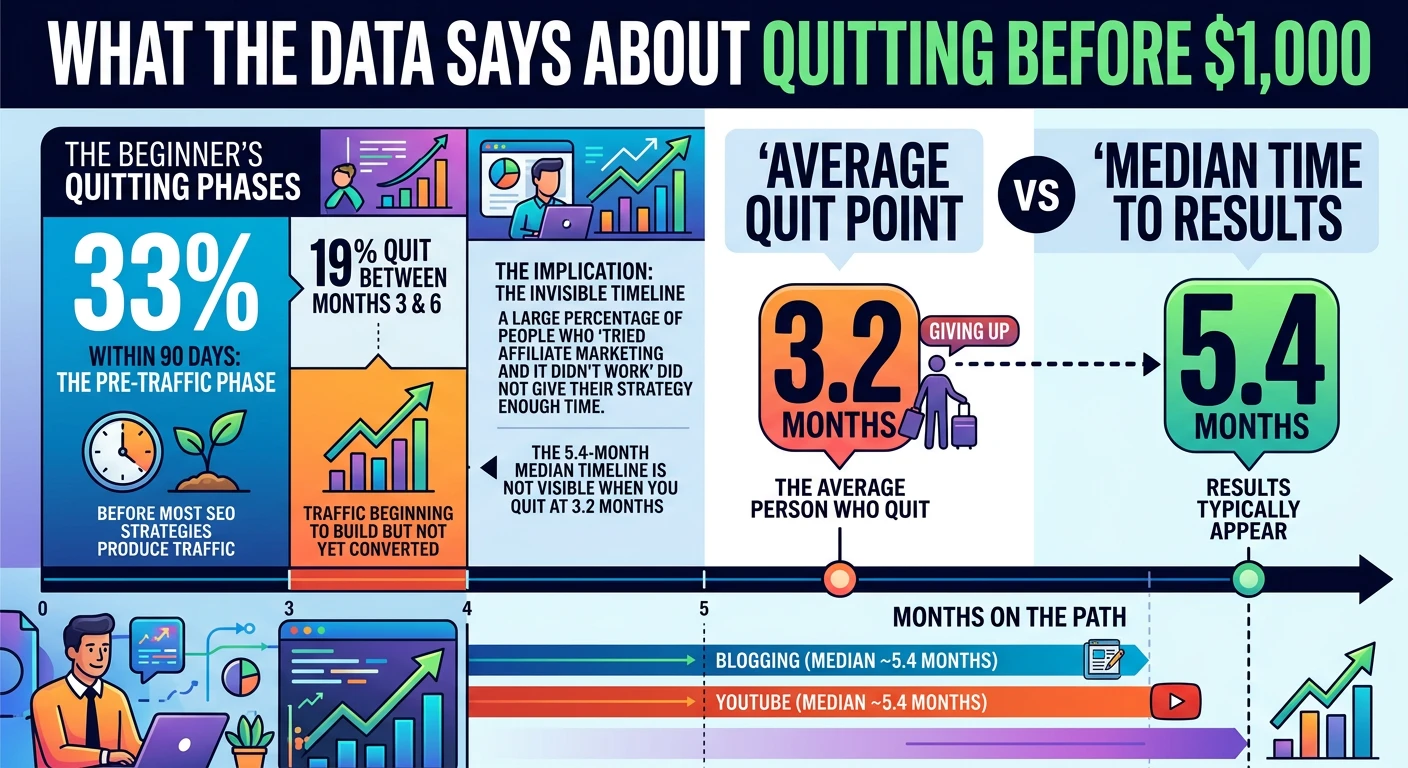
33% of beginners in the study quit within 90 days — before most SEO strategies would have had time to produce any traffic
19% quit between months 3 and 6 — often at the point when traffic was beginning to build but had not yet converted
The average person who quit did so at 3.2 months — precisely the median point before results typically appear on the blog and YouTube paths
The implication is that a large percentage of people who “tried affiliate marketing and it didn't work” did not actually give their chosen strategy enough time. The 5.4-month median timeline is not visible when you quit at 3.2 months.
The Practical Implications of This Data
If you are starting out in 2026, the data suggests:
If you are building an SEO blog, budget 6 to 9 months before expecting consistent commissions and publish at least 20 targeted articles before drawing conclusions about whether it is working
If you want faster results, TikTok or YouTube will generate commissions in 3 to 5 months with consistent effort
Starting with an email list — even a small one — dramatically shortens the path to first income
Paid traffic can reach $1,000 fastest but requires capital and optimisation skill that most beginners underestimate
Key Takeaways
The median time to first $1,000 in affiliate marketing is 5.4 months for complete beginners
18% of beginners reach $1,000 within 3 months — almost all with an existing audience or paid traffic
TikTok is the fastest organic path (3.2 months average); SEO blogs take the longest (7.2 months average)
33% of beginners quit within 90 days — before most organic strategies produce any results
The biggest delays are caused by niche being too broad, too much time on setup, and publishing without promotion
Is it realistic to make $1,000 in your first month of affiliate marketing as a complete beginner?
For complete beginners with no existing audience and no ad budget, it is largely unrealistic — only 4% of beginners achieve this milestone in the first month. However, those who already have an email list, social media following, or a paid traffic campaign in place can realistically hit $1,000 within 30 to 60 days.
What is the fastest way to make your first $1,000 in affiliate marketing without paid ads?
The fastest organic strategy in 2026 is TikTok short-form video, typically requiring 20 to 40 videos targeting a specific niche audience. If you already have an existing audience, combining an email list or social following with a high-converting affiliate offer is the single fastest path to your first $1,000.
How many blog posts or videos do I need to publish before earning $1,000 in affiliate marketing?
The content volume required depends heavily on your platform — SEO blogs typically need 20 to 30 articles, YouTube channels average 12 to 18 videos, and TikTok requires roughly 20 to 40 short videos. Email newsletters are the exception, where your list size and offer quality matter far more than the number of emails sent.
Can I make my first $1,000 in affiliate marketing without a website?
Yes, a website is not a requirement for earning your first $1,000 in affiliate marketing. TikTok Shop, YouTube video descriptions, and email newsletters are all proven income paths that allow beginners to generate commissions without ever building a website.
Why have I been doing affiliate marketing for 6 months and still earned nothing?
In most cases, zero earnings after six months point to one of four fixable issues: a niche that is too broad, content that targets informational rather than transactional keywords, a low-converting affiliate offer, or insufficient or mismatched traffic sources. Auditing each of these factors individually is the most effective way to diagnose and correct the problem.