
If you've been paying attention to the affiliate marketing space, you already know that e-commerce is the engine that powers almost everything. Every product review you write, every comparison article you publish, every “best of” list you create — it all feeds into one massive, unstoppable machine called global e-commerce.
And right now, that machine is accelerating faster than ever before.
Whether you're a seasoned affiliate marketer looking to double down on high-converting niches or a beginner trying to figure out where the real money is, understanding the e-commerce market isn't optional. It's the foundation of every smart decision you'll make in the next decade.
So let's break it all down — the numbers, the trends, the regional opportunities, and most importantly, what it all means for your affiliate business.
The Numbers That Should Excite Every Affiliate Marketer:
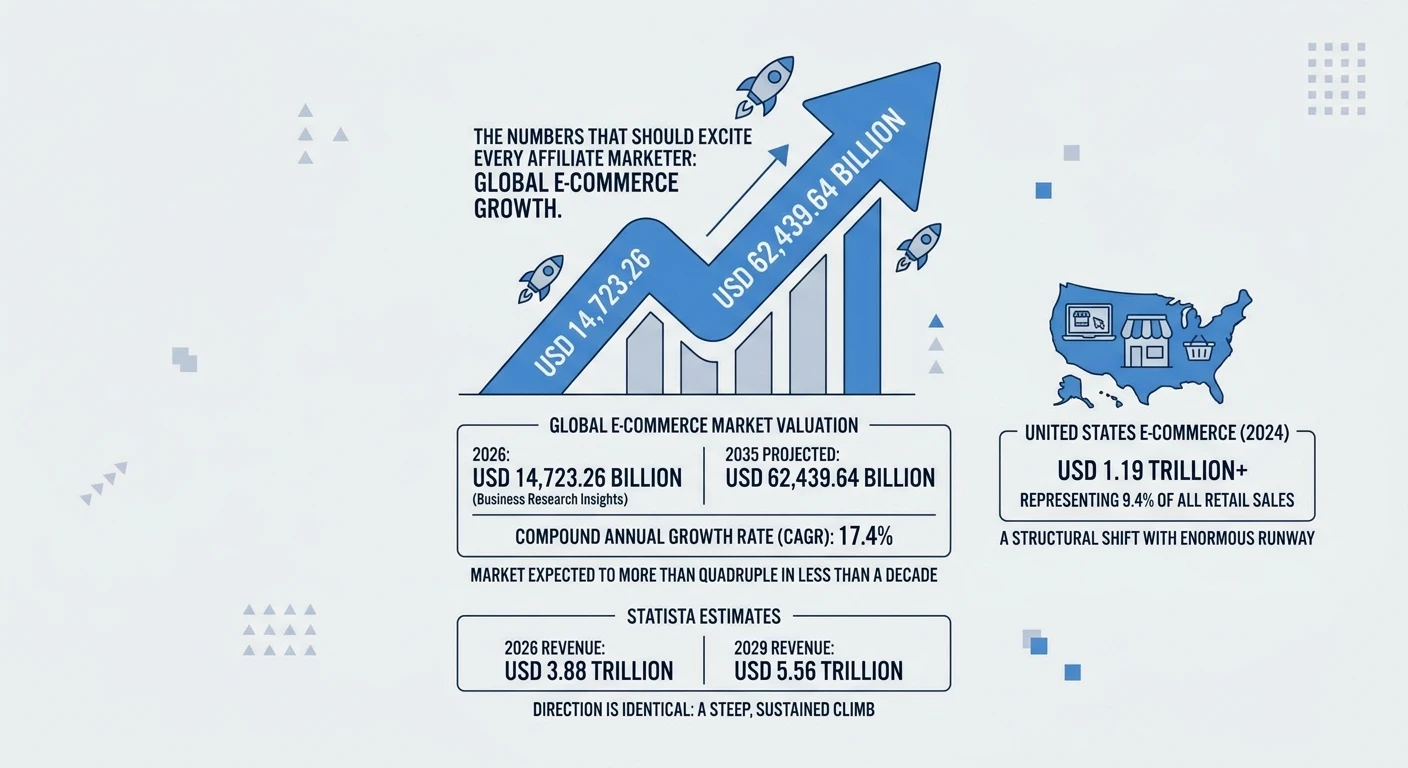
Let's start with the big picture. According to Business Research Insights, the global e-commerce market was valued at USD 14,723.26 billion in 2026. By 2035, that number is projected to hit USD 62,439.64 billion — a compound annual growth rate of 17.4%. To put that into perspective, the market is expected to more than quadruple in less than a decade.
Now, different research firms use different methodologies, so you'll also see figures like Statista's estimate of USD 3.88 trillion in 2026 revenue growing to USD 5.56 trillion by 2029. The variation exists because some reports count gross merchandise value while others focus on net revenue or platform fees. But regardless of which methodology you use, the direction is identical — a steep, sustained climb with no ceiling in sight.
In the United States alone, e-commerce crossed USD 1.19 trillion in 2024, representing 9.4% of all retail sales. That's not just a big number. That's a structural shift in how people buy things — and it's still only 9.4%. There's an enormous runway left as more of traditional retail continues moving online.
Why This Matters Specifically for Affiliate Marketers:
Here's the part that should genuinely get you excited. Affiliate channels are responsible for driving approximately 16% of all e-commerce orders in mature markets. That means for every USD 100 spent online, USD 16 is directly influenced by an affiliate — a blog post, a YouTube review, a social media recommendation, a comparison article.
When you apply that 16% to a market growing toward USD 62 trillion by 2035, the math becomes extraordinary. Even a conservative share would represent trillions of dollars in affiliate-attributed sales annually. The US affiliate industry alone drove USD 113 billion in e-commerce sales in 2024, and that number grows every year as brands increase their performance marketing budgets.
Brands love affiliate marketing for one simple reason — they only pay when a sale happens. As e-commerce competition intensifies and the cost of paid advertising rises, more and more brands are shifting budget toward affiliate programs. This creates a self-reinforcing cycle where the affiliate channel becomes more lucrative as e-commerce itself grows.
What's Driving the Growth? The Key Forces Behind the Numbers:
Understanding why e-commerce is growing this fast helps you position your affiliate strategy to ride the right waves at the right time.
Mobile commerce is arguably the single biggest growth driver. Smartphones now account for 55% of affiliate traffic globally, and in emerging markets like India, Indonesia, and Brazil, mobile is essentially the only device that matters. As billions of new consumers come online for the first time via mobile, they naturally start shopping online through the same device. This isn't a trend — it's a permanent shift in consumer behaviour that will compound year after year.
Social commerce is the new frontier that's turning content directly into commerce. Platforms like TikTok Shop, Instagram Shopping, and YouTube have eliminated the friction between discovering a product and buying it. TikTok Shop alone generated USD 112.2 billion in GMV in 2026, growing at a remarkable 87.3% year-on-year. For affiliates, this means you no longer need to drive traffic to a product page and hope for a conversion. You can embed purchase capability directly into your content, shortening the buyer journey dramatically and boosting conversion rates.
Artificial intelligence is reshaping e-commerce at every level. AI-powered recommendation engines drive up to 35% of Amazon's revenue by connecting buyers with products they didn't know they needed. AI-driven search personalisation, dynamic pricing, and predictive inventory are making online shopping more relevant and frictionless for consumers. For affiliates, AI tools now help you identify winning products faster, create optimised content at scale, and track attribution more accurately than ever before.
Cross-border e-commerce is opening up entirely new markets for global affiliate campaigns. Consumers in Southeast Asia are buying from US brands. Indian shoppers are purchasing from European luxury retailers. Latin American buyers are shopping on platforms based in China. This globalisation of online retail means affiliate marketers with multilingual content or region-specific SEO strategies have access to audiences that were simply unreachable five years ago.
The Regional Picture: Where Is the Money Moving?
North America is the most mature and highest-value e-commerce market, but it's also the most competitive. The US market is dominated by Amazon, Walmart, and Target, all of which run affiliate programs that pay billions in commissions every year. Despite the competition, North America remains the highest-converting market for English-language affiliate content, and it still offers excellent opportunities in overlooked niches.
Asia-Pacific is where the most explosive growth is happening. China is the world's largest e-commerce market by transaction volume, but it's relatively closed to international affiliates. The real opportunity lies in markets like India, Indonesia, Vietnam, Thailand, and the Philippines, where e-commerce is growing at 25–35% annually and affiliate marketing is still in its early stages. Getting into these markets now, while competition is low, is one of the smartest long-term plays available to affiliate marketers today.
Europe is growing steadily, particularly in sustainable products, ethical fashion, premium electronics, and B2B software. European consumers tend to be highly research-driven buyers, which means long-form comparison content and in-depth review articles perform exceptionally well. The GDPR regulatory environment adds some complexity for tracking, but first-party data strategies and contextual advertising are filling that gap effectively.
Latin America and Africa represent the next generation of e-commerce growth. Brazil, Mexico, Nigeria, and South Africa are seeing rapid adoption of online shopping as smartphone penetration increases and payment infrastructure matures. These markets are largely untapped by Western affiliate marketers, which means the potential for first-mover advantage is real and significant.
The Niches That Will Win the Decade:
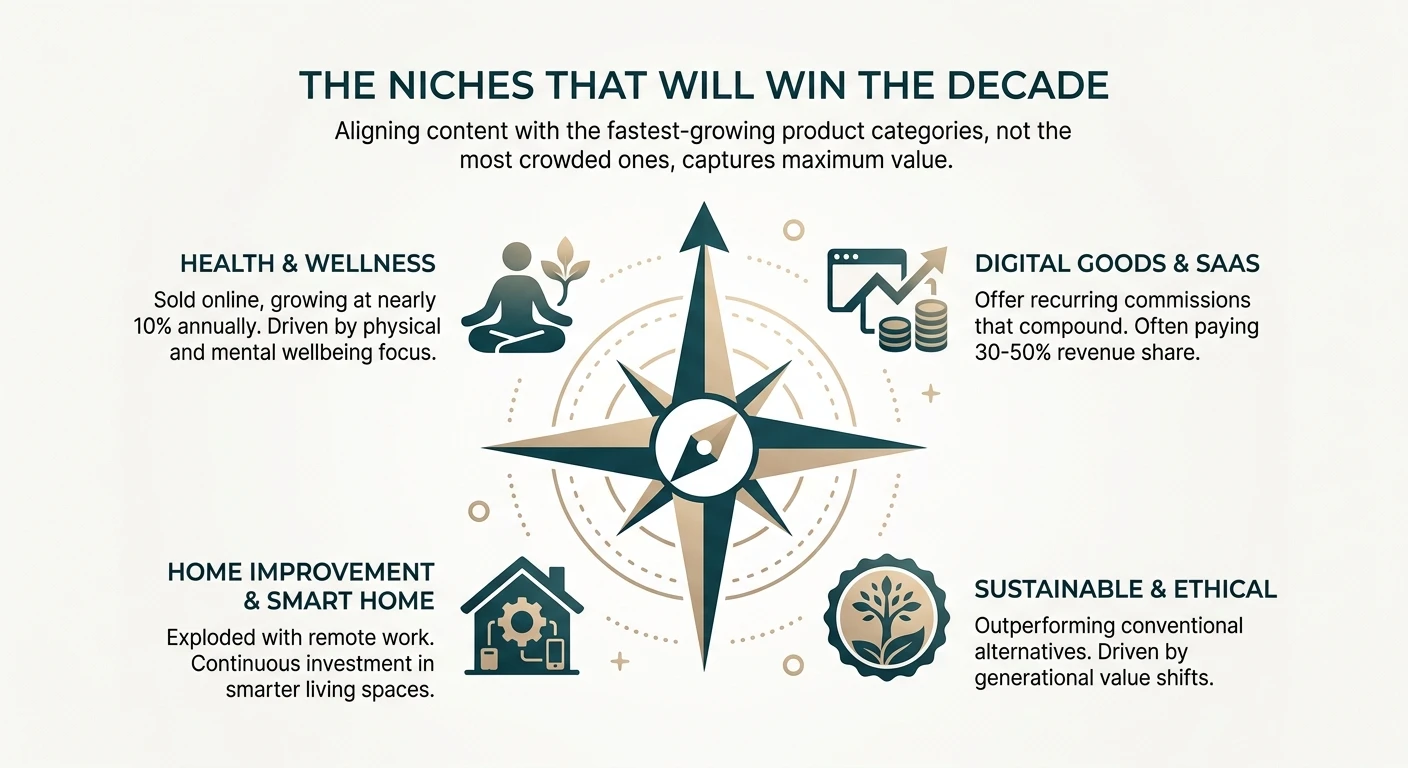
Not all e-commerce categories will grow equally. The affiliates who capture the most value will be those who align their content with the fastest-growing product categories rather than chasing the most crowded ones.
Health and wellness products sold online are growing at nearly 10% annually as consumers take greater ownership of their physical and mental wellbeing. Digital goods, software subscriptions, and SaaS products offer recurring commissions that compound over time — often paying 30–50% of subscription revenue rather than the 3–10% typical of physical products. Sustainable and ethical products are growing faster than conventional alternatives in Europe and increasingly in North America, driven by a generational shift in consumer values. Home improvement and smart home technology exploded during and after the pandemic and continues to outperform the broader market as remote work drives investment in living spaces.
The Strategic Playbook for Affiliate Marketers:
The e-commerce growth story gives every affiliate marketer a clear mandate. Build content that targets high-intent buyers in growing product categories. Diversify your affiliate partnerships beyond Amazon to include platform-specific programs on Flipkart, Shopee, Lazada, and direct-to-consumer brands. Invest in mobile-optimised content because your audience is increasingly discovering you on a smartphone. Explore social commerce formats — shoppable content on TikTok and Instagram is not a gimmick, it's where the next generation of e-commerce conversions is being won.
Most importantly, think long-term. The e-commerce market is projected to grow for at least another decade at a pace that few industries in history have sustained. The affiliates who build authority in the right niches today will be collecting commissions on a market that is four times larger by 2035. That's not a prediction — it's a mathematical certainty based on the trajectory we're already on.
FAQs
The global e-commerce market is expected to surpass $15 trillion by 2035, driven by mobile commerce, AI-powered personalization, and expanding internet access in emerging markets. This represents a massive opportunity for affiliate marketers to tap into high-growth niches over the next decade.
Affiliate marketers can capitalize by focusing on high-demand verticals like sustainable products, cross-border commerce, and subscription-based services that are projected to see the strongest growth. Building content around emerging platforms and optimizing for mobile-first audiences will also be critical strategies during this period.
No, e-commerce growth is not expected to slow down — in fact, analysts project sustained compound annual growth rates (CAGR) of 12–15% through 2035 as new technologies like AR shopping and voice commerce become mainstream. Affiliate marketers who position themselves early in these trends stand to gain significant long-term commissions.
This decade is considered a golden era because converging factors — including the rise of social commerce, AI-driven product recommendations, and expanding global middle-class purchasing power — are creating unprecedented affiliate commission opportunities. The shift toward performance-based marketing also means brands will increasingly rely on affiliates to drive measurable sales.
Yes, beginners can realistically profit by starting with niche product categories that align with projected growth sectors such as health tech, eco-friendly goods, or digital services. Focusing on long-tail SEO keywords and building trust-based content around emerging consumer trends gives newcomers a strong competitive entry point.