
There was a time when “influencer marketing” meant paying a celebrity to hold up a product in a photo. That era is long gone. In 2026, influencer marketing is a USD 32.6 billion global industry, growing at over 21% per year, and it has become one of the most sophisticated, data-driven, and measurable channels in the entire digital marketing stack. For affiliate marketers, understanding this industry is not optional — because influencer marketing and affiliate marketing have effectively merged into a single ecosystem.
This guide breaks down the market size, growth trajectory, segmentation, key drivers, challenges, and what it all means for affiliate marketers building income in 2026.
📊 Market Snapshot
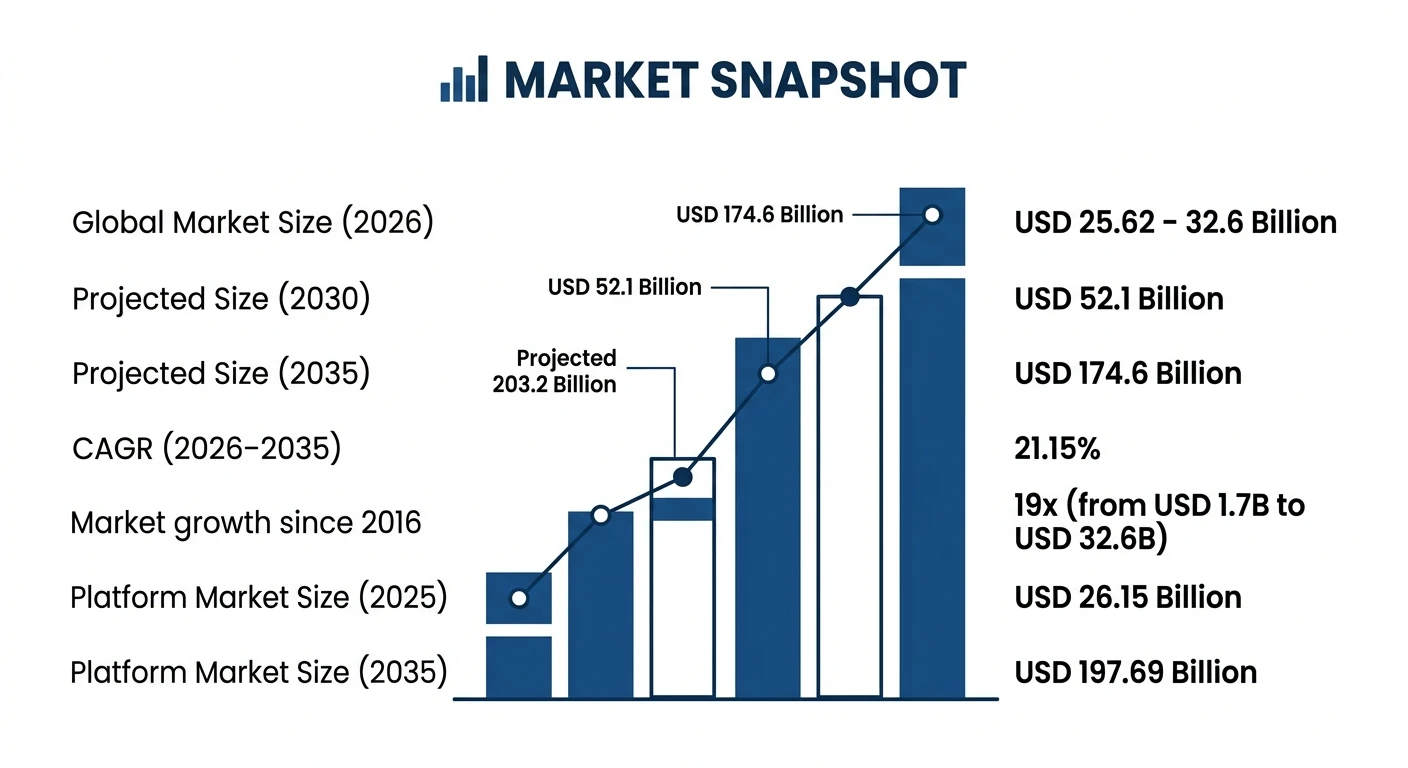
Metric | Value |
Global Market Size (2026) | USD 25.62 – 32.6 Billion |
Projected Size (2030) | USD 52.1 Billion |
Projected Size (2035) | USD 174.6 Billion |
CAGR (2026–2035) | 21.15% |
Market growth since 2016 | 19x (from USD 1.7B to USD 32.6B) |
Platform Market Size (2025) | USD 26.15 Billion |
Platform Market Size (2035) | USD 197.69 Billion |
The Big Picture
The influencer marketing industry has grown 19 times over since 2016, when it was valued at just USD 1.7 billion. By 2024 it had reached USD 24 billion. In 2026 it has crossed USD 32.6 billion, and it is on a trajectory to hit USD 52.1 billion by 2030. These are not speculative projections — they are backed by actual brand budget allocations, platform monetisation data, and advertiser spending reports from across the industry.
What is driving this growth is a fundamental shift in how consumers make buying decisions. According to 2026 data, 72% of consumers now trust influencer recommendations over traditional brand advertising. That number alone explains why 93% of marketers who have tried influencer marketing say it is effective, and why 63% of brands plan to increase their influencer spend this year. The channel works because it bypasses the scepticism that has built up against traditional advertising over decades. When a person you follow on YouTube or Instagram tells you a product changed their life, you believe them in a way you never would believe a television commercial.
The return on investment data supports this. On average, brands earn USD 5.78 for every USD 1 spent on influencer marketing. In the beauty and fitness categories, top campaigns return as much as USD 11 per USD 1 spent. These numbers make influencer marketing one of the highest-ROI digital channels available, comfortably outperforming display advertising, which delivers 8.7 times less value per impression.
How the Market Breaks Down
The influencer marketing market is not a monolithic category. It segments across influencer tier, platform, industry, and enterprise size, and the differences between segments are dramatic.
The most important segmentation story in 2026 is the rise of micro and nano influencers. Creators with audiences between 1,000 and 100,000 followers now command 45.5% of total influencer marketing spend globally. This is a massive structural shift from the era of celebrity-first campaigns. The reason is simple and backed by hard data: micro-influencers deliver a 3.86% average engagement rate compared to 1.21% for mega influencers, they convert at 2.18% versus 0.91% for celebrities, and they do it at a fraction of the cost. A micro-influencer post costs between USD 250 and USD 1,250 compared to USD 10,000 to USD 50,000 or more for a celebrity post. The ROI per dollar spent on a micro-influencer is USD 7.14 — the highest of any tier in the market.
The platform picture is equally important to understand. Instagram remains the dominant platform for influencer campaigns, with 67% of brands running campaigns there. But TikTok is where the growth is happening. TikTok's average influencer engagement rate of 5.53% is the highest of any platform, and TikTok Shop's integration of influencer content with direct purchasing has created an entirely new commerce model where a creator's video can drive thousands of sales within hours. YouTube holds steady at 51% brand adoption and offers the unique advantage of content longevity — a well-made review video can drive affiliate commissions for years after its publication date.
By industry, fashion and apparel remains the largest spending category at USD 6.8 billion, followed by beauty and cosmetics at USD 5.4 billion and health and fitness at USD 3.9 billion. But the fastest-growing verticals are financial services (+38% YoY), technology (+31% YoY), and travel (+21% YoY) — all categories that are critically important for affiliate marketers who operate in these high-commission niches.
Key Statistics at a Glance
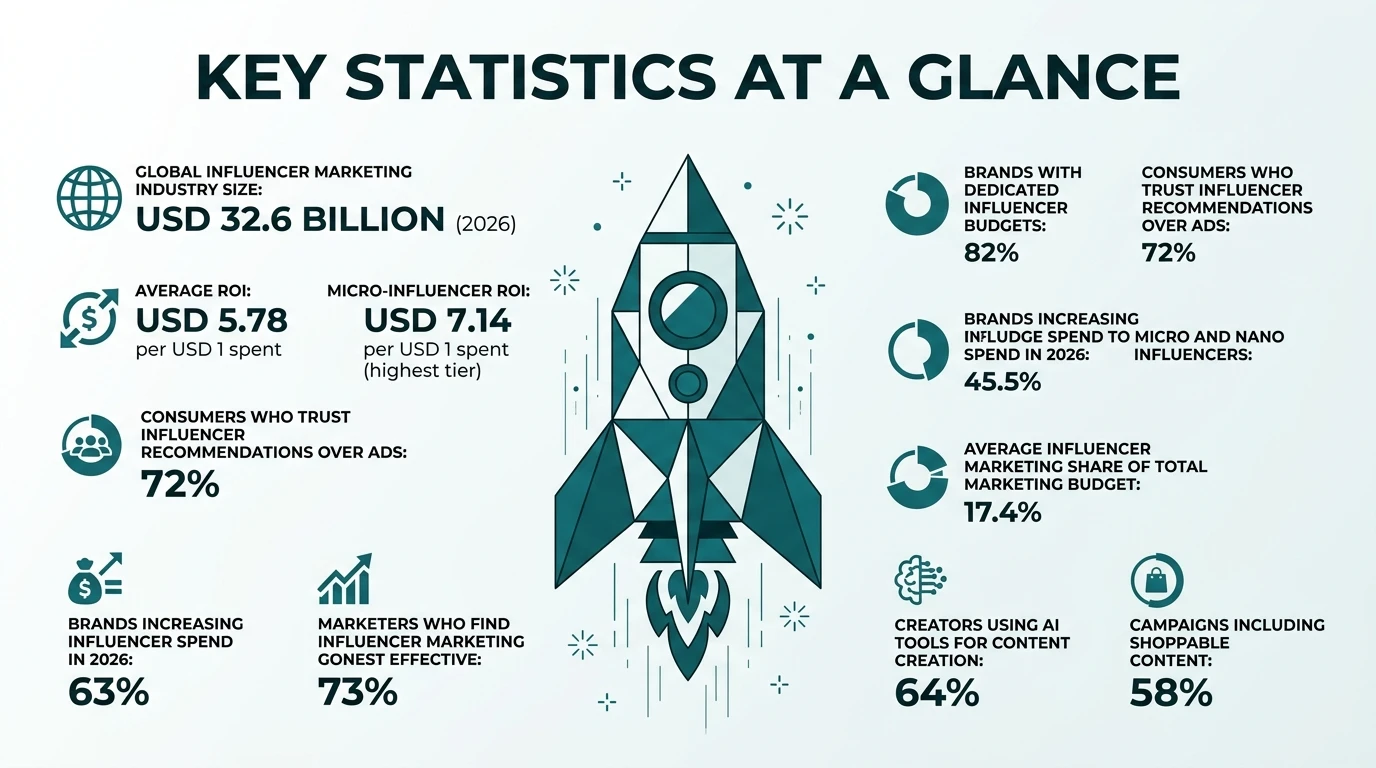
Global influencer marketing industry size: USD 32.6 Billion (2026)
Average ROI: USD 5.78 per USD 1 spent
Micro-influencer ROI: USD 7.14 per USD 1 spent (highest tier)
Brands with dedicated influencer budgets: 82%
Consumers who trust influencer recommendations over ads: 72%
Marketers who find influencer marketing effective: 93%
Brands increasing influencer spend in 2026: 63%
Share of spend going to micro and nano influencers: 45.5%
Average influencer marketing share of total marketing budget: 17.4%
Brands shifting to performance-based influencer compensation: 73%
Creators using AI tools for content creation: 64%
Campaigns including shoppable content: 58%
What Is Driving the Market
The single biggest driver of influencer marketing's growth is the collapse of consumer trust in traditional advertising. Banner blindness is real — people have trained themselves to ignore display ads. Ad-blocking software usage continues to rise. Television viewership is declining, particularly among the 18 to 34 demographic that most brands covet. In this environment, the authentic voice of a creator who has built a genuine relationship with their audience becomes extraordinarily valuable.
Artificial intelligence is reshaping the mechanics of the industry in parallel. In 2026, 81% of brands use AI for influencer discovery and matching, identifying the right creators based on audience demographics, engagement quality, and content alignment in real time rather than through weeks of manual research. AI fraud detection tools now catch fake followers and artificial engagement with 94% accuracy, reducing the USD 1.3 billion in annual losses that the industry previously suffered from influencer fraud. For brands, this means their campaign investments go further. For genuine creators, it means the playing field has been levelled against those who cheat.
The emergence of social commerce — particularly TikTok Shop — has also fundamentally changed the influencer marketing calculus. When a creator can embed a shoppable link directly into their video and a viewer can complete a purchase without ever leaving the app, the distance between content and conversion collapses to near-zero. In 2026, 38% of creator revenue now comes directly from commerce rather than sponsorships, and 2.8 times higher conversion rates from live shopping versus static posts tell you everything about where this is heading.
The Challenges the Market Faces
Influencer fraud remains the industry's most persistent problem, though it is improving. Fake followers, bot-generated engagement, and misrepresented metrics cost the industry an estimated USD 1.3 billion annually. 48% of brands report having been affected at some point. The good news is that third-party verification platforms — now used by 79% of enterprise brands — reduce fraud exposure by 67%, and AI detection tools are rapidly closing the gap.
Measuring ROI continues to present challenges despite significant progress. Tracking the direct sales impact of an influencer campaign requires robust attribution infrastructure, and many smaller brands still rely on engagement metrics like likes and comments as proxies for business outcomes. As the industry matures and performance-based compensation becomes the norm — already adopted by 73% of brands — measurement will continue to improve.
Platform algorithm changes represent a structural risk for both creators and brands. A single algorithm update can reduce a creator's organic reach by 30-50% overnight, disrupting campaign projections and creator income simultaneously. This is one of the key reasons creators are increasingly building owned communities and email lists as distribution channels they control completely.
🌍 Regional Overview
Region | Market Status | Key Platforms | Key Trend |
North America | Largest, most mature | Instagram, YouTube, TikTok | Live streaming, performance-based compensation |
Europe | Second largest | Instagram, YouTube | GDPR transparency, ethical marketing |
Asia-Pacific | Fastest growing | TikTok, Weibo, WeChat, YouTube | Live commerce, highest engagement rates |
India | Explosive growth | Instagram, YouTube | INR 3,375 Cr market by 2026 |
Latin America | Emerging | TikTok, Instagram | Young demographic, high social time |
What This Means for Affiliate Marketers
The convergence of influencer marketing and affiliate marketing is one of the defining structural shifts of 2026. When 73% of brands are moving to performance-based influencer compensation, the line between “affiliate” and “influencer” is being erased. Creators are now evaluated on the sales they drive, not just the impressions they generate — which is exactly the model affiliate marketers have operated on for years.
For affiliate marketers on AffiliateBooster.com, the practical implications are clear. Micro-influencer partnerships represent a high-ROI traffic acquisition strategy that is more cost-effective than paid ads. Building a presence on TikTok and integrating shop links into short-form content is the fastest path to high conversion rates in consumer product categories. And focusing on the fastest-growing niches — financial services, technology, and health — aligns content strategy with where brand budgets are flowing most aggressively.
FAQs
The influencer marketing market is expected to grow significantly from 2026 to 2035, with projections estimating it could surpass $500 billion by 2035 driven by rising social media adoption and creator economy expansion. This growth reflects increasing brand investment in authentic, content-driven advertising strategies.
The influencer marketing industry is forecast to grow at a compound annual growth rate (CAGR) of approximately 25–30% during the 2026–2035 period. Key growth drivers include AI-powered influencer discovery tools, short-form video dominance, and expanding markets in Asia-Pacific and Latin America.
Brands are increasing influencer marketing budgets because it consistently delivers higher engagement rates and better ROI compared to traditional advertising channels. The shift toward trust-based consumer purchasing decisions and the rise of micro and nano influencers make this channel increasingly cost-effective and targeted.
Yes, platforms like TikTok, Instagram, and YouTube remain dominant forces in influencer marketing growth heading into 2026 and beyond. Emerging platforms and technologies like augmented reality and AI-generated content are also opening new influencer marketing opportunities throughout the 2026–2035 forecast period.
Small businesses can absolutely benefit from influencer marketing growth trends by leveraging micro and nano influencers who offer highly targeted audiences at lower costs. Advances in influencer marketing platforms and analytics tools are making campaign management more accessible and affordable for businesses of all sizes.