
Every affiliate marketer is a creator. Whether you build SEO content, make YouTube reviews, write newsletters, or post on TikTok, you are part of the creator economy — one of the fastest-growing economic ecosystems in modern history. In 2026, the global creator economy is valued between USD 200 billion and USD 323 billion depending on the measurement approach, and it is growing at a CAGR of 22–30% annually. By 2035, projections put it at over USD 2 trillion. This is not a niche internet phenomenon. This is a structural transformation in how content, commerce, and community generate economic value.
📊 Market Snapshot
Metric | Value |
Global Market Size (2025) | USD 191–254 Billion |
Global Market Size (2026) | USD 200–323 Billion |
Projected Size (2030) | USD 500–820 Billion |
Projected Size (2035) | USD 2,084.57 Billion |
CAGR (2026–2035) | 22–30.6% |
Active Creators Globally | 200 Million+ |
Professional/Semi-professional Creators | ~50 Million |
Six-figure income earners | 2 Million+ |
US Creator Economy Market (2026) | USD 56.3 Billion |
The Scale of the Creator Economy in 2026
More than 200 million people around the world now identify as content creators. Of those, roughly 50 million are professional or semi-professional — meaning they derive meaningful income from their content. Over 2 million creators earn six figures annually from their work. The creator economy has grown more than 10 times in size since 2015, and between 2020 and 2025 alone, 165 million new creators joined major social platforms. One in four internet users now publishes some form of content online, and more than 30% of Gen Z considers becoming a creator a viable career path.
These numbers matter for affiliate marketers because they define the competitive and collaborative landscape you operate in. The creator economy is the distribution layer for affiliate marketing. Every piece of content you produce — every review, every tutorial, every recommendation — is a creator economy asset. Understanding the forces shaping that ecosystem helps you build more durable income.
The most important shift in the creator economy in 2026 is not about growth — it is about structure. The data from Circle's 2026 Community Trends Report reveals that 88% of creators now monetise through paid memberships, up from 54% the previous year. Sponsorship income has dropped to 18% of creator revenue as creators move away from brand dependency and toward owned, recurring revenue models. Affiliate marketing, meanwhile, accounts for 22% of creator monetisation — and it is one of the fastest-growing segments in the mix.
How Creators Are Making Money in 2026
The monetisation landscape for creators in 2026 looks fundamentally different from even two years ago. The old model — grow a large audience, attract brand sponsors, earn per post — has given way to something more layered and more durable.
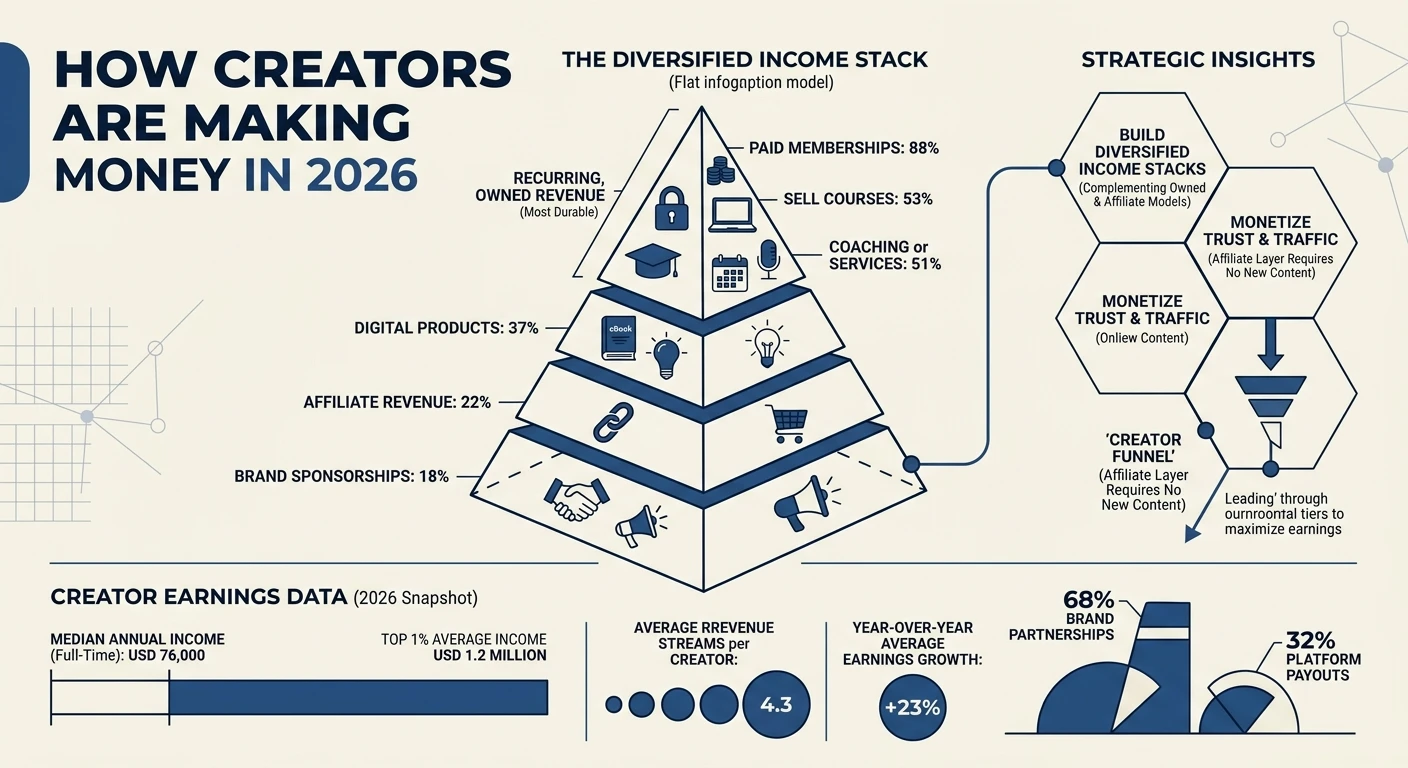
According to current data, 88% of creators monetise through paid memberships, 53% sell courses, 51% offer coaching or services, 37% sell digital products, 22% generate affiliate revenue, and only 18% rely primarily on brand sponsorships. The ordering here tells the story. Recurring, owned revenue sits at the top. Transactional, platform-dependent income sits at the bottom.
This is a critical insight for affiliate marketers. The most successful creators in 2026 are building diversified income stacks where affiliate commissions complement owned products and memberships. A creator who runs a paid community, sells a course, and includes affiliate recommendations across their content can generate income from multiple sources simultaneously. The affiliate layer, while not the largest piece on average, benefits from every other monetisation layer because it requires no additional content creation — it simply monetises the trust and traffic the creator has already built.
Creator earnings data reveals significant stratification. The median annual income for a full-time creator in the US is USD 76,000, while the top 1% earns an average of USD 1.2 million per year. 68% of creator income comes from brand partnerships rather than platform payouts. The average full-time creator manages 4.3 different revenue streams. Year-over-year, average creator earnings have grown 23%.
Key Statistics at a Glance
Global creator economy value: USD 200–323 Billion (2026)
CAGR: 22–30.6% (2026–2035)
Active creators globally: 200 Million+
Creators monetising with paid memberships: 88%
Creators earning affiliate revenue: 22% (fastest growing)
Average revenue streams per full-time creator: 4.3
Median annual creator income (US): USD 76,000
Creators using AI for content creation: 75%
Creators planning to expand AI usage: 68%
56% of communities launched in the last two years
48% of creators operate completely solo
69% say member transformation is their top growth strategy
The Platforms Powering Creator Revenue
Understanding where creators make money versus where they find audiences is one of the most important distinctions in the 2026 creator economy. The data is clear: social platforms like TikTok, Instagram, and YouTube dominate discovery, with 67% of creators saying new audiences find them through social apps. But revenue is increasingly made on owned platforms — communities, memberships, courses — where creators control access, pricing, and relationships.
This split is accelerating because of algorithm volatility. 32% of creators cite declining or unreliable social reach as a major strategic concern. When a platform algorithm changes, organic reach can drop 30-50% overnight with no warning. Creators who have built owned email lists, paid communities, and direct relationships with their audiences are far more resilient to these shocks than those who rely entirely on social distribution.
YouTube remains the most profitable platform for long-form creators because content longevity means a single well-made video can generate affiliate income for years. TikTok offers explosive short-term reach and is now the highest-converting platform for product sales thanks to TikTok Shop. Instagram bridges the gap between awareness and aspiration, particularly in fashion, beauty, and lifestyle categories. For B2B creators, LinkedIn has emerged as the fastest-growing creator revenue platform, with 71% of B2B buyers saying they are influenced by thought leaders on the platform.
AI Is Reshaping How Creators Operate
Artificial intelligence has moved from experimental curiosity to operational infrastructure in the creator economy between 2025 and 2026. In 2025, 76% of creators used AI primarily for content creation and editing. By 2026, the use cases have diversified significantly. 75% use AI for content creation or planning, 46% apply it to generate insights and analyse data, 34% leverage it for member support, and 18% deploy AI agents for community moderation. 68% of creators plan to expand their AI usage further over the next 12 months.
For affiliate marketers specifically, AI is a force multiplier. AI tools can generate optimised product review drafts in minutes, identify high-converting keywords through semantic analysis, personalise content recommendations for different audience segments, and automate email sequences that nurture subscribers toward affiliate purchases. Creators who master AI workflows in 2026 will dramatically outcompete those who rely entirely on manual content production.
The Challenges Creators Face
Despite the market's extraordinary growth, individual creators face significant headwinds. 45% of community operators report visible signs of member burnout — audiences are increasingly disengaged from always-on content environments and are seeking spaces that feel intentional rather than exhausting. 28% of creators worry about market saturation. 27% feel increasing pressure to prove ROI to sponsors and brand partners.
Operating as a solo creator — the reality for 48% of the market — means managing content creation, marketing, community management, revenue generation, and analytics simultaneously without a team. 27% of creators rely on six or more tools to run their business, creating significant operational complexity and cognitive overload. This is driving a major trend toward platform consolidation, with 45% of creators actively trying to reduce the number of tools they use.
The old model of chasing follower counts and engagement metrics is showing diminishing returns. The creators who are thriving in 2026 are those who have pivoted to optimising for member outcomes, community depth, and recurring revenue — a model that is slower to build but far more durable once established.
What This Means for Affiliate Marketers
The creator economy data reinforces several strategies that are central to building sustainable affiliate income on AffiliateBooster.com. Building a niche audience — not a mass audience — is the path to higher conversion rates and better affiliate program access. Diversifying across multiple revenue streams protects income against platform and algorithm risk. Investing in owned assets like email lists and communities provides a distribution channel that no platform can take away.
The 22% of creators who generate affiliate revenue represent the segment that is growing fastest within the creator economy. As more creators understand that affiliate commissions compound passively on top of content that has already been created, the affiliate layer will become a standard part of every serious creator's income architecture.
FAQs
The creator economy market is projected to grow significantly by 2035, with estimates suggesting it could surpass $500 billion as more individuals monetize content across platforms. This growth is driven by the expansion of social media, short-form video, and new monetization tools available to independent creators.
The creator economy is expected to grow at a compound annual growth rate (CAGR) of approximately 22–25% between 2026 and 2035. This rapid expansion reflects increasing brand investment in influencer marketing, the rise of AI-powered content tools, and growing global internet access.
Major trends include the rise of AI-assisted content creation, the growth of subscription-based monetization models, and the expansion of niche micro-creator communities. Additionally, Web3 technologies, creator funds from major platforms, and global market penetration in emerging economies are expected to reshape the industry.
The creator economy is booming because of low barriers to entry, widespread smartphone adoption, and platforms actively investing in creator monetization features. Brands are also shifting advertising budgets toward influencer marketing, recognizing creators as highly effective and targeted marketing channels.
Yes, the creator economy shows strong long-term sustainability due to diversified revenue streams such as sponsorships, merchandise, digital products, and direct fan support. As platforms continue to innovate and new generations enter the workforce valuing independent careers, analyst forecasts consistently point to decade-long growth through 2035.