
Affiliate marketing has quietly become one of the most powerful engines driving the global digital economy. What started as a simple referral model — where a publisher earns a commission for sending a paying customer to a brand — has evolved into a sophisticated, data-driven, multi-billion dollar industry. Whether you are an affiliate marketer, a brand building a partner program, or an investor evaluating the space, the numbers below tell a story you cannot afford to ignore.
📊 Global Market Size at a Glance
Metric | Value |
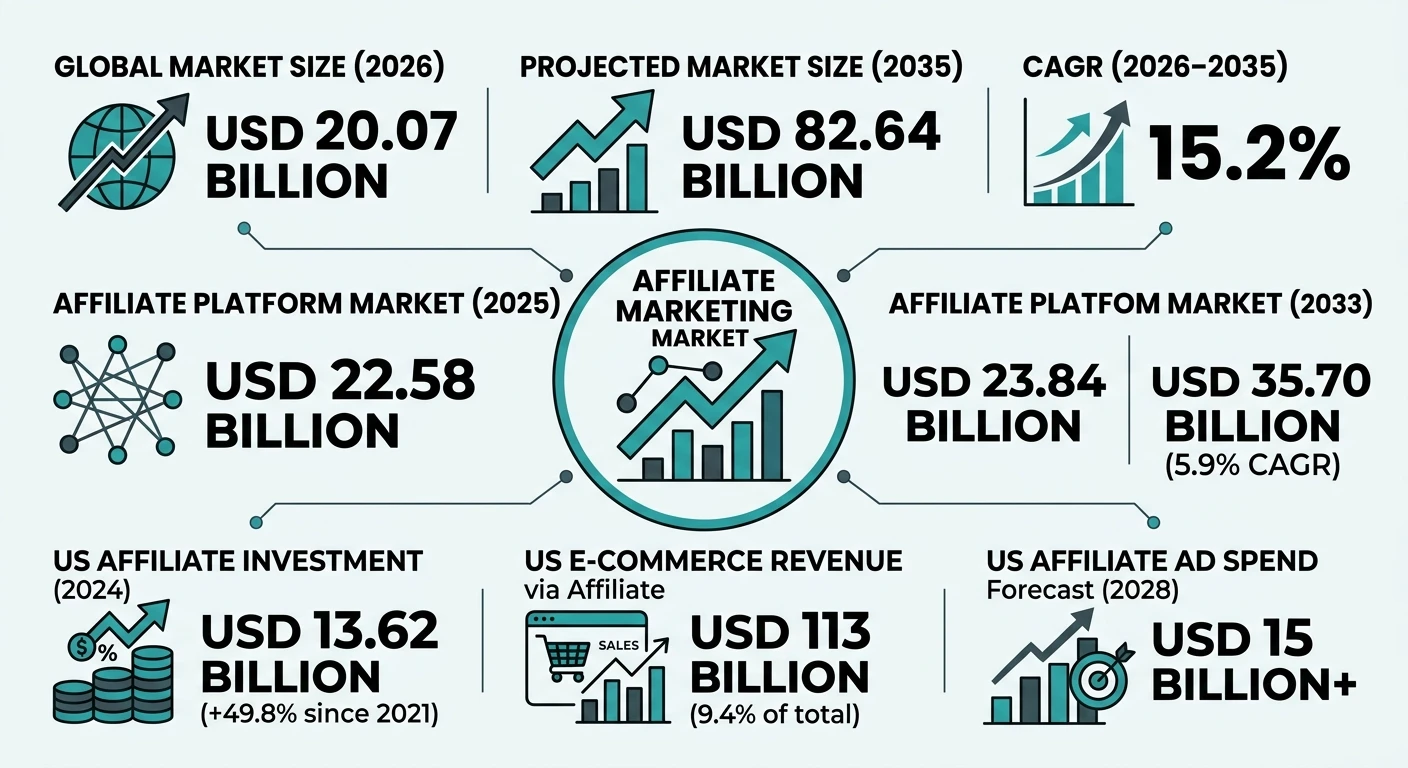
Global Market Size (2026) | USD 20.07 Billion |
Projected Market Size (2035) | USD 82.64 Billion |
CAGR (2026–2035) | 15.2% |
Affiliate Platform Market (2025) | USD 22.58 Billion |
Affiliate Platform Market (2026) | USD 23.84 Billion |
Affiliate Platform Market (2033) | USD 35.70 Billion (5.9% CAGR) |
US Affiliate Investment (2024) | USD 13.62 Billion (+49.8% since 2021) |
US E-Commerce Revenue via Affiliate | USD 113 Billion (9.4% of total) |
US Affiliate Ad Spend Forecast (2028) | USD 15 Billion+ |
💡 What this means: The global affiliate marketing market is set to more than quadruple between 2026 and 2035. Very few industries anywhere in the world are growing at this pace.
📈 Key Statistics at a Glance (2026)
Statistic | Number |
Global e-commerce orders driven by affiliate | ~16% of all orders |
Share of digital performance ad spend | ~12% in mature markets |
Brands actively using affiliate programs | Over 80% |
Mobile-driven affiliate conversions | 55% of all affiliate traffic |
Advertiser adoption growth (YoY) | +25% |
Marketers using AI-driven affiliate tools | 39% and rising |
Social media affiliate growth | +46% |
North America market share | 41% |
Asia-Pacific affiliate activity | 33% of global total |
Top companies' combined market share | 47% |
Rise in SaaS affiliate platforms | +38% |
Growth in mobile commerce affiliate | +33% |
Growth in cross-border affiliate deals | +28% |
Influencer-affiliate AOV lift | +12% |
Affiliate disputes from cookie issues | 38% |
Fraud and invalid affiliate traffic | 8–10% of all clicks |
Lost commissions recovered via S2S tracking | Up to 20% |
🗂️ How the Market Is Segmented
By Commission Model
Model | Market Share | How It Works | Best Industries |
Cost Per Sale (CPS) | 52% | Commission paid only when a sale completes | E-commerce, retail, SaaS subscriptions |
Cost Per Lead (CPL) | 31% | Commission paid for a completed action (form, signup, demo) | Finance, insurance, education, SaaS |
Cost Per Click (CPC) | 17% | Commission paid per click regardless of conversion | Brand awareness, display advertising |
Key Takeaways by Model:
CPS is the gold standard for performance marketing — no sale, no pay, so both sides are fully aligned. Amazon Associates, the world's largest program, runs on CPS. For AffiliateBooster users, CPS programs with lifetime recurring commissions on SaaS products offer the highest long-term compounding income.
CPL converts at higher rates because the barrier is lower than a purchase. It dominates in industries with long sales cycles like finance and B2B SaaS.
CPC delivers the lowest returns for most affiliates and is best used as a supplementary revenue layer, not a primary income source.
By Product Type
Product Type | Growth Rate | Key Platforms | |
Physical Products | 3% to 10% | Steady | Amazon, eBay, Flipkart, Walmart |
Virtual / Digital Products | 30% to 50%+ | Fast-growing | ClickBank, ShareASale, PartnerStack |
Why Virtual Products Win in 2026:
Higher commissions (up to 50% vs. 3–10% for physical goods)
Zero fulfillment cost for the brand
Recurring revenue potential via SaaS and subscription models
Passive, compounding income over time
No inventory, no logistics, no returns to manage
🚀 What Is Driving Market Growth
1. E-Commerce Expansion
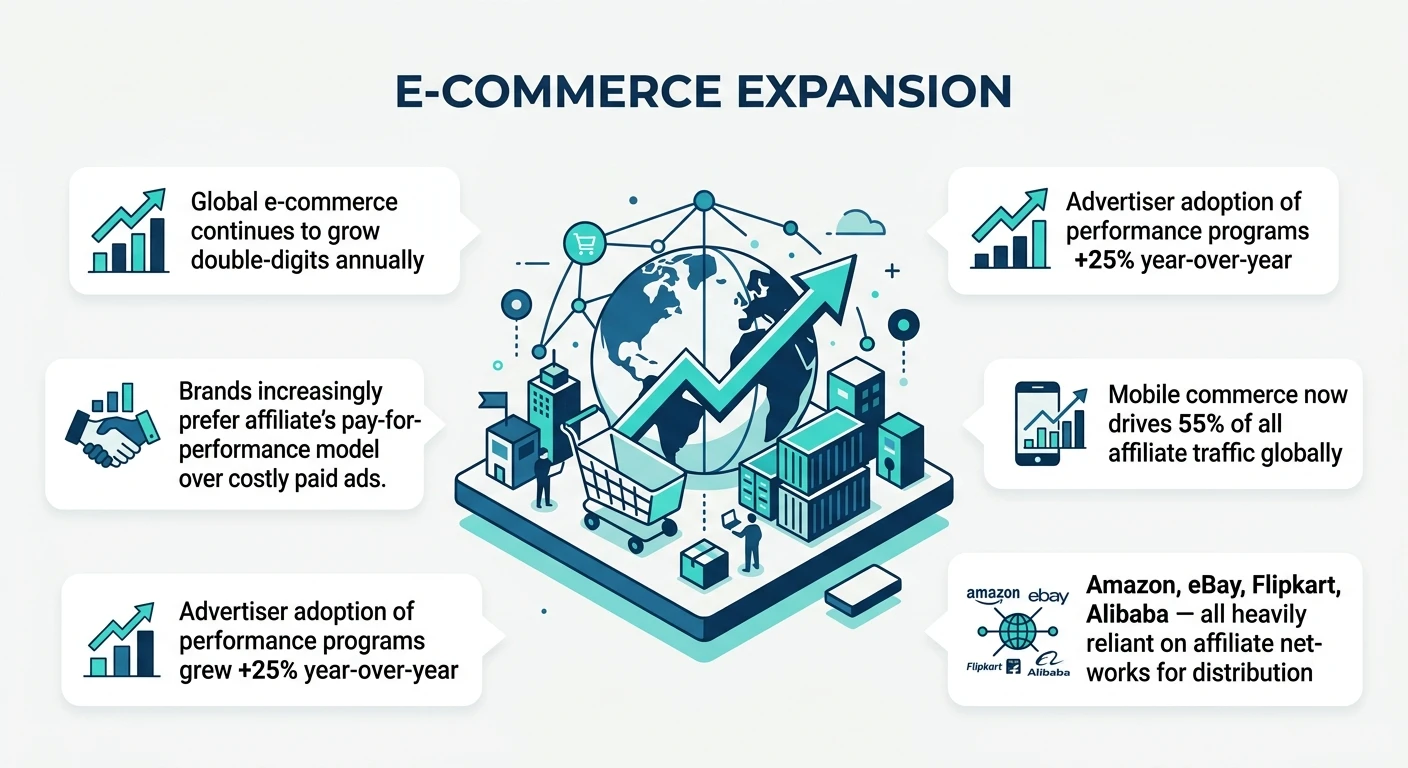
Global e-commerce continues to grow double-digits annually
Brands increasingly prefer affiliate's pay-for-performance model over costly paid ads
Advertiser adoption of performance programs grew +25% year-over-year
Mobile commerce now drives 55% of all affiliate traffic globally
Amazon, eBay, Flipkart, Alibaba — all heavily reliant on affiliate networks for distribution
2. The Performance-Based Advantage
Affiliate marketing's core promise: you only pay when results are delivered
CFOs and marketing directors are shifting budgets away from impressions-based media
Industries leading the shift: Retail, Fintech, SaaS, Health, Online Education
Niche affiliate programs are diversifying the ecosystem and lowering competition within verticals
3. AI and Machine Learning
AI Application | Impact |
Partner discovery and matching | Real-time semantic scoring replaces weeks of manual vetting |
Campaign optimisation | Dynamic ad placements, real-time bidding, predictive analytics |
Attribution accuracy | ML-based multi-touch attribution replaces last-click models |
Fraud detection | AI identifies invalid traffic patterns before payouts |
Content personalisation | AI recommends relevant products to individual users |
Chatbot integration | Affiliate links embedded seamlessly into AI conversations |
39% of marketers have already adopted AI-driven affiliate tools in 2026
AI is the single biggest technology investment in the affiliate platform market right now
4. The Influencer and Creator Economy
Social media affiliate programs have grown +46% year-over-year
TikTok Shop (launched 2025, scaled massively in 2026) is compressing the gap between content and purchase to near-zero
Nano and micro-influencers are the highest-converting affiliate type because of authentic audience trust
Influencer-affiliate integrations lift average order values by +12%
Platforms enabling this: TikTok Shop, Instagram Collabs, YouTube Shopping, Pinterest Affiliate
⚠️ What Is Holding the Market Back
Challenge | Key Data | Impact |
Affiliate Fraud and Invalid Traffic | 8–10% of all clicks are fraudulent | Erodes brand trust, raises operational costs |
Fraudulent Traffic Reported by Marketers | 42% have encountered it | Forces investment in detection tech |
Misreported Conversions | 34% of marketers affected | Damages affiliate-brand relationships |
Cookie Attribution Disputes | 38% of all affiliate disputes | Ongoing pain point as cookies phase out |
Privacy Regulations (GDPR, CCPA) | Restricts user tracking globally | Makes attribution harder and less precise |
Cookie Deprecation Timeline | Cookieless attribution needed within 18–24 months | Forces platform migration urgency |
Platform Market Concentration | Amazon, Google, Meta dominate traffic | Smaller affiliates struggle for visibility |
Commission Rate Instability | Amazon cut rates in 2020, others followed | Structural income risk for single-program affiliates |
Multi-Jurisdiction Compliance | Tax and payout rules increase admin 15–30% | Global programs face growing complexity |
🔮 Emerging Trends in 2026 and Beyond
Trend | What It Means for Affiliates |
AI-Powered Partner Matching | Platforms auto-match affiliates to brands using LLMs and semantic scoring |
TikTok Shop Dominance | Short-form video with embedded purchase is the fastest-growing affiliate channel |
Brand Advocacy Programs | Brands turn existing customers into affiliates for higher trust and conversion |
Cookieless Tracking (S2S) | Server-to-server tracking recovers up to 20% of lost commissions |
Recurring Commission Models | 30–50% lifetime SaaS commissions deliver true passive, compounding income |
Emotional Performance Metrics | Brands reward audience quality and engagement, not just click volume |
First-Party Data Priority | Affiliates with owned email lists and communities become most valuable |
Social Commerce Integration | Instagram, Pinterest, TikTok Shop blur the line between content and checkout |
Nano-Influencer Affiliate Rise | Smaller creators with high engagement outperform mass-reach influencers |
AI Search Optimisation (SGE) | Content must be optimised for both Google and AI-driven search engines |
🌍 Regional Market Breakdown
Region | Market Share | Growth Stage | Key Drivers |
North America | 41% | Mature, steady growth | Amazon Associates, CJ Affiliate, Rakuten; heavy brand investment |
Europe | ~18% | Growing with regulation headwinds | GDPR transparency drives trust; UK and Germany lead |
Asia-Pacific | 33% | Fastest growing | Mobile commerce boom; Flipkart (India), Alibaba (China), SEA expansion |
Latin America | Growing | Emerging | Rising internet penetration, growing middle class |
Middle East and Africa | Growing | Early stage | Mobile-first markets, rapid e-commerce adoption |
Regional Highlights:
North America — US affiliate spending growth consistently outpaces overall digital ad growth. CJ Affiliate, Rakuten, Amazon Associates, and Impact dominate the landscape.
Europe — GDPR has paradoxically strengthened the market by forcing transparency and building consumer trust. Focus areas: sustainable products, premium lifestyle, SEO content.
Asia-Pacific — Contributing 33% of global affiliate activity and accelerating. TikTok Shop, Shopee Affiliate, Flipkart Affiliate, and Lazada are driving explosive growth.
🏢 Key Players in the Ecosystem
Company | Type | Headquarters | Notable Strength |
CJ Affiliate | Network | USA | Largest global affiliate network |
Rakuten Advertising | Network | Japan/USA | Premium brand partnerships |
AWIN + ShareASale | Network | UK/USA | 30% of global publisher links after 2023 merger |
eBay Partner Network | In-house program | USA | 2.5B+ listings, 190 markets |
Everflow | Platform/Tracking | USA | Performance tracking for agencies |
PartnerStack | Platform | Canada | Best for SaaS affiliate programs |
Impact | Platform | USA | Enterprise-level partner management |
Leadpages | Tool/Program | USA | Landing page builder with affiliate program |
Bluehost | Hosting/Program | USA | High-converting affiliate for web hosting niche |
StudioPress (WPEngine) | Tool/Program | USA | Powers 100,000+ affiliate-ready WordPress sites |
📌 The Awin–ShareASale integration (2023) was the most consequential structural deal in the industry's recent history. Combined, they now control 30% of global publisher links, making the US market far more accessible for international brands.
📉 Market Growth Projection Timeline
Year | Estimated Market Size | Notes |
2024 | ~USD 17.42 Billion | Pre-AI adoption phase |
2025 | ~USD 18.50 Billion | Platform market at USD 22.58B |
2026 | USD 20.07 Billion | AI adoption accelerates, TikTok Shop scales |
2027 | ~USD 23.10 Billion | Social commerce mainstream |
2028 | ~USD 26.60 Billion | US ad spend exceeds USD 15B |
2030 | ~USD 35.00 Billion | Cookieless tracking fully mainstream |
2033 | ~USD 56.00 Billion | Platform infrastructure at USD 35.70B |
2035 | USD 82.64 Billion | Market more than 4x the 2026 value |
✅ What This Means for You as an Affiliate Marketer
Priority Action | Why It Matters |
Focus on recurring commission programs | Compounds over time — USD 1,000/month today becomes USD 3,000/month in two years without new traffic |
Adopt AI tools now | 39% already have — early adopters will widen the gap over manual marketers |
Prioritise quality over quantity | Emotional performance metrics reward engaged audiences over raw traffic |
Diversify across programs | Single-program reliance (Amazon, eBay) is a structural income risk |
Build first-party data assets | Email lists and communities become more valuable as cookies phase out |
Explore TikTok Shop | Highest conversion rates in the industry for consumer product categories |
Use S2S tracking wherever possible | Recovers up to 20% of commissions lost to cookie-based attribution gaps |
Target SaaS and digital niches | 30–50% commissions vs. 3–10% for physical goods — the math is simple |
🎯 AffiliateBooster Bottom Line
The global affiliate marketing industry is not slowing down — it is accelerating. The USD 20 billion market of 2026 becomes USD 82 billion by 2035. Every major force in digital commerce — AI, social commerce, mobile-first shopping, subscription economy, creator culture — is either already fuelling affiliate marketing or about to.
The affiliates who win over the next decade will not be the ones who chase the most programs. They will be the ones who build genuine audiences, adopt AI tools early, focus on recurring income models, and own their first-party data.
The opportunity has never been bigger. The only question is how seriously you decide to build.
FAQs
The affiliate marketing market is expected to reach several hundred billion dollars by 2035, driven by the rapid expansion of e-commerce, influencer marketing, and performance-based advertising. Growth projections vary by source, but most analysts forecast a compound annual growth rate (CAGR) of 10–15% between 2026 and 2035.
Key trends shaping affiliate marketing from 2026 to 2035 include the rise of AI-powered tracking, increased dominance of video and social commerce affiliates, and stricter data privacy regulations influencing attribution models. Brands are also expected to shift toward deeper, longer-term partnerships with niche content creators rather than mass affiliate networks.
Yes, affiliate marketing continues to be one of the fastest-growing digital advertising channels, with global spending increasing year over year. The proliferation of online shopping, subscription services, and creator economy platforms ensures strong demand for performance-based marketing well into the next decade.
Affiliate marketing appeals to businesses because advertisers only pay for measurable results such as clicks, leads, or sales, making it significantly more cost-efficient than traditional advertising models. As marketing budgets face greater scrutiny, the ROI-focused nature of affiliate programs makes them an increasingly attractive option for brands of all sizes.
Absolutely — small businesses can leverage affiliate marketing platforms to compete with larger brands by tapping into niche audiences through targeted content creators and bloggers. The democratization of affiliate tools and low entry barriers make it accessible for small businesses to build scalable, performance-driven marketing programs.