
Digital marketing is the umbrella under which everything else in this series lives. E-commerce, SEO, email marketing, content marketing, digital advertising — all of these are sub-disciplines within the broader digital marketing ecosystem. And that ecosystem is enormous, rapidly evolving, and central to the global economy in a way that simply was not true even ten years ago.
The global digital marketing market was valued at approximately USD 667 billion in 2024, growing to USD 870 billion by 2026 and projected to reach USD 2.7 trillion by 2034 — a CAGR of 20.5%. These figures reflect not just the spending on digital advertising and content, but the total ecosystem of tools, platforms, agencies, technologies, and infrastructure that powers modern digital marketing at scale.
For affiliate marketers, understanding this ecosystem is not an academic exercise. It directly shapes the competitive environment you operate in, the tools available to you, the platforms you depend on, and the opportunities that are emerging as the landscape evolves.
The Scale of the Digital Marketing World:
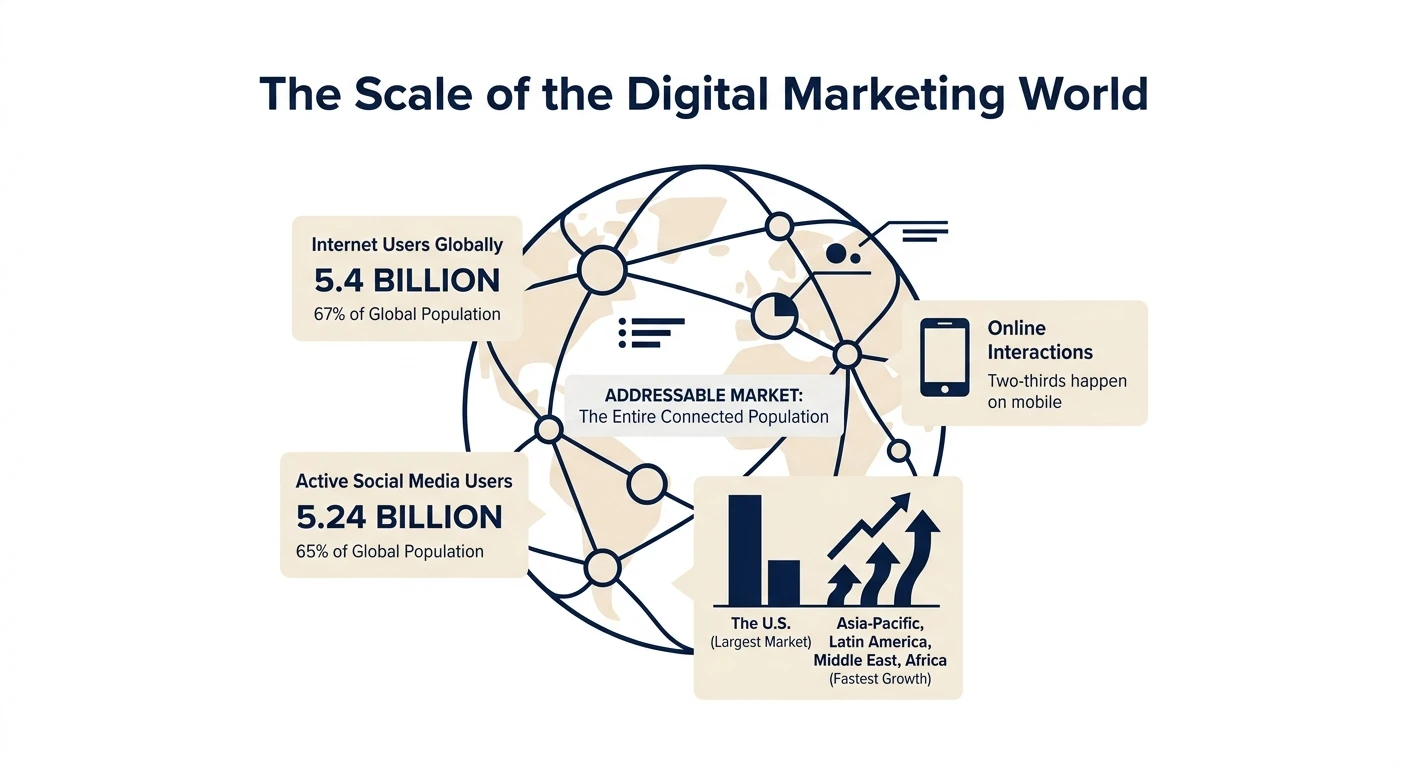
To appreciate the environment affiliate marketing operates in, consider a few foundational numbers. There are currently 5.4 billion internet users globally — 67% of the world's population. Of those, 5.24 billion are active social media users, representing 65% of the global population. Two-thirds of all online interactions happen on mobile devices.
These are not just impressive statistics. They represent the audience for every piece of affiliate content you create, every email you send, every ad you run. The addressable market for digital marketing — and for affiliate marketing specifically — is essentially the entire connected population of the planet. And that population is growing every year as internet access expands into previously underserved regions.
The United States remains the world's largest single digital marketing market, but the growth rates in Asia-Pacific, Latin America, the Middle East, and Africa are far higher. India added more new internet users in 2024 than the entire population of many European countries. Indonesia, Nigeria, Brazil, and Pakistan are all seeing rapid increases in digital connectivity that are creating new audiences for digital marketing campaigns. For affiliate marketers willing to think globally, these growth markets represent some of the most exciting opportunities of the next decade.
The Channels and How They Interconnect:
Digital marketing is not a single channel — it is an integrated system where search, social, email, content, paid advertising, video, podcasting, and influencer marketing all work together. The most successful digital marketers — including the most successful affiliate marketers — understand how to leverage multiple channels simultaneously and how to make them reinforce each other.
Search engine optimisation drives organic traffic from Google. Social media amplifies that content to new audiences. Email marketing nurtures those audiences and converts them into buyers. Paid advertising retargets visitors who didn't convert on their first visit. Content marketing provides the substance that makes all of these channels work — the reviews, guides, comparisons, and tutorials that give people a reason to click, subscribe, and buy.
For affiliate marketers, the channels that work best together depend heavily on niche. In technology and consumer electronics, YouTube reviews combined with SEO-optimised blog posts and email newsletters create a powerful three-channel system. In personal finance and investing, long-form content and email marketing dominate because trust-building requires depth and consistency. In fashion and beauty, Instagram and TikTok content drives discovery while Pinterest captures purchase intent. Understanding which channel combinations work best in your specific niche is one of the highest-value strategic decisions you can make.
The Tools Revolution Is Democratising Digital Marketing:
One of the most significant developments in digital marketing over the past five years is the democratisation of enterprise-grade marketing tools through affordable SaaS platforms. The marketing technology landscape — commonly called “MarTech” — now includes over 11,000 distinct tools covering every aspect of digital marketing from SEO and content creation to email automation, social media management, affiliate tracking, and analytics.
For affiliate marketers, this abundance of tools means you can now build a marketing stack that, ten years ago, would have required a team of specialists and a six-figure technology budget. SEO research that used to require an agency can now be done with Ahrefs or Semrush for a few hundred dollars per month. Email marketing automation that was once reserved for enterprise clients is now available through ConvertKit or ActiveCampaign for less than USD 100 per month. AI content assistance tools that can research, outline, and draft articles in minutes cost a fraction of what human writers charge for the same output.
This tool democratisation is both an opportunity and a levelling force. It means individual affiliate marketers can compete with larger operations on technical sophistication. It also means that basic marketing competency is table stakes — everyone has access to the same fundamental tools, so the differentiation comes from strategy, creativity, and execution quality rather than tool access.
The AI-Driven Future of Digital Marketing:
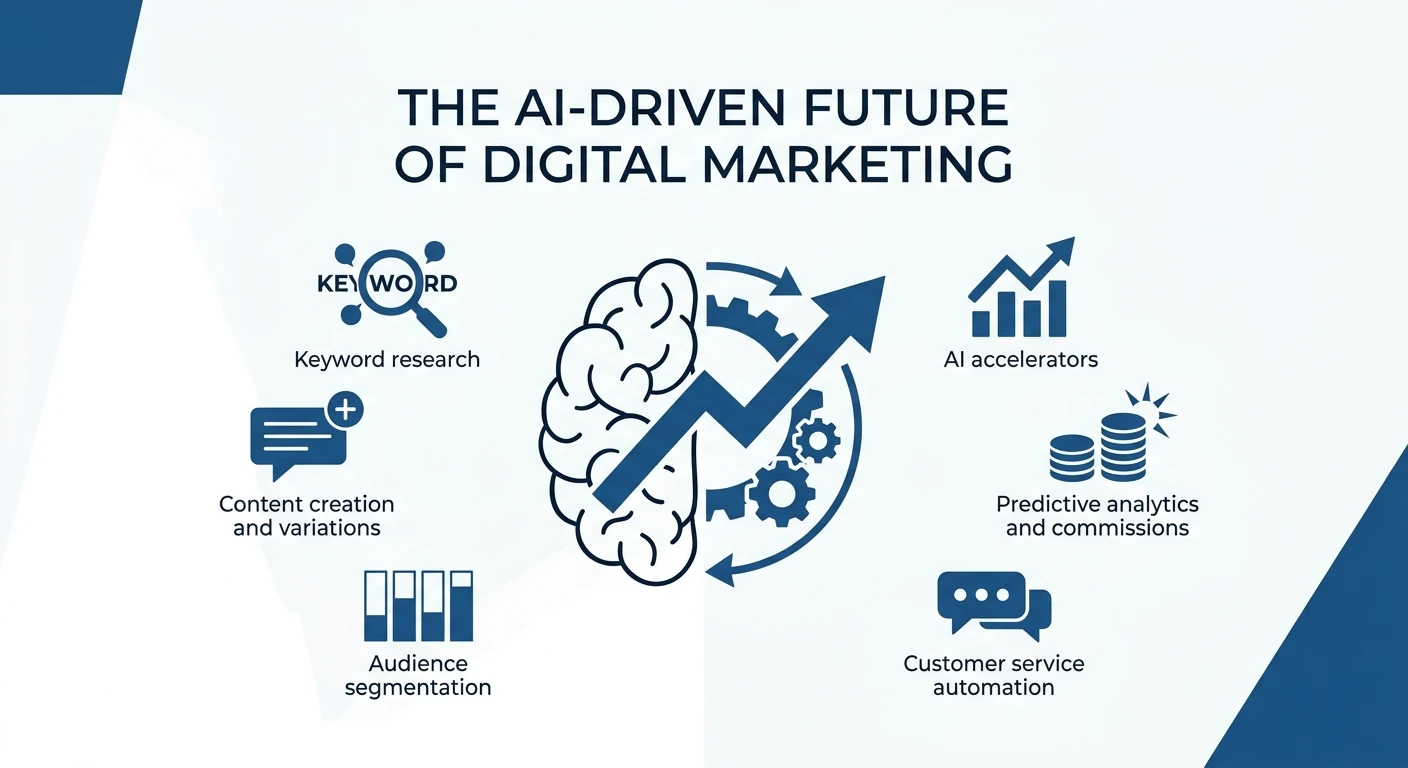
No discussion of digital marketing trends would be complete without addressing the profound impact of artificial intelligence. AI adoption in marketing is growing at 47% CAGR, and it is already transforming every aspect of the discipline. AI-driven campaign optimisation, content personalisation, audience segmentation, predictive analytics, and customer service automation are no longer experimental — they are standard practice for competitive marketers.
For affiliate marketers, AI's most immediate practical benefits are in content production and SEO. AI tools can now conduct keyword research, identify content gaps, write first drafts, optimise existing content for search intent, and generate multiple variations for A/B testing — all at a speed and scale that was previously impossible for individual creators. The affiliates who master AI-assisted content workflows are producing five to ten times more content than their purely manual counterparts, which translates directly into more rankings, more traffic, and more commissions.
But AI is also raising the competitive bar. When every affiliate marketer has access to AI content generation, the differentiation comes from the human elements that AI cannot replicate — personal product experience, original research, authentic editorial voice, community relationships, and the willingness to take editorial positions rather than hedge everything. The affiliate sites that will dominate search in the coming years are those that use AI as an accelerator for human expertise, not as a replacement for it.
Voice Search, AR, and the Next Generation of Digital Interaction:
Beyond AI, several emerging technologies are reshaping how consumers interact with digital marketing. Voice search now accounts for an estimated 50% of all search queries in certain categories, as smart speakers, phone assistants, and in-car systems make voice the dominant search modality for convenience-driven information. Affiliate marketers who optimise their content for voice search — focusing on conversational question-and-answer formats, featured snippet optimisation, and local search intent — are positioning themselves for a shift that will accelerate significantly over the next five years.
Augmented reality is another technology with direct affiliate implications. The ability to virtually try on glasses, see how a piece of furniture looks in your living room, or preview a paint colour on your walls before purchasing is becoming a standard feature on retail platforms. As AR reduces purchase hesitation and increases conversion confidence, the categories where AR is most effective — fashion, furniture, beauty, and home decor — will see significant lifts in affiliate conversion rates.
Short-form video continues its dominance, with platforms like TikTok, Instagram Reels, and YouTube Shorts driving 87% higher engagement than long-form content on social media. For affiliates, the challenge is that short-form video is harder to directly monetise through traditional affiliate links — but it excels at top-of-funnel awareness and audience building that feeds into email lists, YouTube channels, and blog traffic where conversions ultimately happen.
What This All Means for Your Affiliate Business:
The digital marketing market growing to USD 2.7 trillion by 2034 is not a distant abstraction — it is the environment you are operating in right now. Every dollar brands spend on digital marketing creates demand for the channels, tools, and content that affiliate marketers provide. As digital marketing investment grows, affiliate programs become more competitive, commission rates increase in high-value niches, and the overall pool of revenue available to performance-based publishers expands.
The most practical strategic takeaway from this market overview is the importance of staying current. Digital marketing evolves faster than almost any other industry. The channels, formats, tools, and algorithms that drive results today may be superseded by new approaches in 12–18 months. The affiliate marketers who invest in continuous learning — who stay on top of platform changes, algorithm updates, emerging tools, and shifting consumer behaviour — consistently outperform those who build a strategy and never update it.
Build your affiliate business on the most durable foundations — a quality content library, an engaged email list, a strong brand in your niche, and a diversified traffic strategy — and then adapt the tactics within that structure as the digital marketing landscape evolves around you. In a USD 870 billion market growing toward USD 2.7 trillion, there is more than enough opportunity for every affiliate marketer who is willing to do the work.
FAQs
The digital marketing market is expected to reach well over $1 trillion by 2035, driven by accelerating adoption of AI, programmatic advertising, and mobile-first strategies. This explosive growth creates an increasingly competitive but opportunity-rich environment for affiliate marketers operating within the ecosystem.
As brands increase their digital ad budgets year over year, affiliate programs receive larger commission pools and more competitive payouts to attract top publishers. Affiliate marketers who understand market trends can position themselves in high-growth niches like influencer commerce, AI-driven content, and performance-based channels before they become saturated.
This decade marks the convergence of AI automation, first-party data dominance post-cookie, and global internet expansion in emerging markets, creating structural shifts in how brands reach consumers. Affiliate marketers who adapt early to these changes will have a significant advantage over those who rely on outdated traffic and monetization strategies.
Yes, affiliate marketing remains one of the most cost-efficient performance channels in digital marketing, and its share of brand budgets is growing as advertisers demand measurable ROI. Industry data consistently shows affiliate and partner marketing growing faster than traditional display advertising heading into 2026 and beyond.
Absolutely, because digital marketing growth expands the total addressable audience rather than simply consolidating spend among large players. Niche affiliate sites, micro-influencers, and specialized content creators often outperform larger competitors in conversion rates by serving highly targeted audiences that broad-scale advertisers struggle to reach efficiently.