
Digital advertising is the ocean in which affiliate marketing swims. Understanding its scale, its structure, and its direction is essential for every affiliate marketer — whether you use paid ads yourself, create content that competes with paid placements in search results, or simply want to understand the ecosystem your affiliate links operate within.
The global digital advertising market was valued at approximately USD 740 billion in 2026, growing at a CAGR of 13.18%. To appreciate how remarkable that number is, consider that just a decade ago, the entire global advertising industry — television, print, radio, outdoor, and digital combined — was smaller than digital advertising alone is today. The migration of advertising dollars from traditional to digital media has been one of the most significant economic shifts of the 21st century, and it is far from over.
The Architecture of a USD 740 Billion Market:
Digital advertising is not a monolithic channel — it is a complex ecosystem of formats, platforms, pricing models, and technologies. Understanding the architecture helps you identify where affiliate marketing fits and how to leverage paid channels strategically.
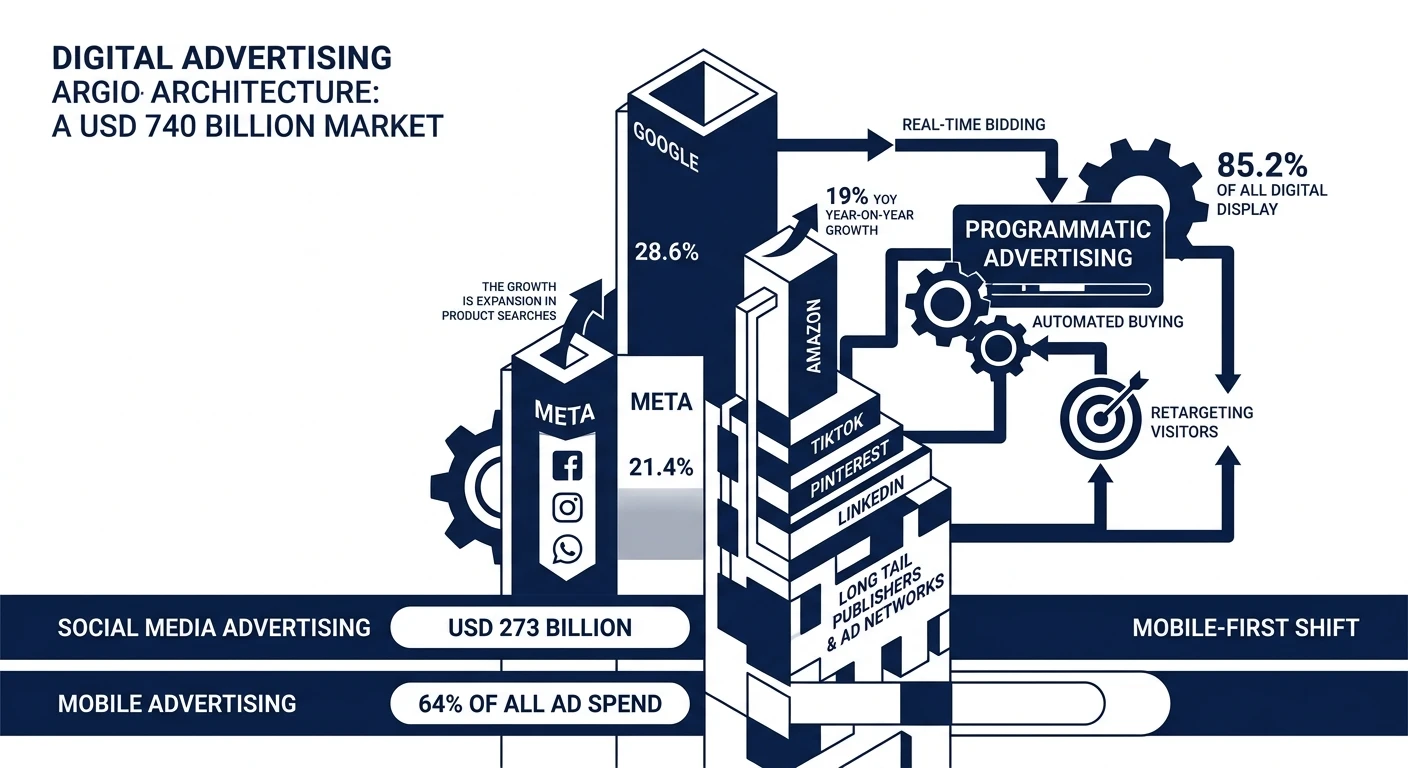
Google holds 28.6% of the global digital advertising market, making it the single dominant player in search advertising. Meta — encompassing Facebook, Instagram, and WhatsApp — holds 21.4% of the market, dominating social media advertising. Amazon is the fastest-growing major player, expanding its advertising business at 19% year-on-year as more product searches shift from Google to Amazon's own platform. TikTok, Pinterest, LinkedIn, and a long tail of specialist publishers and ad networks make up the remainder.
Programmatic advertising — the automated buying and selling of ad inventory through real-time bidding — now accounts for 85.2% of all digital display advertising. This means the vast majority of banner ads, video ads, and native advertising units you see across the web are bought and sold in milliseconds by algorithms rather than through direct human negotiation. For affiliates, this matters because programmatic platforms can be used to retarget your content's visitors with ads — a powerful strategy for recovering lost conversions.
Social media advertising represents USD 273 billion of the total digital advertising market, and mobile advertising accounts for 64% of all digital ad spend — reflecting the same mobile-first shift that is driving e-commerce and email marketing growth.
The Paid vs Organic Balance for Affiliate Marketers:
Most affiliate marketers start with organic traffic — SEO, social media, and content — before layering in paid advertising as their business scales. This sequence makes sense because organic traffic builds compounding assets while paid traffic stops the moment you stop spending. However, understanding the paid advertising landscape is critical even for primarily organic affiliates.
First, paid search ads occupy the top positions in Google search results, above organic listings. For high-competition affiliate keywords, understanding how advertisers are bidding and what messages they're using helps you craft organic content that competes more effectively. Second, paid social campaigns can be used to amplify your best organic content — turning a high-converting review article into a sponsored post that reaches thousands of people in your target audience beyond your organic following.
Third, and most strategically, paid advertising can be used directly for affiliate campaigns in many niches. Affiliates who run Google Shopping ads, YouTube pre-roll campaigns, or Facebook lead generation campaigns for affiliate offers at a positive ROI are effectively arbitraging the difference between what they pay per click and what they earn per conversion. In high-commission categories like SaaS, finance, and online education, this arbitrage can be extremely lucrative.
The Shift That Is Reshaping Everything — Privacy and Cookieless Advertising:
The single most disruptive force in digital advertising right now is the deprecation of third-party cookies and the broader privacy regulation movement. GDPR in Europe, CCPA in California, and Apple's App Tracking Transparency framework have fundamentally limited advertisers' ability to track users across websites and devices. Google has been gradually phasing out third-party cookie support in Chrome, accelerating the shift toward alternative tracking methods.
For affiliate marketers, this privacy shift has important implications. The traditional last-click attribution model — where the affiliate who drove the final click before a purchase receives 100% of the commission — is becoming harder to execute accurately as cross-device tracking degrades. Server-to-server (S2S) tracking, which works at the server level rather than relying on browser cookies, is increasingly the standard for accurate affiliate attribution and can recover up to 20% of commissions that were previously lost to cookie blocking.
First-party data — the data you collect directly from your own audience through email subscriptions, user registrations, and on-site behaviour — is becoming the most valuable asset in digital advertising. Affiliates who have built email lists and engaged communities own first-party data that allows them to run retargeting campaigns, personalised recommendations, and lookalike audience targeting without relying on third-party tracking. This is another powerful argument for prioritising email list building as a core affiliate strategy.
AI-Driven Advertising and What It Means for Affiliates:
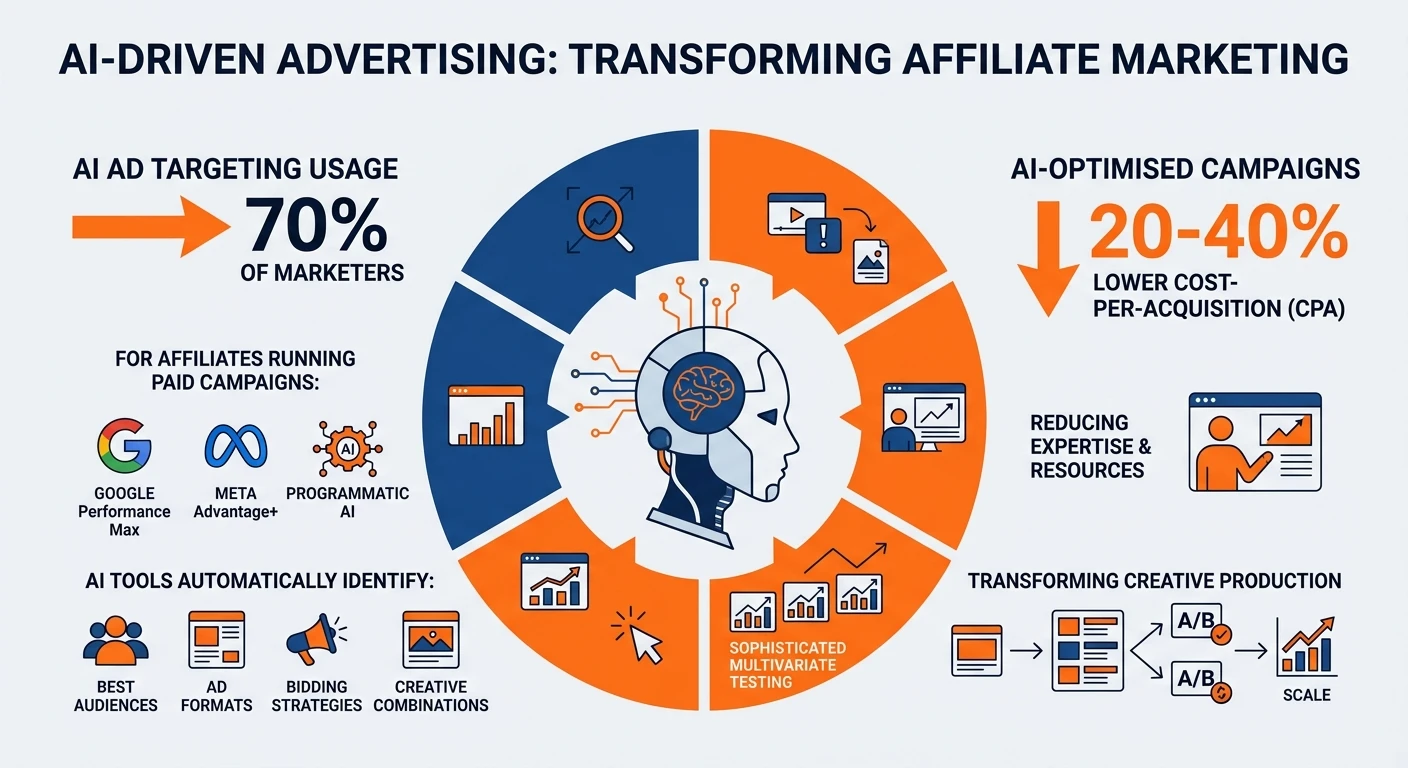
Artificial intelligence is transforming digital advertising at an extraordinary pace. AI-driven ad targeting is now used by 70% of marketers to optimise campaign performance, and the results are significant — AI-optimised campaigns consistently achieve 20–40% lower cost-per-acquisition than manually managed campaigns.
For affiliates who run paid campaigns, AI tools like Google's Performance Max, Meta's Advantage+ Shopping Campaigns, and programmatic AI platforms can dramatically reduce the expertise required to run profitable paid campaigns. These platforms use machine learning to automatically identify the best audiences, ad formats, bidding strategies, and creative combinations for your specific goal — whether that's maximising clicks, conversions, or return on ad spend.
AI is also transforming creative production for ads. Tools that generate multiple ad variations from a single brief, test them automatically against each other, and scale the winning combinations have made it possible for individual affiliate marketers to run sophisticated multivariate testing that would previously have required a dedicated marketing team.
The Long-Term Opportunity in Digital Advertising for Affiliates:
The digital advertising market growing toward and beyond USD 740 billion in 2026 creates a specific opportunity for affiliate marketers that is easy to miss. As brands spend more on digital advertising, they are also allocating more budget to affiliate programs — because affiliate marketing offers the performance guarantee that brand advertising cannot. Every dollar spent on an affiliate commission is a dollar tied to a measurable outcome.
This means the affiliate channel benefits indirectly from every increase in the digital advertising market. Brands with growing digital marketing budgets tend to invest more in affiliate programs, raise commission rates, offer larger bonuses for top performers, and develop more sophisticated tools and creatives for their affiliate partners. The rising tide of digital advertising spend lifts the affiliate marketing boat.
FAQs
The digital advertising market is expected to surpass $1.5 trillion by 2035, driven by growth in programmatic advertising, mobile platforms, and emerging markets. This rapid expansion presents significant revenue opportunities for affiliate marketers who align their paid media strategies with these trends.
Affiliate marketers can capitalize on this growth by diversifying their paid media mix across search, social, connected TV, and programmatic channels. Staying ahead of audience targeting innovations and first-party data strategies will be critical to maximizing ROI as the market evolves.
Understanding market trends helps affiliate marketers anticipate shifts in ad costs, platform dominance, and consumer behavior before they happen. Marketers who act on these insights early can secure lower CPCs, better placements, and stronger conversion rates ahead of increased competition.
Yes, programmatic advertising is forecast to account for the majority of global digital ad spend by 2035, automating the buying and selling of ad inventory at scale. Affiliate marketers who master programmatic channels will have a distinct competitive advantage in reaching highly targeted audiences efficiently.
Absolutely, smaller affiliate marketers can compete by focusing on niche audiences, leveraging performance-based ad models, and using AI-driven optimization tools that were previously only available to large advertisers. The democratization of ad technology means budget-conscious affiliates can still achieve strong returns if they choose the right platforms and monitor campaign data closely.