
Three years ago, AI-assisted coding was a curiosity. Today, 90% of Fortune 100 companies use GitHub Copilot, developers are working 55% faster, and the product generates more revenue than GitHub itself did when Microsoft acquired it for $7.5 billion. Here is the complete statistical story.
The Numbers That Matter
Metric | Number |
All-time users | 20 million |
Paid subscribers | 4.7 million |
Subscriber YoY growth | +75% |
Fortune 100 adoption | 90% |
Organisations deployed | 50,000+ |
Task completion speed | 55% faster |
Code generated by Copilot | 46% of user code |
PR time reduction | 75% |
Developers feeling more fulfilled | 90% |
AI coding tools market share | 42% |
Section 1: User and Growth Statistics
All-Time and Active Users

GitHub Copilot crossed 20 million cumulative users in July 2025. Microsoft CEO Satya Nadella made this announcement during the Q3 2025 earnings call, noting the platform had added 5 million users in just three months.
Year-over-year user growth hit 400% between early 2024 and early 2025, a pace few enterprise developer tools have ever matched.
Period | Users |
Launch (2022) | Limited preview |
Early 2024 | ~3.75 million |
Early 2025 | 15 million |
July 2025 | 20 million |
Paid Subscribers
As of January 2026, GitHub Copilot had 4.7 million paid subscribers — up 75% year-over-year. Paid subscriber growth ran at approximately 30% quarter-over-quarter throughout 2024.
Individual Pro+ subscriptions (the premium tier) grew 77% quarter-over-quarter in the most recent reported period.
Section 2: Enterprise Adoption
Enterprise adoption moved from experimentation to standard deployment.
Enterprise Metric | Data |
Fortune 100 adoption | 90% |
Organisations using Copilot | 50,000+ |
Enterprise customers (FY2024) | 77,000 |
Enterprise QoQ growth (Q2 2025) | 75% |
License utilisation rate | 80% |
GitHub YoY revenue growth | 40% |
90% of Fortune 100 companies using Copilot means almost every major corporation in America has deployed it. The 80% license utilisation rate — meaning 80% of developers with access actually use it — shows this is organic adoption, not procurement that sits unused.
Industry Breakdown
Industry | Enterprise Adoption |
Technology/startups | 90% on paid licenses |
Banking/finance | 80% |
Healthcare | 70% |
Insurance | 70% |
Industrial | 60% |
Even insurance (70%) and healthcare (70%), both historically cautious technology adopters, have deployed Copilot at high rates. For healthcare, that reflects the scale of the coding problem — large clinical systems require enormous ongoing development work.
Satya Nadella quote (July 2025): Copilot is now a larger business than GitHub was at the time of the 2018 acquisition. This is the clearest signal of how commercially significant AI coding assistance has become.
Section 3: Productivity Impact
Speed and Delivery
Metric | Data |
Individual task speed | +55% |
Pull request time | 9.6 days → 2.4 days |
PR time reduction | 75% |
Development lead time | -55% |
Code review speed | +15% |
PRs per developer | +8.69% |
Merge rate | +11% |
Successful builds | +84% |
Coding projects per week | +126% |
The 84% increase in successful builds is a particularly important number. More successful builds means less time debugging failed deployments, which compounds across large teams significantly.
Code Generation Rates
Language | Copilot's Share |
Java | 61% |
Python | 40% |
JavaScript | 30–35% |
TypeScript | 30–35% |
Average (all languages) | 46% |
Copilot writes 46% of all code for active users — nearly half. Up from 27% at launch. As models improve, this number will continue rising.
Developer Experience and Wellbeing
Metric | Data |
Reduced cognitive load (repetitive tasks) | 87% |
Longer flow states | 73% |
Less frustrated while coding | 59% |
Focus on higher-value tasks | 74% |
More fulfilled at work | 90% |
Better job satisfaction | 60% |
Rate tool extremely useful | 51% |
Rate tool extremely easy to use | 43% |
88% code retention rate | 88% |
The wellbeing data stands out. 90% feeling more fulfilled is not a typical productivity software outcome. It suggests Copilot is solving a genuine pain point — the cognitive drain of repetitive boilerplate code — rather than just adding speed.
Adoption Behaviour
81.4% install the IDE extension on their very first day
96% accept their first suggestion on day one
67% use Copilot 5+ days per week
60–75% feel more fulfilled and focused when using the tool
These numbers show immediate and sustained adoption, not a tool that requires weeks of onboarding before adding value.
Section 4: Code Quality
What the Research Shows
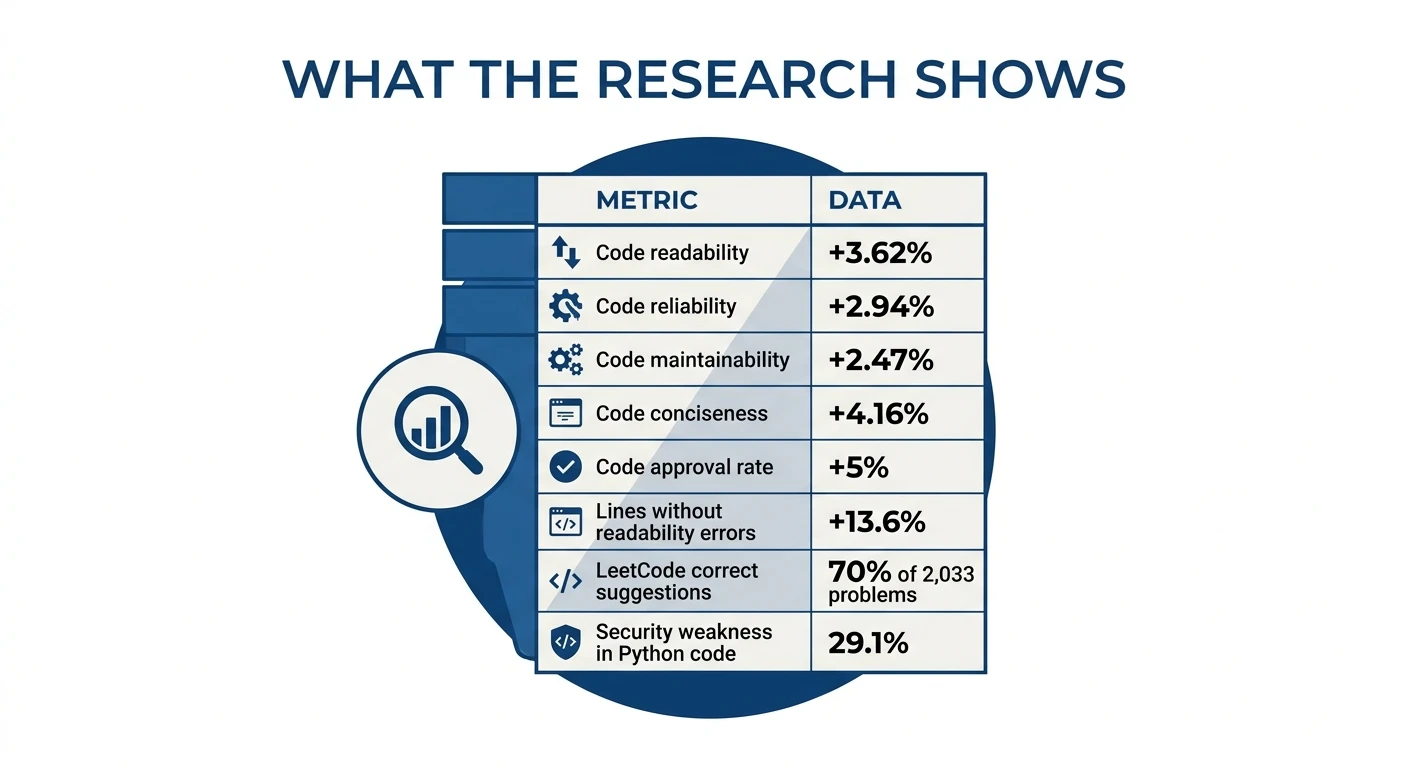
Metric | Data |
Code readability | +3.62% |
Code reliability | +2.94% |
Code maintainability | +2.47% |
Code conciseness | +4.16% |
Code approval rate | +5% |
Lines without readability errors | +13.6% |
LeetCode correct suggestions | 70% of 2,033 problems |
Security weakness in Python code | 29.1% |
The quality improvements are modest but consistent. More important is the security caveat: 29.1% of Copilot-generated Python code contains potential security weaknesses. This does not make Copilot risky — human code has security vulnerabilities too — but it requires organisations to maintain code review processes rather than treating AI-generated code as automatically safe.
By April 2025, Copilot had auto-reviewed more than 8 million pull requests across enterprise deployments.
Section 5: Revenue and Market Data
Revenue Estimates
Estimate | Method |
Conservative ARR | ~$451M (4.7M subs × $8/month) |
Higher ARR | ~$848M (4.7M × $15/month with enterprise mix) |
GitHub total revenue growth | +40% YoY |
Market Position
Metric | Data |
AI coding tools market 2025 | $7.37 billion |
Copilot market share | 42% |
Market size 2024 | $4.91 billion |
Market growth YoY | +50% |
Competitor landscape:
Tool | ARR | Position |
GitHub Copilot | $450–850M | Market leader |
Cursor | $500M | Fastest growing |
Amazon CodeWhisperer | Growing | Enterprise challenger |
Tabnine | Established | SMB focus |
Cursor's $500M ARR and 1 million+ daily users makes it a genuine challenger. But Copilot's enterprise distribution through GitHub and Microsoft 365 is a structural advantage.
Section 6: Pricing
Plan | Price | Best For |
Free | $0 | Students, limited use |
Pro | $10/month | Individual developers |
Pro+ | $39/month | Power users |
Business | Custom | Teams |
Enterprise | Custom | Large organisations |
Conclusion
GitHub Copilot in 2026 is no longer a feature — it is infrastructure. 90% of Fortune 100 companies use it. Developers work 55% faster. Pull requests close 75% faster. Successful builds increased 84%. And 90% of developers say they are more fulfilled at work.
The ROI case is clear. The developer satisfaction case is clear. The only remaining question for organisations not yet deployed is whether they can afford to continue ceding a 55% productivity advantage to competitors who are.
FAQs
GitHub Copilot has reached 20 million all-time users as of July 2025, with 4.7 million paid subscribers as of January 2026. That subscriber base grew 75% year-over-year, making it the dominant player in AI-assisted coding tools.
GitHub Copilot holds 42% of the paid AI coding tools market, which was valued at $7.37 billion in 2025. This makes it by far the most widely adopted commercial AI coding assistant available today.
GitHub Copilot's Pro plan costs $10 per month, while the Pro+ plan is priced at $39 per month. Business and Enterprise plans are available at custom pricing tailored to organizational needs.
Developers complete individual coding tasks 55% faster with GitHub Copilot, and weekly coding projects completed increases by 126%. Pull request cycle time also drops dramatically, falling from 9.6 days down to just 2.4 days.
No — while GitHub Copilot can improve overall code quality metrics, 29.1% of Copilot-generated Python code contains potential security weaknesses. Human code review remains essential to catch vulnerabilities before they reach production.