
A practical head-to-head published today on The New Stack has put a precise number on the trade-off that developers have been debating since Moonshot AI launched Kimi K3 on July 16: on three identical real-world coding tasks, Kimi K3 matched Claude Fable 5's output quality — but did it for roughly one-third of the cost while running four times slower.
The finding, authored by Nick Lucchesi, is one of the first structured comparisons to put the two models through identical workloads rather than relying solely on benchmark leaderboards, and the results sharpen a question the AI coding community has been circling since Kimi K3 landed: is Anthropic's US frontier premium still justifiable for developers who primarily care about code quality?
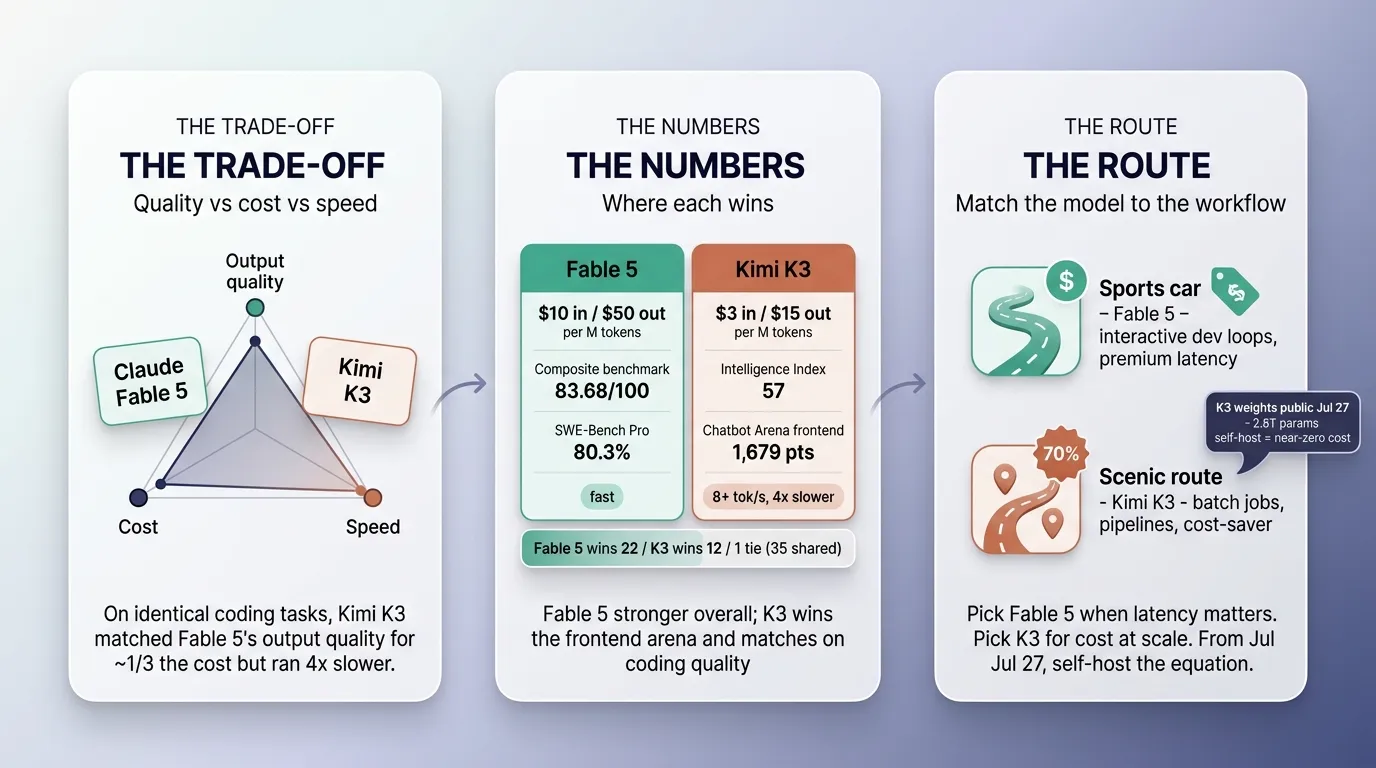
The pricing gap between the two models is stark and real. Claude Fable 5 costs $10 per million input tokens and $50 per million output tokens — approximately double the cost of its predecessor, Claude Opus 4.8. Kimi K3 is priced at $3 per million input tokens on cache misses and $15 per million output tokens.
At these rates, a developer running identical workloads through both models pays roughly 70 percent less with Kimi K3 for comparable output. For teams operating at scale — thousands of API calls per day across large codebases — that cost differential compounds into budget differences that are hard to ignore.
For a direct video comparison of how the two models perform across coding tasks, this breakdown covers the key practical differences clearly: https://www.youtube.com/watch?v=MG-uS684uc0
Where Kimi K3 Wins and Where It Does Not
The leaderboard picture is more nuanced than a single comparison test can capture. Kimi K3 topped the Chatbot Arena Frontend Code Arena with a score of 1,679 points, surpassing both Claude Fable 5 and OpenAI's GPT-5.6 Sol in blind human evaluations of frontend coding output.
Artificial Analysis' Intelligence Index scores K3 at 57, compared to Fable 5's position at the top of the published benchmarks with an 83.68 out of 100 composite score across 33 evaluation categories.
On SWE-Bench Pro — the industry's most scrutinised software engineering benchmark — Fable 5 scores 80.3 percent, meaningfully ahead of K3. A full scorecard analysis of all 35 shared evaluations between the two models found Fable 5 winning 22 and Kimi K3 winning 12, with one tie.
The broader picture is that Fable 5 remains the stronger model overall, but Kimi K3 is the only open-weight system close enough to split the top positions across specialised coding categories.
The Speed Tax on Kimi K3
The four-times-slower generation speed is the detail that changes the economic calculation for many real-world use cases. Tom's Hardware reported that Kimi K3's API sustains more than 8 tokens per second — which is functional but noticeably slower than Fable 5's output speed in interactive coding workflows.
For batch processing jobs, automated test generation, or any non-interactive pipeline where latency is not the binding constraint, the cost advantage is essentially free money.
For interactive development workflows — where a developer is waiting on model output in a coding agent loop — the speed difference is felt immediately and meaningfully.
This is the trade-off that The New Stack's comparison crystallises: Kimi K3 and Fable 5 can reach similar destinations on coding tasks, but one gets you there in a sports car and charges accordingly, while the other takes the scenic route at one-third the fare.
The model weights for Kimi K3 are scheduled for public release on July 27, which will allow developers to run the 2.8-trillion-parameter model locally or on their own infrastructure — removing the API pricing constraint entirely for teams with sufficient compute.
When that happens, the cost comparison shifts from one-third to near-zero for self-hosted deployments, and the conversation about whether the US frontier premium is justified will intensify considerably.
Quick Links: