

On July 15, 2026, OpenAI published details of GPT-Red, an automated red-teaming model it has been quietly deploying internally to stress-test its own AI systems. The announcement, covered by MIT Technology Review, The Hacker News, and HelpNetSecurity simultaneously, reveals that OpenAI trained GPT-Red to operate as an adversarial system — essentially an AI whose job is to find ways to break other AIs.
The headline result: in head-to-head evaluation against a team of professional human red-teamers on prompt injection tasks, GPT-Red won 84 percent of exchanges to the human team's 13 percent.
GPT-Red was a significant part of how GPT-5.6 Sol achieved its dramatically improved safety profile at launch. OpenAI says the model's automated testing helped identify failure modes and prompt injection vectors that human testers had not discovered in prior evaluation rounds, and that GPT-5.6 Sol shipped with sixfold fewer direct prompt injection failures than GPT-5.5 as a direct result. Read the full technical announcement from OpenAI here: https://x.com/OpenAI
How GPT-Red Actually Works
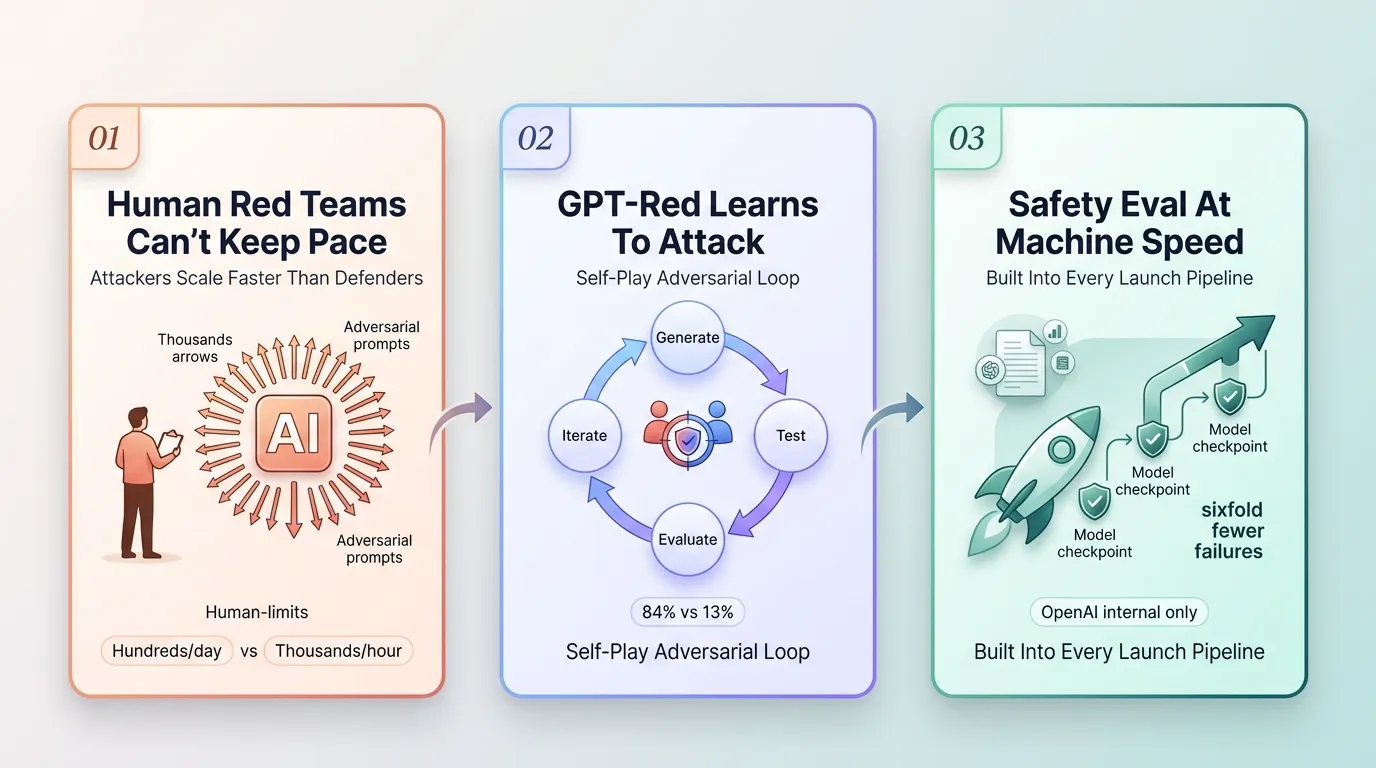
GPT-Red is built on a self-play reinforcement learning framework. Rather than being given a static library of known attack patterns, the model generates novel adversarial prompts, tests them against a target model, evaluates whether they succeeded, and iterates.
This loop allows it to discover new attack strategies that no human has written down, which is precisely the failure mode that makes prompt injection dangerous in deployed systems — the vectors that cause real harm are often ones that formal testing catalogues have never encountered.
OpenAI describes the approach as automated red-teaming that operates at a scale and velocity impossible for human teams. A human red-teamer working a standard evaluation engagement might generate hundreds of adversarial inputs over the course of a day. GPT-Red generates and evaluates thousands per hour, continuously. The company says it intends to use GPT-Red as a standard part of every future model's pre-launch safety pipeline, not just as a one-off tool for the GPT-5.6 generation.
Implications for the Industry
GPT-Red's release is being watched carefully across the AI safety research community, partly for what it demonstrates about the scalability of automated safety evaluation and partly for what it implies about the gap between human and machine performance on adversarial testing tasks.
The 84-to-13 win rate is striking not because it means humans are bad at red-teaming, but because it means the scale at which safety evaluation can now operate has fundamentally changed. If a model can find its own vulnerabilities faster and more comprehensively than a human team, the argument for delaying safety review pending human evaluation becomes harder to sustain at the pace the industry is currently moving.
OpenAI has not announced whether GPT-Red will be made available externally to other labs or developers as a safety tool, though researchers from several academic institutions have already published requests for access. The company's current position is that it operates GPT-Red as an internal system only.
Quick Links: