
“Content is king” has been repeated so many times in digital marketing circles that it has started to feel like a cliché. But clichés become clichés because they contain a truth that refuses to go away. In 2026, content marketing is not just still relevant — it is growing faster than most other marketing channels, backed by a global market valued at USD 143.77 billion and expanding toward USD 331.3 billion by 2035 at a CAGR of 9.72%.
For affiliate marketers, content is not just a strategy — it is the product. Your review articles, comparison guides, buying resources, tutorial videos, and email newsletters are the actual value you deliver to your audience. Without content, there is no affiliate marketing. Understanding the broader content marketing landscape helps you appreciate why this approach works, where it's heading, and how to build a content strategy that compounds in value over the next decade.
The Business Case for Content Marketing Is Overwhelming:
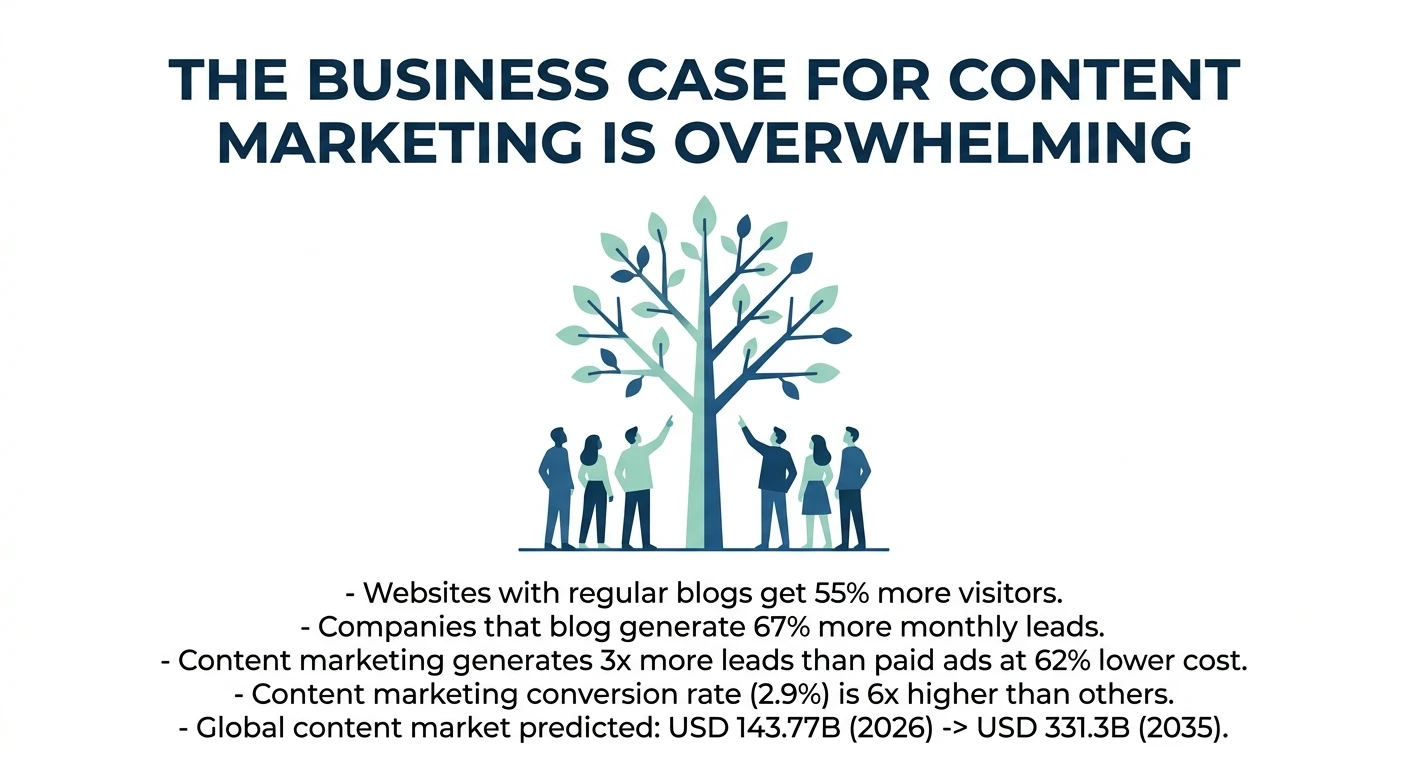
The numbers behind content marketing's effectiveness are some of the most consistently impressive in all of digital marketing. Websites that publish regular blog content receive 55% more visitors than those that don't. Companies that blog generate 67% more leads per month than those without a blog. Businesses that invest in content marketing generate 3 times more leads than paid advertising at 62% lower cost. And the conversion rate for content marketing — 2.9% — is six times higher than the average for businesses that don't invest in content.
For affiliate marketers, these statistics crystallise the core argument for building a content-first business. Your blog articles, product reviews, and comparison guides are not just traffic sources — they are trust-building assets that systematically move readers from curiosity to purchase intent to conversion. The affiliate marketer who has written a comprehensive, genuinely helpful review of the best noise-cancelling headphones is not competing on price or advertising budget. They're winning on authority, relevance, and trust — assets that compound over time and are extremely difficult for competitors to replicate quickly.
The global market validating this is enormous. With USD 143.77 billion being spent on content creation and distribution in 2026, reaching toward USD 331.3 billion by 2035, content marketing has become one of the most funded disciplines in the business world. Brands at every scale — from Fortune 500 companies to solo entrepreneurs — are increasing their content budgets because the ROI speaks for itself.
The Formats That Are Winning Right Now:
Not all content formats perform equally, and the landscape has shifted meaningfully in the last few years. Understanding which formats are gaining and which are declining helps you allocate your time and resources intelligently.
Long-form written content remains the backbone of affiliate marketing. Articles above 2,000 words consistently outrank shorter content in Google search results for competitive keywords, and buying-guide style content — where you comprehensively cover every option in a category — generates the highest affiliate conversion rates. According to content marketing research, long-form blog posts are the primary format for 47% of content marketers, and for good reason: depth signals expertise, and expertise builds the trust that converts readers into buyers.
Video content has become essentially mandatory for any serious content marketing strategy. A remarkable 91% of companies now use video as a marketing tool, reflecting how completely consumer preference has shifted toward visual media. For affiliates, YouTube review videos are particularly powerful because they combine the discoverability of search (YouTube is the world's second-largest search engine) with the trust-building power of seeing and hearing a real person use and evaluate a product. The affiliate links in YouTube descriptions consistently generate some of the highest-converting traffic in the entire affiliate ecosystem.
Podcasts represent the fastest-growing content format in terms of audience engagement and advertising spend. The podcast advertising market is projected to exceed USD 4.4 billion in 2026, and podcast audiences are uniquely loyal and receptive. Affiliates who launch podcasts in specialised niches — personal finance, health and fitness, technology, travel — often find that their podcast listeners convert at significantly higher rates than blog readers, because the relationship built through audio content is more intimate and personal.
The AI Transformation of Content Creation:
The biggest story in content marketing right now is the integration of artificial intelligence into the content creation process. According to recent surveys, 83% of marketers are now using AI tools to assist with content creation, and AI-generated content costs approximately 80% less to produce than traditionally written content. The dominant tools are ChatGPT (used by 83.8% of AI content users), followed by Jasper, Copy.ai, and Surfer SEO's AI features.
For affiliate marketers, AI represents both an opportunity and a competitive challenge. The opportunity is in production speed — AI can help you research, outline, draft, and optimise content at a pace that was simply impossible for individual creators even two years ago. A single affiliate marketer with the right AI workflow can now produce content that would have previously required a team of writers.
The challenge is that AI is also raising the floor. When every affiliate marketer has access to AI-generated first drafts, the differentiation comes from what you add on top — your personal experience with products, your original research, your unique editorial voice, your willingness to be honest when a product isn't worth buying. Google's search algorithms are increasingly rewarding Experience, Expertise, Authoritativeness, and Trustworthiness (E-E-A-T), which means the affiliates who combine AI efficiency with genuine human expertise will win, while those who simply publish undifferentiated AI content will struggle to rank.
The Content-Commerce Convergence:
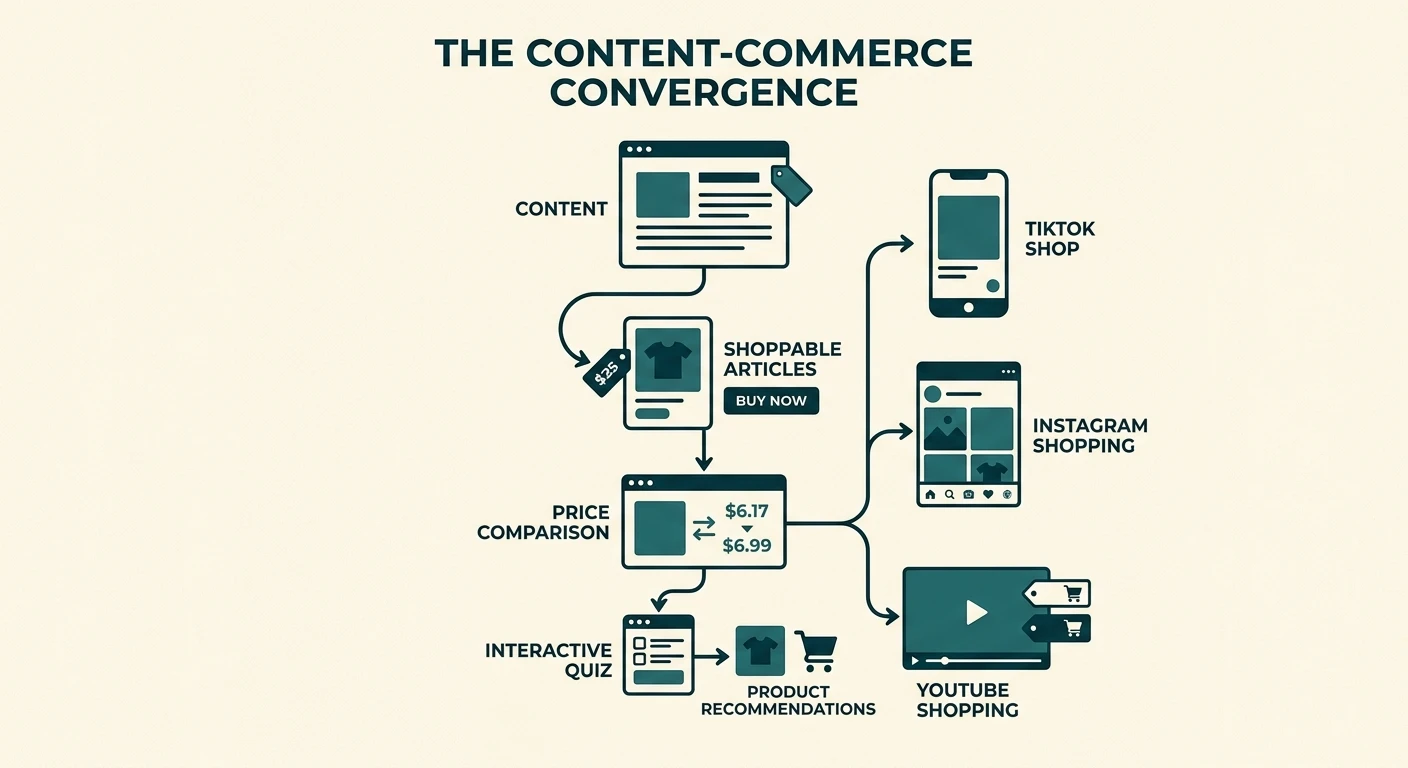
One of the most significant trends reshaping content marketing for affiliates is the convergence of content and commerce. The traditional model — write content, attract traffic, hope visitors click affiliate links — is being supplemented by shoppable content formats that dramatically reduce friction between reading and buying.
Shoppable articles with embedded product cards, in-content price comparisons that update in real time, and interactive recommendation quizzes are all converting at higher rates than static text links. Platforms like TikTok Shop and Instagram Shopping are turning social content directly into storefronts. YouTube's integrated shopping features allow creators to tag products in videos that viewers can purchase without leaving the platform.
This convergence benefits affiliates who think of their content not just as traffic-generating material but as a shopping experience. The reader who lands on your “best running shoes” article should be able to see current prices, read key specs, compare options, and click through to buy — all within your content. Building that kind of rich, interactive content experience is increasingly the differentiator between affiliate sites that generate serious revenue and those that generate modest traffic with low conversion rates.
Proving ROI and Building a Sustainable Content Business:
Despite all of content marketing's advantages, the biggest challenge identified by marketers is proving ROI — cited by 38% as their primary difficulty. This challenge is particularly relevant for affiliates who need to justify time spent on long-form content that may take 6–12 months to rank and generate meaningful traffic.
The answer lies in attribution and patience. Affiliate marketers who track every conversion back to its originating content piece, who measure not just traffic but commission per article, and who build their content strategy around data rather than gut feeling are the ones who sustain long-term growth. Tools like Google Analytics 4, affiliate dashboard analytics, and heat mapping software give you the data to understand which content pieces are driving the most revenue — and to produce more content that mirrors the patterns of your top performers.
The content marketing market is growing to USD 331.3 billion by 2035 because the results, when done right, are undeniable. As an affiliate marketer, you are operating in the most leveraged corner of this market — creating content that continues to generate commissions long after it was written, building an audience that trusts your recommendations, and compounding that trust into an affiliate business that grows every year.
FAQs
The content marketing market is expected to reach hundreds of billions of dollars by 2035, driven by explosive growth in digital consumption and brand investment in organic reach. Analysts project consistent double-digit annual growth rates from 2026 onward as businesses prioritize content over paid advertising.
Content builds long-term, compounding traffic through search engines, social sharing, and audience trust — something paid ads cannot replicate. Affiliates who invest in high-quality content consistently earn passive commissions long after the content is published.
AI tools are accelerating content production, personalization, and distribution, allowing marketers to scale faster than ever before. However, human-led, experience-driven content is becoming increasingly valuable as audiences and search engines prioritize authenticity over AI-generated volume.
For long-term affiliate revenue, content marketing consistently outperforms paid advertising because it generates organic traffic without ongoing ad spend. A single well-ranked article can drive affiliate commissions for years, delivering a far superior return on investment over time.
Yes, small affiliates can compete effectively by targeting niche topics, building topical authority, and producing genuinely helpful content that large brands often overlook. The growing market actually creates more opportunity for specialized creators who serve specific audience needs with depth and expertise.