
There's a reason the most successful affiliate marketers in the world obsess over SEO. It isn't because they enjoy technical audits or keyword research spreadsheets — though some of them genuinely do. It's because organic search traffic is the closest thing to free, high-intent, scalable traffic that exists in digital marketing.
And the market that supports SEO — the agencies, tools, consultants, and platforms that help businesses rank on Google — is itself growing into a behemoth. Understanding the SEO services market gives you a sense of just how deeply search engine optimisation is embedded in the modern digital economy, and why it should remain the cornerstone of any affiliate marketing strategy.
The Market Numbers Tell a Compelling Story:
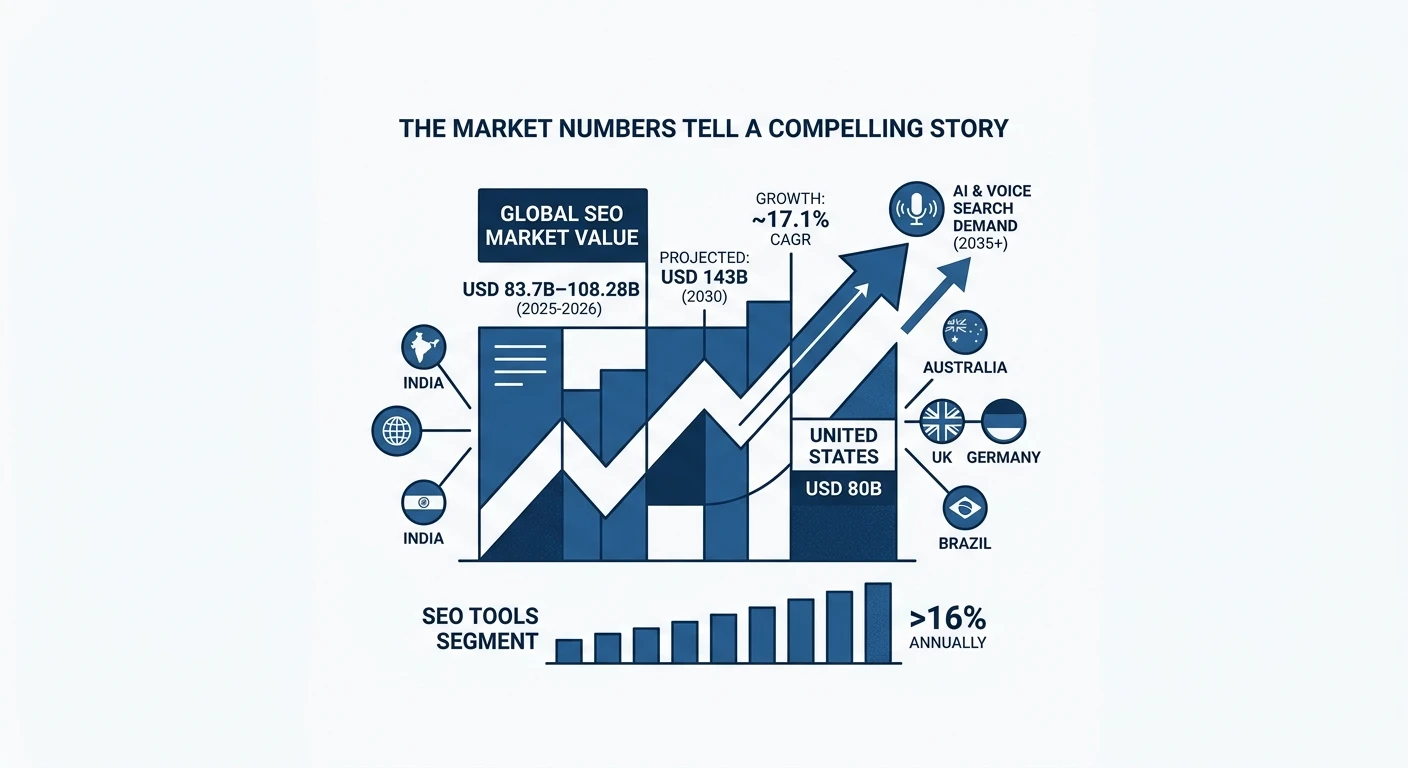
The global SEO services market was valued at approximately USD 83.7–108.28 billion in 2025–2026, depending on methodology and scope. By 2030, projections place the market at USD 143 billion, growing at a CAGR of approximately 17.1%. Some more aggressive forecasts push the 2035 value significantly higher as AI-driven search and voice search create entirely new demand for SEO expertise.
The United States is the single largest SEO market, worth an estimated USD 80 billion on its own. This makes sense when you consider that American businesses collectively spend more on digital marketing than any other country, and search visibility is the primary battleground for that spend. But international markets are growing faster — India, Australia, the UK, Germany, and Brazil all have rapidly expanding SEO services industries as their local digital economies mature.
The SEO tools segment specifically — platforms like Semrush, Ahrefs, Moz, and Surfer SEO — is growing at over 16% annually, reflecting the increasing professionalisation of SEO as a discipline. These tools represent both an affiliate opportunity in themselves (many of them run highly lucrative affiliate programs) and an indicator of how seriously businesses worldwide are investing in organic search as a channel.
Why Organic Search Is Still King:
Despite more than a decade of predictions that “SEO is dead,” organic search remains the dominant source of website traffic across the internet. Google processes 8.5 billion searches every single day. The first position on a Google search results page captures 27.6% of all clicks, and the first page as a whole receives over 75% of all clicks — meaning three out of four searchers never even scroll to page two.
For affiliate marketers, these statistics translate directly into a fundamental truth: if your content ranks on page one, you get traffic. If it doesn't, you might as well not exist. This is why affiliate sites that invest seriously in SEO consistently outperform those that rely on paid advertising or social media traffic, which disappears the moment you stop spending or the algorithm changes.
SEO also generates an average return of 12 times the investment compared to paid advertising, according to multiple industry studies. For a channel that requires primarily time and expertise rather than ongoing per-click spend, that ROI is extraordinary. This is especially relevant for affiliate marketers who operate on tight margins and cannot afford to buy every visitor — building organic traffic through SEO means the audience compounds over time rather than evaporating when a budget runs out.
The AI Revolution Is Reshaping SEO — Not Killing It:
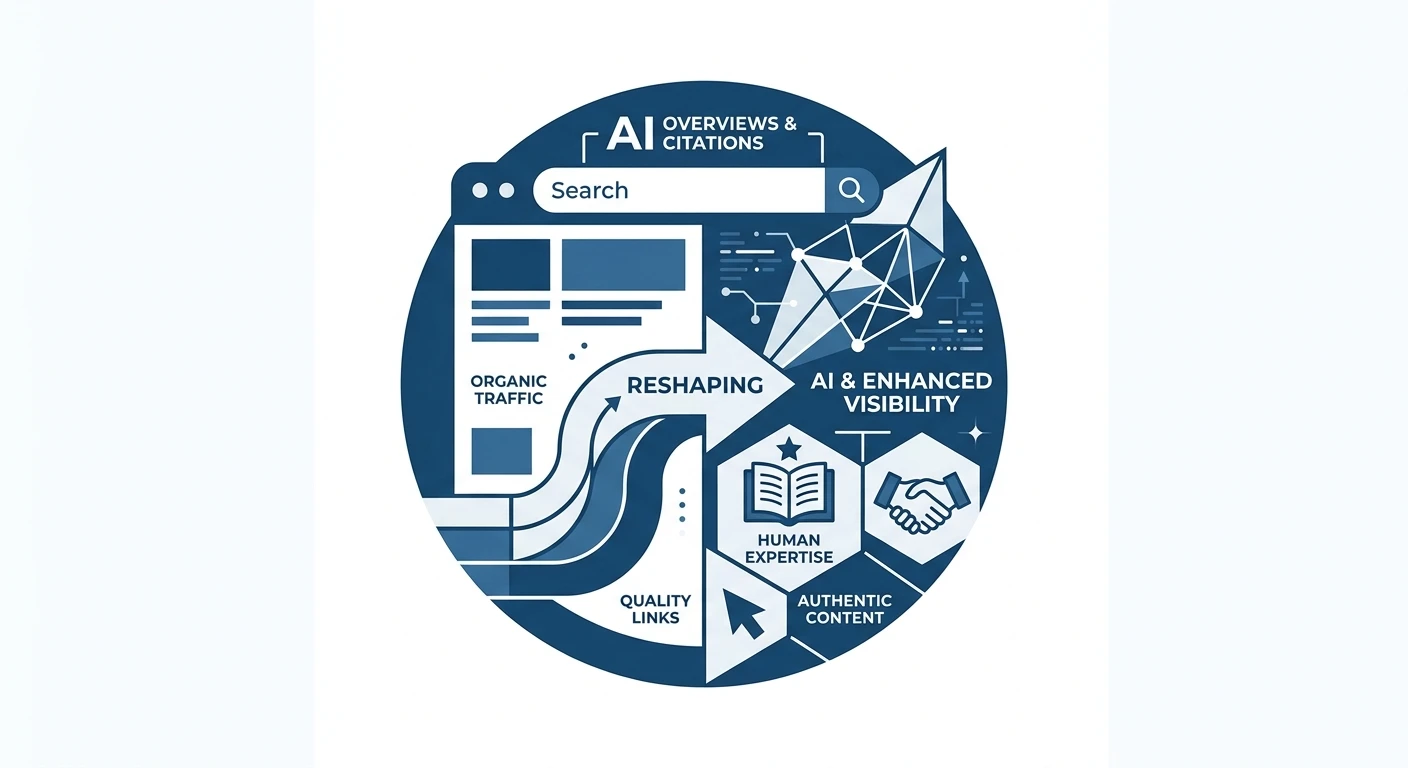
One of the most important conversations in the SEO world right now is about the impact of AI on search. Google's Search Generative Experience, AI Overviews, and competitors like Perplexity and ChatGPT Search are changing how people find information. Some marketers have panicked, interpreting AI-generated answers as a threat to organic traffic.
The reality is more nuanced and ultimately more optimistic for skilled affiliates. AI search features tend to pull content from authoritative, well-optimised pages — meaning high-quality affiliate content that demonstrates genuine expertise still gets cited and linked in AI responses. Zero-click searches are increasing, yes, but they're increasing for simple informational queries. Purchase-intent searches — exactly the kind of searches that drive affiliate conversions — still require clicks, comparisons, and reviews. The buyers doing serious research before making a purchase still click through to read the full review.
What AI is changing is the floor — the minimum quality required to rank. Generic, thin content that used to rank through sheer volume of keywords is being displaced by AI-generated content at a massive scale, which means human-authored content with genuine expertise, personal experience, and original analysis is becoming more valuable, not less. For affiliate marketers who invest in quality, this is actually good news.
Organic Traffic as an Affiliate Asset:
The reason SEO deserves a dedicated section in any affiliate marketing strategy guide is simple — organic traffic is an asset in a way that paid traffic simply isn't. When you rank number one for “best noise-cancelling headphones under $200,” that ranking generates commission every month without ongoing spend. Build enough of these rankings across enough product categories and you have a passive income machine that grows over time as you add more content and authority.
The SEO services market growing to USD 143 billion by 2030 is a direct reflection of how valuable search visibility has become for businesses of all sizes. As a solo affiliate marketer, you are competing in the same organic search landscape as these billion-dollar enterprises — and because of your ability to be nimble, niche-specific, and deeply authentic, you can absolutely win against larger competitors in the right categories.
The affiliate marketers who consistently outperform the market are not the ones spending the most on ads. They're the ones who have built authoritative domains with hundreds of well-optimised pages targeting high-intent buyer keywords. SEO is the how, and a growing USD 108 billion market is proof that the rest of the business world agrees.
FAQs
The global SEO services market is expected to grow significantly between 2026 and 2035, with projections estimating it could surpass $200 billion as businesses increasingly prioritize organic search visibility. This growth is driven by rising digital ad costs, expanded e-commerce adoption, and the compounding value of long-term organic traffic.
SEO delivers the highest ROI for affiliate marketers because organic traffic, once established, generates clicks and commissions continuously without ongoing ad spend. Unlike paid channels, a well-ranked affiliate page can produce passive income for years, making the cost-per-acquisition dramatically lower over time.
The SEO services industry is forecast to maintain a compound annual growth rate (CAGR) of roughly 17–19% through 2035, fueled by AI-driven search changes, voice search expansion, and increasing demand from small and mid-sized businesses. This sustained growth signals strong long-term opportunity for affiliate marketers investing in SEO skills and content.
Yes, SEO remains highly effective in 2026 because AI-powered search engines like Google's AI Overviews still rely on indexed, authoritative content to generate answers. Affiliate marketers who produce expert, well-optimized content are increasingly featured in AI-generated responses, creating new organic visibility opportunities.
Affiliate marketers can absolutely compete by targeting niche, low-competition keywords within high-growth verticals rather than going head-to-head with large SEO agencies. As the market expands through 2035, demand for specialized, trustworthy content in categories like finance, health, and SaaS creates lucrative ranking opportunities for focused affiliate sites.