
Affiliate marketing is having a serious moment right now.
Not because it is new. Not because it is trending on social media. But because the numbers tell a story that is impossible to ignore — and a survey of over 1,000 active affiliates in 2026 reveals that the playbook has changed dramatically from just two years ago.
If you are still doing affiliate marketing the old way, you are probably already feeling the squeeze. This article breaks down what the data actually says, what is working right now, and where the smart money is moving.
The Big Picture: Affiliate Marketing in 2026
Let us start with the headline numbers, because they are genuinely impressive.
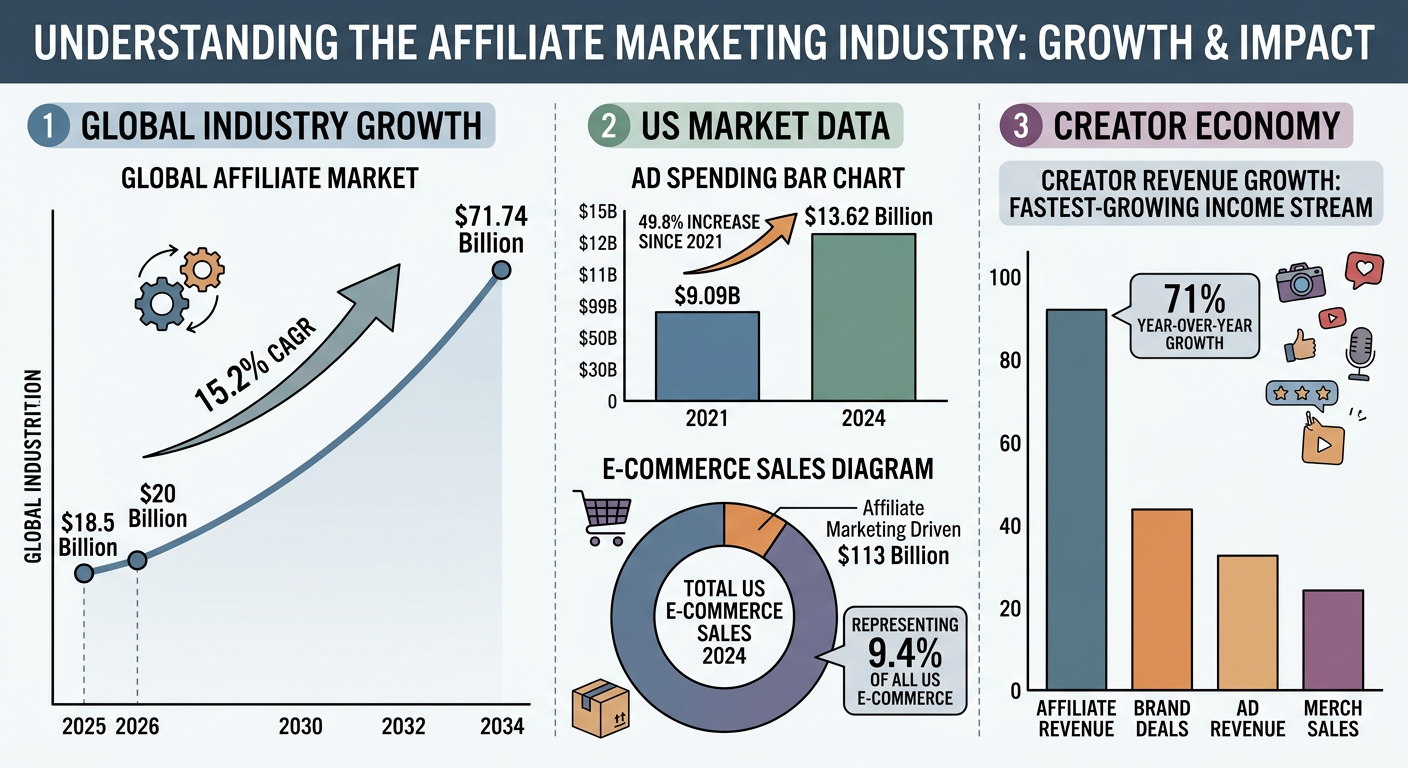
The global affiliate marketing industry is projected to exceed $20 billion in 2026, up from $18.5 billion in 2025
The industry is on track to hit $71.74 billion by 2034, growing at a 15.2% CAGR
US affiliate ad spending alone reached $13.62 billion in 2024, a 49.8% increase since 2021
Affiliate marketing drove $113 billion in US e-commerce sales in 2024, representing 9.4% of all US e-commerce
Affiliate revenue is growing at 71% year-over-year among creators, making it the fastest-growing income stream in the creator economy
These are not small numbers. This is a channel that has quietly become core business infrastructure for thousands of brands globally.
And yet, not everyone is winning. The income gap between the top affiliates and everyone else is massive.
The Income Reality: Who Is Actually Making Money
This is where things get real.
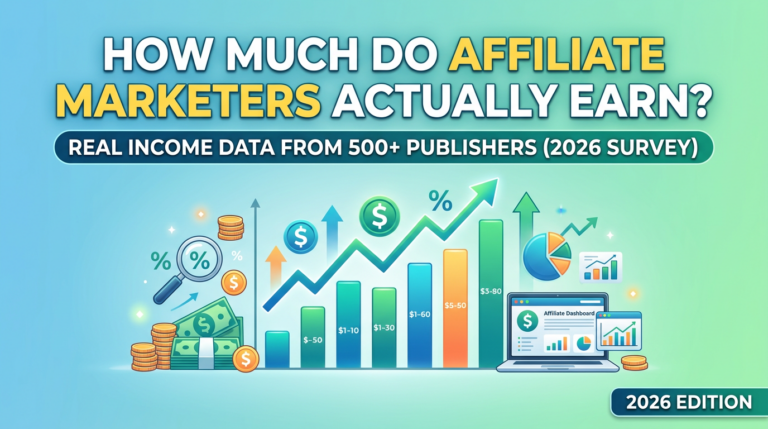
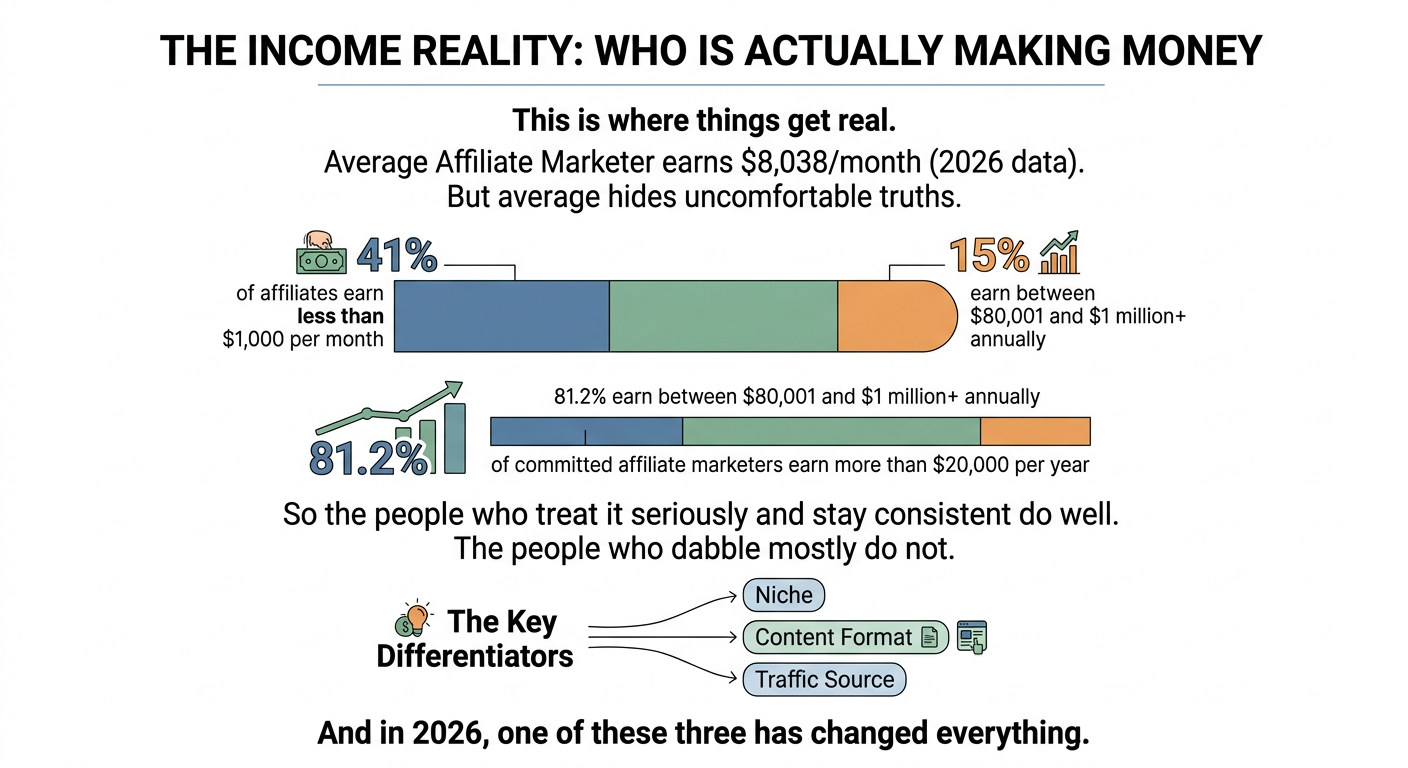
The average affiliate marketer earns $8,038 per month according to 2026 industry data. That sounds great, right? But the average hides a very uncomfortable truth.
41% of affiliates earn less than $1,000 per month
15% earn between $80,001 and $1 million or more annually
81.2% of committed affiliate marketers earn more than $20,000 per year
So the people who treat it seriously and stay consistent do well. The people who dabble mostly do not.
The key differentiator is not which affiliate network you use. It is your niche, your content format, and your traffic source. And in 2026, one of these three has changed everything.
What Is Actually Working: The Top Findings From 1,000+ Affiliates
1. Video Has Taken Over and There Is No Going Back
This is the single biggest shift in affiliate marketing right now.
Video content is projected to drive 55% of all affiliate traffic in 2026. That means if you are relying purely on blog content, you are competing for roughly half the market that video affiliates are accessing.
YouTube and TikTok are the dominant platforms. But TikTok Shop is the one genuinely disrupting everything. TikTok Shop US e-commerce sales are projected to hit $23.4 billion in 2026, a 48% year-over-year increase. Commissions on TikTok Shop range from 5% to 20% per sale, and creators are earning directly inside the platform without needing a website, a funnel, or a mailing list.
What is working for video affiliates right now:
Short-form product reviews under 60 seconds
“Does this actually work?” style testing videos
Comparison videos between two competing products
Unboxing and first-impression videos that feel authentic, not scripted
The affiliates seeing the best results in 2026 are combining short-form video on TikTok and Instagram Reels with longer YouTube reviews for the same products. You get the discovery traffic from short-form and the conversion traffic from YouTube. It is a one-two punch that is extremely hard to beat.
2. Bloggers Are Not Dead. They Just Had to Evolve
Yes, Google's algorithm updates and AI Overviews have caused real pain for SEO-focused affiliates. 69% of publishers in 2026 say they are concerned that Google algorithm changes and AI Overviews are reducing their traffic and affiliate revenue.
But bloggers still capture 40% of all publisher commissions globally. That is not a dead channel. That is a channel under pressure that still works when done right.
What has changed is the type of content that works. Generic “best of” listicles are dying. What is growing:
Deep, experience-based reviews where the author has actually used the product for months
Comparison articles that go 10 levels deeper than any AI-generated answer can
Problem-solving content tied to specific buyer situations, not just product features
Email newsletters tied to blog content, so you own your audience instead of renting it from Google
52% of publishers in 2026 say they are actively experimenting with new forms of promotion to reduce their dependence on search traffic alone. The ones who are winning are building email lists, YouTube channels, and community platforms alongside their blogs.
3. Niche Selection Is the Most Important Decision You Make
The data on this is crystal clear. Your niche determines your ceiling more than almost any other factor.
Here is the monthly earnings breakdown by niche in 2026:
Niche | Average Monthly Earnings |
E-learning | $15,551 |
Travel | $13,847 |
Finance | $9,296 |
SaaS and Software | $7,000 to $12,000 |
Fashion | $3,000 to $6,000 |
Retail and E-commerce | $2,000 to $5,000 |
That is a 6x difference between the top niche and the average. And the reason is simple: e-learning, finance, and SaaS products have high price points, strong recurring commissions, and buyers who are actively researching before they spend.
SaaS affiliate programmes are particularly attractive right now because they pay 20% to 50% recurring commissions. Every customer you refer keeps paying you every single month they stay subscribed. That is compounding income, and it is a completely different model from earning a one-time retail commission.
4. AI Is Changing How Affiliates Work, Not Just What They Write
Almost every affiliate surveyed in 2026 is using AI in some part of their workflow. But the most successful ones are not just using AI to write more blog posts. They are using it strategically:
Research and keyword clustering at scale using AI tools to find hundreds of low-competition buyer intent keywords
Personalised content at scale where AI helps them produce product-specific landing pages for dozens of variants without hiring a full team
AI-assisted video scripts that match the tone and format proven to convert on each platform
Automated email sequences triggered by affiliate link clicks that nurture leads who did not convert on the first visit
The affiliates who are losing with AI are the ones who use it to churn out generic content faster. Google detects it. Readers bounce from it. And conversions tank.
The ones winning are using AI to do more of the strategic work faster, not to replace the human expertise and genuine experience that actually builds trust.
5. Email Lists Are the Comeback Channel of 2026
With search traffic more volatile than ever and social reach increasingly pay-to-play, email has quietly become one of the highest-performing affiliate channels again.
Here is why it makes sense: you own your list. No algorithm can take it away from you.
Affiliates who pair a well-segmented email list with their content are seeing:
Higher click-through rates than social or search-referred traffic
Significantly better conversion rates because the audience already trusts them
The ability to promote time-sensitive offers (like flash sales and limited deals) directly to warm subscribers
The strategy that is working right now is giving something genuinely valuable away for free in exchange for an email address, such as a comparison guide, a free tool, or a short course, and then building a regular newsletter around the niche before recommending products.
6. The Platforms Paying the Most in 2026
Not all affiliate programmes are equal, and the survey data reflects some clear winners in terms of where affiliates are focusing their energy:
Amazon Creator Connections grew from 30,000 to 125,000 active campaigns between January and April 2025, with brands layering an extra 10% to 50% commission on top of the standard Associates rate. Some categories are now earning 15% to 20% total.
TikTok Shop is paying 5% to 20% commission with zero infrastructure required
SaaS programmes through networks like PartnerStack, ShareASale, and Impact continue to deliver the highest lifetime value per referral
Finance programmes paying $50 to $200 per qualified lead remain extremely lucrative but competitive
The biggest mistake affiliates make is chasing the highest CPA number. Publishers who have been doing this for years consistently say that earnings per click (EPC) and funnel reliability matter more than the headline commission rate. A programme paying $200 per lead but converting at 1% is often worse than a programme paying $80 per lead that converts at 5%.
What Is Not Working Anymore
To be balanced, here is what the survey data says affiliates have stopped doing or are pulling back from:
Thin review content written about products the affiliate has never personally used
Mass-publishing AI-generated articles without any original perspective or experience layered in
Relying on a single traffic source, especially organic Google search alone
Promoting high-commission products with terrible conversion rates just for the payout number
Ignoring mobile, where over 65% of affiliate clicks now originate
The One Number That Sums Up 2026
Of all the statistics in this report, this is the one that matters most for anyone thinking about getting into affiliate marketing or scaling their existing income:
81.2% of affiliate marketers who stick with it earn more than $20,000 per year.
The industry is not saturated. The barrier is not the platform or the niche or even the competition. The barrier is the consistency and the willingness to adapt to what the data is showing right now, specifically video-first content, niche depth over breadth, email list ownership, and AI as a productivity tool rather than a content replacement.
Affiliate marketing in 2026 is not easy. But for those who do it right, it is one of the most scalable and measurable ways to build income online.
Key Takeaways
The global affiliate marketing industry exceeds $20 billion in 2026 and is growing at 15.2% CAGR
Video drives 55% of all affiliate traffic; TikTok Shop alone is heading for $23.4 billion in US sales
E-learning affiliates earn the most at $15,551 per month on average; SaaS pays the best recurring commissions at 20% to 50%
69% of publishers are worried about Google and AI Overviews cutting their traffic; diversification is now essential
81.2% of committed affiliates earn over $20,000 annually; the income gap is about consistency and niche selection
Email lists, owned audiences, and platform diversification are the biggest strategic priorities for 2026
Is affiliate marketing still worth starting in 2026?
Yes, affiliate marketing is still worth starting in 2026. The industry is growing at over 15% annually and is projected to exceed $20 billion this year, though success requires a long-term commitment to a specific niche and a diversified traffic strategy.
What niche makes the most money in affiliate marketing in 2026?
E-learning, SaaS and software, and personal finance consistently deliver the highest earnings per month for affiliates in 2026. While fashion has the highest volume of programmes available, its average commissions are significantly lower than these three categories.
How long does it take to start making money with affiliate marketing?
Most affiliates take between 6 and 12 months to see meaningful income. The 41% of affiliates earning under $1,000 per month are typically either in their first year or have not yet committed to a focused niche and consistent content strategy.
Can you do affiliate marketing without a website in 2026?
Yes, you can do affiliate marketing without a website in 2026, with TikTok Shop, YouTube, and email newsletters all working as viable standalone channels. However, combining a website with video content and an email list provides the most stable and resilient long-term income.
Why do so many affiliates struggle with traffic in 2026?
Traffic volatility caused by Google algorithm updates and the rise of AI Overviews is the top challenge for affiliates, cited by 69% of publishers in a survey of over 1,000 affiliates. Building owned audiences through email lists and video content is the most effective way to reduce dependence on search traffic.