
Something remarkable happened to online shopping between 2020 and 2026. It moved from dedicated e-commerce websites into the social media apps where people spend most of their screen time. Shopping no longer requires opening a browser and navigating to a store. It happens while scrolling through a TikTok feed, watching an Instagram Reel, or browsing Facebook. This is social commerce — and in 2026 it is a USD 2.6 trillion global market growing at 26.2% per year, on its way to USD 8.5 trillion by 2030 and USD 32.72 trillion by 2035. For affiliate marketers, this is the most important structural shift in consumer behaviour to understand right now.
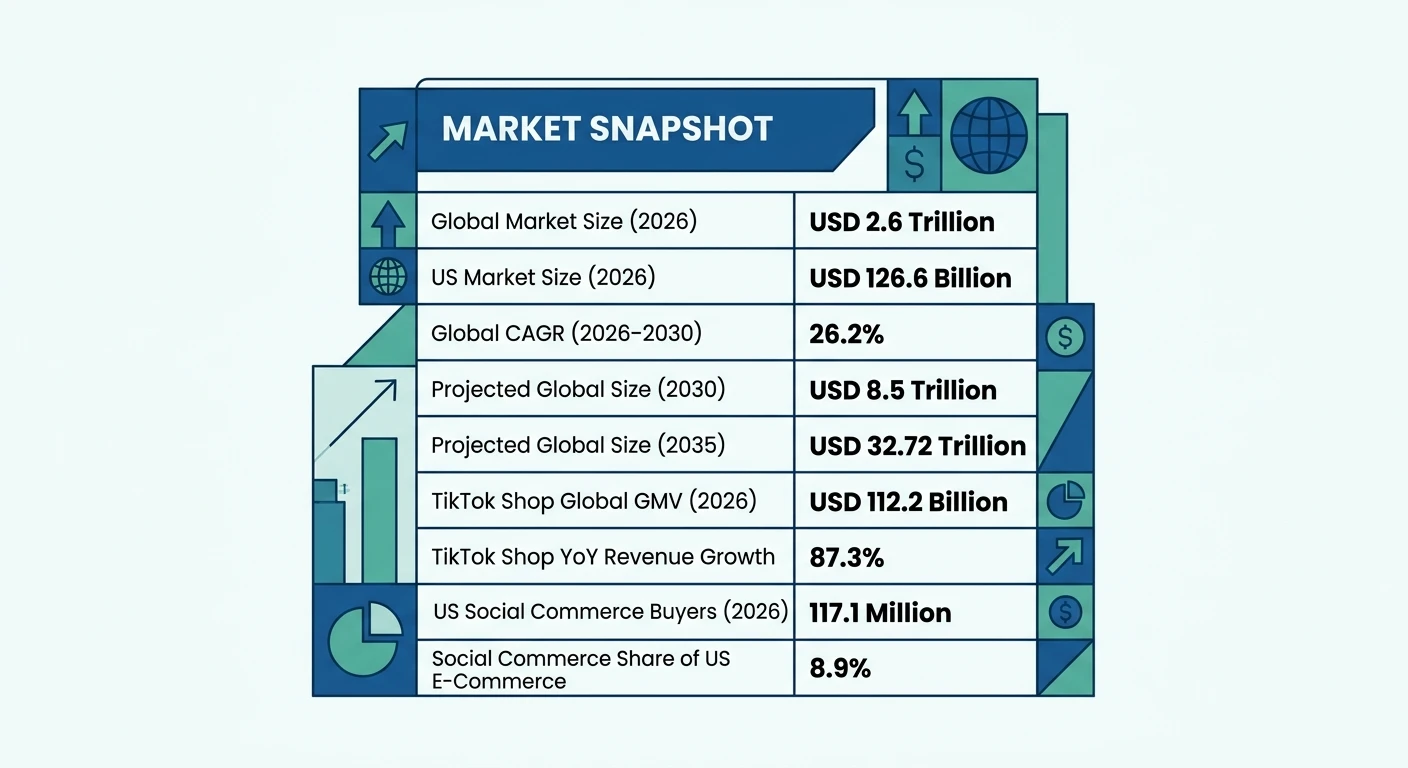
📊 Market Snapshot
Metric | Value |
Global Market Size (2026) | USD 2.6 Trillion |
US Market Size (2026) | USD 126.6 Billion |
Global CAGR (2026–2030) | 26.2% |
Projected Global Size (2030) | USD 8.5 Trillion |
Projected Global Size (2035) | USD 32.72 Trillion |
TikTok Shop Global GMV (2026) | USD 112.2 Billion |
TikTok Shop YoY Revenue Growth | 87.3% |
US Social Commerce Buyers (2026) | 117.1 Million |
Social Commerce Share of US E-Commerce | 8.9% |
The Scale of Social Commerce in 2026
The numbers behind social commerce in 2026 are staggering. The global market stands at USD 2.6 trillion — larger than the GDP of most countries. In the United States alone, 117.1 million people are social commerce buyers, representing 33.5% of the entire population. That is a 46.5% increase since 2020 when the count was 79.9 million. The average American social buyer currently spends around USD 650 per year through social platforms, and that figure is projected to rise to USD 1,223 by 2027 — nearly doubling in two years.
Social media has also become the dominant product discovery channel. 82% of shoppers now use social media to research products before buying. YouTube leads for product research at 52%, followed by Facebook at 45%, Instagram at 38%, and TikTok at 34%. Critically, 58% of US shoppers have already made a purchase directly after seeing a product on social media. Shopping is now the main reason 27% of people use social platforms, and 69% of shoppers report making ambient purchases — buying something while doing something else entirely, like scrolling through videos.
Year-by-Year Market Growth
Year | Global Market | US Market |
2023 | USD 1.3 Trillion | USD 82.2 Billion |
2024 | USD 1.6 Trillion | USD 97.1 Billion |
2025 | USD 2.0 Trillion | USD 114.7 Billion |
2026 | USD 2.6 Trillion | USD 126.6 Billion |
2027 | USD 3.3 Trillion | USD 139.8 Billion |
2028 | USD 4.1 Trillion | USD 154.3 Billion |
2030 | USD 8.5 Trillion | USD 188.3 Billion |
The TikTok Shop Story
No single development has reshaped social commerce more dramatically than TikTok Shop. Launched broadly in 2023 and scaled aggressively through 2025 and 2026, TikTok Shop has achieved a global GMV of USD 112.2 billion in 2026 — up from USD 66 billion in 2025, representing a 70% year-over-year increase. Its affiliate conversion rate of 4.7% is the highest of any social commerce platform, and its 87.3% year-over-year revenue growth makes it the fastest-growing major commerce platform on earth.
In the US, more than 80.4 million people use TikTok Shop, making it the third-largest social commerce platform by spending. By 2027, around 91 million US users — more than three-quarters of TikTok's entire US audience — are expected to shop through the platform. For affiliate marketers in consumer product categories, this is not a platform to explore eventually. It is a channel that is producing results right now, with conversion rates that outperform traditional e-commerce.
What makes TikTok Shop structurally different from earlier forms of affiliate marketing is the elimination of friction between content and purchase. A viewer watching a skincare tutorial does not need to open a browser, search for the product, find the affiliate link, and check out on a separate website. They tap a product tag in the video, confirm with Face ID, and it is done. This compression of the purchase journey is why TikTok Shop converts at 4.7% — more than twice the industry average for e-commerce.
Platform Breakdown
Facebook remains the most widely used social commerce platform in the United States in terms of absolute user numbers. Over 280 million people interact with Facebook Shops every month, and one million users make purchases directly through the platform monthly. Some brands report generating 66% more revenue through Facebook Shops than through their own websites. The average US user spends around 20 hours per month on Facebook, giving brands significant exposure time.
Instagram occupies the sweet spot between aspiration and action, particularly in fashion, beauty, and lifestyle. Shoppable posts, product tags, and the creator collaboration feature have turned Instagram into a discovery and consideration engine that drives significant purchase intent. 38% of US social media users turn to Instagram for product research, and the platform's visual nature makes it especially effective for high-consideration purchases where aesthetics matter.
YouTube provides something that short-form platforms cannot: depth and longevity. A well-produced product review on YouTube can rank in search results and drive affiliate commissions for years after publication. 52% of social media users turn to YouTube first for product research — the highest of any platform — because long-form content allows for the kind of detailed, trustworthy evaluation that informs high-ticket purchases.
Pinterest rounds out the picture with a uniquely high-intent audience. 60% of Pinterest users say they use the platform for shopping inspiration, and the platform's product discovery model is built around purchase intent from the ground up. For affiliates in home, fashion, DIY, and food categories, Pinterest affiliate pins generate passive, long-tail traffic that compounds over time.
Key Statistics at a Glance
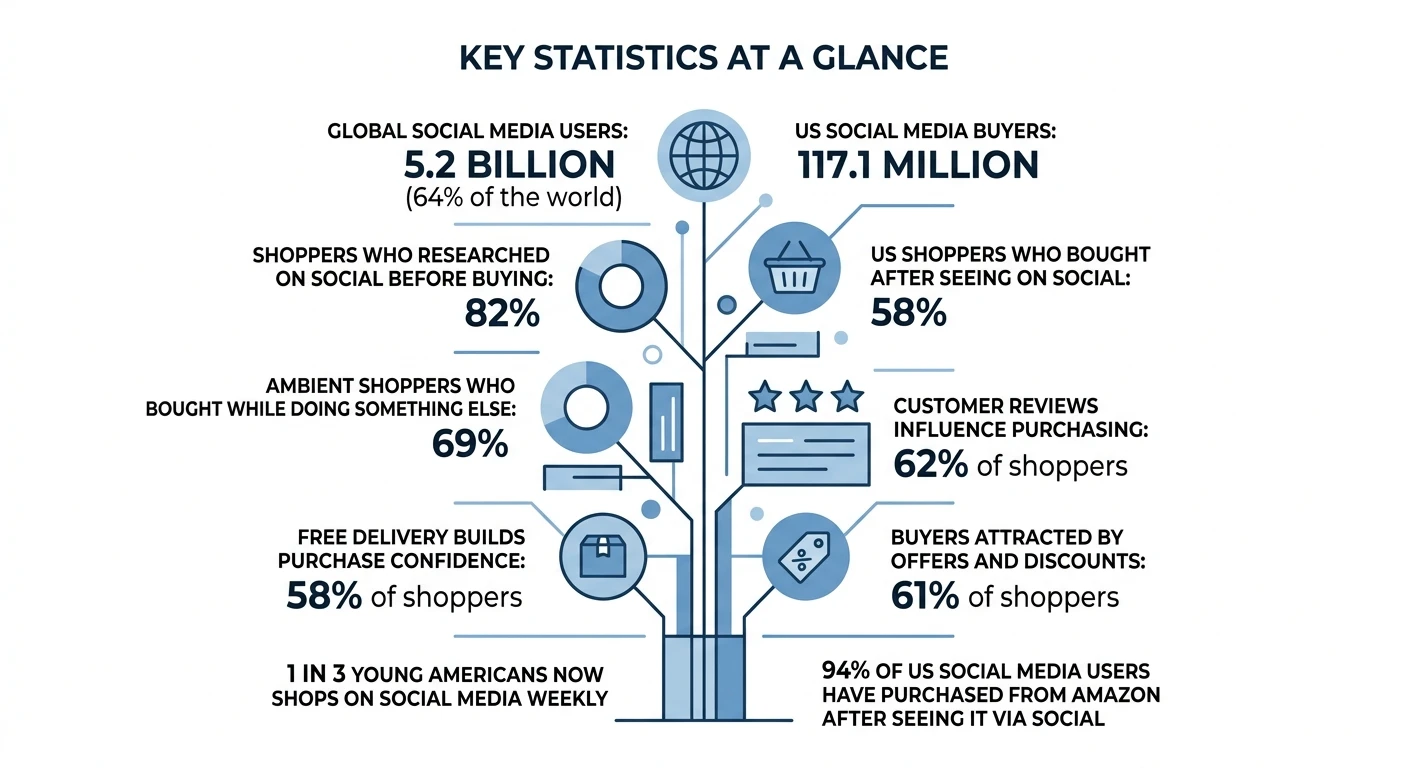
Global social media users: 5.2 Billion (64% of the world)
US social media buyers: 117.1 Million
Shoppers who researched on social before buying: 82%
US shoppers who bought after seeing on social: 58%
Ambient shoppers who bought while doing something else: 69%
Customer reviews influence purchasing: 62% of shoppers
Free delivery builds purchase confidence: 58% of shoppers
Buyers attracted by offers and discounts: 61% of shoppers
1 in 3 young Americans now shops on social media weekly
94% of US social media users have purchased from Amazon after seeing it via social
Demographics: Who Is Shopping on Social
The social commerce buyer in the US is not exclusively young. While the 25 to 34 age group is the largest segment at 23.1% of all social buyers, and 18 to 24 year olds account for 16.8%, the 45 to 64 demographic collectively represents nearly a quarter of all social commerce purchases. Even the 65 and over group has reached 9.6% of social buyers. This matters enormously for affiliate marketers because it means social commerce is no longer a channel only for reaching younger consumers — it is a mainstream shopping behaviour across all age groups.
The gender picture is also shifting. Men are now among the most likely ambient shoppers, with 75% having made a purchase while doing something else on social media. This contradicts the historical assumption that social commerce is primarily a female-dominated behaviour.
What Is Driving This Growth
The social commerce boom is being driven by four converging forces. Mobile-first internet access has put powerful shopping capabilities in everyone's pocket, making purchase decisions more impulsive and immediate. In-app purchasing removes the friction that historically caused cart abandonment between social discovery and e-commerce checkout. Influencer trust converts social content into purchase intent at rates that display advertising cannot match. And AI personalisation ensures that the products shown to each user are increasingly relevant to their demonstrated interests and behaviours.
Live shopping events represent the next frontier and are already showing remarkable results. Two in three global shoppers express interest in live shopping — interactive real-time events where creators demonstrate products, answer questions, and offer exclusive deals. Conversion rates from live shopping are 2.8 times higher than from static posts. In China, live commerce is already the dominant retail format. The US and Europe are following rapidly.
What This Means for Affiliate Marketers
Social commerce is transforming affiliate marketing's distribution landscape in real time. The traditional model — write a blog post with affiliate links and wait for Google traffic — is still valid and important, but it now exists alongside a social commerce layer that can drive massive conversion in hours rather than months. For AffiliateBooster.com readers, the strategic priorities are clear. Build a TikTok Shop presence in your niche before the competition matures. Create shoppable content on Instagram and Pinterest for categories with high visual appeal. Use YouTube for trust-building reviews that drive long-term affiliate income. And always orient your content around the factors that drive social purchase confidence — authentic reviews, clear social proof, and transparent recommendations.
FAQs
The social commerce market is expected to reach hundreds of billions of dollars by 2035, driven by the rapid integration of shopping features into platforms like Instagram, TikTok, and Pinterest. Continuous growth in mobile internet usage and influencer-driven purchasing behavior are key contributors to this expansion.
The social commerce market is anticipated to grow at a robust compound annual growth rate (CAGR) during 2026–2035, with estimates often ranging between 25% and 35% depending on the region and platform adoption rates. Asia-Pacific, particularly China, is expected to lead this growth trajectory.
Emerging markets are experiencing rapid social commerce growth due to increasing smartphone penetration, expanding internet access, and a large base of young, digitally native consumers who prefer discovering and buying products directly through social media. Lower barriers to entry for small businesses on these platforms also fuel adoption.
Social commerce is not fully replacing traditional e-commerce but is significantly reshaping consumer buying journeys by shortening the path from product discovery to purchase. It complements existing e-commerce by embedding transactions within social experiences, increasing impulse buying and brand engagement.
Yes, small businesses stand to gain significantly from social commerce trends as platforms increasingly offer affordable advertising tools, shoppable posts, and direct storefront features that level the playing field with larger retailers. The ability to leverage user-generated content and influencer partnerships makes it easier for small brands to reach targeted audiences cost-effectively.