
Adscend Media is our first comparison for publishers seeking explicitly permitted incentive offers. ayeT-Studios suits custom reward systems, BitLabs fits loyalty audiences and Tapjoy supports app currency rewards. RevU and AdGem are further options. Confirm the reward type and campaign rules before sending traffic.
| Best For | Comparing permitted incentive offers | Custom reward accounting | Loyalty and reward programmes |
| Reward proposition | Rewards across several task categories | Offerwall and survey integrations | Offers and surveys |
| Main Decision | Offer-specific traffic permission | Reliable credits and reversals | Reward funding and payment timing |



A visitor completes a task, earns a reward and comes back for another. That is the appeal of incentive advertising. The business only works, though, when the advertiser accepts that rewarded action and the publisher can afford to deliver the incentive.
The first question is therefore not which network advertises the biggest payout. It is whether the network supports the exact reward model you want to run.
Points inside a game, cash withdrawals and access to content are different promises. Permission for one does not automatically cover the others.
This guide compares six incentive ad networks and platforms for publishers. It focuses on campaign eligibility, reward costs, payment timing and the work involved in running the system. The recommendations use official information, not invented earnings tests.
Best incentive ad networks: Quick comparison
Compare the best incentive ad networks based on reward options, supported platforms, integration features, payout thresholds, and earning potential to find the right solution for monetizing your app, game, or website while encouraging users to complete valuable actions.
Provider | Best fit | Reward proposition | Main decision |
|---|---|---|---|
Adscend Media | Comparing permitted incentive offers | Rewards across several task categories | Offer-specific traffic permission |
ayeT-Studios | Custom reward accounting | Offerwall and survey integrations | Reliable credits and reversals |
BitLabs | Loyalty and reward programmes | Offers and surveys | Reward funding and payment timing |
Tapjoy from Unity | App virtual-currency systems | Currency for eligible offer engagement | Value within the app economy |
RevU | A supported, SDK-free route | Offer-based rewards | Support ownership and agreement |
AdGem | Web or app reward experiences | Offerwall with several integration paths | User identity and chosen route |
These services are not permission to reward clicks on ordinary advertisements. Use only the approved format and campaign.
What is an incentive ad network?
An incentive ad network connects publishers with campaigns that permit users to receive something for completing a defined action. The incentive might be points, virtual currency or another approved benefit.
The qualifying action matters. Opening an offer does not necessarily earn a reward. A campaign may require a completed registration, a specific game milestone or another verified event.
“Incentive” describes the exchange. “Offerwall” describes a way to display the opportunities. “Rewarded video” describes a particular ad experience. These categories overlap, but they answer different questions.
Before comparing providers, write one plain sentence explaining your model: “Users complete approved tasks to earn points that can be used for X.” Send that exact description to prospective partners.
6 Best Incentive Ad Networks in detail
Explore the 6 best incentive ad networks, comparing their key features, supported reward types, integration options, payout methods, and earning potential to help you choose the right platform for monetizing your app, game, or website by rewarding users for completing specific actions.
1. Adscend Media: Best for checking incentive traffic eligibility
Adscend's traffic guidance explicitly lists incentive traffic and cash incentives on allowed offers. It also warns that general guidance is not absolute and that individual offer restrictions must be followed.
That qualification makes Adscend a useful first comparison. You can ask directly whether a campaign permits your proposed benefit, rather than assuming “CPA” means any incentive is acceptable.
Its publisher product includes several task categories and webview or API delivery.
For a new rewards site, begin with a limited set of approved activities. Keep the offer instructions close to the reward amount so users understand the exchange.
Pros
- Official guidance explicitly addresses incentive traffic.
- Multiple task categories and integration options.
Cons
- Permission varies by offer.
- Different task conditions require clear explanations.
Our verdict: Start with Adscend if your main question is whether a particular incentive model is accepted. Get campaign-level confirmation before promoting it.
2. ayeT-Studios: Best for publishers managing their own reward records
ayeT-Studios documents offer and survey APIs alongside conversion and reversal callbacks. Its reference explains how completed events and later chargebacks are communicated to publishers.
This matters when your product maintains its own points ledger. The ledger must reflect what actually happened, not simply increase whenever any notification arrives.
As a practical safeguard, store a unique transaction reference and make repeated notifications safe to process. An interrupted connection should not cause a reward to disappear or be granted twice.
Also decide how an adjustment appears to the user. A clear pending state is easier to understand than a balance that changes without explanation.
Pros
- Documented conversion and chargeback flows.
- API options for a custom reward experience.
Cons
- Your team must maintain dependable accounting.
- Custom work adds testing and support responsibilities.
Our verdict: Compare ayeT-Studios when you have developers and need control over reward records. Treat accounting as part of the product, not an afterthought.
3. BitLabs: Best for a loyalty audience with planned cash flow
BitLabs positions its offers and surveys around reward and loyalty programmes. Its billing documentation states Net-30 payments and a $100 threshold after reconciliation deductions.
The key question is when you promise to reward users compared with when you receive funds.
A publisher offering fast withdrawals may need working capital while network earnings are pending. A points programme also has costs, even if users redeem rewards later.
Build a simple forecast before launch. Estimate rewards owed, possible adjustments and the cash available to cover them. Avoid setting a generous exchange rate merely because it looks attractive next to a competitor.
Pros
- A product designed around reward-oriented audiences.
- Public guidance on payment timing and thresholds.
Cons
- Small adjusted balances can delay payment.
- Publisher cash flow may differ from user expectations.
Our verdict: Shortlist BitLabs when rewards are already part of your service. Make sure the payment cycle fits the benefits you promise.
4. Tapjoy from Unity: Best for in-app virtual currency
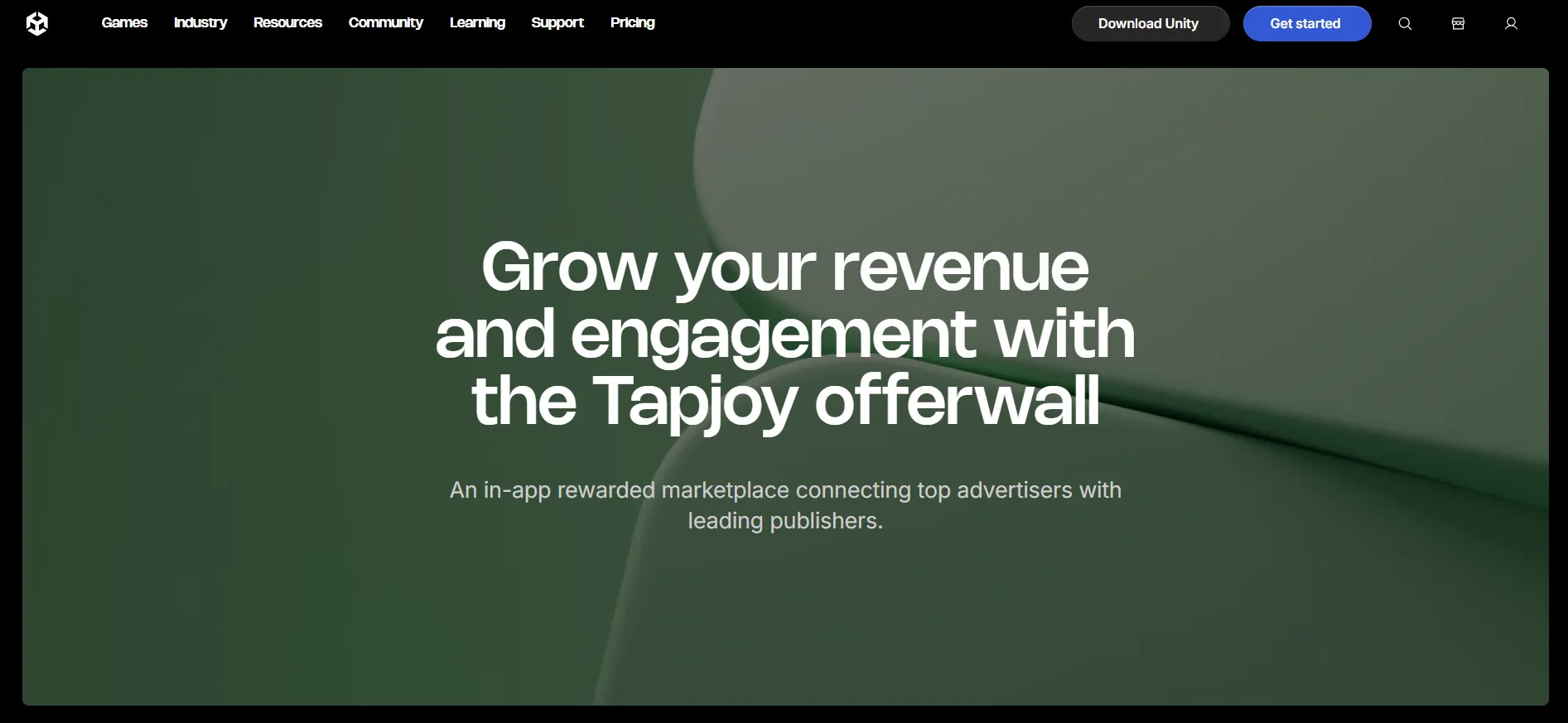
Tapjoy's offerwall lets users earn virtual currency through eligible engagement. Its setup documentation distinguishes provider-managed balances from self-managed currency, where the publisher receives callbacks and maintains the balance.
That makes it a relevant option for an app where currency already has a useful role.
Consider the reward from the player's perspective. Is it enough to make the task worthwhile? Does it fit the pace of the game? Does it create an unfair gap between people who use offers and those who do not?
These are product decisions rather than ad-placement decisions. Monitor the effect on progression, purchases and repeat visits alongside revenue.
Pros
- Explicit support for an app currency system.
- A choice of currency-management approaches.
Cons
- Reward values can affect progression and purchases.
- Implementation needs coordination with the app team.
Our verdict: Compare Tapjoy for a virtual-currency economy. Decide what the incentive should achieve inside the app before choosing its value.
5. RevU: Best for an SDK-free setup with offer support
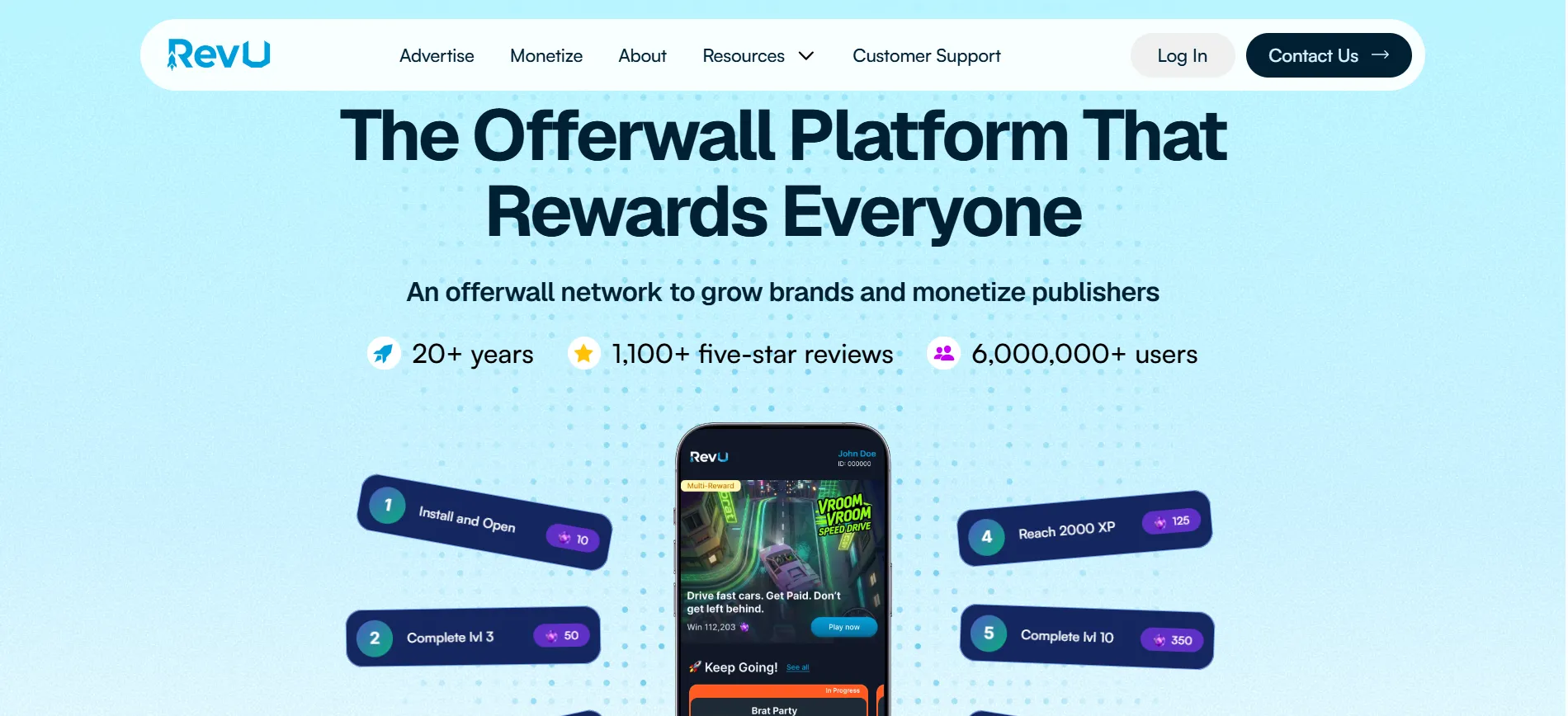
RevU describes a rewarded offerwall delivered through hosted pages, iframes or an API. Its publisher page states that its team handles offer-related support and that payment terms are agreed during onboarding.
This can suit a publisher who wants a reward partner without adding another native SDK.
Support should be part of your evaluation. Ask what happens when a user says a task was completed but no credit arrived. Establish what your team can see and when the network takes over.
For example, a useful internal record would connect the user, offer and transaction reference without asking the person to explain the entire journey repeatedly.
Pros
- SDK-free integration routes.
- A stated role in handling offer-related support.
Cons
- A reward-notification endpoint still needs setup.
- Commercial terms must be confirmed individually.
Our verdict: Compare RevU when implementation and support workload are central concerns. Clarify the handoff before inviting users to start tasks.
6. AdGem: Best for matching the reward system to your platform
AdGem documents web, mobile SDK and API routes. Its core concepts explain how a publisher user identifier links activity with postbacks so the correct person can be rewarded.
That makes it useful when your product spans several environments or you are still deciding how much of the interface to build.

Test account continuity. If someone begins an activity while logged in and returns later, your system should be able to identify the same account without relying on guesswork.
A custom interface can improve the experience, but only if your team keeps task requirements and reward information accurate. Otherwise, a simpler supported integration may be the better choice.
Pros
- Several documented delivery routes.
- Guidance connecting users with reward notifications.
Cons
- More customisation means more maintenance.
- Incorrect identity mapping can cause reward disputes.
Our verdict: Shortlist AdGem when platform fit is the main decision. Choose the integration your team can support reliably after launch.
Can you reward users with cash or gift cards?
Only where the applicable provider and campaign permit that reward. Never assume that support for virtual currency also permits cash, gift cards or points that can be converted into money.
The distinction is visible in official policies. Adscend lists cash on allowed offers. Google's policy for Google-served rewarded ads prohibits direct monetary rewards, including cash, cryptocurrency and gift cards. It also sets conditions for permitted non-monetary rewards.
Those are different rules for different arrangements. Neither should be applied to every network on this list.
Describe the complete redemption path when asking for approval. Calling a reward “coins” does not explain whether users can turn those coins into cash.
Keep a written record of the approved model and recheck it when adding a new campaign type.
How do you calculate incentive advertising profit?
Start with accepted revenue, then subtract the cost of rewards, reversals not already deducted, payment fees and operating work. A large reward budget can increase activity while reducing what the publisher keeps.
Consider this hypothetical monthly example:
Advertiser earnings before adjustments: $1,000.
Reversed or rejected earnings: $100.
User rewards: $600.
Payment fees and support costs: $100.
The contribution is $200 before other business expenses. It is not $400 simply because rewards cost $600.
This example is not a forecast for any network.
Avoid counting reversals twice if your revenue figure is already net of adjustments. Use one consistent calculation across partners.
Then ask whether the activity creates value elsewhere. Do rewarded users return to the main product, or do they leave as soon as the reward is collected? Both groups can generate revenue, but their support needs and long-term value may differ.
What makes a useful incentive campaign test?
A useful test isolates one meaningful choice and follows results long enough to see adjustments. Start with a defined audience, a manageable set of offers and one reward structure.
Changing the network, reward rate and traffic source at the same time makes the result harder to explain.
Before launch, record:
The permitted traffic source and reward type.
The countries and devices included.
What qualifies as a completed action.
The reward cost and expected payment delay.
How complaints and reversals will be handled.
During the test, monitor completion rates, confirmed contribution and support demand. A campaign that produces slightly less revenue may still be preferable if users understand it and fewer rewards need investigation.
Do not manufacture live completions to test tracking. Use the provider's approved testing process.
How should you prevent missing-reward disputes?
Clear conditions and good records are the starting point. Tell users what they must do, what they receive and which conditions could prevent qualification before they begin.
Avoid presenting a maximum possible reward as though every participant receives it for the first action. If rewards are earned in stages, show the stages.
Give users a visible way to check progress. Keep pending activity separate from available rewards where the product supports it.
For support, collect the relevant offer and transaction details. Do not promise that every complaint will result in a credit before the activity has been checked.
Finally, make sure users know who is investigating. Being passed between the publisher and the network without a clear owner is frustrating even when the underlying issue can be resolved.
Who should not use incentive advertising?
Do not add incentives when the advertiser has not permitted them or when your product cannot fulfil the promised reward.
It is also a weak fit if the main goal is to inflate visits, clicks or registrations without creating the action the advertiser agreed to buy. A high conversion count is not useful when those conversions are rejected.
For an ordinary blog, a rewards system introduces accounts, balances and support work that may be unnecessary. For an established loyalty service, those functions may already exist.
The best incentive ad networks fit the business you operate. They should not force you to build a different business just to use an ad format.
FAQs: Best Incentive Ad Networks
Adscend Media is a useful first comparison for offer-specific incentive permission. ayeT-Studios, BitLabs, Tapjoy, RevU and AdGem suit different reward and integration needs. The right choice depends on the approved reward model and the audience.
No. Incentive traffic involves real users receiving an explicitly permitted benefit for a qualifying action. Bots, fabricated activity and misleading completions are not made acceptable by calling them rewarded traffic.
Do not assume that you can. This guide concerns approved incentive campaigns and rewarded formats. Permission to use a network does not mean permission to offer rewards for ordinary ad clicks.
Often, yes. An offerwall can present tasks that users complete for rewards. The offerwall is the interface; the incentive is the benefit offered. Check each campaign's conditions rather than treating the terms as identical.
No universal instant-payment promise is established by this comparison. BitLabs publishes Net-30 terms, while RevU agrees terms during onboarding. Confirm payment schedules, thresholds, holds and adjustments directly with each provider.
Confirmed contribution after reward costs and adjustments is a useful starting point. Also track missing rewards, support costs and whether users return. Gross earnings alone can hide an unprofitable reward structure.
Quick Links:
Which incentive ad network should you choose?: Best Incentive Ad Networks
Start by defining the reward and checking permission. Compare Adscend for campaign eligibility, ayeT-Studios for custom accounting and BitLabs for loyalty-oriented activity. Tapjoy, RevU and AdGem offer further routes for app economies, SDK-free setups and platform flexibility.
Run a limited test, reconcile rewards with confirmed earnings and expand only when the economics and user experience work together.