TrafficStars, ExoClick and TrafficJunky are three ad networks that explicitly mention AI companion or AI dating advertisers in their official material. TrafficStars is our first comparison for a dedicated AI-companion offering. Choose by product approval, inventory fit and paid-user retention. None guarantees that a particular creative or offer will be accepted.
An AI companion app can attract attention without attracting the right customers. People may click because an image is interesting, then leave when they discover the product is a chatbot or that continued use requires payment.
| Best For | A category-specific campaign discussion | Comparing formats and targeting | Suitable adult-oriented inventory |
| Main Check | Product and inventory fit | Creative and destination approval | Audience and brand context |
| Features | Dedicated AI companion advertising page | Explicit casual and AI dating advertiser section | Official FAQ names AI companion offers |



That gap makes honest presentation and customer quality central to the advertising decision.
If you are searching for the best AI dating ad networks, start with a provider that actually addresses the category. General dating traffic is not enough evidence that an AI companion product will be approved.
This guide covers paid acquisition for AI companion and romantic-chat products. It does not rank matchmaking apps, affiliate programmes or tools that write messages for human dating. The recommendations use official product information, not claimed campaign tests.
3 Best AI dating ad networks: Quick comparison
Network | Why it is shortlisted | Best fit | Main check |
|---|---|---|---|
TrafficStars | Dedicated AI companion advertising page | A category-specific campaign discussion | Product and inventory fit |
ExoClick | Explicit casual and AI dating advertiser section | Comparing formats and targeting | Creative and destination approval |
TrafficJunky | Official FAQ names AI companion offers | Suitable adult-oriented inventory | Audience and brand context |
This is deliberately a short list. It includes networks with explicit category evidence rather than assuming every dating advertiser is treated the same.
What does “AI dating advertising” mean here?
Here, AI dating advertising means promoting a product where a user interacts with a virtual companion. The relationship or conversation is generated by software rather than being a match with a real person.
That should be clear in the advertisement and the destination. A simulated conversation should not be presented as a real nearby person waiting to meet.
The category also includes products with very different content boundaries. A general conversation app and an adult-oriented companion service may face different inventory and policy requirements.
Explain the full product to the network before launch. A restrained landing page does not settle the question if the actual service has features that require a different review.
3 best AI dating ad networks in detail
1. TrafficStars: Best for a dedicated AI-companion comparison
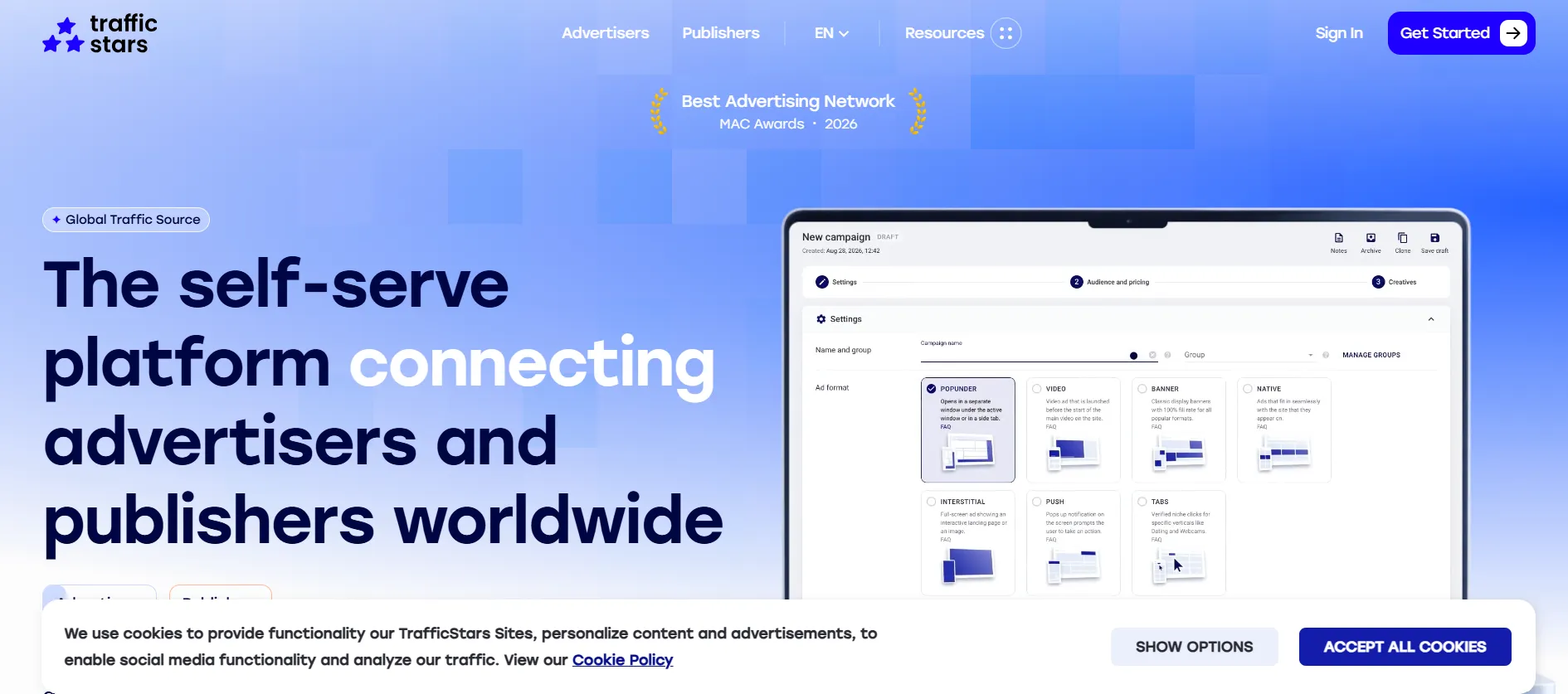
TrafficStars has a dedicated AI companion advertising page. It describes several formats, including native, banner, video, push, popunder and interstitial advertising, with targeting and campaign controls. TrafficStars AI companion advertising
This is a stronger basis for a shortlist than a generic claim that dating campaigns are welcome.
The next step is to match the placement to the product experience. A video demonstration can show the interface. A native placement may introduce the concept through a clear explanation. Either should accurately represent what a user receives.
Ask which inventory is appropriate for your content boundaries and intended adult audience. Do not treat the availability of multiple formats as a reason to enable all of them immediately.
Start with a defined acquisition event, then follow users beyond registration. If many people create an account but few complete a useful conversation or purchase, inspect the expectation set by the ad.
Pros
- Explicit AI-companion product positioning.
- Several documented formats for controlled comparisons.
Cons
- Category support does not guarantee individual campaign approval.
- Broad format testing can obscure the cause of weak results.
Our verdict: Start with TrafficStars when you want a category-specific discussion. Choose one suitable placement and measure the resulting customer journey.
2. ExoClick: Best for format and targeting flexibility
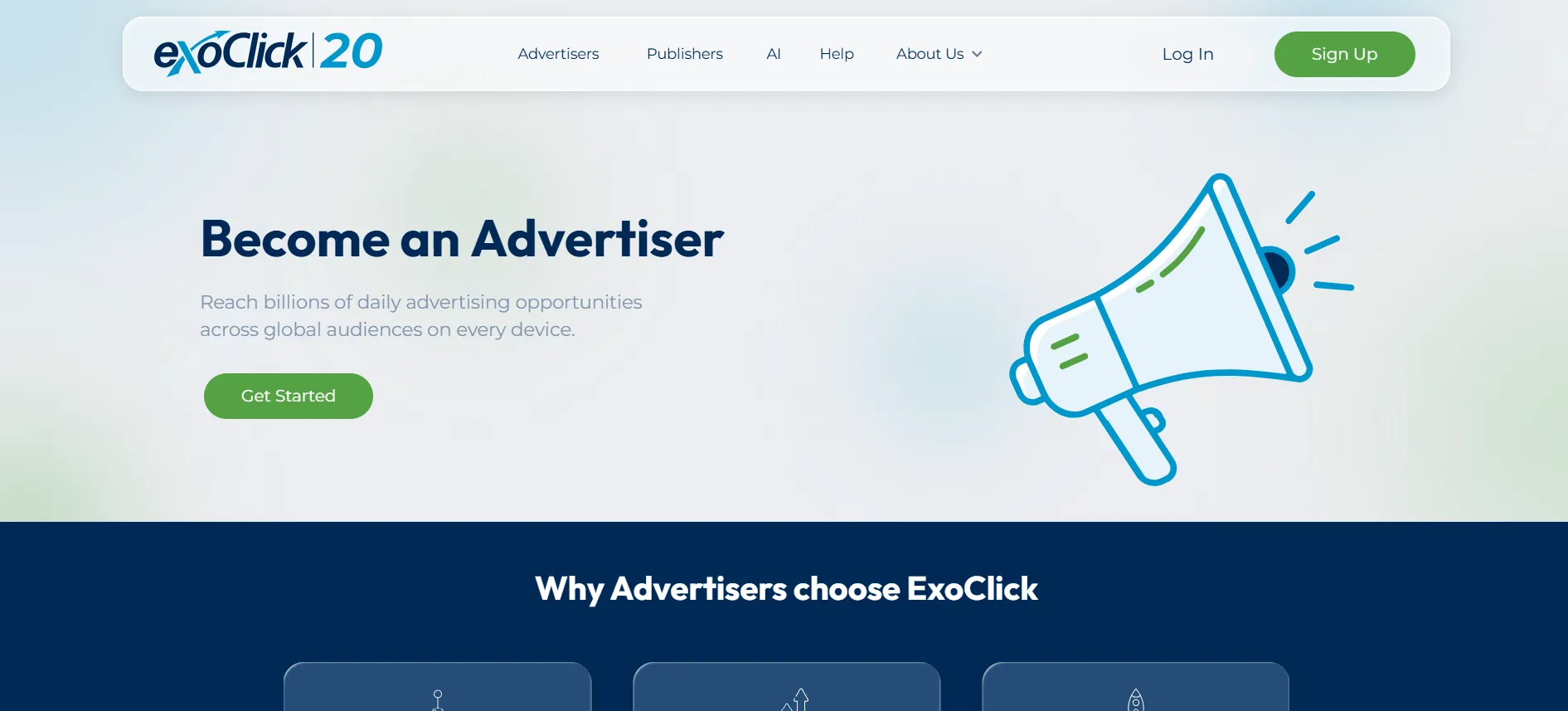
ExoClick's advertiser page explicitly addresses casual and AI dating. It also documents a broad format range and campaign-targeting tools. Its advertiser guidelines make clear that approval remains subject to review. ExoClick advertiser solutions and advertiser guidelines
That makes it a relevant comparison for an advertiser who wants to test how the offer is presented.
Think about what the visitor needs to understand before clicking. If the product offers custom characters, show that feature accurately. If it sells a subscription, do not imply unlimited free access when the free experience is limited.
Review the full path from creative to payment. A mismatch at any stage can produce registrations that never become satisfied customers.
Ask how to separate source-level results and whether the available inventory matches your brand requirements. The right audience is not simply everyone who interacts with dating content.
Pros
- Explicit AI dating relevance.
- A range of formats and advertiser controls.
Cons
- Creatives and destinations remain subject to review.
- General dating interest does not prove demand for an AI companion.
Our verdict: Compare ExoClick when you have several honest creative approaches to test. Evaluate paid-user quality rather than selecting the highest click-through rate.
3. TrafficJunky: Best for appropriate adult-oriented inventory
TrafficJunky's official FAQ names AI companion offers among the categories using its platform. It describes traffic from adult tube sites and directs advertisers to the applicable rules for product and creative eligibility. TrafficJunky advertiser FAQ
This can make it relevant for an adult-oriented companion product whose positioning fits that environment.
It is not automatically the right fit for a general-purpose chat or productivity app. Consider what users are doing when they encounter the placement and whether the product fulfils the expectation created.
Plan the creative around the actual service. A character image can attract a click, but the experience after that click needs to explain the interaction, content boundaries and pricing.
Before testing, agree what will count as a valuable customer. A free account, a paid account and a returning subscriber should remain separate in the report.
Pros
- AI companion offers are explicitly named.
- A clear description of the inventory context.
Cons
- Adult-oriented placements will not suit every brand.
- Traffic context can produce different expectations from the app itself.
Our verdict: Shortlist TrafficJunky when the product and adult-oriented placement environment match. Review eligibility and customer expectations before committing a budget.
Why are only three networks included?
The useful distinction is explicit category support. A provider can offer dating traffic without publicly establishing how it treats virtual companions, generated characters or adult features.
A longer list would not necessarily give you more viable choices.
There may be other suitable providers, but they should be assessed through a direct product review rather than assumed eligible because they advertise another dating service.
The same applies to mainstream platforms. Do not infer a universal approval or ban from someone else's rejected campaign. Review the current rules for your product, content and market.
If a network will not approve the actual destination, changing the visible label does not solve the underlying issue. Use an appropriate channel and an accurate description.
Which AI companion metrics matter beyond clicks?
Track the path from advertisement to a useful product experience and then to retained revenue.
A practical sequence is:
Landing-page visit.
Account creation.
First meaningful product use.
Trial or purchase.
Continued use and renewal.
Refund or cancellation.
Define “meaningful use” for your own product. It should represent real engagement, not an arbitrary event selected because it occurs frequently.
Keep the definition stable during a test. Otherwise, an apparent improvement may come from changing the measurement.
Avoid sending private conversation content into advertising systems as a convenient tracking shortcut. A well-defined event can describe an outcome without copying the user's dialogue.
For affiliates, reconcile tracked sales with accepted commissions. The advertiser's final decision on a payable event matters more than an early dashboard notification.
Why can cheap registrations be expensive?
A low cost per registration can hide poor conversion to paying customers.
Consider a hypothetical comparison. Campaign A spends $300 and produces 300 registrations, of which six become paying customers. Campaign B spends the same amount and produces 100 registrations, of which ten pay.
A costs $1 per registration and $50 per paying customer. B costs $3 per registration and $30 per paying customer.
The cheaper registration campaign is more expensive at the point of purchase. These figures are examples, not results from any listed network.
Even that comparison is incomplete if refund rates or retention differ. Follow the same customer groups over a consistent period before deciding which source deserves more budget.
What should an AI dating landing page say?
It should explain that the companion is AI, describe the actual experience and make the payment model understandable.
Do not leave the most important clarification until after signup. If the ad looks like an invitation from a real person, a later disclaimer does not create a coherent journey.
Useful information includes:
What users can do with the companion.
What is included in free access, if offered.
Which features require payment.
Subscription or credit conditions.
How to manage the account and obtain support.
Demonstrations should reflect the product's capabilities. Avoid presenting an edited example as a typical guaranteed response.
For adult-oriented services, the audience and access controls should be appropriate to that content. Ask the network how the relevant restrictions apply to the campaign.
How should you compare creatives?
Test different accurate explanations of the same product. A feature-led message, a short interface demonstration and a character-customisation example can reveal different reasons people are interested.
Keep the offer consistent while testing the message. If you change the price, free allowance and creative together, you will not know which change affected the result.
Judge the creative by the users it brings. A lower click-through rate may be acceptable if people arrive with a better understanding and remain customers.
Avoid messages that pressure people through loneliness, shame or claims that software can replace all human relationships. A direct explanation of the product gives you a more useful test of actual demand.
Record the winning message in plain terms. “Users responded to clear customisation examples” is more helpful than “the blue image won.”
What should you verify before scaling?
Confirm that the offer is approved, tracking is reliable and customer value is supported by observed results.
Review:
Accepted purchases or affiliate commissions.
Refunds and cancellations.
Repeat use and renewal, where relevant.
Performance by placement and device.
Customer questions that reveal misleading expectations.
The cost of serving and supporting additional users.
AI products can have meaningful usage costs. A customer who pays once and uses the service heavily may have different economics from a lighter user. Account for those costs when setting acquisition limits.
Increase the test in stages. A strong result from one placement does not prove that broader inventory will perform the same way.
Frequently asked questions: Best AI Dating Ad Networks
TrafficStars is our first comparison because it has a dedicated AI-companion advertising offering. ExoClick and TrafficJunky also explicitly name the category. Product approval and audience fit still need checking.
No. An ad network sells traffic or advertising access. An affiliate programme defines the offer and commission. An affiliate may use a network only when the programme permits the traffic source.
Do not misrepresent the product. Make clear that the interaction is with AI, and ensure the creative and landing page describe the same experience.
No universal rate is established by this comparison. Creative, price, product quality, audience and the definition of a conversion all affect results.
No. The placement context should match the actual product and intended audience. A general chat app may have a different acquisition strategy from an adult-oriented service.
Measure useful product engagement, accepted purchases and retained revenue. Keep refunds, cancellations and service costs in the calculation.
Quick Links
- 10 Best iGaming Ad Networks in 2026 (Casinos, Betting, Real Money Gaming)
- 11 Best Gambling Ad Networks in 2026 (Advertisers + Publishers, Full Picture)
- 5 Best Ad Networks for Lead Generation 2026: Beyond Cheap Leads
- 5 Best utilities ad networks
Which AI dating ad network should you choose?
Compare the three networks using the exact product you intend to promote. Ask about category acceptance, inventory context and the conversion signals you can measure.
The best AI dating ad networks bring people who understand what they are buying. Start with accurate creative, follow the customer beyond signup and scale only when retained value supports the acquisition cost.