
In mid-2024, one of my affiliate sites got hit hard by Google's Helpful Content update.
Traffic dropped 40% in two weeks. Revenue dropped accordingly.
I knew exactly why it happened. I had published 50+ articles in 2023 that were thin — written quickly, minimal personal insight, short word counts, and generic information that anyone could have copied from the product websites.
Instead of giving up on the site, I decided to run a recovery experiment: use AI to systematically rewrite every one of those thin articles.
Here is what I did, what happened, and what you can learn from it.
Why Thin Affiliate Content Gets Penalized
Let me be honest about what “thin” means in this context.
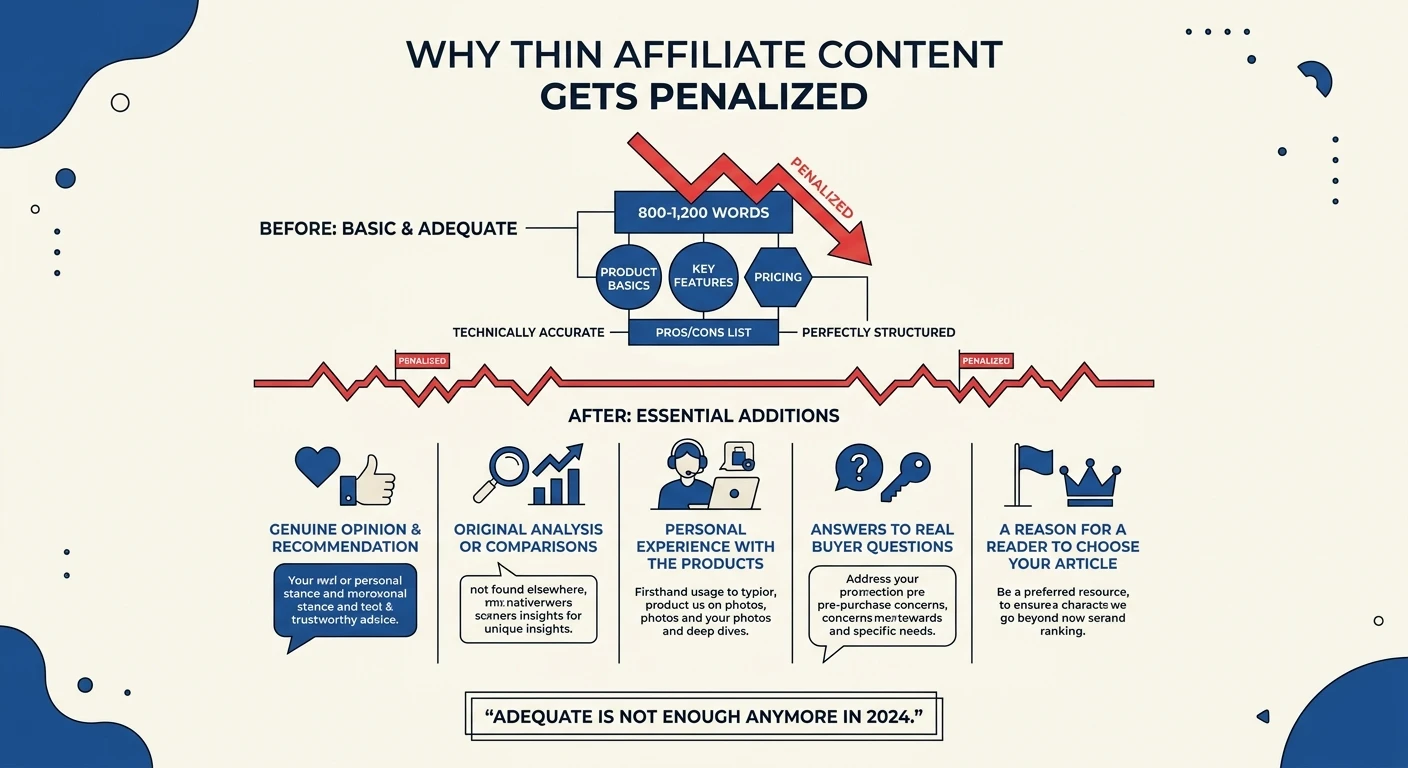
These were not spam articles. They were 800–1,200 word pieces that covered the basics of each product — what it is, key features, pricing, a pros/cons list. Technically accurate. Perfectly structured.
What they lacked:
My genuine opinion and recommendation
Original analysis or comparisons not found elsewhere
Personal experience with the specific products
Answers to the real questions buyers ask before purchasing
Any reason for a reader to choose my article over the top-ranking result
In other words: they were adequate. And in 2024, adequate was not enough anymore.
The Rewriting Strategy
I gave myself 90 days to rewrite all 50 articles.
My rewriting standard for each article:
Minimum 2,000 words (up from 800–1,200)
Must include a clearly stated personal recommendation
Must answer 3 specific buyer questions not covered in the original
Must verify and update all pricing and features
Must add a comparison with 2 alternatives
Must include original research, stats, or test data where possible
The AI-Assisted Rewriting Workflow
Here is exactly how I used Claude to execute this at scale.
Step 1: Audit the existing article.
I opened the original article and used this Claude prompt:
“Read this affiliate article about [product]: [paste article]. Identify: (1) the 3 biggest gaps compared to a fully helpful buyer guide, (2) questions this article fails to answer that a buyer would ask, (3) sections that are too thin and need more depth, (4) anything that appears outdated. Give me a prioritized improvement list.”
This audit took 5 minutes per article. It gave me a specific improvement roadmap for each piece.
Step 2: Research updates with Perplexity AI.
For each article, I ran a quick Perplexity search:
“What has changed about [product] in the last 12 months? Any pricing changes, new features, user feedback trends, or notable issues users report?”
This kept my updated articles current and addressed the specific issues real users were experiencing — which is exactly the kind of original insight Google rewards.
Step 3: Rewrite section by section with Claude.
I did not ask Claude to rewrite the entire article at once. I rewrote section by section, using this framework prompt for each:
“Rewrite this section of my affiliate article about [product]: [paste section]. Improve it by: adding more specific detail, removing generic language, making my recommendation clearer, and adding any relevant current information I provide below: [paste your Perplexity research]. Keep the reading level simple and the tone conversational.”
Step 4: Add the personal layer manually.
After each section was rewritten, I added:
A personal anecdote or specific observation about using the product
My honest take on whether the feature is actually useful or just marketing
A comparison note from my own experience testing alternatives
This personal layer is the most important part. It cannot be automated. It is what makes the article genuinely better than the competition.
The Results: 90 Days of Data
Here is what happened to the site's traffic and revenue over the 90-day rewriting period.
Month 1 (articles 1–17 rewritten):
Traffic actually dropped slightly in month 1. This is normal — Google re-evaluates pages when content changes significantly and there is often a brief dip before recovery.
Revenue: Down 12% from the already-reduced post-penalty baseline.
Month 2 (articles 18–35 rewritten):
Traffic stabilized and started showing green in Search Console. The first rewritten articles began recovering their previous rankings.
Revenue: Up 8% from month 1.
Month 3 (articles 36–50 rewritten):
Significant recovery. 31 of the 50 articles were ranking higher than they had before the penalty. 12 articles were ranking in positions they had never reached before.
Revenue: Up 47% from the post-penalty low.
90 days after completing all rewrites:
Overall site traffic up 73% from the post-penalty low
Site traffic had exceeded pre-penalty levels for the first time
Monthly affiliate revenue had surpassed the pre-penalty peak by 18%
The Articles That Recovered Best
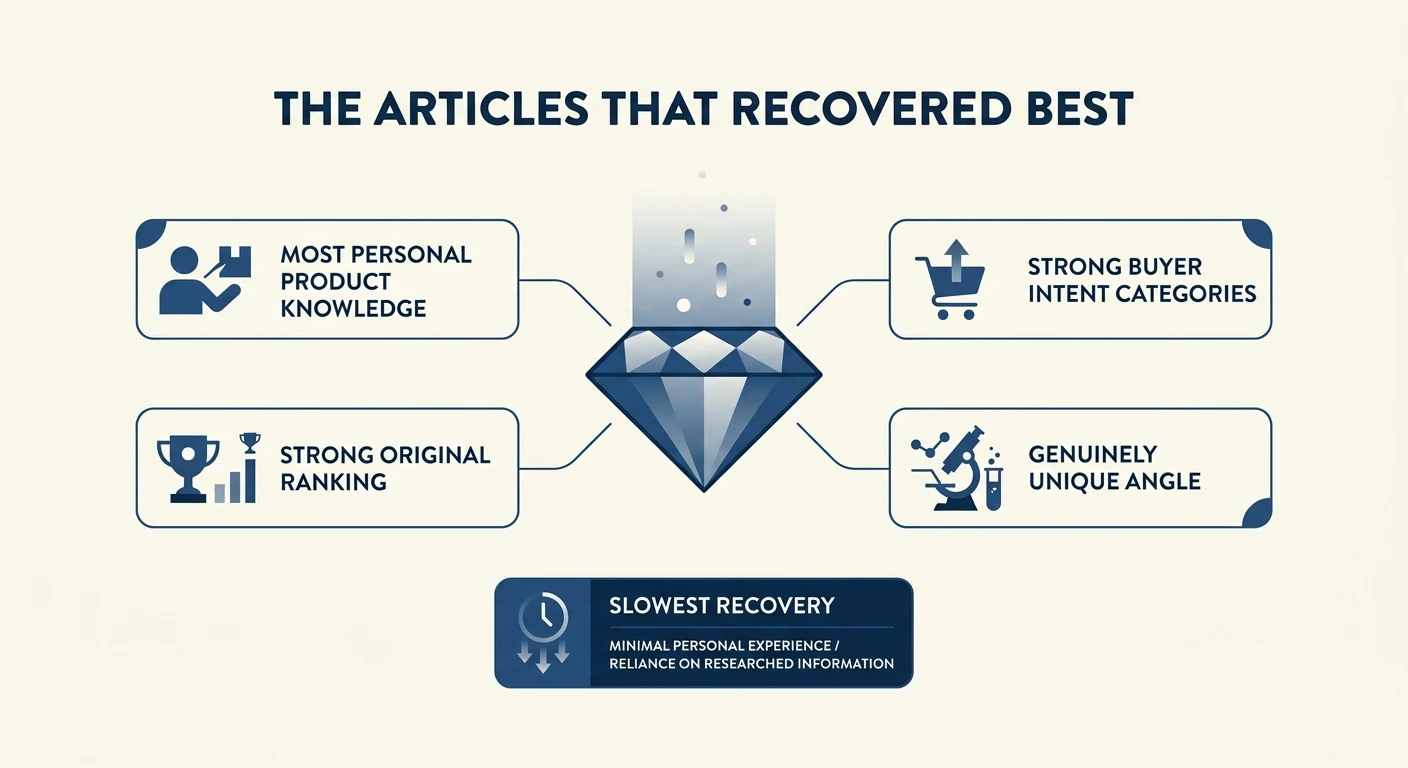
Not all 50 articles recovered equally. The pattern in the best performers:
Articles that I had the most personal product knowledge to add
Articles in product categories with strong buyer intent
Articles where the original ranking had been strong before the penalty (they remembered faster)
Articles where I added a genuinely unique angle — original test data, specific use case coverage nobody else had
The articles that recovered slowest: ones I had minimal personal experience with and where I was still relying heavily on researched-but-not-personal information.
What I Would Do Differently
Start with a content audit before the penalty. The warning signs were there. Short articles. Low engagement metrics. High bounce rates. I should have acted before Google did.
Build a regular review schedule. Every article should be reviewed and updated at minimum once per year. I now have a calendar system where every article gets a quarterly check — does the pricing need updating? Are the features still accurate? Has a better competitor emerged?
Invest more in original research. The articles with the best recovery had something the competition did not — original comparison data, test results, or specific personal observations. Going forward, I budget time for this on every article.
Conclusion
Recovering a penalized affiliate site is possible. It takes time and consistent effort, but it works.
AI tools made the 90-day rewriting project manageable. Without Claude, Perplexity, and Surfer SEO, the same project would have taken 9–12 months instead of 3.
The lesson I took from this experience: do not wait for a penalty to invest in content quality. Build content properly the first time.
FAQs
How long does Google take to recover a site after content improvement?
Based on real-world experience, expect 6–12 weeks for Google to re-evaluate and reward improved content. The timeline varies based on your site's crawl frequency, which is influenced by domain age, authority, and publishing frequency.
Is it better to delete thin articles or rewrite them?
Rewrite if the keyword is worth ranking for, and delete with a 301 redirect to a related page if the keyword has too low traffic potential to justify the investment. Leaving thin articles live without taking any action is the worst option you can choose.
How do I know which articles to prioritize when rewriting thin affiliate content?
Prioritize articles that previously ranked in positions 5–20 since they have the most recovery potential, target high buyer-intent keywords, and promote affiliate products with strong commissions. Always start where the potential revenue impact is highest.
Can I use AI to rewrite thin articles without adding any personal input?
You can, but your recovery results will likely be limited. Articles that recover fastest are the ones with genuine personal insight added, as Google can identify when content is generic versus when it reflects actual hands-on experience.
Should I submit rewritten articles to Google Search Console after updating them?
Yes, use the URL Inspection tool in Google Search Console to request indexing after each significant rewrite. This speeds up Google's re-evaluation process and can reduce your overall recovery timeline by several weeks.