
The quick version:
Huang argues the most important programming language now is plain human language.
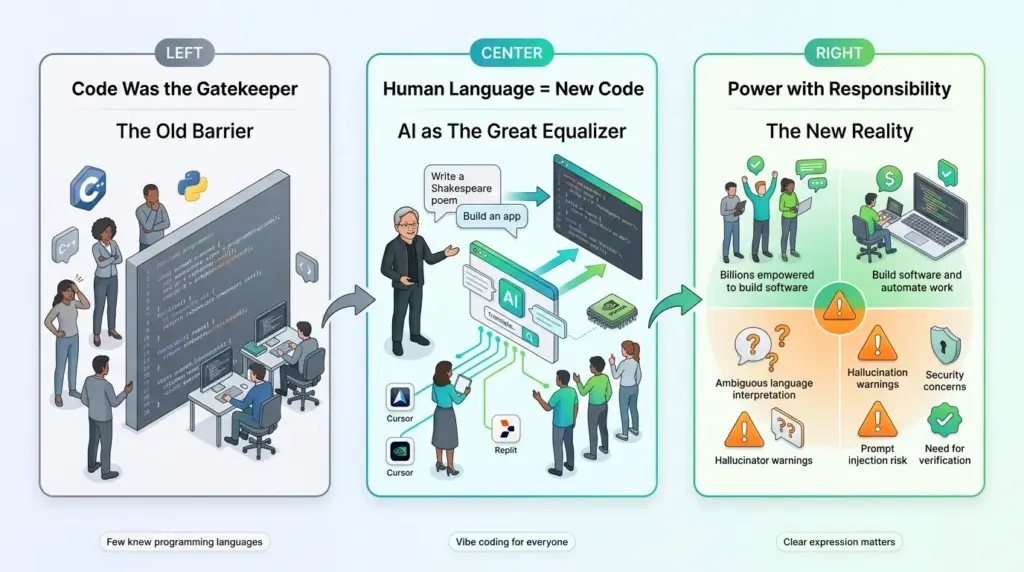
“Most people don't know C++, very few know Python, and everybody knows human,” he said.
He calls AI “the great equalizer” that lets anyone build software by describing what they want.
The core idea
Nvidia CEO Jensen Huang has been making a striking case: you no longer need to learn code to program a computer. Speaking at London Tech Week alongside UK Prime Minister Keir Starmer, he said, “Now, all of a sudden, there's a new programming language.
This new programming language is called human.” His point is that AI now understands everyday language, so the barrier that once kept computing to a trained few has effectively collapsed. You can watch his appearance here:
https://www.youtube.com/watch?v=SsNS3Xm9ig4
How it works in practice
Huang's example was simple: ask the computer to write a poem in the style of Shakespeare, and it does. Tell it the result could be better, and it reflects and tries again, just like a human collaborator.
The same applies to building apps. Tools like Cursor and Replit turn plain-English prompts into working code, a practice now widely called “vibe coding.” Even Google CEO Sundar Pichai has admitted to vibe coding a webpage. Huang frames AI as “the great equalizer,” giving billions of people, not just engineers, the ability to create software, analyze data, and automate work.
The case against
It is not all upside, and serious people have raised concerns. Human language is ambiguous: “send an email to all users” could mean active users, paid users, or everyone.
AI can misinterpret intent or hallucinate, so testing and verification still matter enormously. There is also a deeper worry that if future developers only ever prompt, they may lose the ability to understand and optimize systems at a low level, the way coding trains logical thinking. Prompt injection and security risks grow when natural language becomes the interface.
Why it matters
Huang has an obvious interest here, since more people building with AI means more demand for Nvidia's chips. But his underlying message is one he keeps repeating in different words: “You're not going to lose your job to AI, but you're going to lose it to someone who uses AI.”
Whether or not human becomes the only language that matters, the direction is clear. The valuable skill is shifting from writing perfect syntax to clearly expressing what you actually want.
Quick Links: