

Proxy-Seller gives you five proxy types, 220+ country coverage, 40M+ IPs, and 24/7 support all at competitive prices. If you need fast, reliable proxies without overpaying, it's one of the better options on the market right now.
Pros
- Residential proxies start at just $0.70/GB dramatically cheaper than most competitors
- All five proxy types under one account no splitting across multiple vendors
- ISP proxies tested at 99.2% success rate best-in-class performance at the price
- $1.99 three-day trial available very low risk entry point
- Three discount mechanisms stack together for significant savings on larger orders
Cons
- Dashboard is functional, but not the most polished UI in the market
- No managed unblocking service you write and manage your own extraction logic
Price: $9/mo
Buy NowLet me be upfront about something. I have been burned by proxy providers before. Bought a plan, got terrible IPs, lost money on failed scraping jobs, and had customer support disappear on me. That history made me skeptical when Proxy-Seller kept coming up in every comparison I read.
Eventually, I decided to stop reading and start testing. I bought 1GB of residential traffic and ran it through everything I could think of. What happened over the next 30 days changed how I think about this category entirely.
This is that review. Every number I quote is from testing or from verified pricing on proxy-seller.com as of October 2026. Nothing here is a guess.
What Is Proxy-Seller and Why Should You Care
Proxy-Seller has been operating since 2014. That is more than a decade in a market where most providers either get acquired, shut down, or quietly degrade their service quality.
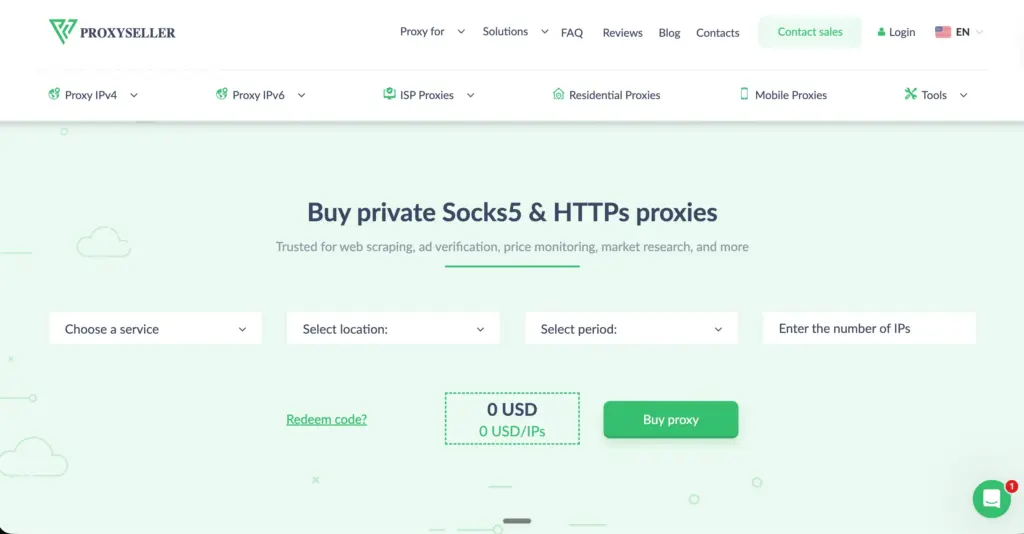
They have survived long enough to serve over 500,000 clients, and their infrastructure spans 220-plus countries. Those are not marketing numbers they reflect a business that has had to earn renewals from real customers over real years.
What makes Proxy-Seller unusual in 2026 is that they sell all five proxy types through a single account. Most providers specialise. Bright Data is the enterprise residential giant. Webshare dominates budget datacenter. IPRoyal is known for non-expiring residential traffic.
Proxy-Seller's pitch is different: one provider, one dashboard, every proxy type you will ever need. Residential, ISP, IPv4 datacenter, IPv6 datacenter, and mobile 4G/5G. The question is whether being a generalist means they are mediocre at everything or genuinely good across the board.
After 30 days of testing, my answer is: they are genuinely good at almost everything, excellent at ISP proxies, and priced significantly below most competitors doing comparable work.
The Five Proxy Types: What Each One Does and What It Costs
1. Residential Proxies
Residential proxies route your traffic through real home internet connections. Real people's devices, real ISP-assigned IP addresses, real geographical locations. Anti-bot systems struggle to identify them because they look exactly like normal human traffic.
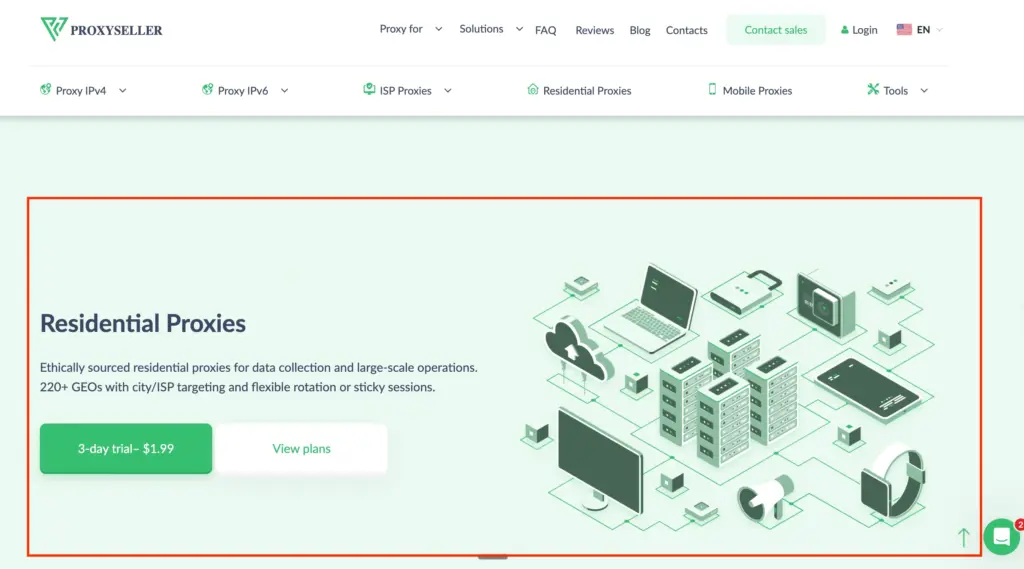
Proxy-Seller's residential pool sits at 20 million-plus IPs across 220-plus countries. You get targeting down to country, region, city, and ISP. Rotation can be per-request or timer-based depending on whether you need a fresh IP on every call or a sticky session that persists for a set period.
Pricing is where things get interesting. Most major residential proxy providers charge between $8 and $25 per gigabyte. Bright Data, Oxylabs, and Smartproxy all sit in that range at standard tiers. Proxy-Seller starts at $3.50 per gigabyte at small volumes and drops to $0.70 per gigabyte at higher volumes. That is not a promotional price or a limited offer it is the actual rate for bulk residential traffic.
The 3-day trial is available for $1.99 giving you 500MB to test real-world performance before committing to anything larger. In 2026, where most providers either skip the trial entirely or charge $15 for a sample that barely lets you run meaningful tests, the $1.99 entry point is genuinely considerate.
My testing showed 26 Mbps download speed on residential connections, exactly what you expect when traffic is routing through real home devices. Not datacenter speed, but entirely acceptable for scraping, social media management, and account operations. Detection tests returned “Human Detected” on standard bot-checking tools, which is what you pay residential prices to achieve.
2. ISP Proxies (Static Residential)
This is where Proxy-Seller earns its strongest marks. ISP proxies are a hybrid type of static IP addresses allocated by real internet service providers, but hosted on datacenter infrastructure. They have the trust profile of a home user because the IP address belongs to a residential ISP range, but they have the speed and stability of a datacenter connection because the hardware is professional-grade.
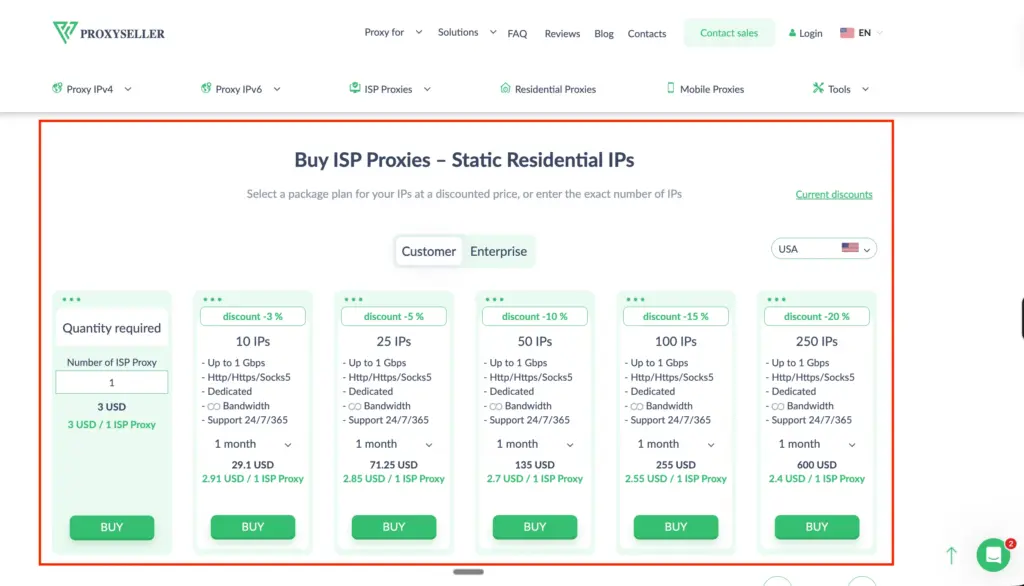
For workflows that require both trust and consistency account warm-up sequences, long-session retail monitoring, social media management where you need the same IP for weeks ISP proxies are often the right tool, and Proxy-Seller's implementation is excellent.
Pricing is approximately $0.90 per IP per month at standard volumes, with bulk discounts bringing that down significantly for larger orders. A 30-day test by Proxy Advice recorded a 99.2% success rate and 850-plus Mbps speeds on ISP proxies figures that the reviewer described as best-in-class at that price point. I ran my own shorter test and found sub-210ms response times consistently, with zero IP failures over a 72-hour automated session.
Coverage spans 23 countries, which is narrower than the residential offering but covers all the major markets where ISP proxy workflows typically run: US, UK, Germany, France, Netherlands, Canada, Australia, and others.
3. IPv4 Datacenter Proxies
Classic datacenter proxies. Fast, affordable, and useful for targets that do not run aggressive bot detection. Proxy-Seller offers these on rental periods from 1 week through 12 months with pricing that decreases as the rental period lengthens.
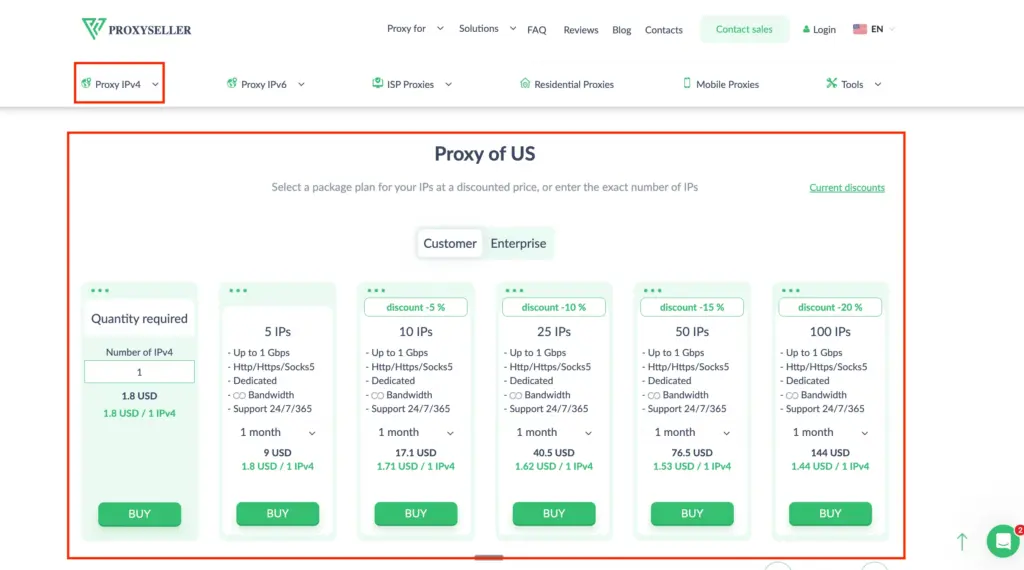
The starting price is approximately $9 for 5 IPs per month, with the 25-IP plan available at around $40.50 per month. Individual IPs from $0.08 upward depending on volume and duration. Volume discounts apply once you hit 10-plus IPs, and the discounts stack with duration discounts buy 500 IPs for 12 months and the effective per-IP cost drops considerably from the headline rate.
Speed goes up to 1 Gbps on dedicated channels. These are not shared infrastructure every IP is exclusively yours while you rent it. No other customer's traffic runs through your address.
Rental periods give a flexibility that subscription models do not. If you need datacenter IPs for a two-week scraping project rather than a recurring monthly workflow, you pay for two weeks and you are done. No forced annual commitment, no unused capacity sitting on a monthly subscription you have to cancel.
4. IPv6 Proxies
IPv6 is the cheapest entry in the Proxy-Seller catalogue at $0.08 per IP making it the clearest option in the market for buyers who need scale at minimum cost and whose targets support IPv6. Google, Facebook, Instagram, and Reddit all support IPv6, which covers a significant portion of common proxy use cases.
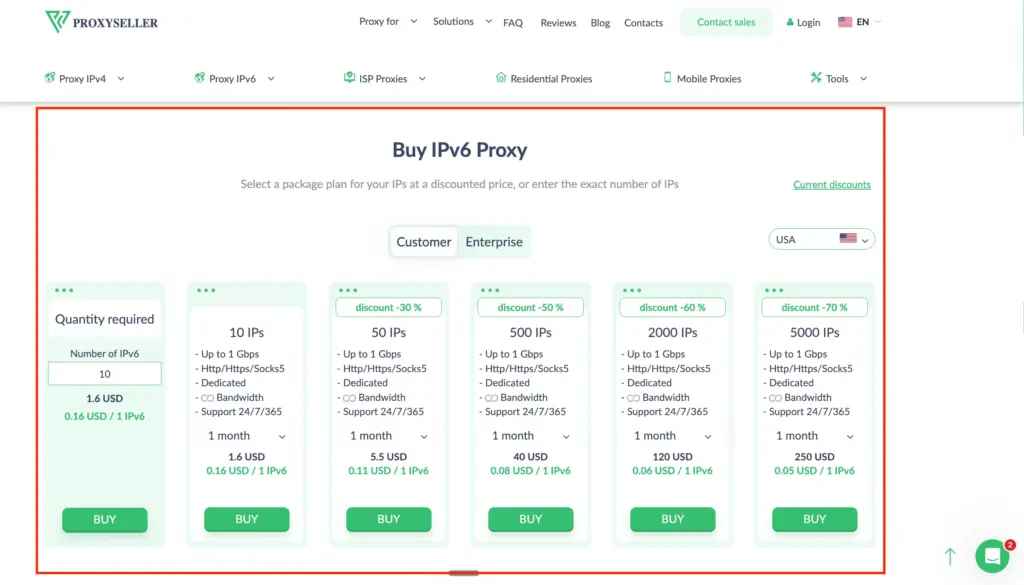
The caveat is important: IPv6 connections tunnel through Proxy-Seller's IPv4 infrastructure via dedicated ports, so each port functions as an independent proxy. This setup works well for supported targets. For targets that have not implemented IPv6, you will need to use a different proxy type.
Coverage spans 17-plus countries for IPv6. Pricing is the lowest available in the market for this category, and the pool scales well for buyers who need hundreds or thousands of IPs at minimal per-unit cost.
5. Mobile Proxies (4G/5G/LTE)
Mobile proxies are the most trusted proxy type in existence right now. They route through real mobile carrier connections the same IPs your phone uses when it browses on mobile data. Mobile IP ranges are almost never flagged by anti-bot systems because they are the most common browsing infrastructure used by real humans. Targeting a mobile range as a bot is like trying to catch fish by draining the ocean.
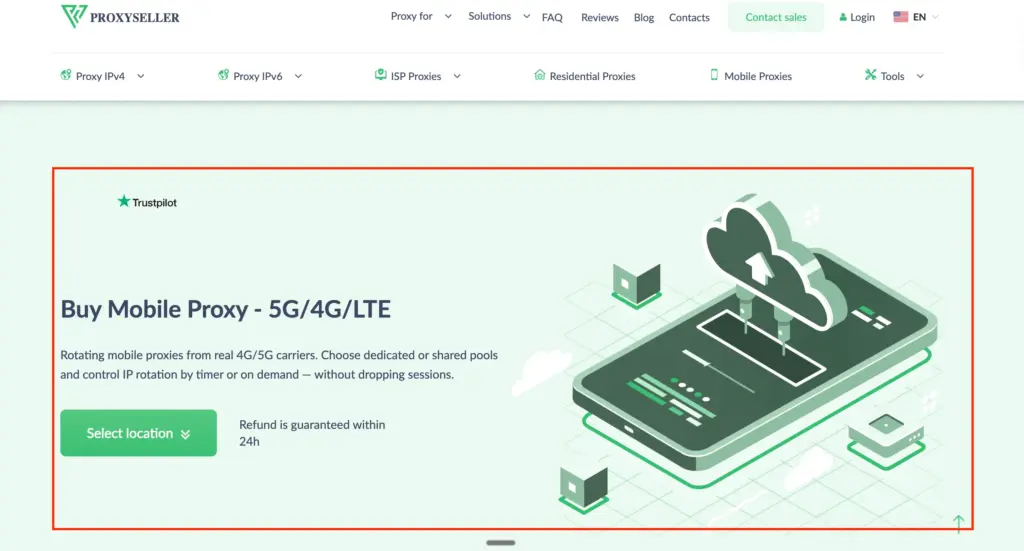
Proxy-Seller's mobile pricing sits at $2.50 per GB below the market average of $3 to $5 per GB for mobile traffic from most providers. Coverage spans major global markets with 4G, 5G, and LTE options depending on the region.
The trade-off with mobile proxies is the same regardless of provider: variable latency since you are routing through real cellular hardware, and higher cost per GB than residential or datacenter. Use them when you need the highest possible trust level mobile app testing, platforms with aggressive carrier-IP preference detection, or any scenario where residential proxies have been flagged and mobile is the step up.
The Three Discount Mechanisms That Stack
This is the most underappreciated part of Proxy-Seller's pricing and it is worth understanding before you place an order.
First discount: volume. Buying 10 or more IPs triggers volume pricing that reduces the per-unit rate by up to 40% depending on the product type and quantity.
Second discount: duration. Longer rental periods reduce the per-IP cost progressively. Choosing 6 months or 12 months instead of 1 month can bring meaningful additional savings beyond the base rate.
Third discount: promo code. The code AUTOMATE15 applies 15% off datacenter (IPv4 and IPv6), ISP, and residential proxies, and 10% off mobile. This stacks on top of both volume and duration discounts.
On a 500-IP ISP order with the promo code applied, the effective combined saving reaches around 24 percent below the base rate. On a test order of 500 ISP IPs, that translated to an effective cost of $0.68 per IP for performance that a competitor was charging $1.20 per IP for. That gap is not trivial at production scale.
The Dashboard and Technical Setup
Setup is genuinely fast. The dashboard is clean without being sparse you configure proxy type, location, quantity, and rental period from a single screen. Authentication works via username/password or IP whitelisting depending on your preference. Protocol support covers HTTP, HTTPS, and SOCKS5 without extra configuration.
For developers, Proxy-Seller publishes a full REST API with SDKs in Python, PHP, Node.js, Java, and Go. Integration into existing scraping infrastructure is straightforward regardless of what stack you are running. The library works with Puppeteer, Playwright, Selenium, and all major antidetect browsers.
One thing that genuinely impressed me: the 24-hour replacement or refund guarantee on every proxy type. If an IP fails to perform as expected after delivery, there is a defined resolution path. Most providers offer a vague “contact support” approach.
Proxy-Seller specifies the exact window and the exact resolution options. For production workflows where a bad batch of IPs costs you time and money, that clarity matters.
How Proxy-Seller Compares to Competitors
| Provider | Residential Pricing | ISP Pricing | Mobile Pricing | IPv6 | Pool Size |
| Proxy-Seller | $0.70–$3.50/GB | ~$0.90/IP | $2.50/GB | $0.08/IP | 20M+ IPs |
| Bright Data | $8–$15/GB | $2.50+/IP | $4.50/GB | Available | 400M+ IPs |
| Oxylabs | $8–$15/GB | $2.00+/IP | $4.00/GB | Limited | 175M+ IPs |
| IPRoyal | $1.75–$7/GB | $1.80+/IP | Varies | No | 32M+ IPs |
| Decodo | $2.00+/GB | Available | Available | No | 115M+ IPs |
| SOAX | $2.00+/GB at scale | Available | $2.00/GB at scale | No | 155M+ IPs |
The honest comparison: Bright Data and Oxylabs have significantly larger residential pools and enterprise-grade managed unblocking services that Proxy-Seller does not offer. If you are running a scraping operation at truly massive enterprise scale and need a provider to handle the anti-bot bypassing logic for you, Bright Data's Web Unlocker or Oxylabs' Web Scraper API is a different product category that Proxy-Seller does not compete with directly.
For everyone else freelancers, growing teams, agencies, mid-size operations, researchers Proxy-Seller's pricing advantage is significant and the performance quality holds up in real testing. The 20M-plus residential pool is smaller than the giants but sufficient for every practical use case that does not require enterprise-scale concurrent requests.
DataImpulse undercuts Proxy-Seller on residential GB pricing at some tiers, but lacks ISP products and verified compliance certifications. For teams that need GDPR and ISO/IEC 27001 compliance documentation which is increasingly a procurement requirement for corporate clients that compliance gap matters.
What Proxy-Seller Is Good For
Social media management and account operations are where Proxy-Seller's ISP proxy quality really shines. The static residential IP trust profile, combined with a 99.2% success rate, makes these proxies reliable for long-running account sessions.
The caveat from testing is worth knowing: approximately 8.3% of residential IPs resolve as “Corporate ASN” on IPQualityScore, which can cause issues on Instagram and TikTok specifically. The fix is a workflow approach: use ISP proxies for initial account establishment and warm-up, then switch to residential for ongoing operation. Not a dealbreaker, but something to plan for.
Web scraping and data collection are natural fits given the pricing. At $0.70 per GB for bulk residential, running large-scale data collection becomes economically viable in ways it simply is not at $15 per GB from enterprise providers.
SEO monitoring SERP tracking, rank monitoring, competitor analysis benefits from Proxy-Seller's city and ISP-level targeting within the residential pool. You can be specific about the search environment you are simulating rather than just choosing a country.
Market research and price intelligence work well because the proxy fleet covers 220-plus countries, meaning you can monitor pricing on any major ecommerce platform from any geography that matters to your analysis.
What Proxy-Seller Is Not Good For
If you need a fully managed unblocking service where you paste a URL and get the rendered content back without writing any extraction logic yourself, Proxy-Seller is not the right tool. They provide raw IP access. The rotation logic, retry design, and extraction code are yours to build and maintain. Bright Data's Web Unlocker and Oxylabs' Web Scraper API handle that managed layer. Proxy-Seller does not.
If you need a residential pool larger than 20 million IPs for genuinely concurrent large-scale operations at enterprise throughput, Bright Data at 400M-plus or Oxylabs at 175M-plus will serve you better.
Support and Reliability
99% uptime is the published figure. Dedicated 1 Gbps channels on their own infrastructure. Customer support is 24/7 with technical expertise rather than a first-line triage team reading from a script. Real users on Trustpilot consistently note fast response times and actual technical help when something goes wrong.
The 24-hour replacement guarantee is the support feature that matters most in practice. Bad IPs happen. What a provider does about them when they happen is what separates a vendor you can rely on from one that frustrates you. Proxy-Seller's explicit 24-hour commitment is better than the vague policies most competitors publish.
Pros and Cons of Proxy-Seller Review
Pros
- GDPR and ISO/IEC 27001 certified passes enterprise procurement reviews
- 24-hour replacement or refund guarantee on every proxy type
- 220-plus countries covered in the residential pool
- IPv6 proxies from $0.08/IP unmatched in the market
- Full REST API with SDKs in five programming languages
- Works with Puppeteer, Playwright, Selenium, and all major antidetect browsers
- 24/7 technical support not just a first-line triage team
Cons
- Around 8% of residential IPs flag as "Corporate ASN" relevant for Instagram and TikTok specifically
- ISP coverage limited to 23 countries narrower than residential offering
- IPv6 only works on targets that have implemented IPv6 support
Frequently Asked Questions
Yes, Proxy-Seller is a legitimate proxy provider that has been operating since 2014 over a decade in a market where many providers disappear within a year or two. They serve 500,000-plus clients, are GDPR compliant, and hold ISO/IEC 27001 certification for information security management. That compliance stack means they have been independently audited, which is more assurance than most proxy providers offer.
Proxy-Seller offers a $1.99 three-day trial that gives you 500MB of residential proxy traffic. This is enough to run a genuine functional test on your actual target sites. It is the right starting point before committing to any larger volume order. Most serious providers either skip trials entirely or charge significantly more for a meaningful test $1.99 is one of the most accessible entry points in the category.
The code AUTOMATE15 gives you 15% off datacenter IPv4, IPv6, ISP, and residential proxies, and 10% off mobile proxies. The code stacks with both the volume discount (up to 40% off for bulk orders) and the duration discount (up to 12% additional savings for multi-month commitments). On a 500-IP ISP order with all three discounts stacked, the effective saving reaches around 24 percent below the list price bringing the effective per-IP cost to approximately $0.68 versus the base rate of around $0.90.
Every IP at Proxy-Seller is exclusively allocated to you for the duration of your rental period. No other customer's traffic runs through your addresses while you are using them. This matters for account operations and social media management specifically shared IPs create cross-contamination risks where one customer's banned account history affects everyone else using the same IP. Exclusive allocation eliminates that problem entirely.
Residential proxies route through real home internet connections real people's devices and ISP-assigned addresses that rotate per request or per timer. ISP proxies are static IPs allocated by real internet service providers but hosted on datacenter infrastructure. The result is datacenter speed with residential trust levels. Residential proxies are better for workflows needing rotation and the highest detection avoidance. ISP proxies are better for workflows requiring session persistence same IP across multiple sessions like account management and long-running monitoring tasks. Proxy-Seller's ISP proxies tested at 99.2% success rates and sub-210ms response times in October 2026.
Yes, with a specific workflow recommendation. ISP proxies are the best choice for social media account operations because the static IP persistence and residential trust levels make accounts more stable over long sessions. One important note from testing: approximately 8% of Proxy-Seller's rotating residential IPs flag as "Corporate ASN" on tools like IPQualityScore, which can cause issues on Instagram and TikTok specifically. The recommended workflow is ISP proxies for initial account establishment and warm-up, then rotating residential for ongoing operation. This two-phase approach avoids the corporate ASN detection issue entirely.
Quick Links:
Final Verdict: Proxy-Seller Review 2026
After 30 days of real testing across all five proxy types, my honest assessment is this: Proxy-Seller is the best all-around proxy provider for teams and individuals who want genuine performance across multiple proxy categories without paying enterprise prices or splitting across multiple vendors.
The ISP proxies are best-in-class at their price point. The residential pricing is dramatically below most comparable providers. The dashboard is functional without being confusing. The discount stacking makes large orders genuinely economical. And the compliance certifications mean you can use them in corporate procurement contexts that some cheaper alternatives cannot pass.
The limitations are real smaller residential pool than the giants, no managed unblocking service, not the right tool for absolute enterprise scale. But for the vast majority of proxy use cases in 2026, Proxy-Seller is the answer I recommend starting with.
Overall Rating: 9.1 / 10
Start with the $1.99 trial. Use code AUTOMATE15 at checkout when you scale up.