
I have been doing affiliate marketing since 2012.
And I can tell you honestly — nothing has changed the game as fast as AI has in the last two years.
When I started, I used to spend 6–8 hours just writing one blog post. Now I can plan, write, optimize, and publish it in under two hours. And the results? Better than before.
If you are still doing affiliate marketing the old-school way — manually writing every piece of content, guessing which keywords to target, and hoping your landing page converts — this guide is going to change how you work.
Let me walk you through exactly how I use AI for every stage of affiliate marketing. From finding the right topic to getting that final conversion.
What Does AI Actually Do for Affiliate Marketers?
Before we get into the tools and tactics, let me clear one thing up.
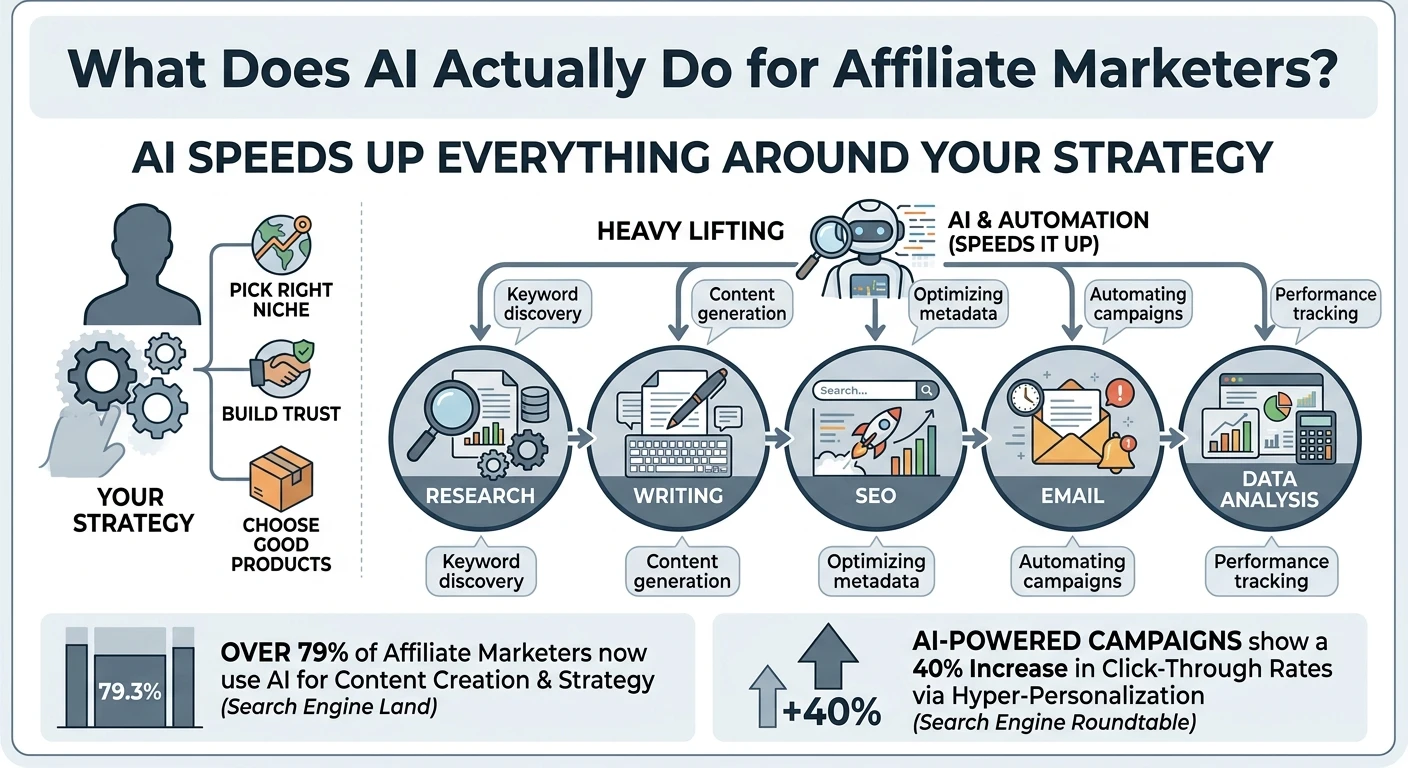
AI does not replace your strategy. It speeds up everything around it.
You still need to pick the right niche, build trust with your audience, and choose good affiliate products. But AI takes care of the heavy lifting — research, writing, SEO, email, data analysis — so you can focus on growth.
According to recent data, 79.3% of affiliate marketers now use AI for content creation and strategy. Search Engine Land If you are not in that group yet, you are already behind your competitors.
AI-powered campaigns show a 40% increase in click-through rates thanks to hyper-personalization. Search Engine Roundtable That is not a small number. That is the difference between a struggling affiliate site and a profitable one.
Step 1: Use AI to Find Your Winning Niche and Keywords
This is where most affiliate marketers waste months of time.
They pick a niche based on gut feeling. Then they spend three months building content only to realize the niche is too competitive or has no buyer intent.
AI tools like Semrush, Ahrefs, and even ChatGPT can help you avoid this mistake.
Here is what I do. I use a combination of Semrush's Keyword Magic Tool and ChatGPT to build my content strategy. I start by asking ChatGPT: “What are the top problems people have with [product category]?” Then I cross-reference those topics with actual search data in Semrush.
This approach helps me find keywords that have real search volume AND buyer intent. Not just informational traffic that never converts.
Quick Tip: Target long-tail keywords like “best [tool] for [specific use case] in 2026” instead of broad terms. These convert much better because the reader already knows what they want.
In 2026, Semrush added AI Visibility Analytics that tracks brand mentions across ChatGPT, Google AI Overviews, Perplexity, and other AI search engines. The Search Herald This is a massive feature for affiliate marketers who want to see if their content is getting picked up by AI answers.
Step 2: Create High-Quality Affiliate Content Faster With AI
Content is still king in affiliate marketing.
But in 2026, generic “Top 10 best tools” articles are not enough. Google and AI search engines both reward content that actually helps the reader solve a problem.
Here is my personal content workflow using AI:
1. Start with an outline in ChatGPT or Claude. Give it your keyword, your target audience, and your angle. Ask it to create an H2/H3 structure. Review it and adjust before you write a single word.
2. Write section by section, not all at once. I never ask AI to write the entire article in one go. I write each section separately and add my own stories, examples, and opinions. This keeps the content human and authentic.
3. Add personal experience and proof. This is the part AI cannot do for you. Your screenshots, your income numbers, your honest take on whether a product is worth it — this is what builds trust and drives conversions.
4. Optimize with Surfer SEO or NeuronWriter. Once the draft is ready, I run it through Surfer SEO to check keyword density, word count benchmarks, and missing semantic terms. It takes 15 minutes and makes a real difference in rankings.
Affiliates producing high-quality, machine-readable content positioned to answer AI queries will capture disproportionate traffic as AI search platforms expand. Search Engine Roundtable
This means your content needs to be structured clearly — short paragraphs, proper headings, direct answers to questions. Not walls of text.
Step 3: Build Landing Pages That Actually Convert
Great content brings traffic. But a weak landing page kills your commissions.
I have tested dozens of landing page structures over the years. In 2026, the pages that convert best have a few things in common:
A clear headline that matches the reader's search intent
Social proof above the fold (testimonials, ratings, user numbers)
A strong CTA that tells the reader exactly what to do next
Fast load speed (under 2 seconds)
AI tools like Unbounce and LanderLab have changed how I build landing pages.
LanderLab was purpose-built for affiliate marketers and includes proven advertorial templates, pre-sell pages, and an AI quiz funnel builder that creates complete multi-step flows from a single prompt. The Search Herald
The quiz funnel is especially powerful. Instead of sending everyone to the same landing page, you ask a few questions and route each person to the product that fits them best. This feels personalized — because it is — and conversions go up significantly.
Step 4: Use AI for Email Marketing and Follow-Up Funnels
Most affiliate marketers I know leave a lot of money on the table because they have no email follow-up system.
Someone visits your site, clicks your affiliate link, and does not buy. That visitor is gone forever — unless you captured their email.
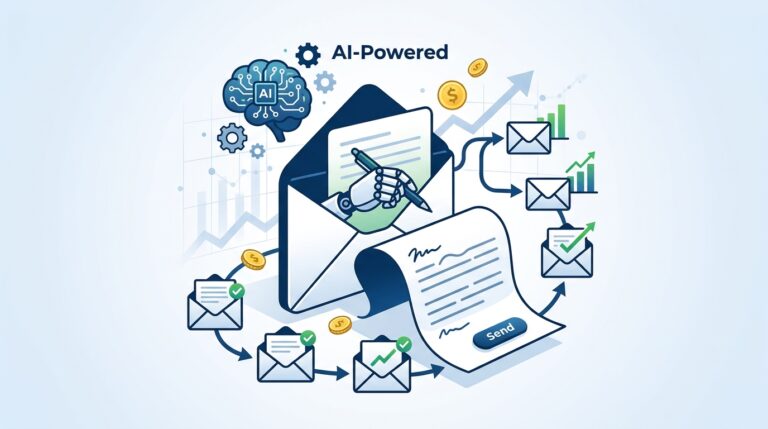
Email is where AI has made my life dramatically easier. I use tools like ConvertKit or ActiveCampaign with AI-written sequences. Here is what a basic affiliate email funnel looks like:
Email 1 (Day 0): Welcome email + free resource delivery
Email 2 (Day 2): Problem-focused email that introduces the product
Email 3 (Day 4): Case study or personal story with soft CTA
Email 4 (Day 6): Direct comparison email (product vs alternatives)
Email 5 (Day 8): Urgency or bonus offer email
I write the framework and let AI generate the draft. Then I edit to add my personal tone, specific examples, and updated data. Each email takes me 20 minutes now instead of 2 hours.
Step 5: Automate Competitor Research and Product Selection
One of the most time-consuming parts of affiliate marketing is keeping track of what your competitors are doing.
Which products are they promoting? What angles are working? Where are they getting traffic?
AI-powered tools like Ahrefs' Content Gap feature and SpyFu let you reverse-engineer competitor strategies in minutes.
Leading affiliate teams use tools like PiPiADS for TikTok and Anstrex for push and native campaigns to find winning angles — not to copy, but to analyze the emotional hook and then iterate. Search Engine Land
This is exactly the right approach. Never copy a competitor's content. But do study what is working and find a way to do it better.
For product selection, I use AI to analyze commission structures, average order values, and conversion rates across affiliate networks before I commit to promoting anything. This saves months of promoting the wrong products.
Step 6: Track Everything With AI-Powered Analytics
You cannot scale what you cannot measure.
This is something a lot of beginner affiliate marketers skip. They set up their links, publish their content, and hope for the best.
I track every click, every conversion, and every revenue source in detail. In 2026, AI analytics tools have made this so much easier.
Google Analytics 4's AI insights automatically surface anomalies and opportunities — and when combined with WeCanTrack, it bridges affiliate network conversion data directly to traffic sources for precise attribution. The Search Herald
What does this mean in practice? You can see exactly which blog post, which keyword, and which email drove your last 100 conversions. Then you double down on what is working.
I review my analytics every Monday morning. It takes 30 minutes. And it guides my entire content and promotion strategy for the week.
Step 7: Stay Ahead With AI Search Optimization (GEO)
This is the new frontier that most affiliate marketers are ignoring.
Google's AI Overviews and tools like ChatGPT and Perplexity are now where millions of people go to get product recommendations. If your content is not showing up in these AI answers, you are missing a growing traffic source.
This is called Generative Engine Optimization (GEO) — and it is different from traditional SEO.
To show up in AI answers, your content needs to:
Directly answer specific questions with clear, factual information
Cite data and statistics from credible sources
Use structured content with clean H2/H3 headings
Build authority through original research and expert insights
According to McKinsey research, brand website content accounts for only 5–10% of AI search sources, while affiliate and user-generated content comprises significantly more. Search Engine Roundtable
This is actually great news for affiliate marketers. Your review articles, comparison guides, and how-to content are exactly the type of material AI systems pull from.
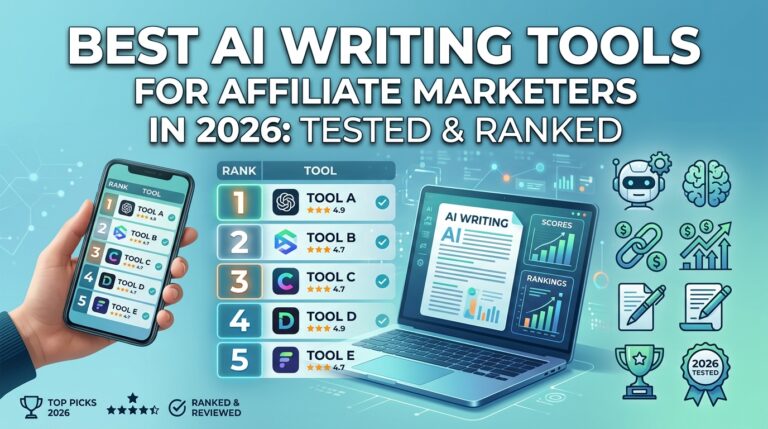
Best AI Tools for Affiliate Marketing in 2026
Here is a quick breakdown of the tools I personally use and recommend:
Tool | Purpose | Best For |
ChatGPT / Claude | Content drafting, brainstorming, email copy | All affiliate marketers |
Surfer SEO | On-page SEO optimization | Blog content |
Semrush | Keyword research, competitor analysis, AI visibility tracking | Strategy |
Jasper | Long-form affiliate content with Brand Voice | Content teams |
LanderLab | Landing pages, quiz funnels, advertorials | Paid traffic affiliates |
ConvertKit | Email marketing automation | Email funnel building |
RedTrack | Multi-touch attribution tracking | Campaign optimization |
Ahrefs | Backlink analysis, Content Gap, keyword explorer | SEO growth |
Start with two or three of these. Get good at using them. Then add more as you scale.
Common Mistakes to Avoid When Using AI for Affiliate Marketing
I have made these mistakes myself, so I want to save you the time.
Publishing AI content without editing. Raw AI output is generic. It lacks your voice, your experience, and your unique perspective. Always edit before you publish.
Over-relying on AI for strategy. AI is a tool, not a strategist. The niche selection, the product choice, the audience relationship — these are still yours to own.
Ignoring data. AI tools give you tremendous amounts of data. But if you are not reviewing and acting on it regularly, you are wasting the biggest advantage AI gives you.
Skipping the human touch on high-intent pages. Your money pages — the ones where you ask someone to click an affiliate link — need to feel personal and trustworthy. Do not let these pages read like they were written entirely by a robot.
Conclusion
AI has made affiliate marketing more accessible and more competitive at the same time.
The marketers who will win in 2026 and beyond are the ones who use AI as a productivity multiplier — not a replacement for real expertise and genuine audience trust.
I have been doing this for over 14 years. And my honest advice is this: start with one AI tool, master it, see the results, and then expand your stack slowly.
You do not need 20 tools. You need the right three or four tools used consistently.
The combination of AI-powered content, smart keyword targeting, optimized landing pages, automated email follow-ups, and solid analytics is what separates affiliates making $1,000/month from those making $10,000+/month.
Start building that system today.
FAQs
Yes, absolutely. Most AI tools today are beginner-friendly and designed for non-technical users. Tools like ChatGPT, Jasper, and Surfer SEO have simple interfaces that anyone can use within a few hours — start with content creation for the fastest visible results.
Google does not penalize AI-generated content by default — it penalizes low-quality, thin, and unhelpful content regardless of how it was written. If you use AI to create genuinely useful, well-edited, experience-backed affiliate content, it can rank very well in 2026.
Begin with ChatGPT or Claude for content creation and Semrush or Ahrefs for keyword research, as these two areas give you the highest return on your time investment early on. Mastering just these tools can dramatically accelerate your affiliate growth.
AI can cut your content creation time by 50–60%, turning tasks that once took 4–6 hours into 1–2 hour workflows. Over a full month, that translates to dozens of extra hours you can reinvest into building more content, testing new products, or growing your email list.
Yes, as long as you follow standard disclosure rules and clearly state that your content contains affiliate links. AI does not change your compliance obligations, so always include an affiliate disclaimer at the top of every article you publish.
Focus on search intent, proper keyword placement, and E-E-A-T signals — experience, expertise, authoritativeness, and trust — while adding your own real-world insights to every article. Pair this with Surfer SEO for on-page optimization, strong internal linking, and backlink building to boost your site's authority.
GEO stands for Generative Engine Optimization, which means optimizing your content to appear inside AI-generated answers on platforms like ChatGPT, Perplexity, and Google AI Overviews. As more users turn to AI tools for product recommendations, ranking in these answers is becoming just as critical as traditional Google search visibility for affiliate revenue.