

Decodo is a reliable and affordable proxy service with a huge IP pool and smart tools for web scraping, SEO, and more. It’s great for beginners and advanced users who want fast speeds and strong uptime at a good price.
- Large IP pool (125 M+)
- Useful AI-powered tools
- Fast and reliable
- 24/7 customer support
- Affordable pricing with discounts
- No full free trial
- Live chat support can be slow
- Not ideal for sneaker copping
Price: $0.026/IP
Let me be clear.
The proxy market is crowded. Everyone promises speed, low cost, and reliability. Few deliver. Decodo does.
I ran real scraping jobs, tested different regions, hit protected sites, and compared results with other paid networks.
What began as Smartproxy in 2018 has evolved into a wider web data platform. The move to Decodo in April 2025 brought new tools, APIs, and AI features, backed by the same solid infrastructure.
If you scrape sites, track prices, monitor rankings, manage accounts, or build datasets, this matters.
In this Decodo review, I will break down what Decodo offers, its pricing, how it compares, and whether it earns your money.
What Is Decodo? (Formerly Smartproxy)
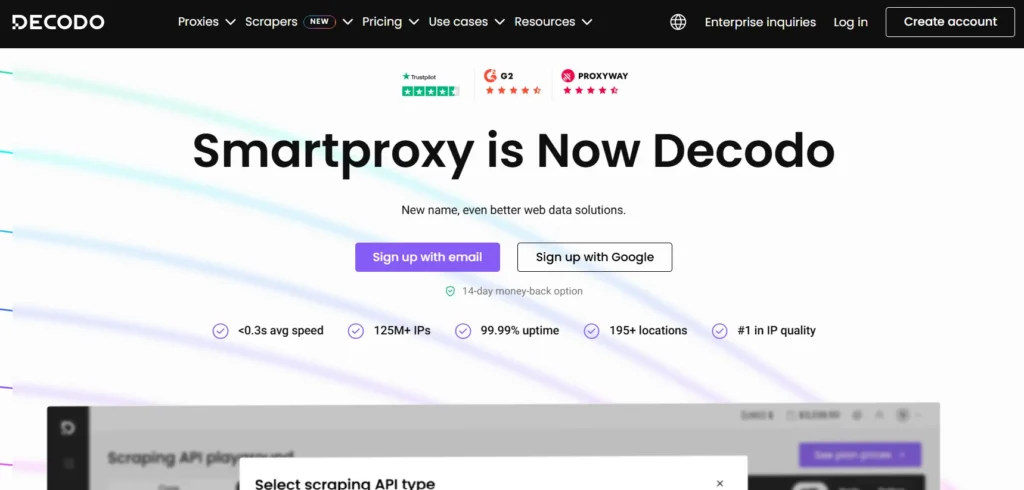
Decodo is a provider of proxy infrastructure and web data collection tools designed for businesses and professionals. The company started in 2018 under the name Smartproxy and later changed its name to Decodo in April 2025.
This rebrand shows its growth from a proxy focused service into a broader platform built to support access to public web data at scale.
Decodo works as an intermediary network that directs internet traffic through a large pool of IP addresses. This allows users to appear as if they are browsing from different locations around the world. It also helps overcome challenges such as location-based restrictions, request limits, IP blocks, and many common bot-detection systems.
The platform operates one of the largest ethically sourced residential proxy networks available today. It includes more than 125 million IP addresses collected from real residential and mobile devices across 195 countries, providing users with wide global coverage and reliable access to web data.
Decodo offers many types of proxies:
- Residential proxies: IPs from real home devices, great for looking like a regular user.
- Static residential (ISP) proxies: IPs from internet providers, blending speed and authenticity.
- Mobile proxies: IPs from mobile devices, perfect for mobile tasks.
- Datacenter proxies: IPs from servers, fast but easier to detect.
- Dedicated datacenter proxies: Private IPs just for you, ensuring high performance.
Decodo also provides scraping APIs for collecting data from websites like social media, search engines, and online stores. With its new tools and focus on user needs, Decodo is a great choice for individuals, businesses, and marketers.
What’s New with Decodo?
AI Parser — Data Without Code
You no longer need a developer to collect structured web data.
Point the AI Parser at any website, describe what you need in plain English, and get back clean JSON data instantly, no scripts, no coding, no maintenance.
- Works on any website, not just pre-built templates
- Outputs clean JSON ready for tools, spreadsheets, or pipelines
- No technical knowledge needed — just describe and collect
MCP Server — Live Web Access for AI Agents
This is the biggest addition in 2026.
The MCP Server connects AI tools — Claude, LangChain agents, custom GPTs, VS Code workflows — directly to Decodo's scraping infrastructure. Your AI can now browse the live web and fetch real-time data on its own.
- Works with Claude, LangChain, VS Code, and any JSON-RPC AI client
- Handles CAPTCHAs and geo-targeting automatically
- Runs locally in Node.js or via Smithery cloud in one command
- Setup takes under a minute
Advanced Scraping API — JavaScript Pages Solved
The original API handled basic pages. The new Advanced Scraping API handles the hard ones.
It uses headless browser technology to load and read JavaScript-heavy websites that basic scrapers fail on completely.
- Handles dynamic, JavaScript-rendered pages
- Outputs in LLM-ready Markdown format
- Supports automated scheduling for hands-free jobs
- Includes native n8n integration
- Starts at $0.95 per 1,000 requests
Video Downloader — YouTube Data at Scale
Built for teams that need YouTube content for AI training, media research, or content archiving — not personal use.
- Enterprise-level volume supported
- Fully compatible with yt-dlp
- Runs on dedicated high-speed proxies
- Starts at $0.08 per GB
Site Unblocker — Automatic Anti-Bot Handling
Send a request. Decodo handles everything blocking it. You get clean data back.
- Bypasses CAPTCHAs, IP bans, and browser fingerprinting automatically
- Works on heavily protected sites like Amazon and LinkedIn
- No manual configuration needed
- Starts at $0.95 per 1,000 requests
New Tool Integrations
Decodo now connects with the tools most data and AI teams already use.
- n8n — drag-and-drop workflow automation
- LangChain — AI application development
- Smithery — one-command cloud deployment
- Any JSON-RPC AI client via the MCP Server
Types of Proxies offered by Decodo
1. Residential Proxies
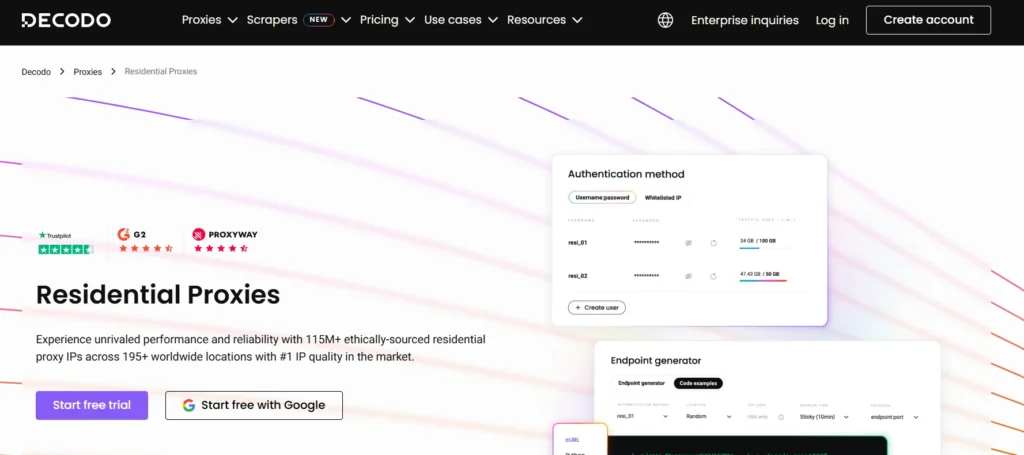
- What it does: IPs from real home devices (115 million+ IPs), great for anonymity.
- Use cases:
- Web scraping: Collect data without getting blocked.
- Geo-restrictions: Access content from different countries.
- My experience: I used residential proxies to scrape e-commerce sites. The IPs worked well, and I could rotate them to avoid bans. Speeds were fast (around 0.3 seconds average response time).
2. Static Residential (ISP) Proxies
- What it does: IPs from internet providers, blending speed and authenticity.
- Use cases:
- Social media: Manage multiple accounts safely.
- eCommerce: Track competitor prices.
- My experience: I used ISP proxies for social media management. The sticky sessions (up to 30 minutes) kept the same IP, preventing account flags.
3. Mobile Proxies
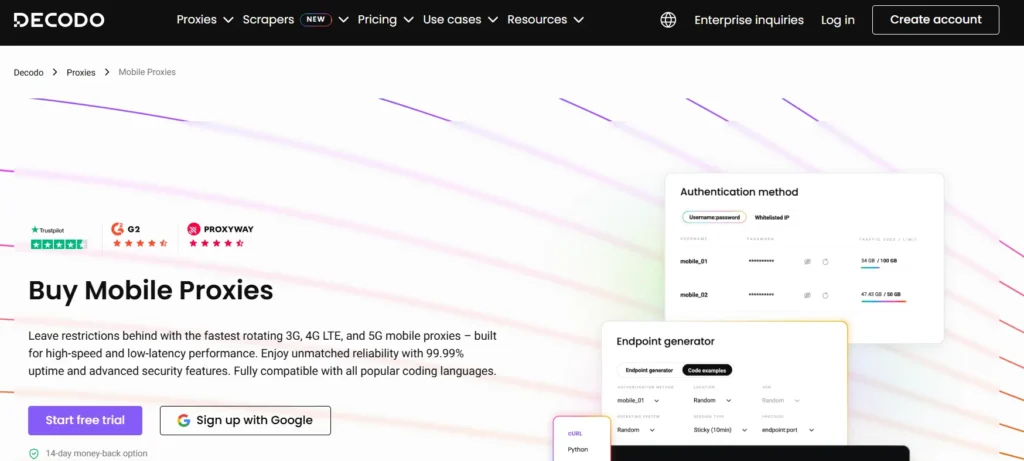
- What it does: IPs from mobile devices (10 million+ IPs), with 3G/4G/5G options.
- Use cases:
- App testing: Test apps from different mobile networks.
- Mobile research: Access mobile-specific content.
- My experience: I tested mobile proxies for app research. They worked well, but the $4.5/GB price is a bit high for casual users.
4. Datacenter Proxies
- What it does: IPs from servers, fast but easier to detect (500 K+ IPs).
- Use cases:
- Browsing: Hide your IP for casual surfing.
- Streaming: Access geo-blocked content.
- My experience: Datacenter proxies were fast for browsing but got blocked by some scraping sites. They’re best for non-sensitive tasks.
5. Dedicated Datacenter Proxies
- What it does: Private IPs just for you, ensuring high performance.
- Use cases:
- Secure tasks: Scraping or SEO with no shared IPs.
- My experience: These were great for scraping sensitive sites, with no interruptions.
6. Scraping APIs
- What it does: Tools to automate data collection from social media, search engines, eCommerce, and websites.
- My experience: I used the eCommerce Scraping API to collect product data from Amazon. It was easy to use, and the data came in a neat format (JSON).
7. Latest Features (Post-Rebranding)
- Universal Scraper: Collects data from tricky websites with one API.
- AI-Powered Parser: Turns raw data into useful insights quickly.
- My experience: The Universal Scraper was amazing for scraping dynamic websites, and the AI parser saved me time organizing data.
8. Free Tools
- What it does: Includes X Browser, Chrome/Firefox extensions, and Proxy Checker.
- My experience: The Chrome extension made switching proxies super easy while browsing.
Verdict:
Decodo offers a huge range of features, from proxies to scraping APIs. The new Universal Scraper and AI parser are game-changers for data collection. The free tools and global coverage (195+ locations) make it even better.
Why I Tested Decodo?
I’ve used proxies for years for legal tasks like:
- Scraping data from websites to track prices for clients.
- Managing multiple social media accounts for marketing.
- Accessing geo-blocked content for research.
- Browsing anonymously to protect my privacy.
I decided to test Decodo because I heard about its rebranding and new features, and I wanted to see if it could solve common proxy problems like high costs and IP blocks. I also noticed they’re offering a 30% off discount with the code DECODO30, which makes it a good time to try it. To test Decodo, I:
- Signed up for an account and tested residential, mobile, and datacenter proxies.
- Ran speed tests for browsing, scraping, and accessing blocked content.
- Checked its security features and privacy policies.
- Used the dashboard and new tools like the Universal Scraper.
- Contacted customer support to see how helpful they are.
Here’s what I found after weeks of testing.
Pros and Cons of Decodo
Pros
- Large proxy network with global coverage
- Ethically sourced residential and mobile IPs
- Easy-to-use dashboard
- Supports web data collection at scale
- Good performance and stable connections
- Suitable for businesses and professionals
Cons
- Pricing may feel high for beginners
- Limited value for very small or casual use
- Not designed for personal browsing needs
How Much Does Decodo Cost?
Residential Proxy Pricing
- Pay As You Go: $12.5 per GB (1 GB included).
- Micro: $80/month (8 GB, $10/GB).
- Starter: $225/month (25 GB, $9/GB).
- Regular: $400/month (50 GB, $8/GB).
- Advanced (Enterprise): $700/month (100 GB, $7/GB).
Each plan includes whitelisted IPs and usernames/passwords. The Advanced plan also comes with a dedicated account manager. There’s a 3-day money-back option for self-service plans.
1. Pay As You Go ($12.5/GB)
- Details: Pay only for what you use, starting at 1 GB.
- Who’s this for?
- One-time users: If you only need proxies for a small project (e.g., scraping a few websites), this plan is perfect because you don’t commit to a monthly subscription.
- Beginners: At $12.5/GB, it’s good for trying Decodo without spending too much.
- With 30% off (DECODO30): Drops to ~$8.75/GB, making it even more affordable.
2. Micro Plan ($80/month, 8 GB)
- Details: $10/GB, includes 8 GB of data.
- Who’s this for?
- Freelancers: If you’re scraping small amounts of data or managing a few social media accounts, 8 GB is enough, and $80/month is reasonable.
- Small projects: Good for occasional use, like market research.
- With 30% off (DECODO30): Drops to ~$56/month, saving you $24.
3. Starter Plan ($225/month, 25 GB)
- Details: $9/GB, includes 25 GB of data.
- Who’s this for?
- Small businesses: If you’re scraping more data or running multiple accounts, 25 GB gives you room to work, and $9/GB is cheaper than smaller plans.
- Marketers: Great for SEO research or managing social media campaigns.
- With 30% off (DECODO30): Drops to ~$157.50/month, saving you $67.50.
4. Regular Plan ($400/month, 50 GB)
- Details: $8/GB, includes 50 GB of data.
- Who’s this for?
- Growing businesses: If you need more data for scraping or automation, 50 GB is a good amount, and $8/GB saves money.
- Researchers: Perfect for collecting data from many websites.
- With 30% off (DECODO30): Drops to ~$280/month, saving you $120.
5. Advanced (Enterprise) Plan ($700/month, 100 GB)
- Details: $7/GB, includes 100 GB of data, plus a dedicated account manager.
- Who’s this for?
- Large businesses: If you’re scraping lots of data or running big projects, 100 GB is ideal, and the account manager helps with support.
- Heavy users: Great for AI training or large-scale automation.
- With 30% off (DECODO30): Drops to ~$490/month, saving you $210.
Other Proxy Plans
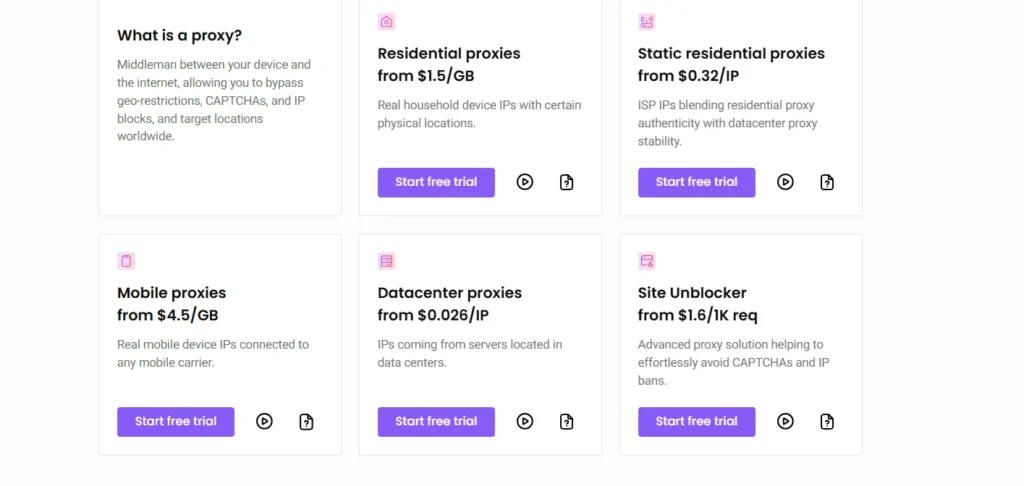
- Static Residential (ISP) Proxies: From $0.32/IP (shared or dedicated).
- Who’s this for? Marketers managing social media accounts or e-commerce tasks.
- With 30% off (DECODO30): Drops to ~$0.22/IP.
- Mobile Proxies: From $4.5/GB.
- Who’s this for? Users needing mobile IPs for app testing or mobile research.
- With 30% off (DECODO30): Drops to ~$3.15/GB.
- Datacenter Proxies: From $0.026/IP.
- Who’s this for? Budget users needing fast proxies for browsing or streaming.
- With 30% off (DECODO30): Drops to ~$0.018/IP.
- Dedicated Datacenter Proxies: From $7.5/month.
- Who’s this for? Users needing private IPs for secure tasks.
- With 30% off (DECODO30): Drops to ~$5.25/month.
Scraping API Plans
- Social Media, SERP, eCommerce, Web Scraping APIs: From $0.08/1K requests.
- Who’s this for? Developers or businesses are automating data collection from specific sites.
- With 30% off (DECODO30): Drops to ~$0.056/1K requests.
Verdict:
Decodo’s pricing is competitive, especially with the 30% off discount (DECODO30). The Pay As You Go plan is great for beginners or one-time users.
Micro and Starter plans suit freelancers and small businesses, while Regular and Advanced plans are best for growing businesses or heavy users.
Other proxy types, like mobile and datacenter, are affordable for specific needs, and the scraping APIs are perfect for automation.
Speed and Performance
Speed is key for proxies, especially for scraping or browsing. I tested Decodo’s performance.
Test Results
- Residential proxies: Very fast, with an average response time of 0.3 seconds. Download speeds were around 50-100 Mbps.
- Mobile proxies: Good speeds, around 30-50 Mbps, but slower than residential.
- Datacenter proxies: Fastest, up to 200 Mbps, but some sites blocked them.
- ISP proxies: Balanced speed, around 50-100 Mbps, with stable connections.
Use Cases of Decodo
- Browsing: All proxies were fast for general browsing. No delays.
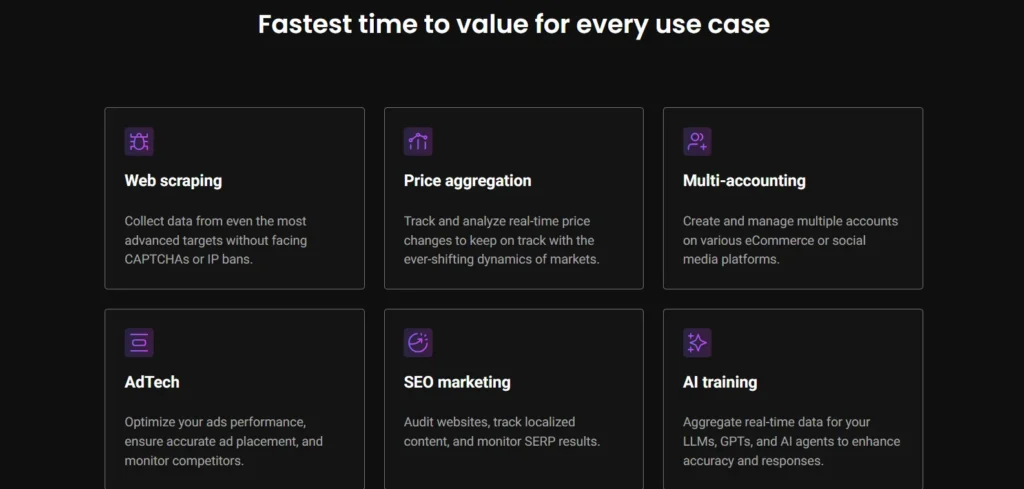
- Web scraping: Residential proxies were excellent for scraping, with a 99.47% success rate. ISP proxies were great for stable sessions.
- SEO research: I checked search results from different countries using residential proxies. It worked perfectly.
- Streaming: Datacenter proxies worked for streaming (e.g., YouTube), but residential proxies were too expensive for this ($1000/month for Netflix, per Decodo’s estimate).
- Gaming: Not ideal due to latency. A VPN is better for gaming.
Decodo Integration
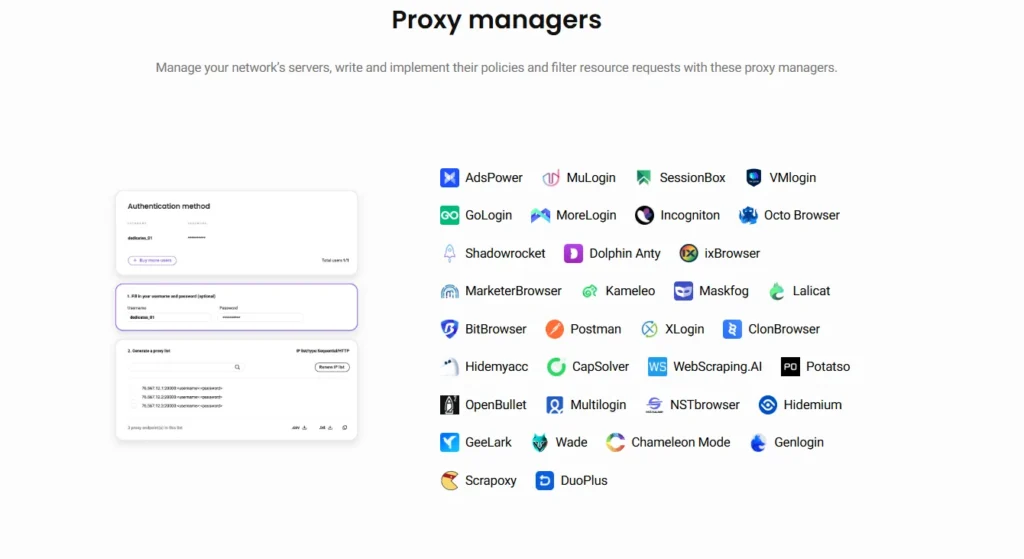
Decodo integrates easily with a wide range of tools and platforms, making it a flexible choice for different types of users. You can connect it with web scraping tools, automation software, browser extensions, SEO tools, and even your own custom scripts or apps. This kind of integration is useful for many real-world tasks.
For example, you can use Decodo with Python or Scrapy to collect product data from e-commerce sites.
Marketing teams can plug it into SEO tools to track search rankings from different locations.
Ad tech companies can integrate it into systems that check if ads are being shown correctly across regions.
Social media managers can connect it to browsers to safely run multiple accounts without getting blocked.
Whether you’re doing market research, price tracking, content monitoring, or ad verification, Decodo fits smoothly into your workflow.
It doesn’t matter if you’re technical or not; the integration is built to support how you already work.
Security and Privacy
One thing I really like about Decodo is how seriously it handles security and privacy. When you’re using proxies, especially for large-scale tasks,, you want to be sure your data is safe and your identity is protected, and Decodo does a great job at both.
Their proxies are ethically sourced, meaning they come from real people who’ve agreed to share their IPs, which is important not only for privacy but also for staying compliant with data laws.
Here’s how Decodo protects your data:
- Ethically sourced IPs from real users who’ve given consent
- HTTPS encryption for secure data transmission
- Session control options include duration, rotation frequency, and geolocation
- Natural browsing patterns that reduce the risk of detection or blocking
If you’re doing things like ad verification or competitive research, this kind of protection gives you peace of mind.
You can control how your sessions behave, how long they last, how often they rotate, and which country or city your IP appears to come from, which makes your activity look more natural and harder to detect.
In short, Decodo helps you stay safe, anonymous, and within ethical limits, all without slowing down your work.
Ease of Use
A lot of proxy tools feel overwhelming at first because they make you deal with too many settings, and it’s easy to get confused, but Decodo is different. It’s actually easy to use, with a user-friendly approach that simplifies complex tasks.
Here’s what makes Decodo easy to work with:
- Clean and simple dashboard that’s intuitive even for beginners
- Quick setup process—pick your proxy type, choose a location, and copy the connection details
- Multi-platform compatibility—works seamlessly with browsers, scrapers, and custom apps
- Reliable customer support through live chat, FAQs, and step-by-step guides
Even if you’re brand new to proxies, you can figure it out pretty quickly. And if you do run into issues, their support team is fast and helpful, making sure you’re never stuck for long.
Whether you’re integrating Decodo into your daily workflow or using it for a one-off project, it runs smoothly and doesn’t get in your way. That’s what real ease of use looks like. Decodo keeps it simple without cutting corners
Decodo Vs. Competitors
How does Decodo compare to other proxy services? I looked at IPRoyal, High Proxies, and Bright Data.
1. Decodo vs. IPRoyal
- Network size: Decodo has 125 million IPs; IPRoyal has 34 million.
- Pricing: Decodo starts at $1.5/GB (residential); IPRoyal at $1.75/GB.
- Features: Decodo offers scraping APIs and new AI tools; IPRoyal has a browser extension.
- Who’s it for?: Decodo is better for scraping and AI tasks. IPRoyal suits sneaker copping.
2. Decodo vs. High Proxies
- Network size: Decodo has 125 million IPs; High Proxies has 50,000+.
- Pricing: Decodo is $1.5/GB (residential); High Proxies is $1.20/month (private).
- Features: Decodo has more proxy types and APIs; High Proxies has social media proxies.
- Who’s it for?: Decodo is great for scraping and global coverage. High Proxies is better for social media.
3. Decodo vs. Bright Data
- Network size: Decodo has 125 million IPs; Bright Data has 72 million.
- Pricing: Decodo is $1.5/GB; Bright Data is $8/GB.
- Features: Both offer scraping APIs, but Decodo’s new AI tools stand out.
- Who’s it for?: Decodo is for budget users; Bright Data is for enterprises.
Verdict:
Decodo is a top choice with its huge IP pool, new AI tools, and competitive pricing (especially with 30% off). It’s better for scraping and global tasks than IPRoyal or High Proxies, but Bright Data is more advanced for enterprises.
Final Verdict: Is Decodo Worth It?
Decodo is a powerful, affordable proxy service great for beginners, small businesses, and advanced users. With 125 million IPs, smart tools like the Universal Scraper and AI parser, plus global coverage, it’s perfect for web scraping, SEO, and managing multiple accounts. It offers fast speeds, 99.99% uptime, 24/7 support, and a 30% discount with code DECODO30.
Though it doesn’t have a full free trial, and live chat can be slow, Decodo gives excellent value. For sneaker copping or big enterprise needs, look at IPRoyal or Bright Data.
More Posts to check out:
- MyPrivateProxy Review: World-leading Private Proxies provider?
- SOAX Review: Is it the Premium Proxy Service?
- ProxyEmpire Review: Is It Worth Trying For Online Privacy?
- Storm Proxies Review: Is It the Best Proxy Service for You?
- IPRoyal Review: Ultimate Proxy Solution for Businesses?
- Squid Proxies Review: Does It Provide High Quality Proxies?
FAQs: Decodo Review 2026
Yes. Smartproxy officially rebranded to Decodo on April 14, 2025, keeping the same underlying infrastructure, pricing philosophy, and team while adding new tools like the Universal Scraper under the new name.
Independent testing recorded Decodo's average response time at 0.54 seconds, the fastest among major providers benchmarked, alongside a 99.68% success rate. The company attributes this partly to infrastructure investment that predates the rebrand.
Yes, on eligible plans through a signed Business Associate Agreement (BAA), alongside standard GDPR compliance. This is a less common offering among mid-market proxy providers, most of which only publish general compliance statements.
Generally yes, at comparable residential proxy volume, with Decodo's rates typically running lower than both enterprise providers. The tradeoff is a smaller IP pool and less extensive compliance documentation than those larger competitors offer.
Web Scraping API, Site Unblocker, Fast Search API, AI Parser, and the newer Universal Scraper all sit alongside the core residential, datacenter, ISP, and mobile proxy networks, aimed at teams that want managed scraping rather than building everything on raw proxy connections themselves.