
Running affiliate sites involves keyword research, topic identification, detailed reviews, comparisons, content updates, and traffic monitoring. Managing multiple niches becomes challenging. This Soro SEO review examines how the tool simplifies these tasks for affiliate publishers at scale.

Soro is useful for affiliate publishers seeking to scale without expensive freelancers. Brand Voice, SEO scoring, and CMS integrations simplify content creation. However, articles need human editing and lack of free trial may deter some users. Worth considering for solo publishers and small teams.
Pros
- Fully automated daily content creation and publishing
- Learns brand voice to write authentic sounding articles
- Supports 50+ languages for global reach
- Works with all major platforms including WordPress and Shopify
- 200k articles prove track record with 1.6 billion impressions
Cons
- Requires initial setup and learning period for AI
- No free trial is currently available.
Starting from $39/mo
Buy NowThis is where AI-powered content platforms are becoming increasingly useful. Soro is designed to automate several steps of the content workflow, from keyword discovery and article generation to image creation and direct publishing.
The idea sounds appealing, especially for affiliate publishers who want to scale their websites without hiring a large writing team. But automated content also raises important questions.
Can the articles match a website's tone? Are the SEO recommendations useful? Can publishers rely on the generated reviews? And does Soro offer enough flexibility for custom affiliate marketing workflows?
I went through the onboarding process and reviewed Soro's main features, pricing and publishing workflow to understand where the platform can help affiliate publishers and where human involvement is still necessary.
Soro Setup: Website Analysis, Brand Voice and Keyword Discovery
Soro keeps the initial setup relatively simple. Instead of requiring users to complete a long configuration form, the platform takes them through four main steps.
The first step involves entering the website URL. This allows Soro to analyse the existing website and understand the type of content already being published.
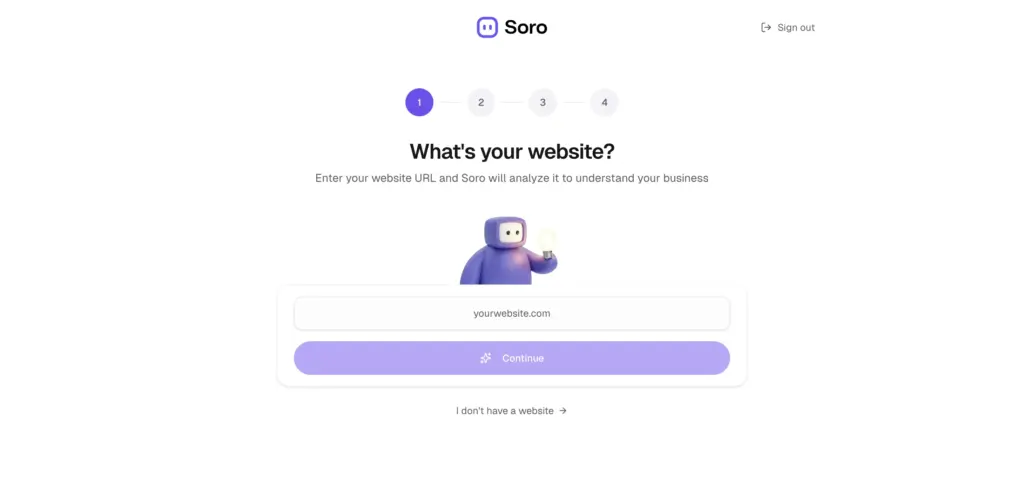
The next step is more interesting for publishers who already have an established niche site. Soro analyses the website and creates a written Brand Voice profile, along with a list of Key Themes based on existing content.
During a test on a SaaS review website, Soro described the brand as expert-guide and customer-aligned. It also identified eight different content themes without requiring manual keyword input.
This type of onboarding can help affiliate publishers who want new articles to maintain a similar tone to their existing content. For example, a technology affiliate site may use a conversational but informative writing style, while a B2B software review website may prefer a more professional and detailed approach.
A Brand Voice profile can provide a useful starting point, but it should not be considered a guarantee that every article will sound exactly like the publisher's original writing. A manual review is still needed to check tone, accuracy and consistency.
Language and AI Image Styles
Soro also includes a content language selector covering multiple languages. This may be useful for publishers operating websites that target different markets or audiences.
Users can select the visual style for AI-generated images. Available styles include:
- Clean & Minimal
- Photorealistic
- Watercolor
- 3D Render
- Vintage
- Abstract

For affiliate websites, featured images can help make review articles and comparison pages more visually consistent. However, publishers should avoid using AI-generated images when an article requires an accurate product photograph, real testing image or screenshot.
For example, a software review should ideally include genuine screenshots of the dashboard, features and user interface. An AI-generated image can be used as a supporting visual, but it should not replace evidence of actual product testing.
Keyword Discovery With Article Ideas
Keyword discovery is one of the most important steps in an affiliate content workflow. Publishers need to identify search terms that match the audience's needs and have the potential to attract relevant traffic.
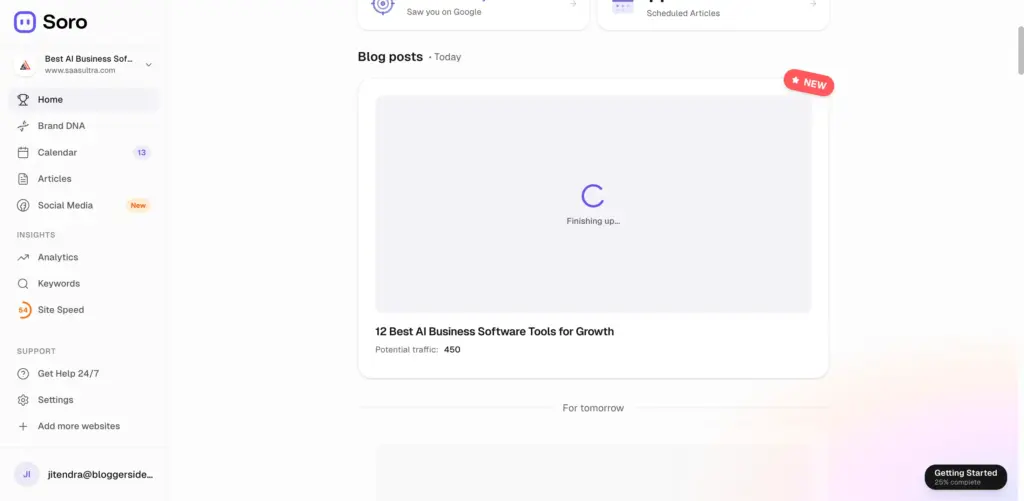
Soro presents suggested article titles instead of showing only a standard list of keywords. Each title also includes an estimated monthly traffic boost.
This makes the process more practical for publishers who want to move from keyword research to actual content planning.
For an affiliate website, the suggested topics could include:
- Best products for a specific use case
- Product comparison articles
- Alternatives to popular software
- Detailed product reviews
- Buying guides
- Supporting informational content
For example, a publisher operating a website focused on SEO tools may want to create articles such as “Best Keyword Research Tools for Small Businesses” or “Tool A vs Tool B.” A website focused on consumer technology may instead target comparison articles, product buying guides and smartphone reviews.
The traffic estimates should be treated as estimates rather than guaranteed results. Ranking potential depends on several factors, including competition, search intent, website authority, backlinks, content quality and how well the article answers the reader's question.
After the keyword discovery stage, Soro completes the setup and begins generating the first article.
What Soro's Daily Content Workflow Looks Like?
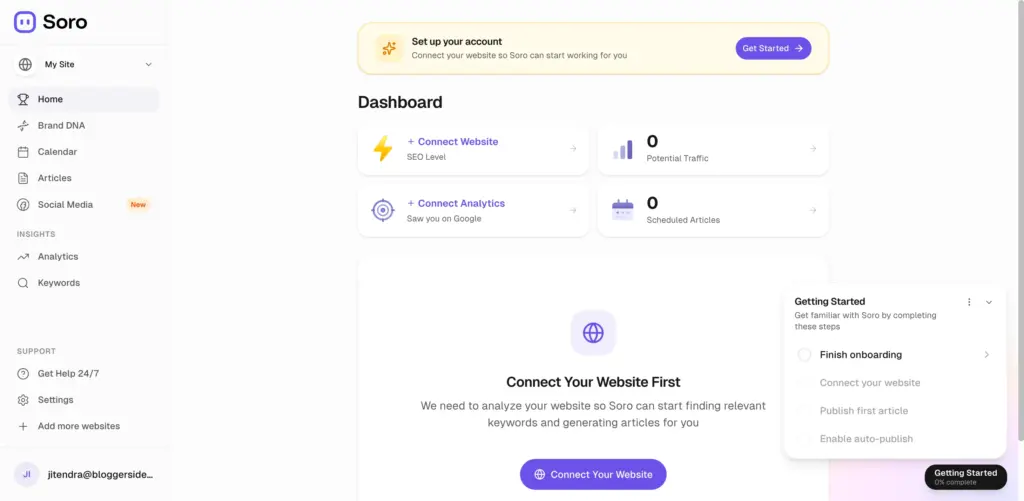
Once onboarding is complete, Soro provides a dashboard for tracking the content pipeline. It displays information such as SEO Level, Potential Traffic and the number of articles in the queue.

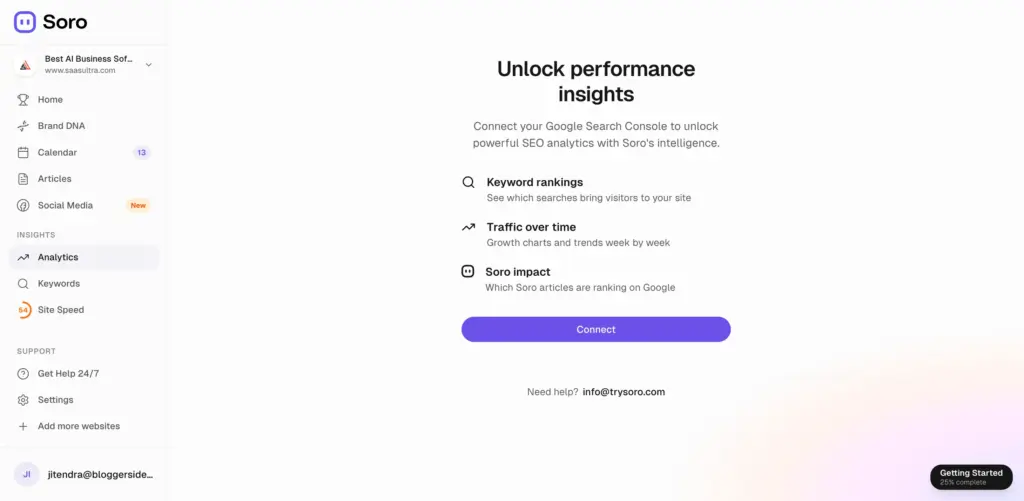
The dashboard also includes a prompt to connect analytics. This can help publishers monitor how their content performs after publication, although the quality of the insights depends on the analytics data available.
For affiliate publishers, the main benefit of a central dashboard is organisation. Managing one website may be relatively easy, but operating several niche sites can require a more structured workflow.
Content Scheduling for Affiliate Websites
Soro includes a calendar-based scheduling feature that allows users to plan articles across upcoming days and weeks.
Articles can be arranged in advance, and days without a manually assigned topic may be automatically filled by Soro. This allows the content pipeline to continue without requiring the publisher to select every topic individually.
This feature may be helpful for publishers who need to maintain regular output across multiple websites. For example, an affiliate publisher managing technology, SaaS and productivity sites could use a calendar to organise upcoming reviews, comparison articles and informational content.
However, consistent publishing should not be confused with a complete content strategy. Affiliate publishers need to balance different types of content rather than publishing large numbers of similar articles.
A practical publishing plan may include:
- Product reviews targeting commercial keywords.
- Comparison articles for readers evaluating multiple options.
- Informational articles that attract relevant organic traffic.
- Updates to older reviews when prices or features change.
- Supporting content that links to important money pages.
- Content created around seasonal trends and product launches.
Automatically filling the calendar can save time, but publishers should still review the suggested topics. A high publishing frequency is useful only when the content is relevant, accurate and valuable to the target audience.
SEO Score Inside the Article Editor
Soro provides a live SEO score inside its article editor. The score is broken down into several on-page factors, making it easier to identify areas that may need improvement.
The editor checks factors such as:
- Keyword usage
- Word count
- Readability
- Heading count
- Meta description length
- Title length
- Featured image
- Links
One sample article received a score of 100, with the individual factors clearly displayed rather than being hidden behind one overall number.
This can be useful for publishers who want a quick on-page SEO checklist before publishing an article. It may also help newer affiliate website owners understand some of the basic elements of article optimisation.
However, an SEO score alone cannot predict whether an article will rank on Google. A page may meet technical on-page requirements and still fail to perform because it does not provide enough original information or does not match search intent.
Affiliate publishers should look beyond the score and review whether an article includes accurate product details, useful comparisons, original insights, relevant internal links and a clear structure.
A product review with perfect on-page optimisation can still be weak if it simply repeats information from the manufacturer's website.
Social Media Publishing
Soro also has a Social Media tab for connecting Facebook and Instagram.
Once connected, the platform can automatically share published articles. This is a straightforward way to extend the reach of content that has already been published.
The feature is more focused on sharing published content than on providing a complete social media management system. Publishers looking for detailed campaign planning, advanced scheduling, audience analytics or multi-platform content creation may need additional tools.
For affiliate publishers, social sharing can be useful as a supplementary traffic source. However, social media posts should not be considered a replacement for SEO, email marketing or a broader audience-building strategy.
Soro Pricing: Monthly, Quarterly and Annual Plans
Soro offers monthly, quarterly and annual billing options. The entry-level pricing is publicly available, although publishers should check the live pricing page for the latest plan details, limits and inclusions.
| Billing plan | Effective monthly cost | Approximate saving |
| Monthly | $39 | — |
| Quarterly | $27 | Around 31% compared with monthly billing |
| Annual | $18 | Around 54% compared with monthly billing |
The monthly plan costs $39 per month and can be cancelled before the next renewal. It includes approximately 30 articles per month, along with core features such as keyword research, Brand Voice matching, on-page SEO scoring, AI image generation and direct CMS publishing.
Quarterly billing brings the effective monthly cost to around $27, while the annual plan reduces it further to approximately $18 per month.
For an affiliate publisher, pricing needs to be considered alongside the amount of content that can realistically be reviewed and maintained.
A publisher may be able to generate 30 articles a month, but that does not necessarily mean all 30 should be published without editing. Commercial content often requires additional time for checking product specifications, reviewing pricing, adding affiliate links and ensuring that comparisons are accurate.
The entry-level plan may be more suitable for publishers who want to create a steady stream of supporting content or test an AI-assisted workflow. Publishers operating multiple websites should confirm the number of websites, article limits and publishing restrictions included in their selected plan.
Higher-Tier Plans
Soro also offers higher-volume plans for publishers who need more content output. However, pricing and limits for these plans are not consistently published in the information reviewed.
Anyone planning to use Soro for a larger affiliate operation should confirm the following before upgrading:
- Monthly article limits.
- Number of supported websites.
- Available CMS integrations.
- Image generation limits.
- Content scheduling restrictions.
- Additional costs, if any.
- Whether the plan supports the required publishing workflow.
This is particularly important for agencies and publishers managing multiple client or niche websites.
Free Trial and Money-Back Guarantee
Soro does not currently offer a free trial. Instead, plans include a 14-day money-back guarantee.
This means users need to pay upfront and request a refund within the applicable period if the platform does not meet their expectations.
The refund policy is different from a free trial, so users should read the relevant terms before subscribing. Publishers can use the initial period to evaluate the quality of generated drafts, the accuracy of keyword suggestions and the compatibility of the publishing workflow with their website.
CMS Integrations and Custom Automation Support
Soro supports direct publishing to several platforms, including:
- WordPress
- Shopify
- Webflow
- Ghost
- HubSpot
- Notion
- Wix
- Next.js
This range of integrations can be useful for affiliate publishers who operate websites on different platforms. WordPress users, in particular, may find direct publishing helpful because many affiliate websites rely on WordPress for content management.
However, there is an important limitation for publishers building custom workflows.
Soro does not currently offer a public API or MCP server. This means publishers cannot rely on a publicly available API or MCP connection to integrate Soro directly into their own scripts, external SEO tools or independent AI agents.
Soro does support webhooks for custom integrations. Webhooks can help connect certain Soro events to external systems, depending on the available triggers, payloads and documentation.
Publishers planning a custom automation setup should confirm which webhook events are supported and whether the available data is sufficient for their workflow.
For example, a publisher may want to send a notification to a project management tool when an article is ready for review. Whether this specific workflow is possible depends on the webhook functionality Soro currently provides.
The distinction between webhooks, a public API and an MCP server is important. Webhooks can send information when supported events occur, while an API generally allows external systems to request and manage data through defined endpoints. An MCP server is a separate integration mechanism for connecting AI systems with tools and data.
Soro's webhook support provides some flexibility, but it should not be presented as equivalent to having a public API or MCP server.
How Soro Can Help Affiliate Publishers?
Soro's potential value becomes clearer when it is considered in the context of affiliate publishing rather than general blogging.
Affiliate publishers often need to manage a large number of articles with different search intents. They may publish a product review one day, a comparison article the next and an informational guide after that.
Soro can help with parts of the initial research, drafting and scheduling process, but publishers should retain control over the editorial and commercial decisions.
1. Scaling Product Review Content
Product reviews are a major part of many affiliate websites. A publisher covering software, technology, home appliances or online services may need to publish multiple reviews within the same category.
Soro can potentially help generate initial drafts and organise the content schedule. The publisher can then improve the article by adding information from actual testing and research.
A useful affiliate review should ideally include:
- An explanation of who the product is for.
- Main features and limitations.
- Pricing and available plans.
- Hands-on testing or clearly identified research.
- Comparison with relevant alternatives.
- Pros and cons.
- Information about customer support and integrations.
- Clear affiliate disclosures.
- Relevant affiliate links.
AI-generated content may speed up the initial writing process, but it should not create the impression that the publisher has personally tested a product when they have not.
This is especially important for SaaS reviews. A publisher should verify whether the software actually includes a specific feature, whether pricing varies by plan and whether the product works as described.
Soro can help create a first draft, but the responsibility for the final review remains with the publisher.
2. Maintaining Niche Websites
Publishers managing multiple niche websites may use Soro to organise their publishing schedule and maintain a regular content flow.
For example, one website might focus on SEO tools, another on productivity software and a third on consumer technology. Each site needs its own content themes, audience expectations and editorial style.
Soro's Brand Voice feature may help create a starting point for maintaining consistency across articles. The calendar can also help publishers plan content ahead of time.
However, each niche requires individual oversight. A technology article may need accurate hardware specifications, while a software comparison may require checking pricing, integrations and feature availability.
Publishers should also regularly update older articles. Product prices, software plans and availability can change, and outdated information may affect both reader trust and affiliate conversions.
3. Publishing Comparison Articles
Comparison articles can be particularly valuable for affiliate websites because they address readers who are evaluating different products.
Examples include:
- Product A vs Product B.
- Best alternatives to a specific tool.
- Free vs paid software.
- Different versions of the same product.
- Best options for beginners or advanced users.
Soro's keyword discovery workflow may help publishers identify potential comparison topics and create an initial article structure.
However, the comparison needs to be fact-checked. A useful comparison should explain how products differ in terms of features, pricing, usability, limitations and suitability for different audiences.
The article should not simply declare one product the winner without explaining the criteria. Readers may have different requirements, and affiliate publishers should provide enough information for them to make an informed decision.
Comparison articles should also be updated when products introduce new features, change their pricing or discontinue a plan.
4. Supporting Organic Traffic Growth
Organic traffic is an important source of visitors for many affiliate websites. Soro's keyword discovery and SEO scoring features may help publishers organise content around potential search opportunities.
A practical workflow could involve:
- Finding keywords relevant to the website's niche.
- Understanding the search intent behind each keyword.
- Creating useful informational and commercial articles.
- Building internal links between related pages.
- Publishing detailed product reviews and comparisons.
- Monitoring performance through analytics and Search Console.
- Updating content based on rankings, traffic and product changes.
Soro can assist with some of these steps, but it cannot guarantee search rankings or affiliate revenue.
Traffic estimates shown during keyword discovery should be treated as planning information rather than a promise of future performance. Search results can change, and competition may be higher than expected.
Publishers should also avoid creating large numbers of articles only because a tool suggests them. Content should serve a clear purpose and provide useful information to readers.
Pros and Cons: Soro SEO Review
Soro brings several content production features into one platform, which may be useful for affiliate publishers looking to streamline their workflow.
Pros
- Simple website onboarding.
- Brand Voice analysis based on existing content.
- Suggested article titles through keyword discovery.
- Content scheduling through a calendar.
- SEO scoring inside the editor.
Cons
- No free trial is currently available.
- Users must pay upfront and rely on the 14-day money-back guarantee.
The Brand Voice feature may be useful for established websites, while the scheduling system can help publishers organise recurring content production.
The SEO score also provides a quick way to check basic on-page elements before publication.
Soro may not be the right fit for agencies that need granular keyword-level control, detailed editorial briefs or deep integration with a custom automation stack.
It may also be unsuitable for high-stakes topics, including medical, legal and financial content, unless qualified professionals provide appropriate review and oversight.
FAQs: Soro SEO Review
Soro's reported entry-level pricing starts at $39 per month with monthly billing. Quarterly and annual plans reduce the effective monthly cost. Prices and plan features should be confirmed on the official website before subscribing.
Soro does not currently offer a free trial. It provides a 14-day money-back guarantee instead. Users should review the refund terms before making a payment.
Soro may help affiliate publishers with keyword discovery, article drafting, content scheduling, comparison content and routine niche website maintenance. Human review is still necessary for product information, pricing, links and editorial quality.
Soro can assist with the content generation process, but publishers should add verified product information, original insights and relevant comparisons. AI-generated content should not claim first-hand testing that has not taken place.
Yes, Soro supports direct publishing to WordPress and several other platforms. Available features may depend on the selected plan and current integration support.
No public API or MCP server is currently offered. Soro does support webhooks for custom integrations. Publishers should confirm the available webhook events and technical documentation before planning a custom workflow.
Automatic publishing should be used carefully. Affiliate publishers should review factual claims, product details, internal links, affiliate disclosures and overall usefulness before articles go live.
No AI content platform can guarantee search rankings or organic traffic. Soro's keyword estimates and SEO scoring can support planning, but actual performance depends on content quality, competition, website authority and search intent.
High-stakes content requires specialised review and careful fact-checking. Soro should not be relied on as a substitute for qualified human oversight in medical, legal or financial publishing.
Quick Links:
Latest information about TrySoro on Social Media
I just HACKED the AI Overview using Google itself 😂
AI SEO is not that difficult when you've been reverse engineering search engines for nearly two decades, and can spot the most powerful parasite instantly!!
The ONLY source cited? My page.. So I just used the fact that Google… pic.twitter.com/AaQ4iVg5pD
— Charles Floate 📈 (@Charles_SEO) September 19, 2026
Final Verdict: Should Affiliate Publishers Use Soro?
Soro is designed to bring several stages of the content workflow into one platform. It can help with keyword discovery, article generation, AI image creation, SEO checks, scheduling and direct publishing.
For affiliate publishers, its main potential benefit is reducing the repetitive work involved in maintaining niche websites. Publishers may use it to plan supporting content, create initial drafts for product reviews and comparison articles, and organise a regular publishing schedule.
The platform may be particularly useful for solo publishers and small teams that need assistance with content production but still want to manage editorial decisions themselves.
However, scaling content is not the same as scaling a successful affiliate business. A website needs accurate information, relevant search intent, original insights and content that helps readers make decisions. Publishing more articles without proper review can create quality issues and weaken reader trust.
Soro's SEO score can help identify basic on-page improvements, but it should not be used as a substitute for a complete SEO strategy. Similarly, traffic estimates can support topic planning but cannot guarantee rankings or revenue.
The platform's integration options also deserve attention. Soro supports several CMS platforms and provides webhooks for custom integrations, but it does not currently offer a public API or MCP server. This may limit the options available to publishers building complex automation systems around external tools or AI agents.
Soro is best considered an AI-assisted content production platform rather than a fully hands-off affiliate publishing solution. It can help publishers save time on research, drafting and scheduling, but human involvement remains important for fact-checking, product testing, comparison quality, internal linking and affiliate compliance.
For publishers who want to increase content output while maintaining editorial control, Soro may be worth evaluating through its available plans and refund period. The decision should ultimately depend on the website's content requirements, publishing volume, budget and need for custom integrations.