
Meta shares climbed more than 7% on July 10 after the company confirmed it is building a standalone cloud infrastructure business, internally called Meta Compute, that will sell surplus AI computing power and hosted models to outside customers — putting Meta into direct competition with Amazon, Microsoft and Google for the first time.
An internal memo revealed plans to double Meta's total computing power by 2027, backed by long-term chip supply deals and a new $10 billion, 1-gigawatt data center in Alberta, Canada. Bloomberg covered the plan in detail here.
Two Layers: Raw Compute and Hosted Models
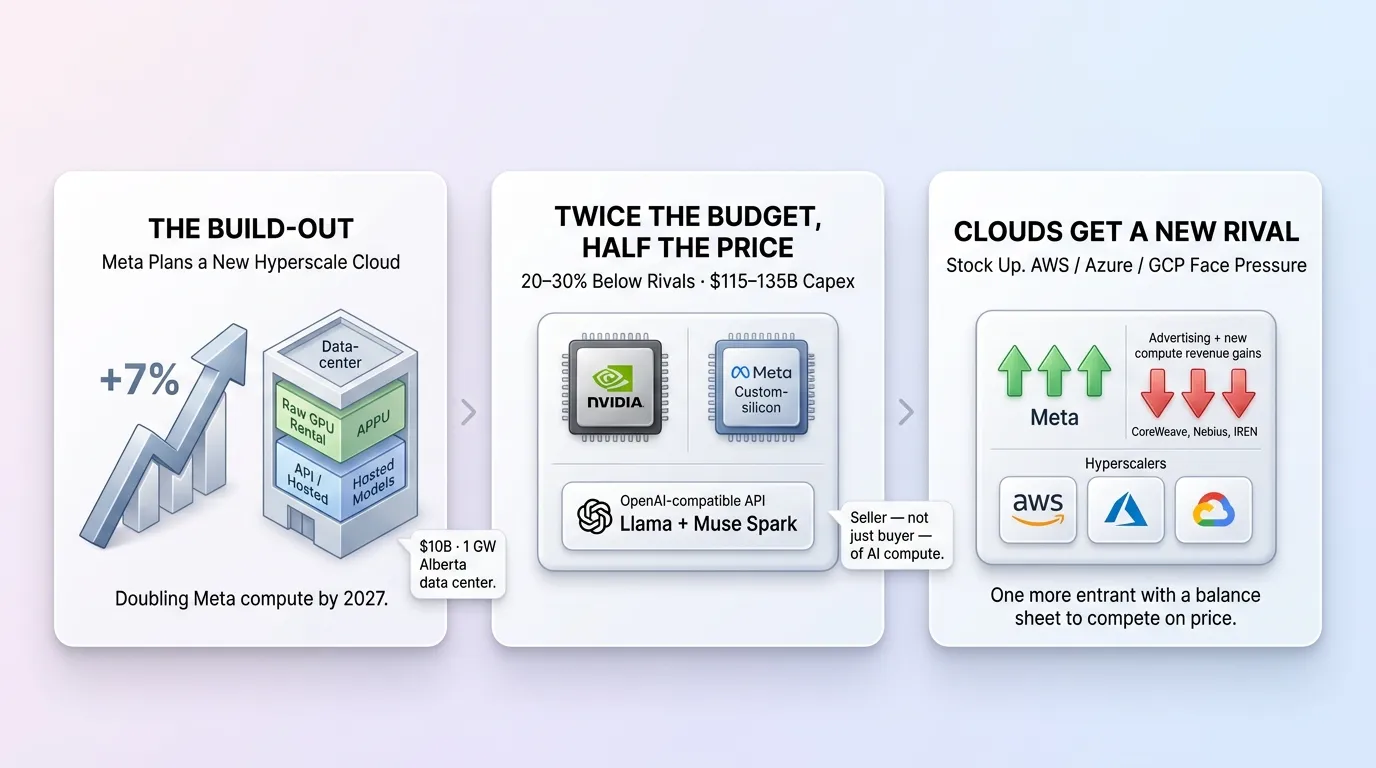
Meta Compute is structured around two offerings. The first is raw GPU rental — access to Nvidia's latest chips alongside Meta's own custom silicon — aimed at companies that need training or inference capacity without building their own data centers. The second is a fully managed, OpenAI-compatible API layer for hosted models, including Meta's Llama family and the newly launched Muse Spark suite.
Meta is reportedly pricing the service 20-30% below rivals, a strategy funded by capital expenditure guidance of $115 billion to $135 billion for 2026 alone, most of it earmarked for AI capacity. The logic: after years of aggressive data center buildout for its own AI ambitions, Meta now has enough spare capacity to become a seller rather than only a buyer of compute.
Winners and Losers on Wall Street
The market reaction was immediate and split. Meta's own stock rose on the news as investors welcomed a new potential revenue stream beyond advertising. But shares of dedicated AI infrastructure providers — including CoreWeave, Nebius and IREN — fell as investors priced in a deep-pocketed new competitor entering the rental-compute market with scale few rivals can match.
The move also reframes how Meta is positioned relative to Amazon Web Services, Microsoft Azure and Google Cloud, which have long treated hyperscale cloud as a core business rather than a byproduct of internal AI investment.
Analysts are split on whether Meta Compute represents a genuine long-term platform play or a way to better utilize capacity that was arguably overbuilt during the industry's AI infrastructure race. Either way, it signals that the AI compute market — long dominated by a handful of specialized and hyperscale players — now has one more major entrant with the balance sheet to compete on price.
Meta has not yet detailed a broad customer rollout timeline for Meta Compute beyond the initial capacity commitments already announced.
Quick Links: