

MangoProxy is a next-generation global proxy provider offering dynamic and static Residential, ISP, Mobile, and Datacenter proxies.
Pros
- 99.7%+ network uptime
- New Average response time below 0.7 seconds
- 90+ million IP addresses
- 24/7 technical support
- Support for HTTP and SOCKS5 protocols
- User-friendly dashboard and API integration
- Clean IP reputation with a low risk of blocks
- Coverage in 200+ countries for dynamic proxies and 30+ countries for static proxies
- Residential, ISP, Mobile, and Datacenter proxies (both dynamic and static)
Cons
- Customer support response times may vary
- No free trial on some plans
I'll be honest with you. I did not expect to like Mango Proxy this much. But my hands-on Mango Proxy review after real testing. Residential from $0.6/GB, 90M+ IPs, anti-detect integration, speeds, honest downsides, and who it suits.
When a proxy provider is barely two years old, my guard goes up. The proxy world is full of shiny new names that vanish six months later, taking your prepaid balance with them. So when I first loaded up a small amount of traffic on Mango Proxy, I did it the way I test every new provider: cautiously, with money I could afford to lose, and a long list of ways it might disappoint me.
Three months later, it is one of the proxies I reach for without thinking. That does not happen often. Let me walk you through exactly why, what it does well, where it falls short, and whether it deserves a place in your stack too. This is my real experience, not a spec sheet dressed up as an opinion.
What Mango Proxy Actually Is
MangoProxy is a next-generation global proxy provider offering dynamic and static Residential, ISP, Mobile, and Datacenter proxies.
The platform is designed for professionals who require stable connections, high-quality IP addresses, and extensive geographic coverage for demanding workloads. The service covers more than 200 countries and provides access to a pool of over 90 million IP addresses.
MangoProxy is widely used for affiliate marketing, web scraping, multi-account management, market research, SMM, automation, SEO, and other professional use cases. The average response time is under 0.7 seconds, with a network uptime of 99.7%+.
The platform includes an intuitive dashboard and API for seamless integration with third-party tools. It supports both HTTP and SOCKS5 protocols, while 24/7 technical support is available to assist users at any time.
Why I Actually Kept Using It
Here is the thing that won me over, and it is not the raw numbers. Plenty of providers boast about huge IP pools.
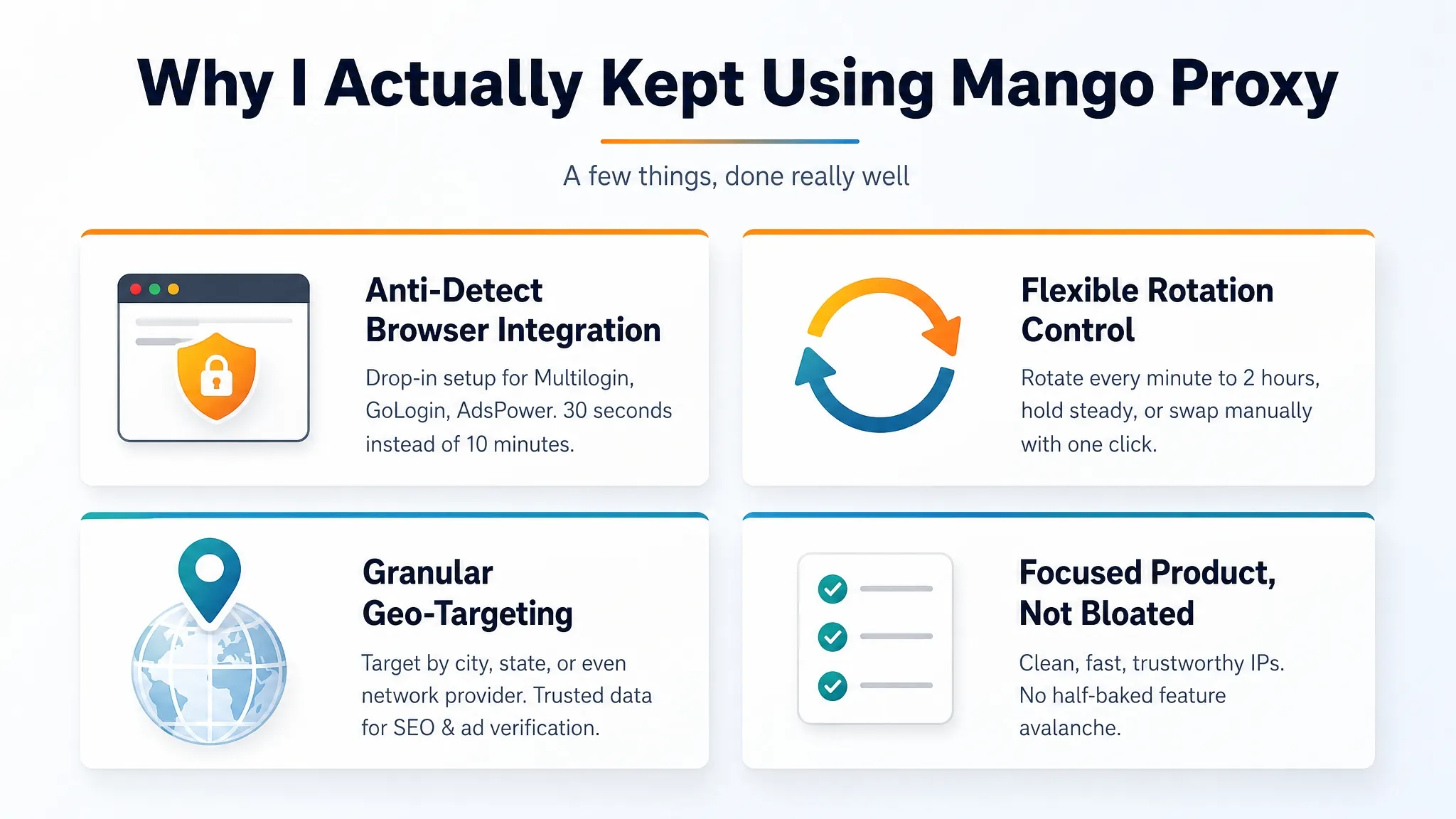
What I liked is that Mango does a few things and does them well, instead of drowning you in a hundred half-baked features. I have used the big providers with their endless dashboards full of tools that half work and mostly exist to justify a bigger bill. Mango feels like the opposite. It focuses on delivering clean, fast, trustworthy IPs, and it makes them easy to actually use.
The feature that genuinely surprised me was the anti-detect browser integration. If you run multiple accounts, you probably use an anti-detect browser like Multilogin, GoLogin, or AdsPower to keep each profile separate. Setting up proxies inside those tools is usually a fiddly, error-prone chore.
Mango formats its proxies to drop straight into whichever anti-detect browser you use. The first time I connected a profile in about thirty seconds instead of ten frustrating minutes, I actually said “oh, nice” out loud to an empty room. It is a small thing that saves real time when you are managing dozens of profiles.
The rotation control is the other piece I lean on. You can set IPs to rotate anywhere from every minute up to two hours, or hold one steady, or swap it manually with a single click mid-session. That flexibility matters. Some tasks need a fresh IP constantly; others, like keeping an account logged in, need the same IP to stay put. Mango lets you decide instead of forcing one behavior on you.
Geo-targeting is included and granular. You are not stuck with “somewhere in the US.” You can drill down to a specific city or state, or even target by the network provider itself. For local SEO checks or ad verification, that authenticity is the difference between data you can trust and data you cannot.
The Speeds: What I Measured
I do not take a provider's word on speed. I test it. And here is where Mango genuinely impressed me.
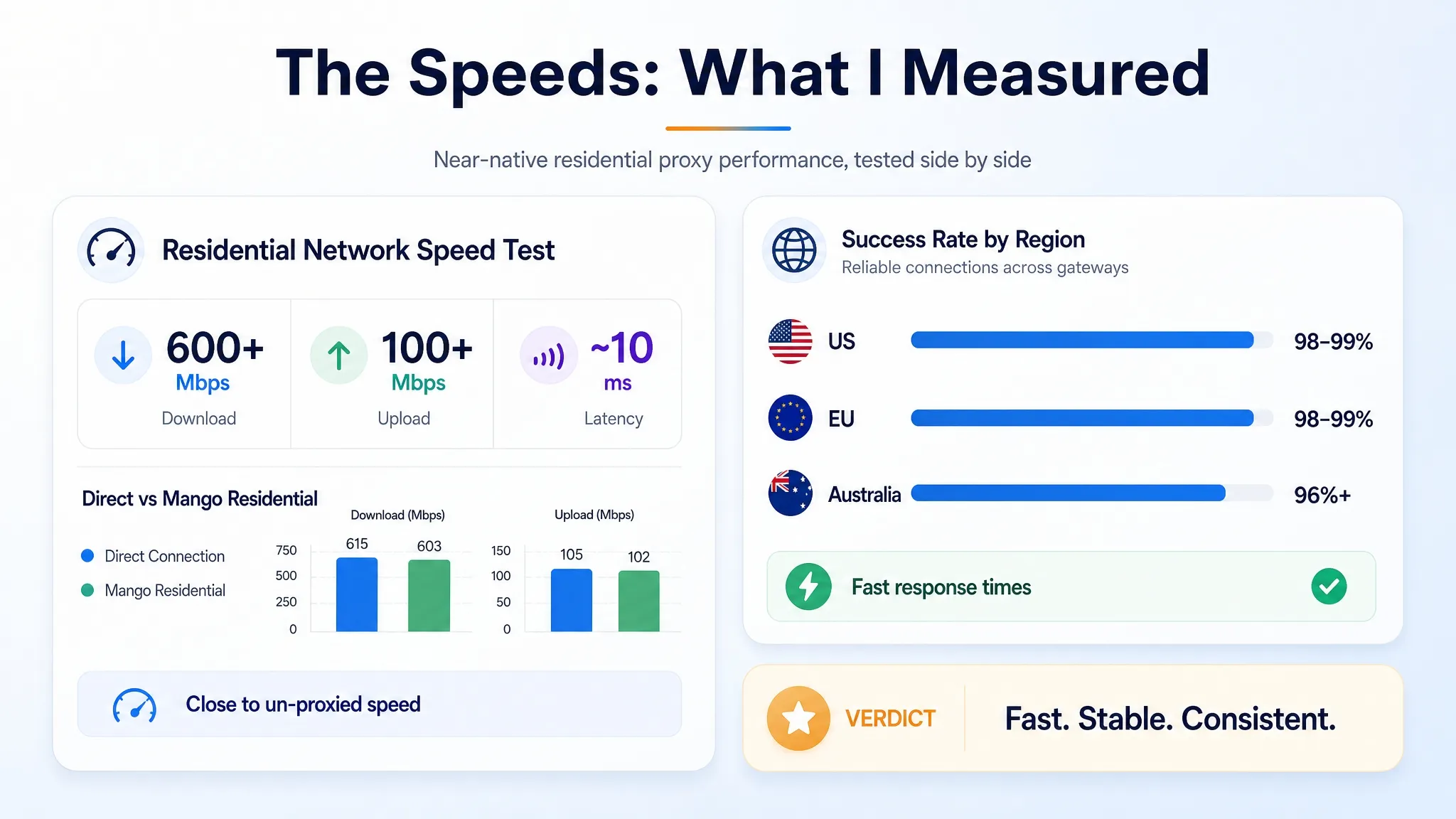
When I ran a straight speed test through their residential network, the connection came back close to my direct, un-proxied speed, which almost never happens. Download speeds sat well over 600 Mbps, upload over 100 Mbps, and ping around 10 ms. For a residential proxy, that is excellent. Most residential IPs add noticeable lag because they route through real home connections, so getting near-native speed felt like a genuine win.
I also checked how reliably the IPs connected across different regions, because a big pool means nothing if the IPs keep failing. Across the gateways I tried, the success rates were strong and consistent.
The EU and US pools were the standouts, both clearing 98 to 99% success with fast response times, and even the further-flung regions like Australia stayed above 96%. In my own day-to-day scraping and account work, I rarely hit a dead IP, and when I did, a quick rotation fixed it instantly.
Are these the fastest proxies on Earth? I would not make that claim, and neither should anyone honest. But they are fast, stable, and consistent, which is what actually matters when you are running real work through them for hours at a stretch.
What I Use Mango Proxy For
Let me get specific, because “proxies are useful” helps nobody. Here is where Mango has earned its place in my workflow.
1. Managing multiple accounts
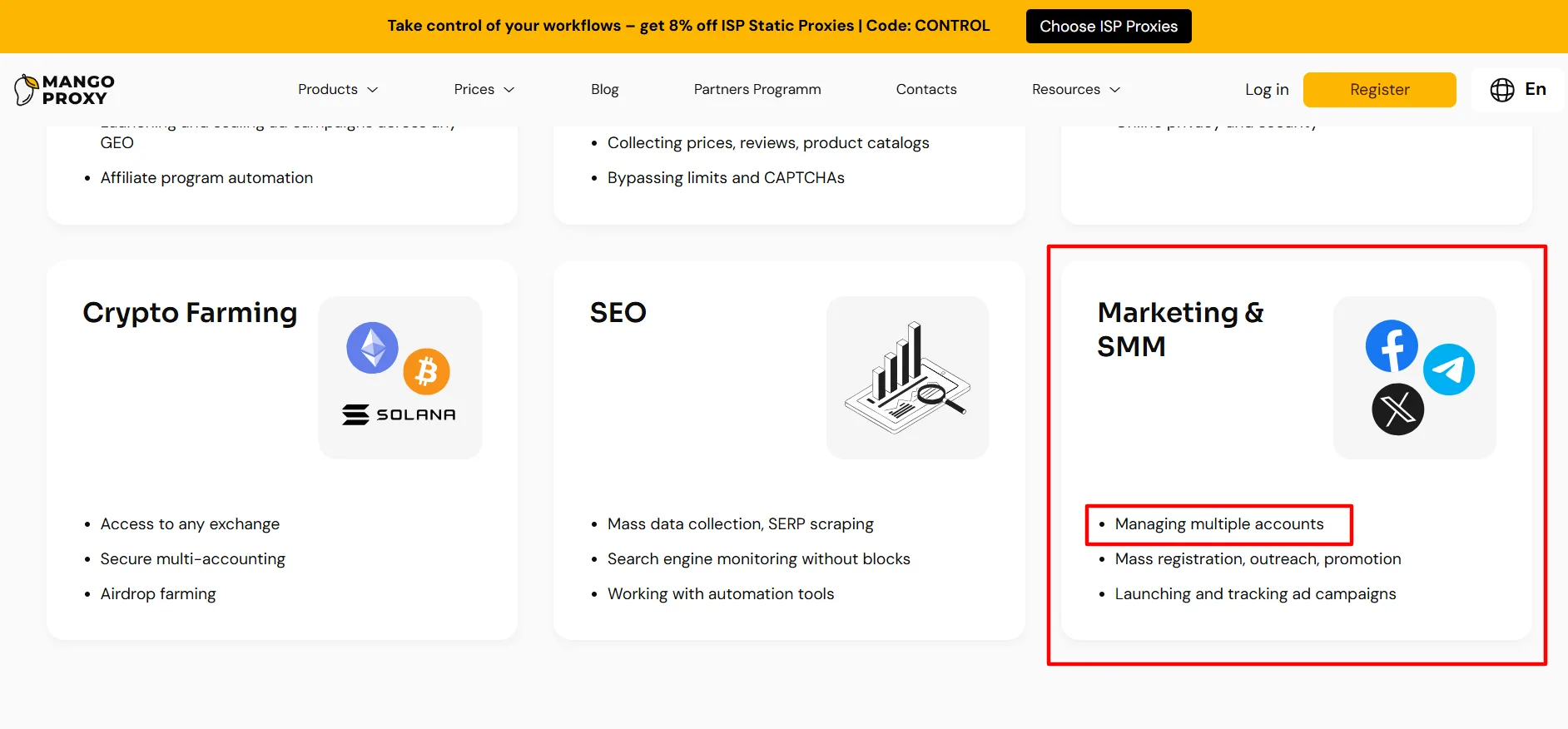
This is my biggest use. Between the anti-detect integration and the trustworthy residential IPs, I can run many profiles across social and e-commerce platforms without them getting linked or flagged. Each profile gets its own believable IP, and the platforms treat them as separate real people.
2. Web scraping and data collection
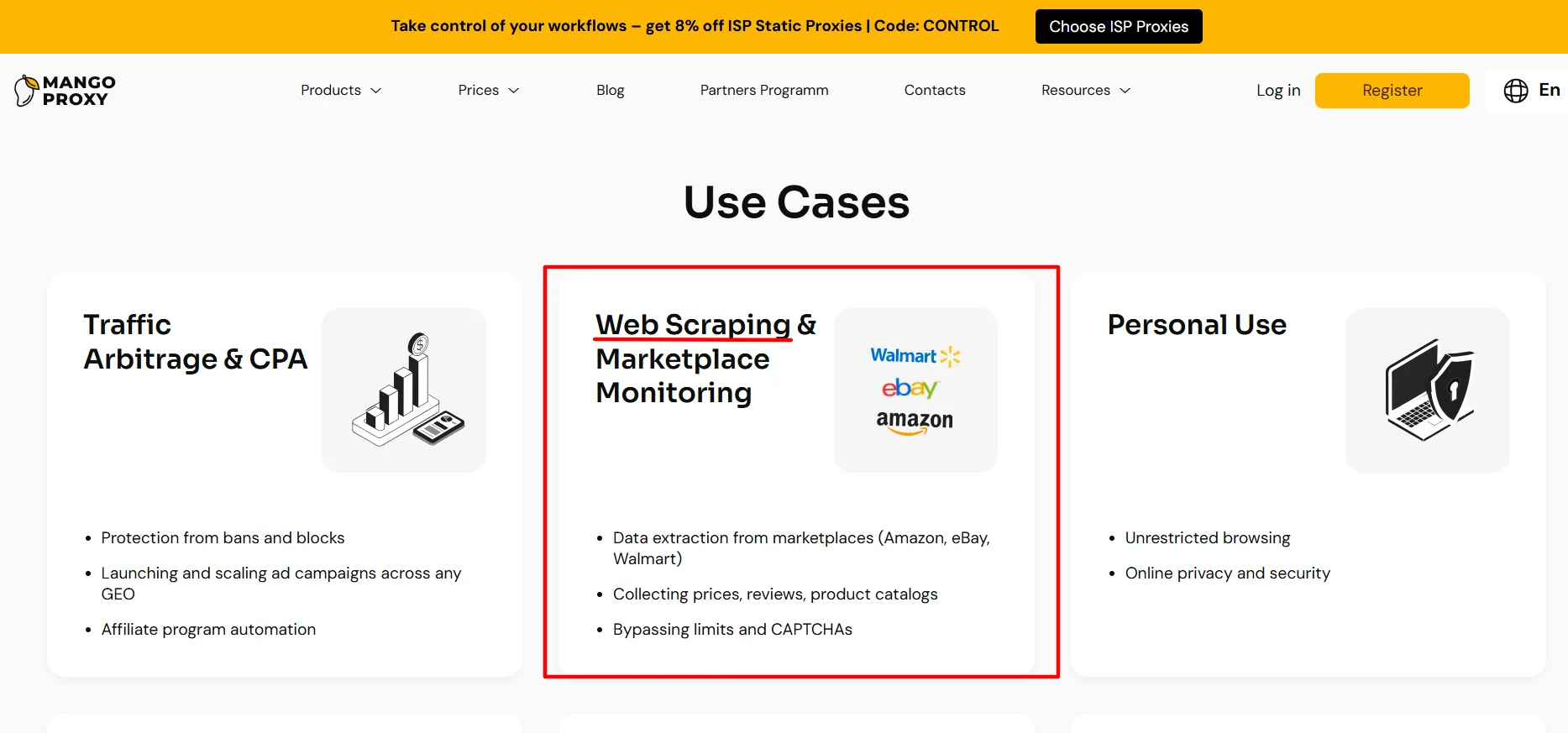
When I need to pull data at scale, the rotating residential pool lets me spread requests across thousands of IPs so I do not get rate-limited or blocked. The high success rates mean fewer failed requests and cleaner data.
3. Ad verification and local SEO
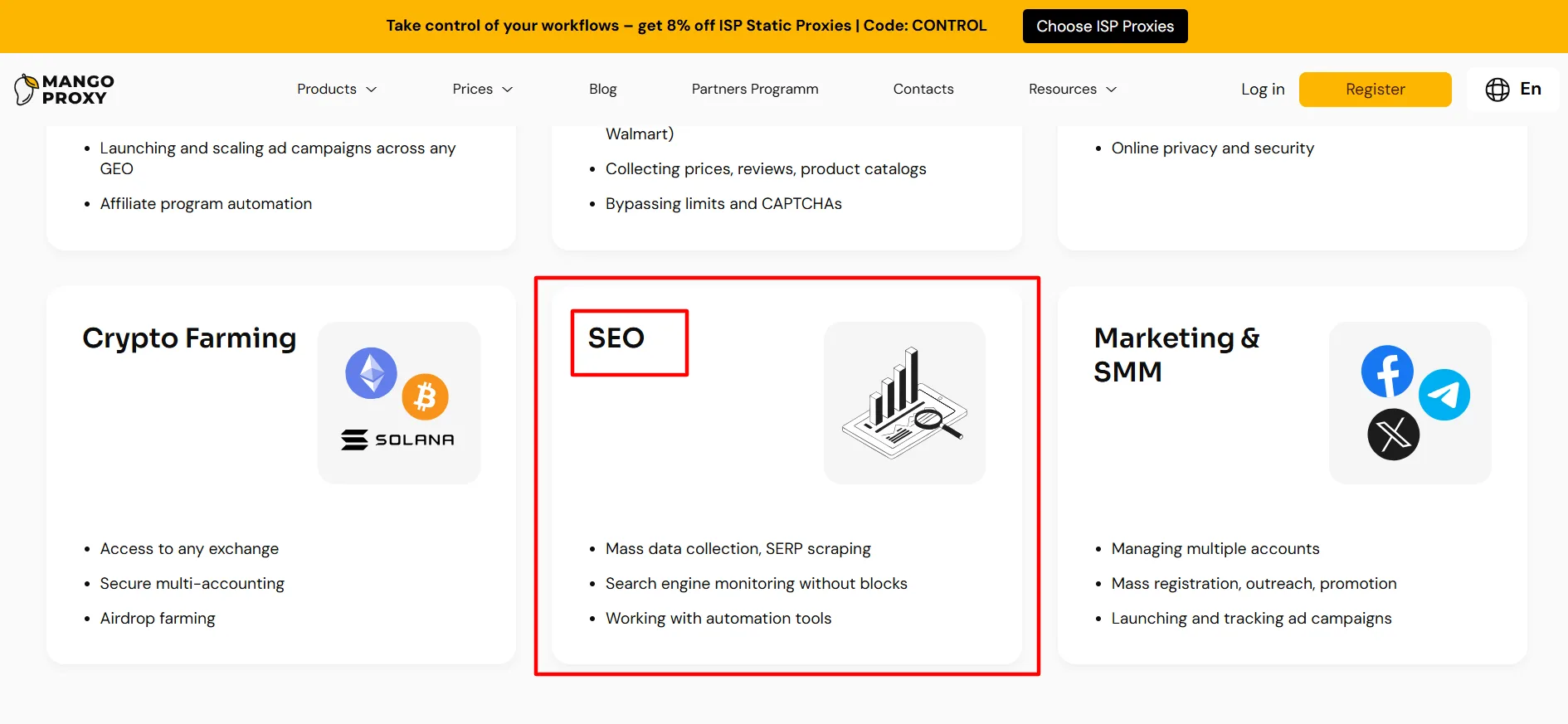
Because I can target a specific city, I can see exactly what a real person in that location would see, whether that is a search result, a localized price, or an ad placement. That city-level control is genuinely useful and not something every provider offers for free.
4. Handling captchas at volume
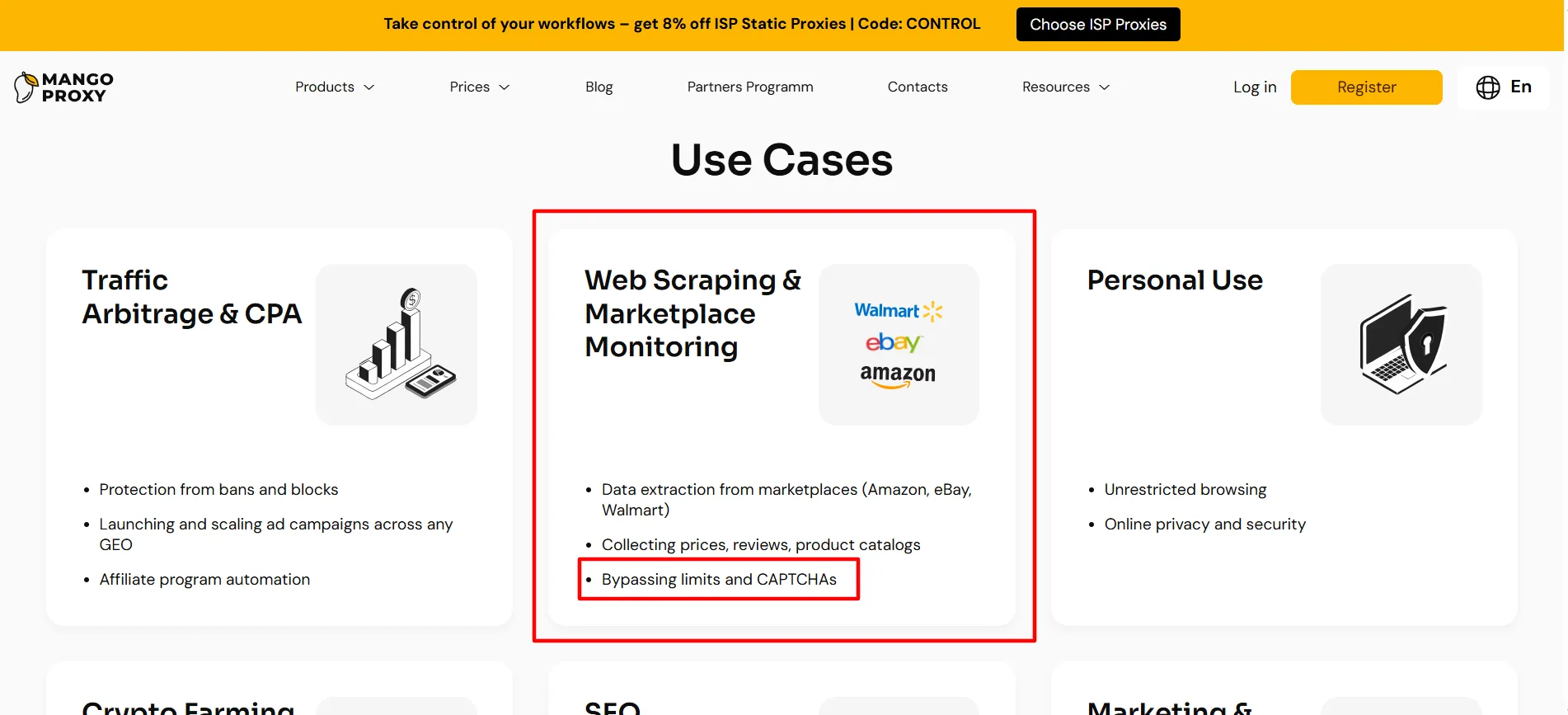
Anyone running automation knows captchas can grind everything to a halt. Rotating fresh IPs through Mango keeps me moving instead of getting stuck in verification loops.
One detail worth flagging for anyone doing email work: Mango keeps mailing ports open, which many providers block. If you run outreach or deliverability testing, that is a rare and useful touch.
The Pricing, Explained Honestly
Here is where I want to be straight with you, because proxy pricing is deliberately confusing across this whole industry.
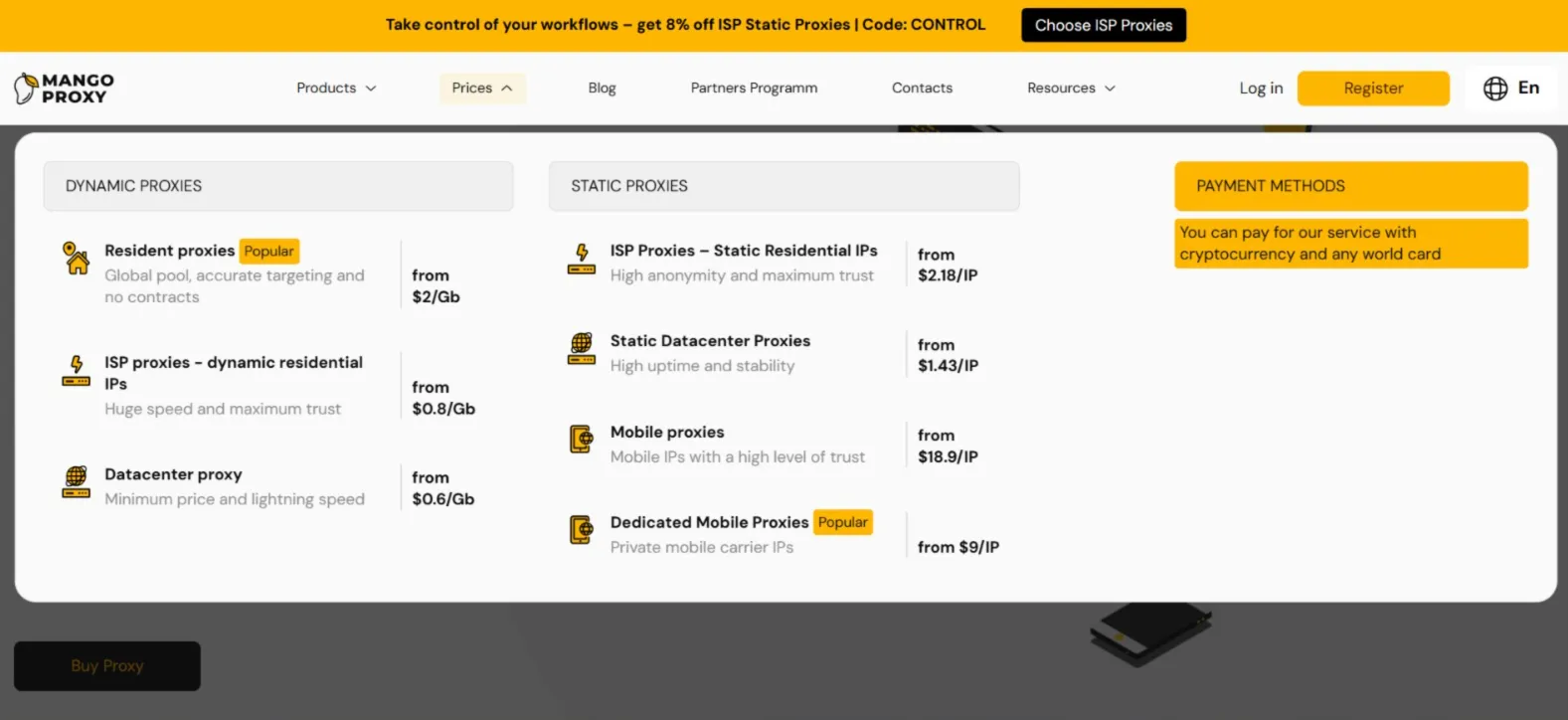
Mango's residential proxies start from around $0.6 per GB at the entry point the website advertises, which is genuinely cheap for residential traffic. In practice, the price you pay depends on how much you buy. Pay-as-you-go, small-volume rates sit higher, and the per-GB cost drops steadily as you commit to larger packages, all the way down to a couple of dollars per GB at serious business volumes. That is normal for the industry, so read the tiers rather than fixating on the headline number.
The static datacenter and ISP proxies start from around $1.9 per IP, and mobile proxies from around $9 per IP with unlimited traffic. There is usually a promo code floating around too; at the time I'm writing this, there's a discount on ISP static proxies, so it is worth checking for an active code before you buy.
Two things I appreciated about the billing. First, your traffic does not expire at the end of the month, so buying a chunk of GB does not become a use-it-or-lose-it panic. Second, there is a near-free way to test: for a very small amount you can buy 1 GB and try the network properly before committing real money. I always recommend doing exactly that with any provider, and Mango makes it easy.
Payments go through cards and a wide range of cryptocurrencies, and I did not run into hidden fees. There is also a short refund window, but with a strict condition: you cannot have used even a kilobyte of the traffic. So decide before you touch it, not after.
BOOSTER – 8% off Static ISP Proxies.
Use coupon code BOOSTER to get an exclusive 8% discount on MangoProxy Static ISP Proxies. Verified partner deal for new customers.
The Honest Downsides: Mango Proxy Review
No review is worth reading if it only gushes, so here is where Mango falls short. It would be dishonest to pretend it is perfect.
It is still young
Two years is not nothing, but it is not a decade either. There is less independent, long-term track record than you get with the old enterprise names. I have had a good run, but I would not yet route a mission-critical operation entirely through any provider this new without a backup.
The product range is narrow
Mango focuses tightly on its core proxy types and skips the sprawling toolkits of the big players. I personally see that focus as a strength, but if you want an all-in-one platform with built-in scrapers, dashboards full of extra tools, and managed data products, this is not that. You bring your own tools; Mango brings the IPs.
Independent reviews are still thin
Because it is new, you will not find mountains of third-party reviews on the big aggregator sites yet. The reputation I found was positive, sitting around 4.5 stars on the reviews that do exist, and a couple of the rare complaints were resolved by support. But there is simply less crowd-sourced data than for a ten-year-old provider, so you are trusting a smaller sample.
Support runs on set hours
The team is responsive, but it operates within working hours on a specific timezone rather than truly around the clock, so a late-night issue might wait a bit.
None of these were dealbreakers for me. But your situation might weigh them differently, and you deserve to know them going in.
Who Should Use Mango Proxy?
Let me make this practical. After three months, here is who I would genuinely point toward Mango.
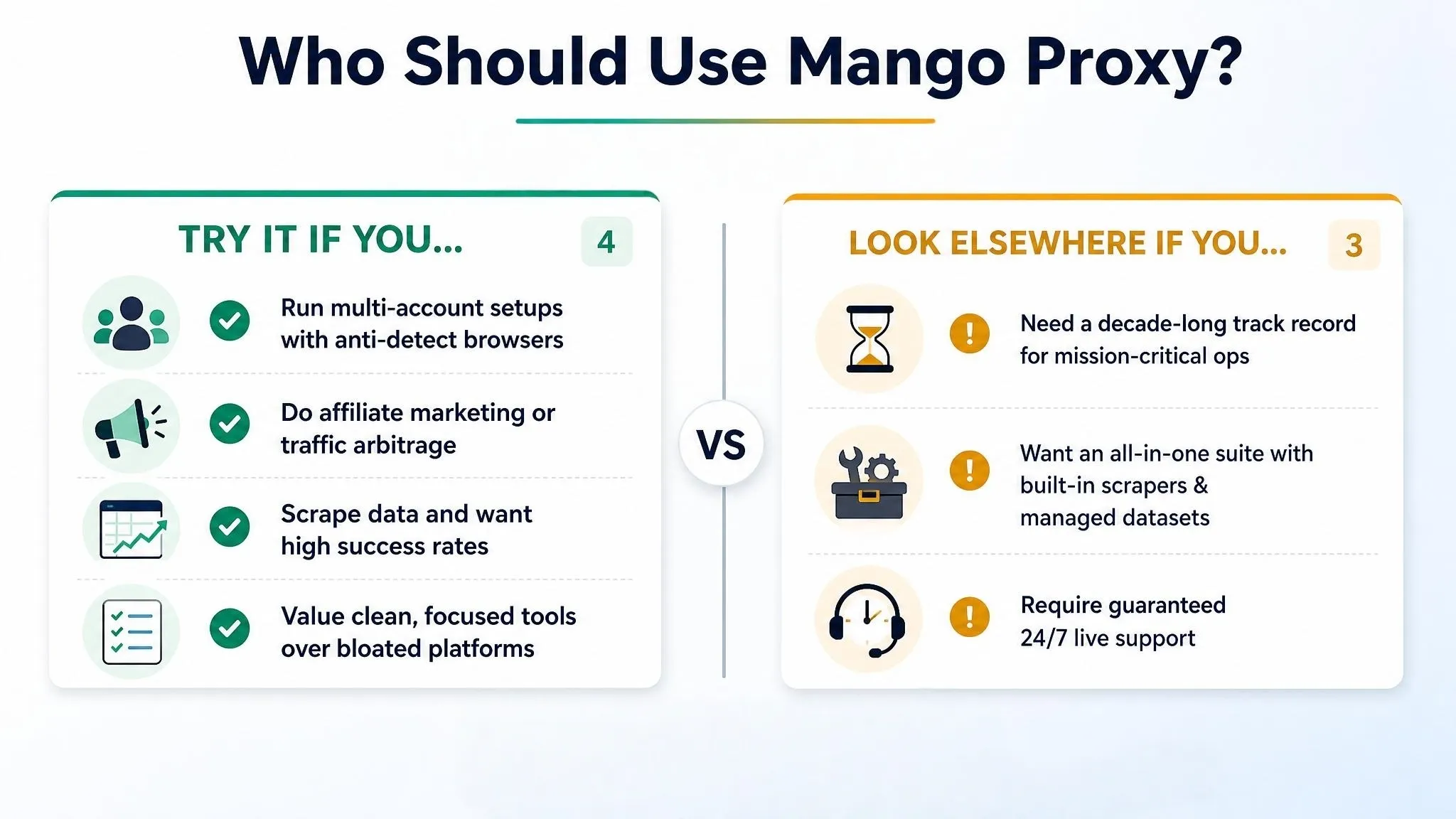
You should try it if you run multi-account setups and use anti-detect browsers, because that integration is the smoothest I have used. You should try it if you do affiliate marketing or traffic arbitrage and need trustworthy, geo-targeted residential IPs at a fair price. You should try it if you scrape data and want high success rates without paying enterprise money. And you should try it if you value clean, focused tools over bloated platforms.
You should look elsewhere, or at least keep a backup, if you need a decade-long track record for a mission-critical operation, if you want an all-in-one suite with built-in scrapers and managed datasets, or if you must have guaranteed 24/7 live support at 3 a.m.
Quick Links:
My Final Verdict: Mango Proxy Review
I went into Mango Proxy expecting another forgettable newcomer. I came out using it every week.
What makes it work is not the marketing numbers, though 90 million IPs and near-native speeds are real and impressive. It is that Mango picked a few things that matter, the trustworthy residential IPs, the effortless anti-detect integration, the flexible rotation, the fair and non-expiring pricing, and it does them properly instead of spreading itself thin. In an industry full of providers trying to be everything, doing a few things really well is refreshing.
Is it flawless? No. It is young, focused to the point of being minimal, and still building its public reputation. But in my hands, over real work, it delivered exactly what it promised, and it did so at a price that undercuts most of the big names.
My honest advice is the same advice I follow myself. Do not take my word for it, or anyone's. Grab 1 GB for almost nothing, run your own real tasks through it for a few days, and watch how it behaves with your specific targets. That small test will tell you more than any review, including this one. For me, that test turned a skeptic into a regular, and I think there is a good chance it does the same for you.