
Let me tell you something. When I first came across Fiction Profits Academy, I was sitting at my desk at 11 PM, completely burned out from trying to figure out how to make money online.
I had seen every kind of “passive income” pitch imaginable: dropshipping, affiliate marketing, YouTube channels, you name it.
So when an ad popped up promising that I could earn money by publishing fiction books on Amazon without even being a writer myself, my first reaction was… here we go again.
But I did something I don't usually do. Instead of scrolling past, I actually dug deep.
I spent hours going through their website, watching YouTube reviews, reading real student experiences on Trustpilot, and even crawling through Reddit threads where people weren't afraid to say the ugly truth. What I found was genuinely interesting and not in the way I expected.
So let me give you the most honest, most detailed review of Fiction Profits Academy (FPA) that you'll find anywhere. No hype, no fake enthusiasm, no “click this link to get rich.” Just the real stuff: the good, the not-so-good, and the things nobody tells you before you pay.
What Is Fiction Profits Academy, and Who Started It?
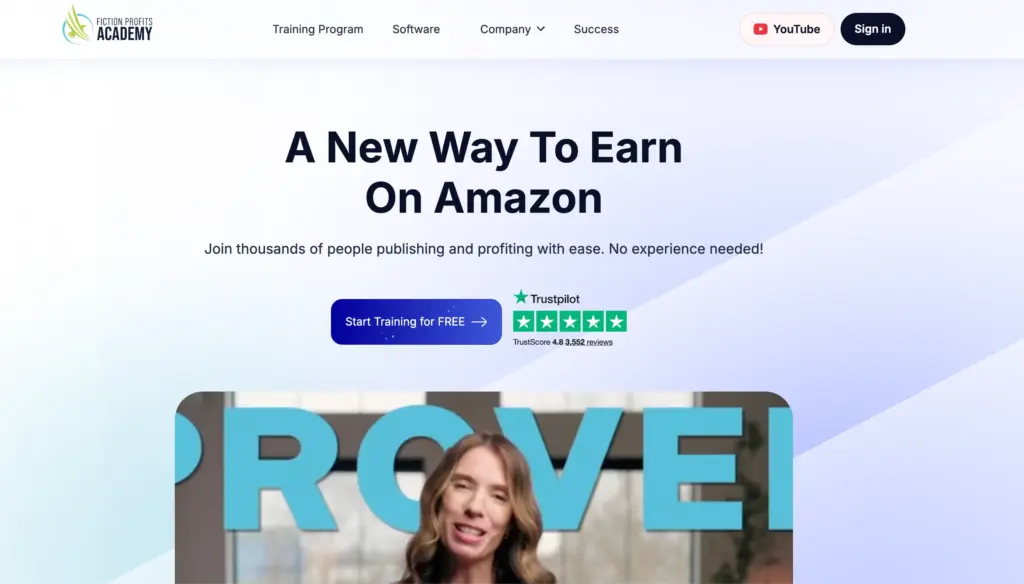
Fiction Profits Academy is an online education and mentorship program founded in 2015 by Karla Marie, a woman who has personally published over 60 fiction novels and built her own six-figure publishing business on Amazon's Kindle Direct Publishing (KDP) platform.
She's not someone who teaches theory she's never practiced. She actually lived this system first, scaled it to real income, and then built a program around it.
The core idea behind FPA is simple and honestly quite clever. Instead of teaching you to write books yourself, Karla Marie teaches you how to function as a fiction publisher, someone who identifies profitable genres, hires vetted ghostwriters to produce the content, and then publishes and markets those books under a pen name on Amazon.
You run the business side. The writing gets outsourced. The royalties are yours.
As of 2026, Fiction Profits Academy has grown to over 15,000 students worldwide, has collected over 3,197 verified Trustpilot reviews with a 4.6 to 4.8 star rating, and has been featured in media outlets including USA Today, Forbes, CEO Magazine, Rolling Stone, and Yahoo Finance.
The program employs a team of over 40 experienced professionals who actively mentor and coach students. That's not a small operation; that's a real company.
One of the co-founders, Roy Lewis, started as a student himself, applied the FPA system, and went on to earn over $2.3 million in royalties before eventually joining the team.
That kind of story is either the world's best marketing fiction or a genuine proof of concept. Based on the verified third-party reviews, it leans heavily toward the latter.
Why Fiction? Why Not Nonfiction?
This is actually one of the most compelling arguments FPA makes, and the data backs it up.
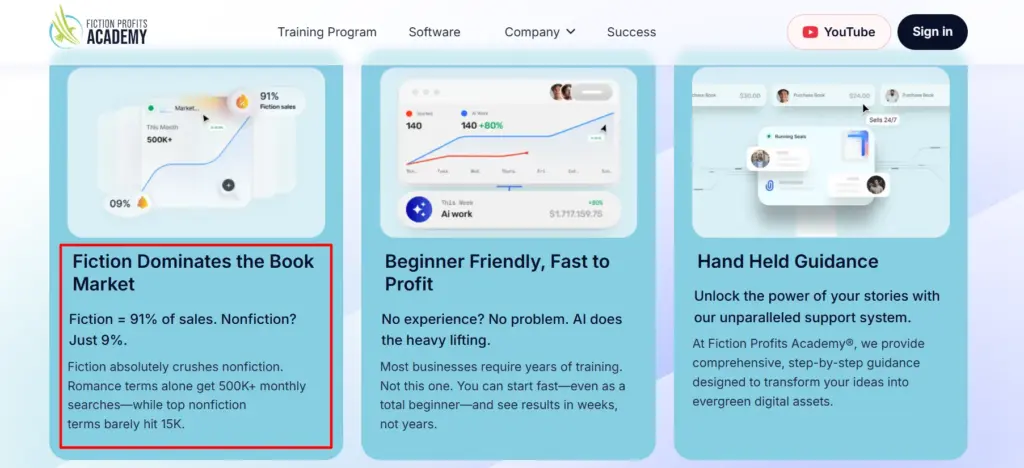
According to their research and analysis of Amazon Kindle charts, 91% of books sold on Amazon Kindle are fiction, while nonfiction accounts for only 9% of sales.
Romance search terms alone generate over 500,000 monthly searches, while even the most popular nonfiction terms barely hit 15,000.
Most online publishing courses teach how to write nonfiction business books, self-help guides, and how-to manuals.
They teach it because it's easier to explain and sounds more “professional.” But they're essentially teaching you to fight over the smallest slice of the market. FPA goes straight for where the money actually is.
The genres FPA focuses on include romance, mystery, cozy mystery, fantasy, science fiction, and thriller, all of which are evergreen categories where readers buy voraciously and come back for more.
These are the kinds of genres where loyal reader bases exist, where series sell, and where a strong pen name brand can generate consistent monthly royalties for years.
What Do You Actually Learn Inside Fiction Profits Academy?
When you join FPA, you don't just get a collection of pre-recorded videos and a Facebook group. The program is structured as a full mentorship system with multiple layers of support and training. Let me walk you through each component in detail.
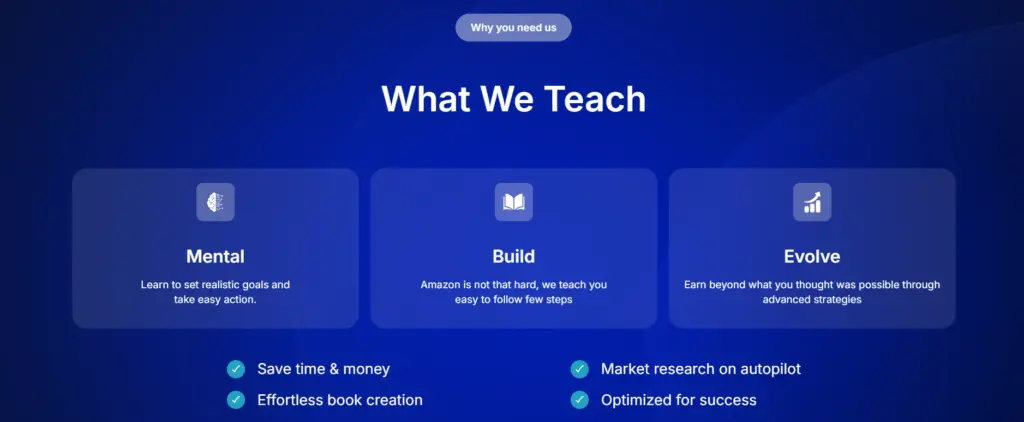
The foundation of the program is the step-by-step video course, which you access through your member login at fpa.partners.
The course walks you through every stage of building a fiction publishing business, from the basics of how KDP works to advanced marketing and scaling strategies.
The modules cover picking your niche and subgenre, selecting “tropes” (recurring story themes that readers love and actively search for), writing or commissioning your book, designing a professional cover, writing a compelling blurb (which FPA treats as a serious sales skill, not an afterthought), formatting your manuscript, uploading to Amazon, running Facebook ads, building an email list, and eventually outsourcing your entire operation.
One module that stood out to me is the blurb training. FPA's FAQ section explicitly states that you need to rewrite your blurb at least 10 times before submitting it for review from a coach.
They explain that writing a blurb is a sales skill, not a writing skill, and that even your ghostwriter won't do it well because ghostwriters are content creators, not marketers. This kind of thinking treating every component of the business with precision is what separates a proper program from a shallow course.
Beyond the video modules, students get live group coaching calls five days a week. These calls are the real pulse of the program.
You show up, ask questions, get feedback on your cover, your blurb, your niche choice, your ads, and you hear what's working for other students in real time. All calls are recorded and stored for about 30 days so you can catch up if you miss one.

On top of group calls, students unlock one-on-one coaching calls at specific milestones in the course.
The recommended points for these personal calls are after you choose your tropes and titles, after you write your blurb 10 times, after your cover is designed, and when you start running Facebook ads.
These aren't random support calls; they're strategic touchpoints designed to catch your biggest potential mistakes before they cost you money.
New students also get a success call right at the start: a welcome call with a high-performance coach who helps you set goals and build a custom publishing plan.
This onboarding experience is something that many cheaper programs completely skip, and it makes a genuine difference for people who feel overwhelmed at the beginning.
Students also get access to an active Facebook community group where you can post questions, share wins, get feedback, and learn from people at every stage of the journey. Coaches actively participate in the group, not just other students.
One bonus that most people don't talk about: when you join FPA, you get an additional membership for a friend or family member. That's a meaningful perk that doubles the value for households where two people want to build the business together.
The AI Component: What FPA Does With Artificial Intelligence
This is where FPA has evolved significantly in recent years. The program now incorporates proprietary AI software that streamlines and accelerates the publishing process.
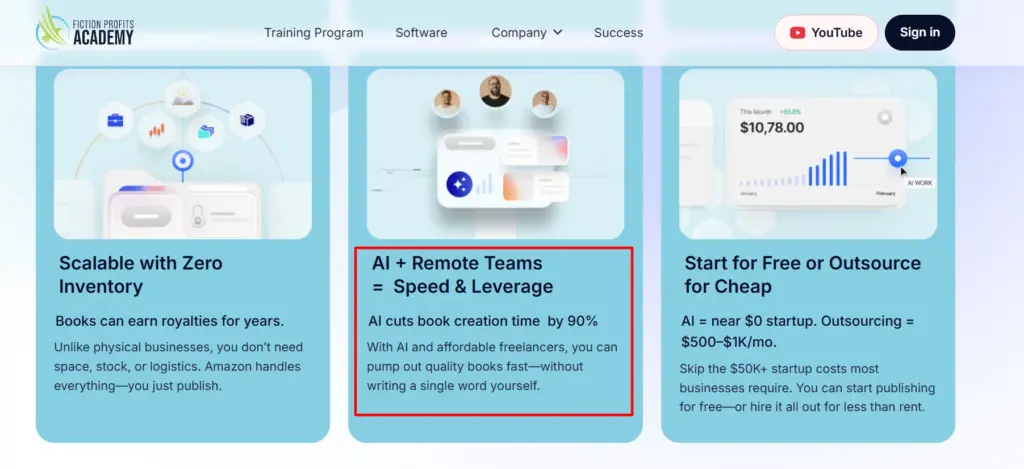
According to their website, AI cuts book creation time by up to 90%. This doesn't mean AI writes your books without oversight; it means AI handles research, plot development support, formatting assistance, and content generation tasks that used to take weeks.
FPA is careful to teach students how to use AI responsibly. This includes being transparent with Amazon about AI-assisted content, which their training covers.
One YouTube reviewer, Kyle, specifically noted that “you are required by Amazon to let them know if your book is written by AI,” and FPA addresses this in its curriculum. This kind of compliance training protects students from having their accounts suspended or their books removed.
The combination of AI for speed and human ghostwriters for quality gives FPA students a competitive advantage that solo writers simply don't have. You can move faster, publish more consistently, and maintain quality simultaneously.
How Much Does Fiction Profits Academy Cost, and What Are the Ongoing Expenses?
FPA does not publicly advertise its enrollment price on its website; you learn the cost through their webinar or sales process. Based on widely reported information, the main program costs approximately $1,995 to $2,000, though various payment plans may exist.
Beyond the program fee, you also need to budget for the actual business costs of publishing. FPA is refreshingly transparent about this, and their FAQ section breaks it down clearly.
In the initial stage (0 to 6 months), they recommend shorter books of 10,000 to 30,000 words. At around $0.01 per word, a ghostwriter costs approximately $100-$300 per book. Cover design typically runs $20 to $50. This is a relatively low-barrier entry point to test the waters.
In the intermediate stage (6 to 12 months), as you gain confidence and your books start generating royalties, you move to longer books of 30,000 to 50,000 words, costing around $300 to $500. Some students at this stage choose to pay $0.02 per word for higher-quality writers, which improves book ratings and reader loyalty.
In the advanced stage (1 year or more), top students invest $400 to $800 per book in premium ghostwriting, better cover design, and more sophisticated marketing, but by this point, their royalties fund those investments.
The recommended publishing frequency across all stages is one book per month, which keeps your audience engaged and builds your momentum.
FPA recommends using Upwork as the primary platform for hiring ghostwriters and also lists vetted ghostwriting companies in Module 2 of the course. They explicitly warn against certain companies that are not good, protecting students from wasting money on low-quality work.
Additional ongoing costs include email service providers, domain names, and Facebook ad spend when you reach the ads module. These are all standard costs of running a real online business, not hidden surprises invented to squeeze more money out of you.
What Do Real Students Actually Say?
I spent considerable time reviewing Trustpilot reviews, the FPA blog, and the testimonials section of their website. The patterns are consistent and striking.
Kristen Wilsey wrote in April 2025 that she was “so relieved” to have found FPA, saying the coaches are willing to help “no matter the amount of times you have reached out to them regarding the same questions.” That kind of patience and accessibility is genuinely rare in online education programs.
Daniela Soqui described her coach, Tara, as “incredibly insightful throughout this journey,” noting that Tara helped her figure out her niche, select the right tropes, review her launch strategy, and follow up consistently. This isn't just a testimonial it describes a hands-on, relationship-based mentorship experience.
Juanita Albin wrote: “What can I say, this team is outstanding, and they really want me to succeed! I had a fantastic 1:1 with Daniel, who helped me get unstuck with some technical challenges. The group calls, recordings, lessons, and resources are absolutely invaluable.”
Tracy Lavender praised her coach, Daniel, for his deep knowledge of the cozy mystery genre and for bringing humor and personality to the experience. Even small details like this a coach who understands specific genre nuances reflect genuine expertise, not generic advice.
FPA's overall Trustpilot rating is 4.6 out of 5, based on over 2,300+ verified reviews, which is exceptional for any educational program in this space.
What Criticisms and Real Concerns Should You Know About?
I'd be doing you a disservice if I only shared the positive. Let me be honest about the challenges real people have raised.
The biggest concern I found in the Reddit community and in independent YouTube reviews is whether the KDP fiction market is becoming more competitive, particularly as AI-generated books flood the platform. Amazon has policies around AI content disclosure, and the quality bar for fiction on Kindle is rising.
Students who produce low-quality ghostwritten content without strong editing, a compelling cover, and a well-crafted blurb will not succeed simply by mechanically following the system.
FPA addresses this by emphasizing quality at every step, but it's important to understand that this is a real business that requires real effort, not a passive income button you press once.
The program costs approximately $2,000, which is a serious investment. If you buy in and then don't do the work, don't engage with the coaching, and don't implement the modules consistently, you will not see results.
One Reddit user shared their experience of buying a similar $2k KDP course and stalling out within a month, not because the information was bad, but because they got discouraged when results didn't come immediately.
FPA is explicit in their materials that most students take 6 to 12 months to see consistent results, and some take longer. If you need money next week, this is not the right vehicle.
Another fair concern raised by independent reviewers is that FPA's partnership model (where FPA earns 5% of your Kindle royalties in the first year) means they have a financial incentive to sign you up.
However, it also means they have a financial incentive to ensure you actually succeed, because if you don't publish and sell books, they don't earn anything either. That alignment of incentives is actually a reasonable structure.
Some YouTube reviewers also noted that Amazon requires disclosure when AI assists in creating a book. FPA addresses this in its training, but students need to stay informed about Amazon's evolving policies in this area, as Amazon continues to update its terms of service regarding AI content.
The Refund Policy: Read This Carefully
FPA offers an ironclad 6-month, 100% money-back guarantee, one of the longest refund windows in the online course industry.
However, their FAQ section has an important note: they strongly advise against disputing the charge through your bank, as bank disputes can take 3 to 6 months to resolve and often don't succeed.
If you want a refund, contact their support team directly at support@fictionprofitsacademy.com, and they will work something out with you.
Their response time during business hours (Monday through Friday, 8am to 6pm Eastern) is 30 minutes or less, which is genuinely fast for a customer support team.
The Licensing Question: Is FPA Legitimate or Is This a Scam?
The question of legitimacy comes up constantly in YouTube reviews and Reddit threads. Here's what the evidence actually shows. FPA has been in business since 2015, over 10 years.
It has featured media coverage from verifiable outlets including USA Today, Forbes, and Yahoo Finance. It has over 3,000 third-party-verified Trustpilot reviews (a platform where companies cannot easily manipulate ratings).
It has a real team of 40+ professionals. Its co-founder Roy went from student to earning $2.3 million in royalties. And the program is built around Amazon's actual platform, an existing, verifiable marketplace where millions of fiction books sell every month.
Is it possible to fail with FPA? Absolutely. Any business can fail, especially if you don't put in the work. But “possible to fail” is not the same as “this is a scam.” The evidence strongly supports the conclusion that FPA is a legitimate, established educational program with genuine student success stories.
Who Is Fiction Profits Academy Right For?
FPA works best for people who want to build a real business with scalable income over 12 to 24 months, who can invest $100 to $500 per month in ghostwriting and production costs, who are willing to engage actively with the coaching and implement the course steps consistently, who are interested in the fiction publishing space and willing to learn what readers in specific genres actually want, and who have realistic expectations about timelines and understand this is not a get-rich-quick scheme.
FPA is probably not the right fit if you need income within the next 30 to 60 days, have no budget for ghostwriting and marketing costs beyond the course fee, are not willing to engage with coaching and just want a set-and-forget system, or are looking for a completely passive business that runs itself without any ongoing involvement.
Quick Links:
My Final Verdict: Fiction Profits Academy Review 2026
After everything I've read, watched, and analyzed the website, the YouTube reviews, the Trustpilot feedback, the Reddit threads, the FAQs, and the detailed course structure Fiction Profits Academy stands out as one of the most well-structured, well-supported, and genuinely transparent online publishing programs available today.
Is it perfect? No. The cost is high, results take time, and success requires real commitment. But those are true of every legitimate business education program worth taking seriously.
What FPA offers is a proven system built by someone who actually used it, a coaching team that shows up every single day, and a community of students who hold each other accountable. That combination is genuinely rare.
If you're serious about building an online business through fiction publishing on Amazon, and you have the patience, the budget, and the work ethic to follow through, Fiction Profits Academy is worth your serious consideration.
If you want fast money with minimal effort, look elsewhere and save yourself the frustration.
The opportunity in fiction publishing is real. Amazon's Kindle marketplace is massive, fiction dominates the charts, and readers buy books every single day.
Whether FPA is your path into that market is a question only you can answer, but at least now you have the full picture to make that decision with your eyes open.