
Here is the thing nobody tells you when you start with Octo Browser. The fingerprints are the easy part. Octo handles those out of the box with real-device profiles, so a platform looking at your canvas hash, fonts, and screen specs sees a believable user every time.
Where people get burned is the IP. Put two profiles behind the same exit node, or run a cheap datacenter IP that some bot-detection vendor flagged months ago, and your accounts get linked and wiped no matter how clean the fingerprint looked.
So the real question is not which antidetect browser to use. It is which proxy you put behind each profile. I have run a lot of profiles across a lot of providers, and the list below is the seven I would actually trust with accounts in 2026, sorted so the best all-round pick comes first and the specialist tools come after.
One quick note before the list. Octo has its own Proxy Shop built in, and it is genuinely handy for a few profiles. But it starts around 7 euros per GB on a pool of smaller resellers with not much detail on where the IPs come from.
Octo itself is cheap, with plans roughly 10 to 29 euros a month and the 10-euro Lite tier capped at three profiles, so once you scale up the proxy bill is your real cost. That is exactly why bringing your own residential or mobile provider pays off fast.
Quick Comparison
| Provider | Best At | Who Should Use It |
| Decodo | Easy setup, all-round value | Anyone running mixed accounts |
| Oxylabs | Toughest targets | High-stakes, must-not-fail work |
| IPRoyal | Longest sticky sessions | Accounts you keep for weeks |
| SOAX | Mobile carrier IPs | TikTok and Instagram farms |
| NetNut | Connection stability | Always-on monitoring profiles |
| NodeMaven | Pre-cleaned IPs | Cautious work on strict sites |
| DataImpulse | Lowest price per GB | Big profile stacks on a budget |
7 Best Proxies For Octo Browser 2026
1. Decodo

Decodo earns the top spot for a boring but important reason. It is the one provider here with a step-by-step Octo Browser setup guide in its own documentation. That removes the single most common cause of a dead profile, which is a proxy string typed in slightly wrong.
Add a 115M-plus residential pool across more than 195 locations and you have the safest default for someone who just wants accounts that work without fiddling.
Reach for it when your profiles are a mix of marketplaces, ad accounts, and social, and you want one provider that covers all of it.
The short version
- Pool: 115M-plus residential and 10M-plus mobile IPs
- Targeting: country, city, state, US ZIP, and ASN
- Reliability: 99.86% published success, under 0.6s response
- Scale: 130K-plus clients, named best value by Proxyway
- Octo fit: native setup guide and bulk import
Pricing: Residential subscriptions start at 3.75 dollars per GB and fall to 2 dollars per GB at the 1TB level. Pay-as-you-go residential is 8.50 dollars per GB. Mobile runs 3.75 down to 2.25 dollars per GB, and static ISP IPs start at just 0.27 dollars per IP. New users get a 3-day trial with 100MB and a 14-day money-back window.
Pros
- 99.86% success beats IPRoyal's real-world 89 to 95% on hard sites
- ISP IPs at 0.27 dollars each are far cheaper than Oxylabs at 1.60 dollars
- Biggest documented US pool in independent tests
Cons
- Its own site shows two different PAYG rates, so confirm at checkout
- ID checks can hold up access for a day or two
- Smallest tiers feel pricey next to DataImpulse
Bottom line: It is the lowest-hassle way to get Octo profiles online with a documented setup and a pool that benchmarks well.
For most operations under a terabyte a month, the value is tough to beat.
2. Oxylabs
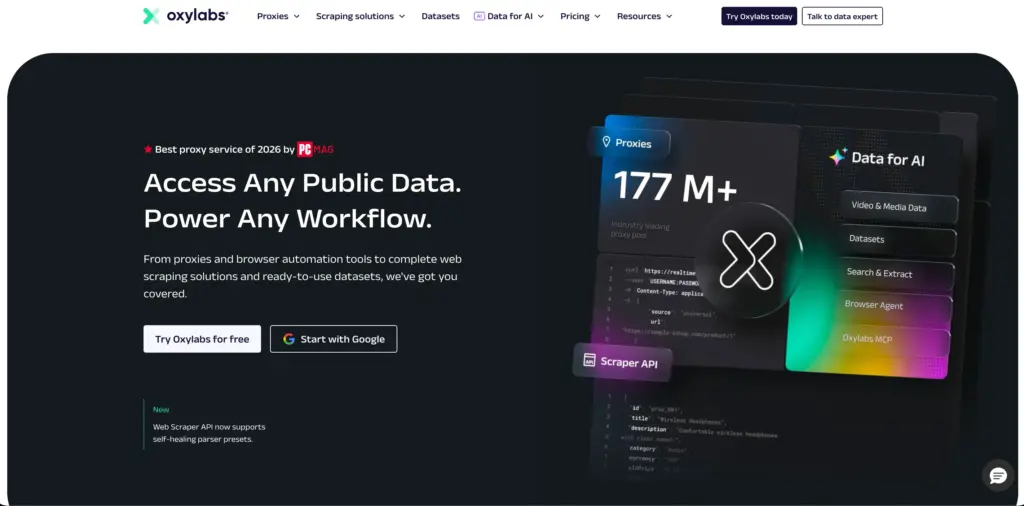
Oxylabs brings the biggest pool on this list at 175M-plus residential IPs and the highest measured success rate at 99.95%, and it has its own Octo setup guide. When you are working the most heavily defended platforms and a failed login costs you a profile you spent days warming up, that extra reliability is worth paying for.
Best for the hardest targets and high-stakes work where success rate beats price.
The short version
- Pool: 175M-plus residential across 195 countries
- Reliability: 99.95% success, 0.6s response
- Static: ISP proxies from 1.60 dollars per IP
- Filters: IP-version and OS filters for stability
- Octo fit: official guide with port-based rotation
Pricing: Residential pay-as-you-go is 4 dollars per GB. Subscriptions go from 6 dollars per GB on the 30-dollar Starter to 2.50 dollars per GB on the 2,500-dollar Corporate plan (1TB). Annual billing knocks off 10%. There is a free datacenter trial with 5 IPs, but residential trials go through sales.
Pros
- 99.95% success edges out Decodo on the worst sites
- Largest pool here means more IP diversity for big stacks
- OS and IP-version filters help on fingerprint-touchy platforms
Cons
- Starter at 6 dollars per GB is six times DataImpulse
- Advanced filters and some targets need KYC
- No instant residential trial, you have to talk to sales
Bottom line: This is the reliability ceiling. When the target is brutal and a banned profile means lost warm-up time, the 99.95% success rate and the 175M pool justify the premium.
3. IPRoyal
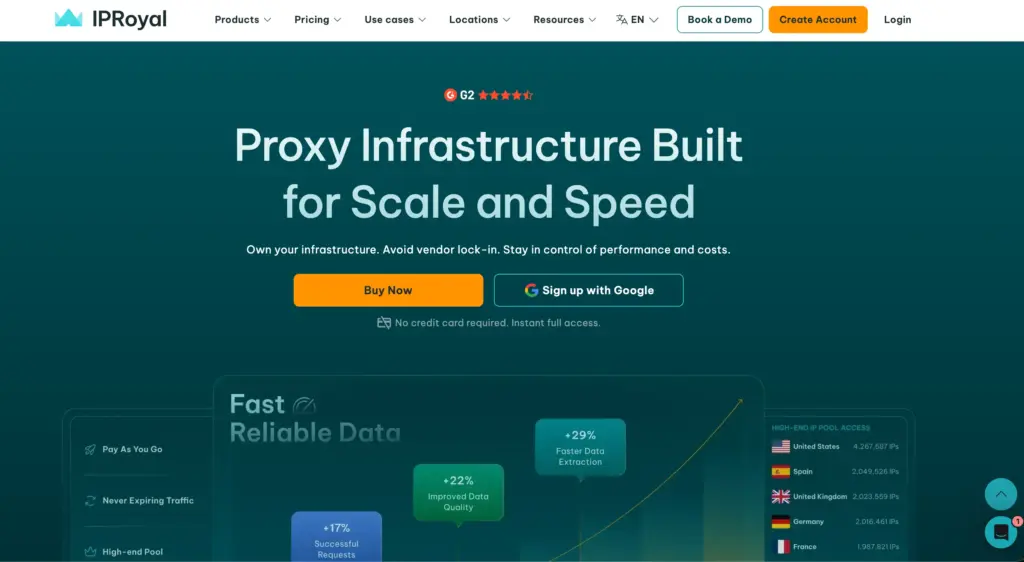
IPRoyal's calling card for antidetect work is its sticky session that holds for up to seven days, the longest of anyone here. For account management that matters more than pool size. An account you log into every day for a month wants the same IP each time, and a week-long hold means you barely rotate at all compared to SOAX's one-hour limit.
Best for accounts you plan to nurture over weeks and cannot risk a sudden IP change on.
The short version
- Sticky: up to 7 days on one residential IP
- Billing: pay-as-you-go, traffic never expires
- Pool: 32M-plus IPs across 195-plus countries
- Tools: Chrome extension for quick switching
- Static: ISP proxies from 2.40 dollars per IP per month
Pricing: Residential runs 7 dollars per GB at 1GB, dropping to 4.90 dollars at 50GB and as low as 1.75 dollars in bulk. Pay-as-you-go is about 7.35 dollars per GB. ISP static IPs are 2.40 dollars per IP per month on the 90-day plan or 1.80 dollars on the 24-hour plan. The IPR50 code cuts residential in half for nine months.
Pros
- Seven-day sticky sessions blow past Decodo's standard rotation
- Non-expiring traffic means dormant profiles do not waste prepaid GB
- Bulk pricing at 1.75 dollars undercuts SOAX's Business rate
Cons
- Entry rate at 7 dollars is seven times DataImpulse
- Real-world success of 89 to 95% trails Decodo and Oxylabs
- Per-IP fraud scores swing a lot, so strict sites may still flag some
Bottom line: When keeping accounts alive long-term is the whole point, the seven-day sticky plus non-expiring traffic is the friendliest billing model in the space. It is a favorite of serious operators for good reason.
4. SOAX
SOAX runs a separate 33M-plus mobile network on 4G and 5G, sitting on top of a 155M-plus residential pool, and it lets you target by carrier ASN on every paid plan. That means you can pin a profile to T-Mobile, Vodafone, EE, and the rest without paying for an enterprise contract. For platforms that trust mobile carrier IPs above everything, that control is the difference between a profile that lasts and one that does not.
Best for TikTok and Instagram account farms, where carrier identity drives survival.
The short version
- Mobile: 33M-plus 4G and 5G IPs with carrier targeting
- Residential: 155M-plus IPs across 195 countries
- Protocols: HTTP(S), SOCKS5, UDP, and QUIC for HTTP/3 sites
- Sticky: adjustable from 30 seconds to about an hour
- Hard targets handled in the same gateway, no separate product
Pricing: Starts at 4 dollars per GB on the 90-dollar Starter plan (22.5GB), drops to 3.60 dollars on Business, and reaches 2 dollars at high volume. There is no pay-as-you-go, and unused GB do not carry over.
Pros
- 33M mobile pool dwarfs NodeMaven's roughly 10M
- Carrier ASN targeting on every plan, not gated behind enterprise
- QUIC support handles HTTP/3 sites that flag plain TCP proxies
Cons
- The 90-dollar floor makes no sense under about 20GB a month
- No rollover, so leftover GB is lost at renewal
- One-hour sticky ceiling is short next to IPRoyal's seven days
Bottom line: For mobile-first work on the strictest social platforms, the mix of a huge carrier pool, ASN targeting on every plan, and QUIC support is hard to match below enterprise. Size your plan to real usage and it pays off.
5. NetNut
NetNut connects straight through internet service providers instead of bouncing your traffic across a peer network, and the payoff is steady, consistent connections. That is exactly what you want for Octo profiles that stay open all day on dashboards or monitoring tools rather than firing short bursts.
Best for always-on sessions where steady uptime matters more than a giant pool.
The short version
- Setup: direct-ISP routing, fewer hops
- Pool: 85M-plus residential across 195 countries
- Static: ISP line for permanent same-IP sessions
- Concurrency: unlimited sessions
- Mobile network available too
Pricing: Entry plans begin at 99 dollars a month for 10GB. The per-GB rate drops to around 3.53 dollars at mid volume and 1.59 dollars at enterprise scale. Mobile starts at 3.82 dollars per GB, and a free trial is available on request.
Pros
- Direct-ISP routing gives steadier long sessions than P2P pools
- 1.59 dollars per GB at scale undercuts Oxylabs Corporate
- Unlimited concurrency suits running many profiles at once
Cons
- 99 dollars for 10GB at entry is steep next to IPRoyal
- Fewer locations than Decodo or Oxylabs
- The value only really shows past the 1TB mark
Bottom line: If your Octo work is long, always-on sessions rather than quick bursts, the direct-ISP backbone gives you the steadiest connection here. It rewards scale, so it suits established setups over first-timers.
6. NodeMaven
NodeMaven filters its residential pool for cleanliness before any IP reaches you, scoring and dropping flagged addresses so each profile starts on a high-trust IP.
It is the most cautious choice on this list, backed by a money guarantee on quality, which is why careful operators on strict platforms lean on it over cheaper pools that mix in burned IPs.
Best for risk-averse account work where one ban costs far more than the proxy ever will.
The short version
- Filtering: pre-cleaned, high-trust residential IPs
- Reliability: 99.54% success
- Billing: pay-as-you-go with rollover and cashback
- Octo fit: plug-and-play onboarding guides
- Backed by a quality guarantee
Pricing: Residential, mobile, and ISP all start at 2.20 dollars per GB. The trial is 3.99 euros for 500MB. Unused traffic rolls over, and you earn cashback on every GB you buy.
Pros
- Pre-filtered IPs cut the fraud-score lottery that hits IPRoyal users
- Rollover and cashback beat SOAX's strict no-rollover policy
- 99.54% success at a lower entry than Oxylabs
Cons
- Roughly 10M mobile IPs is a fraction of SOAX
- No QUIC or HTTP/3 support
- 2.20 dollars per GB is more than double DataImpulse
Bottom line: When survival beats savings, the pre-cleaned pool and quality guarantee buy real peace of mind. It is the safe-hands pick for anyone who would rather pay a bit more than gamble a warm profile on a dirty IP.
7. DataImpulse
If budget is the thing keeping you up at night, this is your provider. Residential at 1 dollar per GB and mobile at 2 dollars per GB sit well below the usual 3 to 8 dollar range, and it is pure pay-as-you-go with traffic that never expires. When you are running profiles by the dozen, that price difference adds up to real money.
Best for large profile stacks where bandwidth is the main cost and you do not want a subscription hanging over you.
The short version
- Price: residential 1 dollar, mobile 2 dollars, datacenter 0.50 dollars per GB
- Pool: 90M-plus IPs across 195 countries
- Sticky: per-profile sessions through the sessid setting
- Octo fit: bulk import straight into the Proxy Manager
- Trust: 99.51% success, 4.8 on G2, round-the-clock human support
Pricing: Residential is 1 dollar per GB and mobile is 2 dollars, both pay-as-you-go with non-expiring traffic. Datacenter is 0.50 dollars per GB. You can start with 5GB for 5 dollars. Country targeting is included, while city and ASN targeting cost extra.
Pros
- 1 dollar per GB is a quarter of Decodo's entry rate
- Mobile at 2 dollars is roughly half SOAX's Business mobile pricing
- The sessid setup maps cleanly to one IP per profile
Cons
- 90M pool is smaller than Oxylabs at very high volume
- City and ASN targeting are paid extras, unlike SOAX's bundled option
- Less of an enterprise track record than the older names
Bottom line: When you are counting every GB, 1 dollar residential with traffic that never expires and native Octo import is the cheapest honest way to keep every profile on a clean, sticky IP.
How to Add a Proxy in Octo Browser
The steps are the same whichever provider you choose. Open the Proxies tab in Octo and click Add Proxy.
Give it a name, pick the protocol (HTTP, HTTPS, or SOCKS5), then drop in the host, port, username, and password from your provider's dashboard. Hit Check Proxy, and a green result means it works. Click Confirm to save it. To attach it, open or create a profile, go to the Connection tab, click Set Proxy, and choose your saved entry.
Running a lot of profiles? Use Bulk Add under the Proxies tab, paste a plain-text list or drop an export file, and assign one entry per profile. The one rule that keeps accounts alive is simple: one IP per profile, never shared, held sticky for the life of the account.
So Which One Should You Pick?
Go with Decodo if you want a documented, no-surprises default for mixed accounts. Pick DataImpulse when you are watching every GB at a dollar. Choose IPRoyal for accounts you keep for weeks on a seven-day sticky IP.
SOAX is your move for TikTok and Instagram farms that depend on mobile carrier identity. Run Oxylabs when the target is brutal and failure is not an option, NetNut for steady all-day sessions at scale, and NodeMaven when a clean, guaranteed IP matters more than the lowest rate. Match the proxy to the job and your profiles stop dying in those overnight sweeps.
Quick Links: