Oxylabs
- Extensive proxy network
- Residential & datacenter IPs
- Targeted geolocation options
- Advanced anti-CAPTCHA bypass
Bright Data

- IP rotation for anonymity
- Dedicated Google scraping proxies
- 24/7 customer support
- Flexible proxy management tools
Decodo

- Cost-effective solutions
- High-speed scraping
- Customizable IP pools
- Reliable uptime for large-scale scraping
When you scrape data from Google, the first thing you need is a good proxy. Trying to scrape without one is like trying to use a faucet without a handle; it just won’t work.
Proxies are important for avoiding Google’s blocks and CAPTCHA checks. With so many options available, it can be hard to know which ones are best for scraping Google.
In this post, we’ll see the 7 best proxies for Google scraping & how they help with scraping, and which ones are the most effective.
7 Best Proxies For Google Scraping in 2026
1. Bright Data
Bright Data is one of the leading proxy providers and is widely used for high-quality Google scraping. Founded in 2014 and originally known as Luminati, Bright Data is headquartered in Tel Aviv, Israel.
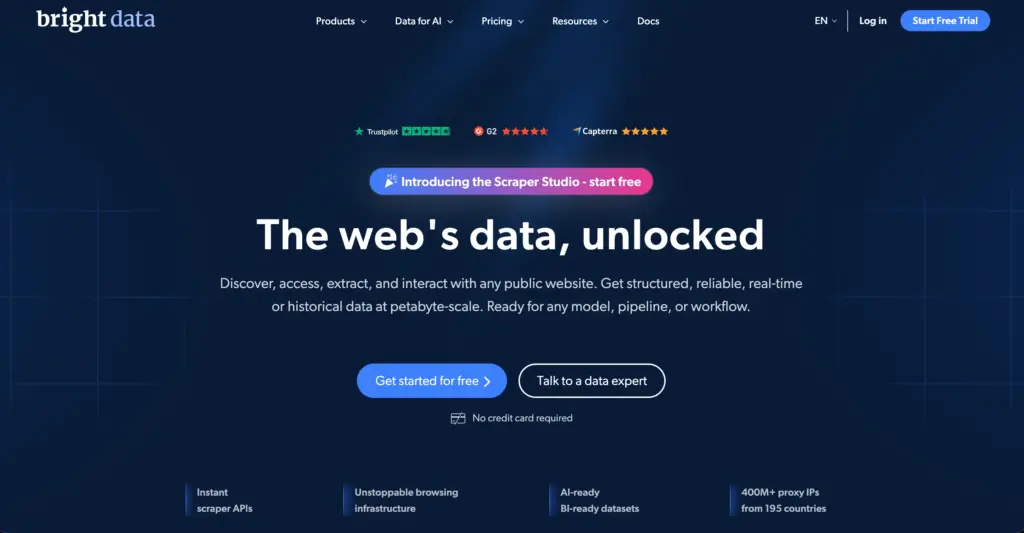
It has grown to become one of the largest and most trusted proxy networks globally, with offices and operations in various locations around the world.
With its vast network of residential proxies, Bright Data allows you to scrape Google without worrying too much about getting blocked.
The service is built to provide smooth, reliable, and scalable scraping experiences, especially for large-scale data extraction projects.
Bright Data offers a variety of proxy types, including residential, datacenter, and mobile proxies, allowing users to tailor their scraping operations to meet specific needs.
Performance:
- High Success Rate: Low failure rate, allowing large-scale Google scraping with minimal blocks.
- Low Latency: Fast network for quick responses from Google, reducing scraping time.
Speed Test:
- Fast Connections: Stable, fast proxies ideal for high-volume scraping, with speed varying by proxy location.
- Reliable Speed: Good performance during peak hours, though large-scale operations may cause slight slowdowns.
Ease of Use:
- User-Friendly Dashboard: Feature-rich but may be complex for beginners. Provides useful insights into proxy usage.
- Advanced Configuration: Offers geo-targeting and device-specific options, but might be overwhelming for new users.
- API Integration: Easy integration with your scraping scripts via API support.
Key Features:
- Huge IP pool (72+ million)
- Residential, mobile, datacenter & ISP proxies
- Powerful scraping tools & API
- Country, city & ASN targeting
- Excellent reliability & speed
Pros
- Large pool of residential and mobile IPs
- Advanced IP rotation for anonymous scraping
- Geotargeting for localized Google search results
- Fast, reliable connections for high-volume scraping
- Excellent customer support and integration with scraping tools
Cons
- Premium pricing may not suit small users
- Complex setup for beginners
2. Decodo
Decodo is an affordable proxy service that provides residential proxies, making it a suitable option for those looking to scrape Google data without a hefty price tag.
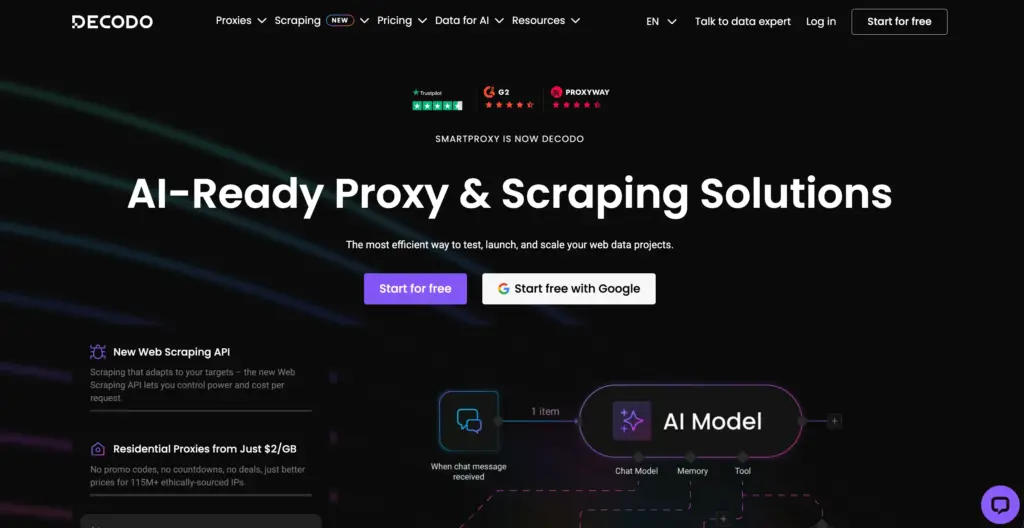
While it doesn’t offer the vast scale of some larger providers, Decodo is a solid choice for users who need a cost-effective solution for moderate scraping projects.
With its simple setup and reasonable pricing, Decodo is ideal for businesses or individuals just starting out with web scraping, especially when Google scraping is a priority.
Decodo offers a reliable network of residential proxies that helps users avoid blocks from Google by using IPs from real devices.
While not as large as competitors like Bright Data, Decodo’s proxies can still be quite effective for scraping tasks that don’t require massive volumes of data.
With easy-to-use features and a focus on simplicity, Decodo is a practical and affordable option for moderate scraping needs.
Performance:
- Reliable Connections: Decodo offers stable proxies that work well for scraping Google without frequent issues.
- Moderate Success Rate: While reliable, the success rate may not be as high as premium providers, especially for large-scale scraping.
Speed Test:
- Decent Speeds: Proxies provide good speeds for general scraping tasks, though may experience slower speeds during peak times.
- Variable Performance: Speed can vary depending on the proxy type and location, so performance may not always be consistent.
Ease of Use:
- Simple Setup: User-friendly interface, making it easy to get started, especially for beginners.
- Basic Configuration Options: Offers basic targeting and rotation features, but lacks some of the advanced options found in premium services.
- API Support: Provides API access for easy integration with scraping tools and scripts.
👉Learn More About Decodo: Decodo Review (Formerly Smartproxy): Best Proxy For Web Scraping?
Key Features:
- 40+ million IPs worldwide
- Residential, mobile, and datacenter proxies
- Easy-to-use dashboard
- Good for SERP scraping
- Affordable plans for all sizes
Pros
- Affordable pricing with good performance
- Rotating residential proxies to avoid IP bans
- Fast connections for efficient Google scraping
- User-friendly dashboard for easy management
- Great customer support
Cons
- Lacks some advanced features for enterprise users
- No SOCKS5 support for additional security
3. Oxylabs
Oxylabs is a top-tier proxy provider known for its vast network of residential proxies, making it a great choice for large-scale Google scraping projects.

With a strong focus on reliability, high performance, and customer service, Oxylabs stands out in the market. Its proxies are ideal for businesses that require consistent and scalable scraping capabilities, especially when targeting Google’s complex anti-bot systems.
The service offers millions of residential IPs across a wide range of locations, making it perfect for accessing geo-targeted data from Google.
Oxylabs also provides both residential and datacenter proxies, giving users more flexibility to choose the best option for their needs.
Performance:
- High Success Rate: Known for a high success rate, Oxylabs ensures minimal interruptions when scraping Google.
- Low Risk of Blocks: Residential proxies are less likely to get blocked, even during extensive scraping sessions.
Speed Test:
- Fast Connections: Oxylabs offers reliable, high-speed connections that make scraping Google fast and efficient.
- Consistent Performance: The proxies perform well even during peak times, ensuring smooth scraping without delays.
Ease of Use:
- Easy Setup: The platform is user-friendly, with a straightforward interface that simplifies setup.
- Advanced Configuration Options: Offers detailed geo-targeting and IP rotation features, making it ideal for large, targeted scraping operations.
- API Support: API integration is available for seamless connection with your scraping scripts and tools.
👉Learn More About Oxylabs: Oxylabs Review: Best Proxy Provider in the Market?
Key Features:
- 100M+ residential & datacenter proxies
- SERP Scraper API included
- Advanced targeting options
- Strong uptime & performance
- Good for large-scale scraping
Pros
- Large pool of high-quality residential proxies
- Unlimited concurrent sessions for large-scale scraping
- Advanced IP rotation for undetected scraping
- Fast connections with high uptime
- Excellent customer support for enterprise users
Cons
- Premium pricing, more suited for large businesses
- Requires technical knowledge for setup
4. Cloro (Best for Tracking Google Search and AI Answers)
Cloro is an API service built for pulling structured data from Google Search and every major AI engine, making it a strong choice for teams running large-scale SEO and AI visibility tracking.
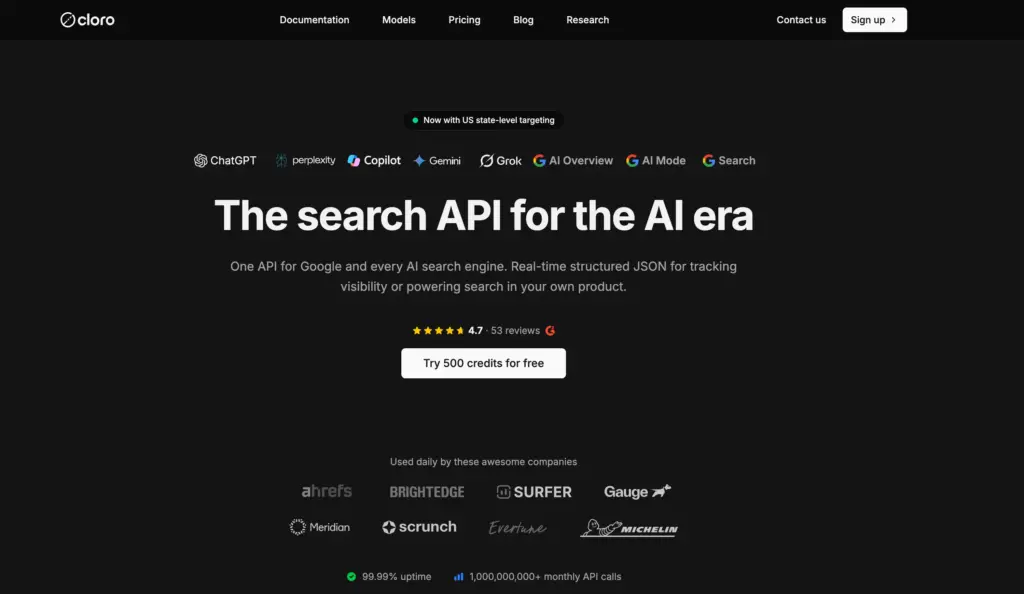
With one API covering ChatGPT, Gemini, Perplexity, Copilot, Google AI Overviews, and Google Search, Cloro stands out in the market. Its service is ideal for businesses that need consistent, scalable data extraction, especially when tracking how AI engines describe brands and which sources they cite.
The platform also runs a hosted MCP server, so Claude, Cursor, or any custom agent can query Google and every AI engine as tools with a single API key. This makes it perfect for automating rank checks and brand monitoring without maintaining separate scrapers for each engine.
Performance:
- High Success Rate: Cloro automatically retries failed requests up to 10 times with a maximum duration of 5 minutes, which keeps success rates high even during heavy scraping runs.
- Pay Only for Delivered Data: Credits are deducted only when the API successfully extracts and returns data. Failed requests and system errors cost nothing.
Speed Test: - Fast Structured Responses: The API delivers parsed responses in 30 to 45 seconds on average, returning clean markdown, JSON, and citations in near real time.
- Consistent Performance: An async endpoint with webhook delivery handles high volume jobs without keeping connections open, so large scraping batches run smoothly without delays.
Ease of Use:
- Easy Setup: The platform is developer friendly, with official Python and TypeScript SDKs plus a copy paste curl command. Getting the first query running takes minutes, not days.
- One API for Every Engine: Each engine accepts the same country targeting and the same request shape, so switching from ChatGPT to Perplexity to Google Search is a config change, not a new integration.
- API and MCP Support: A hosted MCP server connects the API directly to Claude, Cursor, and custom agents, while standard REST endpoints fit any existing scraping pipeline.
- Geo Targeting at Scale: Every engine takes the same country parameter, with US state level targeting on ChatGPT, Copilot, Perplexity, and Gemini, so one run repeats in the next market.
Key Features:
- One API for ChatGPT, Gemini, Perplexity, Copilot, Google AI Overview, and Google Search
- Parsed sources and citations from every response
- Hosted MCP server for agent workflows
- Country-level targeting plus US state-level routing
- Async endpoint with webhook delivery
- Automatic retries up to 10 times per request
- Structured JSON, markdown, and raw HTML options
- Free plan with 500 credits per month
- Credit costs only on successful extraction
Pros
- Replaces five or more separate provider integrations with one API
- Parsed citations and source URLs in clean JSON, no HTML parsing needed
- Predictable credit based pricing, easy to cost a run in advance
- Free tier for testing, paid plans from $30 per month
- High concurrency on higher plans, up to 255 parallel jobs
- Only charges credits when data delivery succeeds
- Strong reviews, 4.7 out of 5 from 53 users
Cons
- Credits expire at the end of each billing cycle, no rollover
- Response times of 30 to 45 seconds are slower than raw SERP APIs
- Some models have regional restrictions, such as Gemini in the EU
- Concurrency caps require upgrading plans for very large pipelines
5. ScraperAPI
ScraperAPI is a specialized proxy service designed to make web scraping easier and more efficient. It’s perfect for users who want a straightforward solution for scraping Google without the need for complex configurations.
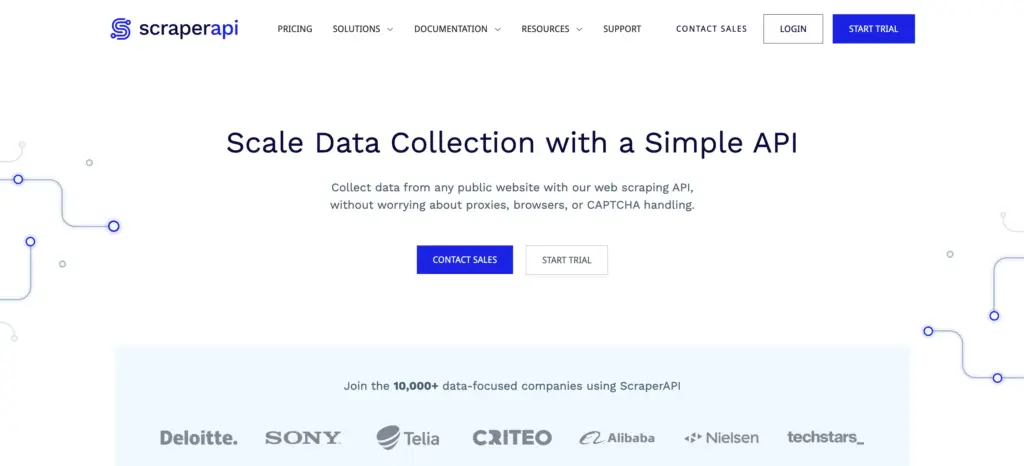
ScraperAPI handles IP rotation, CAPTCHA solving, and other anti-bot measures automatically, making it an excellent choice for developers who want to focus on their scraping tasks without worrying about technical details.
With its simple setup and affordable pricing, ScraperAPI is an excellent option for small to medium-sized scraping projects.
It’s particularly useful for Google scraping, as it’s designed to bypass Google’s anti-scraping mechanisms while providing a user-friendly experience.
Performance:
- Reliable Connections: ScraperAPI offers reliable and stable proxies, making it easy to scrape Google without frequent interruptions.
- Good Success Rate: The service is highly effective at bypassing Google’s blocks and CAPTCHAs, ensuring a smooth scraping process.
Speed Test:
- Fast Connections: ScraperAPI delivers fast connection speeds for scraping tasks, ensuring quick results.
- Stable Speed: Speed remains consistent even under high request volumes, making it suitable for medium-sized projects.
Ease of Use:
- Simple Setup: ScraperAPI is designed with ease of use in mind. It requires minimal configuration, making it a great choice for beginners.
- Automatic Handling of CAPTCHAs and IP Rotation: The service automatically handles CAPTCHA challenges and rotates IP addresses, so users don’t need to manage these tasks manually.
- API Integration: ScraperAPI offers an easy-to-use API, allowing seamless integration into your scraping projects.
Key Features:
- Handles proxies, CAPTCHAs, and browsers
- Simple API integration
- Unlimited bandwidth on all plans
- Country-level geotargeting
- Works great with Google search
Pros
- Automatically handles proxy rotation and CAPTCHAs
- Easy integration with scraping tools
- Scalable solution for large-scale Google scraping
- Simple pricing model based on usage
- Excellent for developers and data analysts
Cons
- Less control over individual proxies
- May not be ideal for users who prefer manual proxy management
6. Webshare
Webshare is a budget-friendly proxy service that offers both residential and datacenter proxies, making it a good option for scraping Google without spending too much.
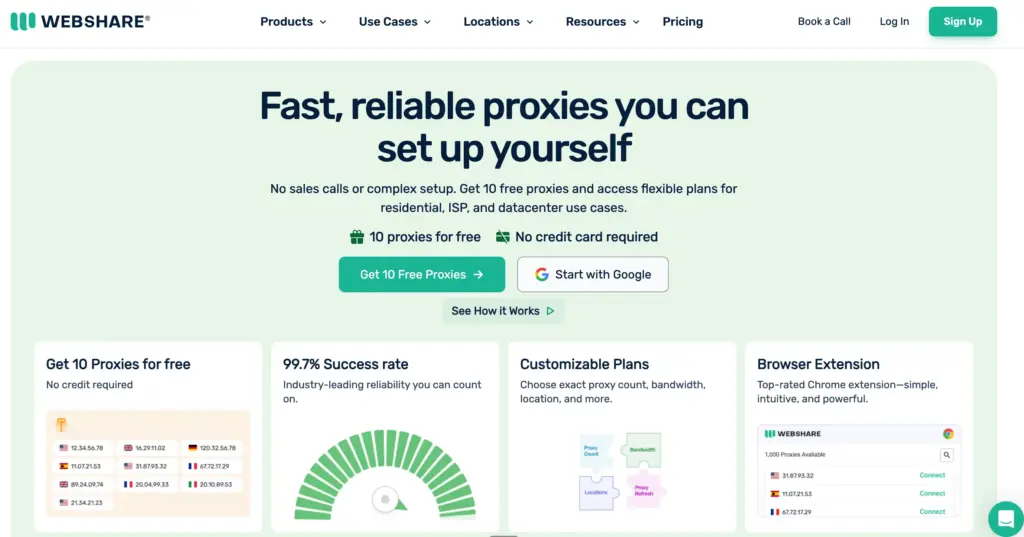
It’s designed for users who want a simple, effective way to collect data from Google, especially for small- to medium-sized projects.
Webshare is easy to use, offers high-quality proxies, and provides the flexibility to choose proxies from different locations.
With Webshare, you can access both residential IPs (from real devices) and datacenter IPs (faster, but easier to block), which makes it a solid choice for Google scraping.
It also offers a variety of geographic locations, so you can scrape localized Google search results for more specific data.
Performance:
- Stable Connections: Webshare offers reliable connections for scraping Google without many interruptions.
- Good Success Rate: While effective for moderate scraping tasks, it may not handle large-scale operations as well as premium options.
Speed Test:
- Good Speeds: Webshare generally provides decent speeds, making it efficient for most scraping tasks.
- Consistent Performance: While speed remains steady, it can slow down with larger volumes of data.
Ease of Use:
- Simple Setup: Webshare is easy to set up, with a clean interface that’s great for beginners.
- Basic Features: It offers features such as IP rotation and geo-targeting, but may lack the advanced tools needed for very large or complex projects.
- API Access: You can easily integrate Webshare into your scraping tools with their API, making it easy to automate your work.
👉Learn More About Webshare: Webshare Review: Is This Proxy Service Worth It? (Pros & Cons)
Key Features:
- Free proxy plan available
- Fast datacenter proxies
- Full control over IP rotation
- Budget-friendly pricing
- Easy setup and clean UI
Pros
- Affordable pricing for small-scale scraping
- Rotating proxies for anonymous browsing
- Easy-to-use dashboard for managing proxies
- Fast and reliable connections
- Good customer support
Cons
- Smaller IP pool compared to premium providers
- Limited features for enterprise-level users
7. Geosurf
Geosurf is a high-quality proxy service known for its vast network of residential proxies, which are particularly well-suited for scraping data from Google.

What sets Geosurf apart is its focus on geo-targeted proxies, making it an excellent choice for users who need to access location-specific data.
Whether you are looking to scrape localized Google search results, track regional trends, or gather data from different countries, Geosurf makes it easy.
Geosurf offers residential proxies that are harder for Google to detect as bots, reducing the risk of being blocked.
The service is ideal for businesses or larger scraping projects that require consistent, high-quality data across multiple locations.
While it is more expensive than many other proxy services, its reliability, performance, and customer support make it a top choice for serious scraping needs.
Performance:
- Reliable Connections: Geosurf provides high-quality residential proxies that offer stable, consistent connections, minimizing disruptions while scraping Google.
- High Success Rate: Because Geosurf uses residential IPs, the success rate is higher than with services that rely on datacenter proxies, which are more likely to be detected and blocked by Google.
Speed Test:
- Fast and Stable: Geosurf offers fast, reliable connections, ensuring scraping tasks run smoothly even for large-scale data extraction. This is especially beneficial for projects that require frequent requests.
- Reliable Speed: The proxies maintain consistent speeds throughout the day, even during peak times, which helps you avoid delays when gathering data from Google.
Ease of Use:
- Simple Setup: Geosurf is easy to set up and comes with a user-friendly interface that simplifies the process, even for those new to web scraping. The setup process is straightforward, allowing users to start scraping quickly.
- Advanced Features: Geosurf provides advanced features such as geo-targeting, which allows users to scrape data from specific countries, cities, or even IP addresses associated with mobile devices. This can be particularly valuable for those looking for region-specific Google data.
- API Integration: Geosurf offers API support, making it simple to integrate their proxies into your scraping scripts and automate tasks. The integration is smooth, allowing for seamless connections to your tools and platforms.
Key Features:
- Premium residential IPs
- Reliable Google scraping performance
- Geo-targeting in 130+ countries
- Clean and stable proxy pool
- 24/7 support for enterprise users
Pros
- High-quality residential and mobile proxies
- Advanced geotargeting for localized Google scraping
- Secure and anonymous connections
- Fast speeds with reliable uptime
- Great customer support
Cons
- Premium pricing suited for enterprise users
- Smaller IP pool compared to top-tier providers
Why You Need Proxies for Google Scraping
Scraping Google without proxies is virtually impossible, especially at scale. Google’s systems are designed to detect and block unusual traffic patterns, such as multiple requests from the same IP address in a short amount of time. Here’s why proxies are essential for Google scraping:
Avoid IP Bans: Google monitors IP addresses for suspicious activity. Without proxies, your IP address can be flagged or banned after sending too many requests. Proxies distribute your requests across multiple IPs, reducing the risk of being blocked.
Anonymity: Proxies mask your real IP address, providing you with anonymous connections that prevent Google from tracking your location or activity.
Bypass Rate Limits: Google has rate limits in place to prevent automated scraping. Proxies help bypass these rate limits by sending requests from different IP addresses, allowing you to scrape larger amounts of data.
Faster Scraping: With proxies, you can use multiple threads to send requests simultaneously. This increases the speed and efficiency of your scraping tasks, especially when you need to gather large volumes of data.
Geo-targeting: Some scraping tasks require you to gather data from specific locations. Residential or mobile proxies can give you IP addresses from different countries or regions, allowing you to scrape localized search results.
Types of Proxies for Google Scraping
When scraping Google, it’s important to use the right type of proxies to ensure optimal performance and avoid detection. Here are the main types of proxies used for Google scraping:
These proxies use real IP addresses from residential devices, making them appear as legitimate users. Residential proxies are ideal for scraping Google because they are less likely to be flagged or blocked.
These proxies come from data centers and are generally faster than residential proxies. However, they are more likely to be detected and blocked by Google. Data center proxies can still be useful for smaller-scale scraping tasks or websites with less stringent anti-bot measures.
Mobile proxies route traffic through mobile networks, making them appear even more legitimate than residential proxies. These proxies are ideal for tasks requiring a high level of anonymity, but they are usually more expensive.
Rotating proxies automatically change IP addresses after each request or session. This makes them ideal for large-scale scraping tasks, as they help avoid detection and ensure uninterrupted scraping.
Quick Links:
- Best UK Proxy Providers
- Best Sneaker Proxies
- Best Proxies for SEO
- Best India Proxy Providers
- Best Web Scraping APIs
- Best Facebook Scraping Tools
Conclusion: Best Proxies For Google Scraping 2026
Scraping Google can be highly beneficial for businesses and individuals looking to gather data for SEO, competitor analysis, or market research.
However, Google’s strict anti-scraping measures make it essential to use reliable proxies. Bright Data, Smartproxy, and Oxylabs stand out as the top proxy providers for Google scraping, offering fast, secure, and rotating proxies that ensure uninterrupted scraping.
For smaller businesses or individuals looking for affordable solutions, Proxy-Cheap and Webshare offer cost-effective options that still deliver reliable performance. Platforms like ScraperAPI simplify the scraping process by automatically managing proxies and CAPTCHA, making them great choices for users who want an easy, scalable solution.
FAQs: Best Proxies For Google Scraping
Google actively blocks unusual traffic patterns, especially multiple requests from the same IP address in a short time. Without proxies, your IP gets flagged or banned after a handful of requests. Proxies distribute your requests across many IP addresses, which protects you from bans, keeps your connection anonymous, helps you bypass Google's rate limits, and lets you run multiple threads at once for faster scraping.
Residential proxies are the best choice for most Google scraping work. They use real IP addresses from residential devices, so they look like genuine users and rarely get blocked. Mobile proxies are even harder to detect but cost more. Datacenter proxies are faster and cheaper, but Google detects and blocks them more easily, so they only suit small scale tasks. For large operations, rotating proxies that switch IP after every request are ideal.
Bright Data and Oxylabs are the top picks for large scale projects. Bright Data offers a pool of more than 72 million IPs with country, city, and ASN targeting. Oxylabs provides over 100 million residential and datacenter proxies with unlimited concurrent sessions and advanced IP rotation. Both deliver high success rates and stable speeds during peak times, though both carry premium pricing.
Decodo and Webshare are the most budget friendly options covered in this guide. Decodo offers 40 plus million IPs with a simple dashboard and affordable plans. Webshare goes further with a genuinely free proxy plan, no credit card required, plus fast datacenter proxies and clean pricing for smaller projects. Neither matches the scale of Bright Data, but both handle moderate scraping reliably.
Two routes work. First, use residential or mobile proxies, which Google rarely challenges because they look like real users. Second, use a tool like ScraperAPI that solves CAPTCHAs automatically and rotates IPs in the background, so you never manage the technical side yourself. Combining high quality proxies with sensible request pacing solves almost every CAPTCHA problem.
Yes, and this is one of the main reasons to use proxies at all. Residential and mobile proxies give you IP addresses from specific countries, cities, or even mobile networks. Bright Data, Oxylabs, and Geosurf all offer geo targeting across 130 plus countries, so you can pull localized Google results, track regional trends, and compare rankings by market.
Not necessarily. ScraperAPI and similar tools handle proxy rotation, CAPTCHAs, and browsers automatically through a simple API, which suits beginners and developers alike. At the other end, Bright Data and Oxylabs offer powerful dashboards and APIs but expect more technical comfort during setup. Beginners should start with Webshare, Decodo, or ScraperAPI and graduate to enterprise tools as their projects grow.
Free proxies, like Webshare's free plan, work for testing and very small projects. They fail for serious scraping because shared free IPs are usually already flagged by Google, which means blocks arrive fast and success rates drop. For any production scraping, paid residential proxies are the minimum sensible investment, because the cost of blocked requests and wasted time exceeds the proxy bill.