
Most of the AI hype is aimed at chatbots and content generators. Demis Hassabis thinks that misses the point. The Google DeepMind co-founder and Nobel laureate has been making one argument all year: the biggest impact of AI will not come from text generators. It will come from science, and specifically from curing disease.
Here is the core of his case:
Not chatbots. Hassabis says the most important use of AI is improving human health, not generating content.
AlphaFold is the proof. His protein-folding model already changed biology and now serves millions of researchers.
A decade-long bet. He believes AI could help treat or cure major diseases within the next ten years or so.
The breakthrough that started it
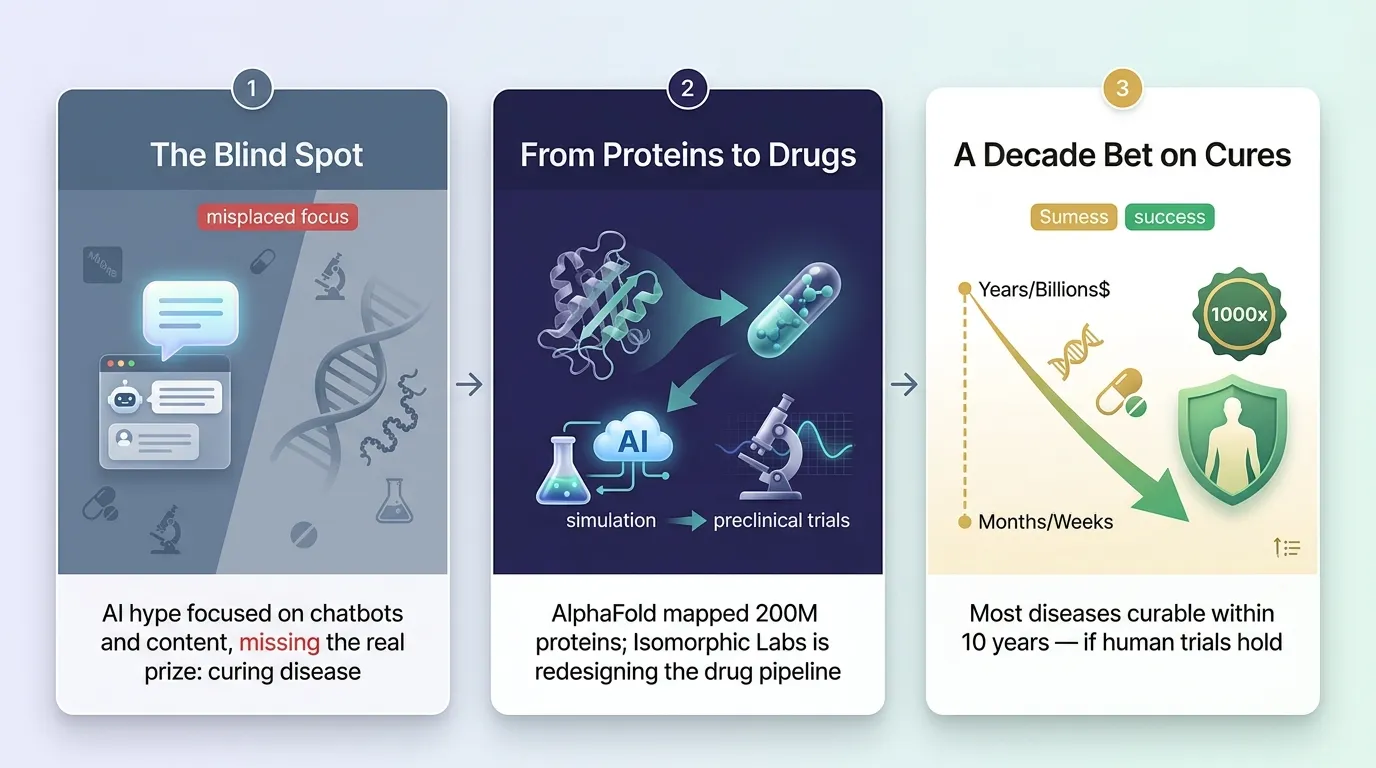
The foundation of his argument is AlphaFold. Proteins do nearly every job in the body, and their shape decides what they can do. For 50 years, mapping those shapes was slow and brutally expensive. AlphaFold changed that almost overnight. By predicting the 3D structure of over 200 million proteins, the model built a road map of the human body now used by more than 3 million researchers. That work won Hassabis a share of the 2024 Nobel Prize in Chemistry.
The point he keeps stressing is that this is the first rung, not the last.
From proteins to drugs
The next step is drug discovery. Today it is painfully slow. Hassabis notes it takes on average about ten years and billions of dollars to design just one drug. He thinks AI can collapse that. He has said the timeline could shrink from years to months, or maybe even weeks.
That is the mission of Isomorphic Labs, his DeepMind spinoff aimed at solving disease. By moving drug discovery from wet labs to computer simulation, Hassabis believes the process can become 1,000 times more efficient, and the company is already in preclinical trials for cancer drugs with hopes to reach clinical trials.
The honest caveat
This is a vision, not a finished result. The big test is still ahead: whether Isomorphic's drugs actually clear human trials. Critics also point out that predicting a protein's shape is not the same as knowing which protein causes a disease or which makes a safe drug. Those harder questions remain unsolved.
Hassabis himself frames his own words carefully. In a 60 Minutes interview, he said he saw no reason why most diseases could not be cured within the next decade, and that it is within reach, not that it is guaranteed.
The takeaway
The lesson for anyone watching AI is to look past the chat window. The flashy consumer tools get the attention, but the deeper shift is happening in scientific workflows that most people never see. If Hassabis is right, the most important AI of the next decade will not write your emails. It will help design your medicine.
Here is Hassabis stating his core position in his own words:
https://x.com/demishassabis/status/2054197462101889277
Quick Links: