

Monetag is our first Smartlink option for publishers comparing website and social traffic monetisation. Adsterra offers a flexible link-placement route, while BidVertiser explicitly describes CPC-based Smartlinks. Clickadu and LosPollos are further options for automated offer routing. Choose by permitted traffic, destination quality and confirmed earnings per click.
| Best For | Mixed website and social traffic | Links placed on web pages or approved social channels | Publishers comparing a click-based model |
| Product distinction | Automated routing through one URL | Smartlink alongside other publisher formats | CPC-based Smartlinks |
| Main Check | Source permission and destination fit | Clear labelling and placement | Valid-click rules and payment method |



A single offer rarely suits every visitor. Someone on an Android phone in one country may need a different destination from a desktop visitor elsewhere.
A Smartlink aims to handle that selection. You share one monetised URL, and the network chooses an eligible destination when the visitor clicks.
That sounds simple, but the link is still part of your publishing experience. Readers judge the page they land on, even when the network selected it.
The best Smartlink ad networks therefore need more than a large offer catalogue. They need to fit your audience, support your traffic source and give you enough reporting to decide whether the arrangement is worthwhile.
Best Smartlink ad networks: Quick comparison
Compare the best Smartlink ad networks based on traffic requirements, targeting capabilities, supported ad formats, payout thresholds, and earning potential to find the right platform for monetizing your traffic and increasing revenue with minimal setup.
Network | Best fit | Product distinction | Main check |
|---|---|---|---|
Monetag | Mixed website and social traffic | Automated routing through one URL | Source permission and destination fit |
Adsterra | Links placed on web pages or approved social channels | Smartlink alongside other publisher formats | Clear labelling and placement |
BidVertiser | Publishers comparing a click-based model | CPC-based Smartlinks | Valid-click rules and payment method |
Clickadu | Automated selection of advertising offers | Dedicated publisher Smartlink product | Reporting and eligible traffic |
LosPollos | Affiliates needing vertical-based routing | Smartlinks and a separate CPA marketplace | Vertical, source and verification rules |
These are publisher options. Buying traffic is a separate decision with its own costs and rules.
How is a Smartlink different from a normal affiliate link?
A normal affiliate link typically points to a particular merchant or offer. A Smartlink can select between destinations using factors such as location, device and available demand.
That is useful for mixed audiences or traffic that does not fit one fixed campaign. It also means the publisher has less certainty over the exact destination each person sees.
A URL shortener, by contrast, may simply make a fixed link shorter. Shortening alone does not create a monetisation agreement or optimise offer selection.
Before choosing a Smartlink, decide whether routing is appropriate. If a product review promises a link to a specific laptop, an unrelated rotating offer is not a suitable replacement.
5 Best Smartlink ad networks in detail
Explore the 5 best Smartlink ad networks, comparing their key features, traffic requirements, targeting options, payout methods, and earning potential to help you choose the right platform for monetizing your traffic and maximizing advertising revenue.
1. Monetag: Best starting point for mixed traffic
Monetag's SmartLink page describes one URL that routes visitors to offers using information such as geography and device. It specifically addresses website owners, social publishers and affiliates.
That makes it a useful first shortlist option when you have several audience sources and do not want to assign one fixed offer to everyone.
Start by separating those sources in your reporting. Traffic from a tutorial, a community post and a resource directory may have different intent, even if the visitors live in the same country.
The convenience of one URL should not hide that difference. If one source repeatedly sends people to unsuitable offers, a strong overall earnings figure is not enough to justify leaving it unchanged.
Pros
- A clearly documented automated link-routing product.
- A relevant option for both site and social publishers.
Cons
- The final offer can differ between visitors.
- Sharing still depends on the rules of the originating platform.
Our verdict: Compare Monetag first for mixed traffic with a legitimate advertising destination. Keep separate source records so you know which audience is producing the result.
2. Adsterra: Best for flexible on-page placement
Adsterra offers Smartlinks alongside its other publisher formats. The link can be associated with page elements such as text, buttons or images, and its publisher page also discusses social traffic.
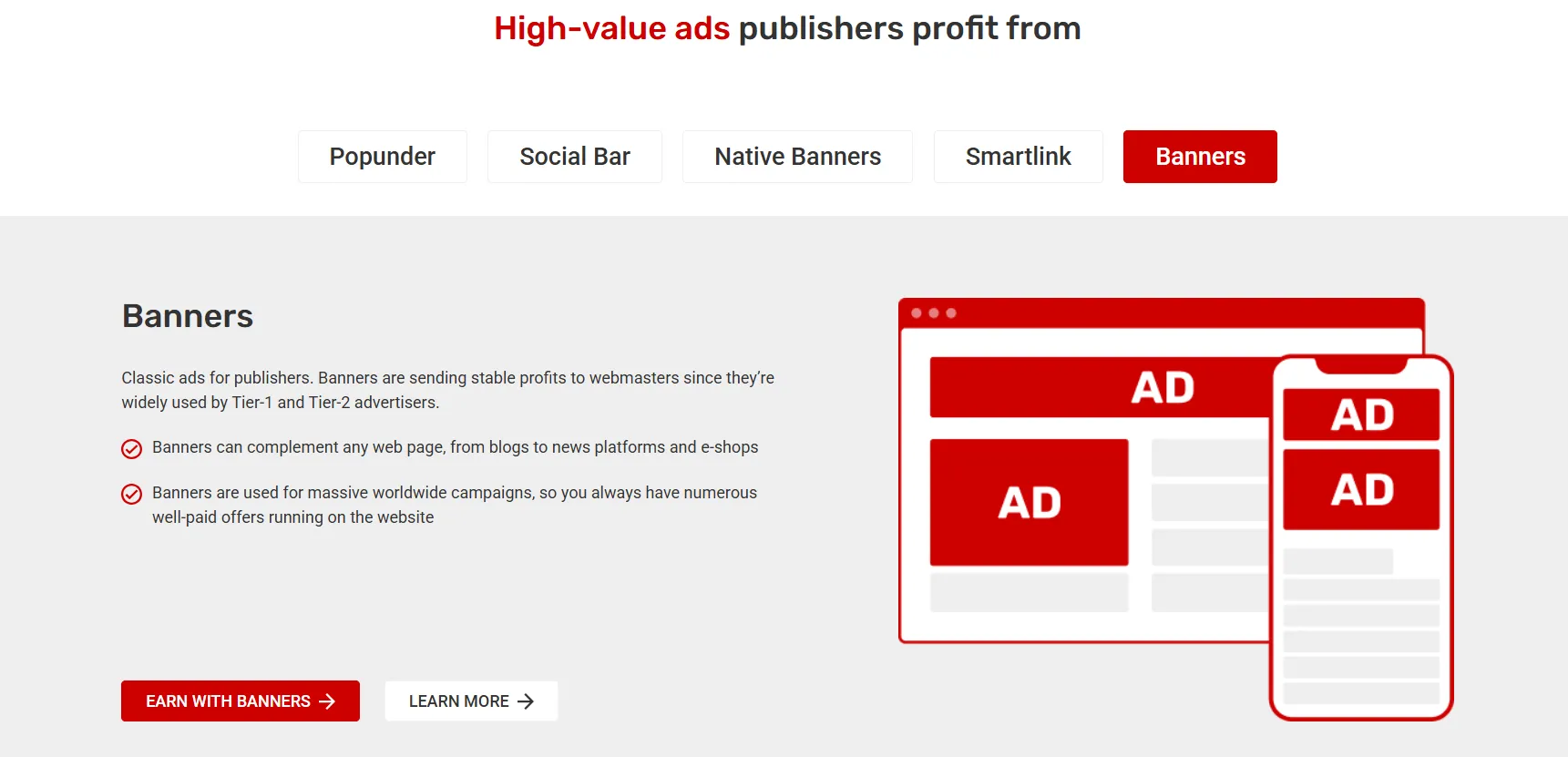
The practical benefit is flexibility over where an advertising opportunity appears. A clearly labelled sponsored-offer section can use a link without needing another rectangular banner.
Placement must remain honest. A button labelled “download the report” should not unexpectedly send someone to an unrelated advertising offer. Do not replace navigation, account controls or editorial references with a monetised destination.
Choose a place where visitors understand that they are opening a promotion. Then compare the net value of that placement with the previous layout.
Pros
- Several possible link placements within a web page.
- Can be evaluated alongside other Adsterra publisher formats.
Cons
- Flexible placement makes unclear labelling an easy mistake.
- An extra outgoing link can distract from higher-value actions.
Our verdict: Shortlist Adsterra for a clearly defined advertising link on an existing site. The label and destination expectations should be part of the setup.
3. BidVertiser: Best for comparing a CPC-based Smartlink
BidVertiser explicitly describes its Smartlinks as CPC-based. Its publisher page also lists other monetisation formats, while its Smartlink documentation describes integration parameters.
That makes it a useful comparison when the earning model matters as much as the routing.
CPC-based does not mean every recorded click is automatically payable. Ask how valid activity is counted, how adjustments appear and which sources are accepted. Use the contract and account reporting rather than an assumption based on the acronym.
It is also worth checking whether your existing tracking system can distinguish the link's placements. A single site-wide number is less useful than knowing which genuine advertising opportunity creates value.
Pros
- An explicitly described click-based Smartlink model.
- Published integration guidance.
Cons
- Valid-traffic conditions still determine payable activity.
- The model does not establish a fixed rate per visitor.
Our verdict: Compare BidVertiser if you specifically want to investigate a CPC-based route. Confirm how clicks, deductions and final earnings are reported.
4. Clickadu: Best for another automated routing comparison
Clickadu has a dedicated publisher Smartlink product that describes routing users to a relevant available offer at the time of the click.
It belongs on the shortlist when you want a second routing provider to compare against an existing setup.
Make the comparison controlled. Use similar source quality and audience segments, and avoid sending one service your best traffic while the other receives only leftovers.
Also compare the destination experience. A link that earns slightly more but creates repeated complaints can damage the source that produced those visitors in the first place.
Ask what reporting dimensions are available and whether you can identify low-quality or unsuitable destinations through support. Operational control matters once the test grows beyond a handful of links.
Pros
- A dedicated publisher Smartlink offering.
- A relevant alternative for an existing routing test.
Cons
- The strongest published marketing claim is not a measured result.
- Destination quality must be assessed alongside revenue.
Our verdict: Evaluate Clickadu as a controlled alternative, with the same traffic conditions and clear rules for stopping an unsuitable test.
5. LosPollos: Best for affiliates choosing a vertical
LosPollos distinguishes its Smartlinks from its CPA marketplace and lists verticals such as dating, e-commerce and lead generation. Its FAQ explains application verification and prohibits illegitimate traffic sources.

That distinction helps affiliates decide how much control they want. A selected CPA offer and a rotating Smartlink are different approaches, even when offered by the same company.
The vertical needs to fit the audience. A general-interest resource should not send visitors into a sensitive or unexpected category simply because it appears profitable.
Before applying, describe the source, audience and proposed placement accurately. Ask which verticals and traffic types are approved for that account rather than interpreting a broad product page as permission for every campaign.
Pros
- Clear separation between Smartlinks and a CPA marketplace.
- Several verticals to discuss with the provider.
Cons
- Some verticals may be unsuitable for a mainstream audience.
- Application and source verification are part of the process.
Our verdict: Put LosPollos on the shortlist when you understand your traffic and need vertical-specific routing. Choose the permitted category before judging payouts.
How should you compare Smartlink earnings?
Use confirmed earnings per click, with a consistent definition of the click count.
EPC = net earnings ÷ clicks.
A hypothetical link that produces $60 from 2,000 clicks has an EPC of $0.03. A second link earning $45 from 1,000 clicks has an EPC of $0.045. The second is more valuable per click in that example, even though its total revenue is lower.
Do not copy those figures as expected rates. They only illustrate the calculation.
Check whether the dashboard's click count includes activity later rejected or filtered. Also separate provisional revenue from settled earnings.
If you buy traffic, include the acquisition cost. Positive revenue does not imply profit.
Why should you segment traffic?
A blended result can make a useful source look poor or a poor source look good.
Suppose one country earns well while another creates most of the complaints. A global average will not tell you how to respond. The same applies to device type and placement.
Use reporting to answer:
Which source sent the click?
What device and country did it come from?
How much confirmed revenue did it create?
Did the visitor return or report a problem?
Did the placement reduce another important action?
You do not need dozens of labels on day one. Begin with the distinctions that can change a decision, such as newsletter versus website or two separate advertising placements.
What should you check before sharing a Smartlink?
Confirm the source's rules and the network's traffic policy. Permission from one does not establish permission from the other.
Inspect the supported preview or ask the provider how to review likely destinations. Avoid repeatedly clicking your own live links as an informal test.
Keep a record of where each link is used. If an offer category changes or a source stops allowing the destination, you should be able to remove the affected placement quickly.
Do not use Smartlinks as disguised system messages, fake download controls or misleading editorial references. Clear expectations help keep the traffic useful to both the advertiser and the visitor.
Is a Smartlink better than a fixed offer?
It can be better for mixed traffic, but a fixed offer often makes more sense when the visitor wants a particular product.
Consider a detailed review. The reader expects the linked product to match the review. A fixed merchant destination preserves that relationship.
Now consider an optional sponsored-offer area aimed at a broad audience. Automated routing may be a reasonable model, provided the categories and destinations are appropriate.
Use Smartlinks where flexibility solves a real problem. Do not introduce routing simply because it is easier to copy one URL.
FAQs: Best Smartlink Ad Networks
Monetag is our first general shortlist choice for mixed website and social traffic. Adsterra, BidVertiser, Clickadu and LosPollos are worth comparing for different placement and earning models.
Some providers support approved social or other traffic sources. Monetag and Adsterra describe options beyond a standalone website. The source platform's rules still apply.
Not necessarily. The earning model and valid-traffic rules vary. BidVertiser describes its Smartlinks as CPC-based, but you should still confirm what counts as payable activity.
EPC is earnings per click. CPM expresses an amount per thousand impressions. Do not compare the two figures directly without understanding what activity each report counts.
Technically flexible placement does not make every use appropriate. The button should clearly represent an advertising destination and must comply with the network and source rules.
That is not a result you should assume. Networks describe optimisation systems, but actual performance depends on eligible demand and your traffic. Measure confirmed earnings and destination quality.
Quick Links:
Which Smartlink network should you try first?: Best Smartlink Ad Networks
Choose one provider that fits the source you already have. Monetag is a useful general starting point; Adsterra suits flexible placement, and BidVertiser provides a click-based model to compare. Clickadu and LosPollos offer further routing options.
Run a limited test with clear labels and source tracking. Expand only when the earnings, destination quality and audience response make the decision worthwhile.