
AI and jobs is the most argued-over topic in tech, and most of the noise comes from missing or cherry-picked data. This roundup collects the most reliable AI job statistics for 2026 in one place, pulled from primary sources like Anthropic, Stanford, the US Bureau of Labor Statistics, PwC, Goldman Sachs, the IMF, and the World Economic Forum. Every stat is attributed so you can judge it for yourself. Figures from layoff trackers and forecasts are estimates and vary by source.
Key Statistics at a Glance
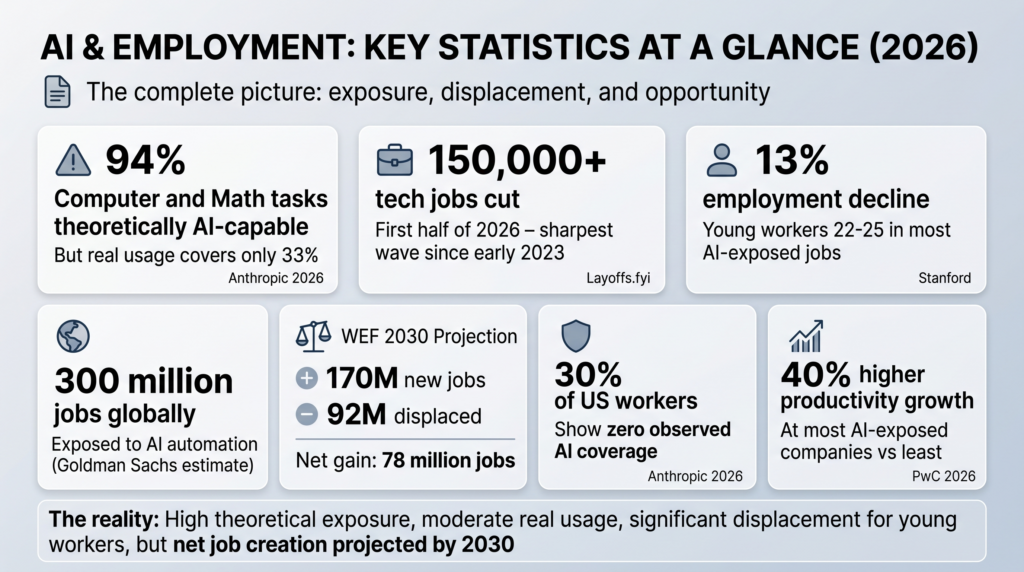
AI could theoretically perform 94% of Computer and Math tasks, but real usage covers only 33%. (Anthropic, 2026)
More than 150,000 tech jobs were cut in the first half of 2026, the sharpest wave since early 2023. (Layoffs.fyi)
Young workers aged 22 to 25 in the most AI-exposed jobs saw a 13% relative employment decline. (Stanford)
Goldman Sachs estimates 300 million jobs globally are exposed to AI automation.
The World Economic Forum projects 170 million new jobs and 92 million displaced by 2030, a net gain of 78 million.
30% of US workers show zero observed AI coverage. (Anthropic, 2026)
Productivity growth is 40% higher at the most AI-exposed companies than the least. (PwC, 2026)
AI Job Exposure Statistics
These figures measure how much of each job AI can do, based on Anthropic's 2026 report and other exposure research.
Computer and Math work is 94% theoretically exposed to AI but only 33% covered in real usage. (Anthropic)
Computer Programmers are the most exposed occupation at 75% task coverage. (Anthropic)
Data Entry Keyers sit at 67% task coverage. (Anthropic)
The IMF estimates 40% of jobs worldwide are exposed to AI, rising to 60% in advanced economies.
Goldman Sachs finds AI can automate tasks equal to 25% of all US work hours.
30% of US workers have effectively zero AI coverage in current usage data. (Anthropic)
Here is theoretical AI coverage by occupational category, from Anthropic's data.
Occupational Category | Theoretical AI Coverage |
Computer & Math | 94.3% |
Business & Finance | 94.3% |
Management | 91.3% |
Office & Administrative | 90% |
Legal | 89% |
Architecture & Engineering | 84.8% |
Arts & Media | 83.7% |
Life & Social Sciences | 77% |
Sales | 62% |
Education & Library | 61.7% |
Healthcare Practitioners | 59.9% |
Social Services | 50.5% |
Agriculture | 15.7% |
Transportation | 12.1% |
Grounds Maintenance | 3.9% |
AI Layoff Statistics
More than 150,000 tech jobs were cut in the first half of 2026 across over 500 companies. (Layoffs.fyi)
Q1 2026 alone saw about 81,700 tech layoffs, the highest quarterly total since early 2023. (Statista, Layoffs.fyi)
Roughly 20% of confirmed 2026 tech layoffs were explicitly tied to AI and automation, up from under 8% in 2025. (RationalFX analysis of Layoffs.fyi)
Tech layoffs totaled about 122,000 to 127,000 in 2025 and roughly 153,000 in 2024. (Layoffs.fyi, Crunchbase)
Total tech layoffs since 2020 are approaching 900,000. (Layoffs.fyi)
Alphabet, Microsoft, Meta, and Amazon are expected to spend close to $700 billion on AI infrastructure in 2026 while cutting headcount.
US unemployment rose from 3.5% in late 2022 to about 4.4% by early 2026. (NerdWallet)
Glassdoor's tech sector confidence index fell 6.8 percentage points year over year to 47.2%, the steepest drop of any industry.
Entry-Level and Young Worker Statistics
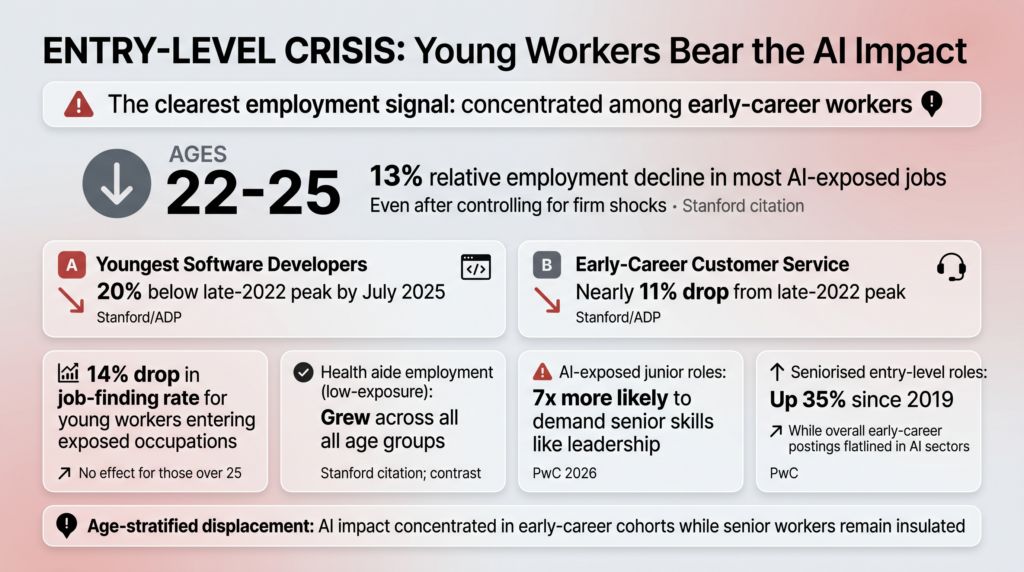
The clearest employment signal so far is concentrated among young, early-career workers.
Workers aged 22 to 25 in the most AI-exposed jobs saw a 13% relative employment decline, even after controlling for firm shocks. (Stanford)
Employment for the youngest software developers was about 20% below its late-2022 peak by July 2025. (Stanford, ADP data)
Early-career customer service workers fell nearly 11% from their late-2022 peak. (Stanford, ADP)
Anthropic measured a roughly 14% drop in the job-finding rate for young workers entering exposed occupations, with no effect for those over 25.
Health aide employment, a low-exposure role, grew across all age groups over the same period. (Stanford)
AI-exposed junior roles are 7 times more likely to demand traditionally senior skills like leadership. (PwC, 2026)
‘Seniorised' entry-level roles have grown 35% since 2019 even as overall early-career postings flatlined in AI-heavy sectors. (PwC)
Jobs Most at Risk vs Safest From AI
A group of 18 AI-exposed occupations, about 10 million US jobs, fell 0.2% between May 2024 and May 2025 while overall employment grew 0.8%. (BLS)
Customer service representatives declined by 130,180 workers, a 4.8% drop in a single year. (BLS)
Excluding medical roles, 17 AI-exposed categories fell 1.6% for a second straight year. (BLS)
The most exposed categories are Computer and Math, Business and Finance, Management, and Office and Administrative, all near or above 90% theoretical exposure. (Anthropic)
The safest work is physical and hands-on: Grounds Maintenance is lowest at 3.9%, with transportation, construction, agriculture, and food service near the bottom. (Anthropic)
Construction jobs tied to AI data-center buildout have risen by 216,000 since 2022. (Goldman Sachs)
Who Is Most Affected
Workers in the most AI-exposed jobs earn 47% more on average than those in unexposed jobs. (Anthropic)
People with graduate degrees make up 4.5% of the least-exposed group but 17.4% of the most-exposed group. (Anthropic)
The most exposed group is 16 percentage points more likely to be female. (Anthropic)
For every 10 percentage point rise in AI coverage, BLS projects 0.6 percentage points slower job growth through 2034. (Anthropic, BLS)
AI Job Creation Statistics
AI does not only remove jobs. Several major forecasts project net job creation.
The World Economic Forum projects 170 million new jobs and 92 million displaced by 2030, a net gain of 78 million. (WEF Future of Jobs)
McKinsey estimates AI could help create 20 to 50 million new jobs globally by 2030.
Employers expect big data specialist roles to grow 117% and software developer roles 57% over five years. (WEF)
Headcount and wages are growing faster at the most AI-exposed companies than the least. (PwC, 2026)
Jobs being reshaped to require more human expertise are growing twice as fast as those simplified by AI, with 42% higher wage growth since 2021. (PwC)
Goldman Sachs notes AI is also creating demand in infrastructure, specialized fields, and AI-skilled roles.
How Workers Use AI: Augmentation vs Automation
On business API traffic, 77% of AI usage is automation versus just 12% augmentation. (Anthropic)
97% of tasks show automation-leaning patterns on the API, compared to 47% on the consumer app. (Anthropic)
On consumer apps the split is close to even, with augmentation slightly ahead at around 52% versus 45%. (Anthropic)
The share of hands-off directive use rose from 27% in late 2024 to 39% in a later sample. (Anthropic)
Coding tasks make up about 35% of consumer Claude conversations and nearly half of business traffic. (Anthropic)
Stanford found job declines concentrated in roles where AI automates work rather than augments it.
Conclusion
The 2026 data tells a layered story rather than a simple one. AI's theoretical reach into knowledge work is enormous, often above 90% in fields like computing, finance, and administration, but real usage covers only a fraction of that, around a third even in the most affected category. Layoffs are real and rising, with AI named as a driver far more openly than before, yet major forecasts still project net job creation by 2030 and the most AI-exposed companies are adding headcount and raising wages.
The sharpest verified signal is at the entry level, where young workers in automation-heavy roles are seeing measurable declines while experienced workers and augmentation-heavy roles hold steady. The takeaway across every credible source is the same: the gap between what AI can do and what it is doing remains wide, and how fast that gap closes is the number worth watching.
FAQs
There is no single clean total, as most effects appear as slower hiring rather than outright job cuts. The clearest evidence includes a 13% relative employment drop for workers aged 22 to 25 in the most AI-exposed roles and a group of 18 AI-exposed occupations covering 10 million jobs that fell 0.2% in one year while overall employment grew.
Knowledge and screen-based roles face the highest exposure, with Computer Programmers at 75% task coverage leading the list, followed by customer service and data entry workers. Broader categories at risk include Computer and Math, Business and Finance, Management, and Office and Administrative work according to Anthropic research.
Physical, hands-on, and care-based jobs remain the least exposed to AI replacement. Grounds Maintenance ranks lowest at just 3.9% exposure, with transportation, construction, agriculture, and food service also among the safest categories.
Major forecasts suggest yes, with the World Economic Forum projecting a net gain of 78 million jobs and McKinsey estimating 20 to 50 million new AI-related roles by 2030. The central challenge is the transition period, since displaced workers may not easily qualify for the new positions being created.
AI is a contributing factor but not the only driver, accounting for roughly 20% of confirmed 2026 tech layoffs, up from under 8% in 2025. Many additional cuts reflect broader cost discipline and companies redirecting budgets toward AI infrastructure investment.