
Affiliate marketing does not exist in isolation. It is one component of a broader performance marketing ecosystem — an industry defined by a single, powerful principle: you only pay for results. In 2026, the performance marketing services market is valued at USD 26.09 billion and is projected to reach USD 40 billion by 2035. The broader digital advertising market that contextualises it has crossed USD 740 billion globally, commanding 73% of all media spend. Understanding where affiliate marketing sits within this larger performance marketing universe helps you understand why the channel continues to grow, what competitive forces are shaping it, and how to position yourself for the decade ahead.
📊 Market Snapshot
Metric | Value |
Performance Marketing Services Market (2024) | USD 25 Billion |
Performance Marketing Services Market (2025) | USD 26.09 Billion |
Projected Size (2035) | USD 40 Billion |
CAGR (2025–2035) | 4.37% |
Global Digital Ad Spend (2026) | USD 740 Billion |
Digital Share of Total Media Spend | 73% |
US Ad Spend Growth (2026) | 9.5% |
Digital Marketing Market (2026) | USD 446.5 Billion |
Digital Marketing Projected (2035) | USD 1.5 Trillion |
What Performance Marketing Actually Is
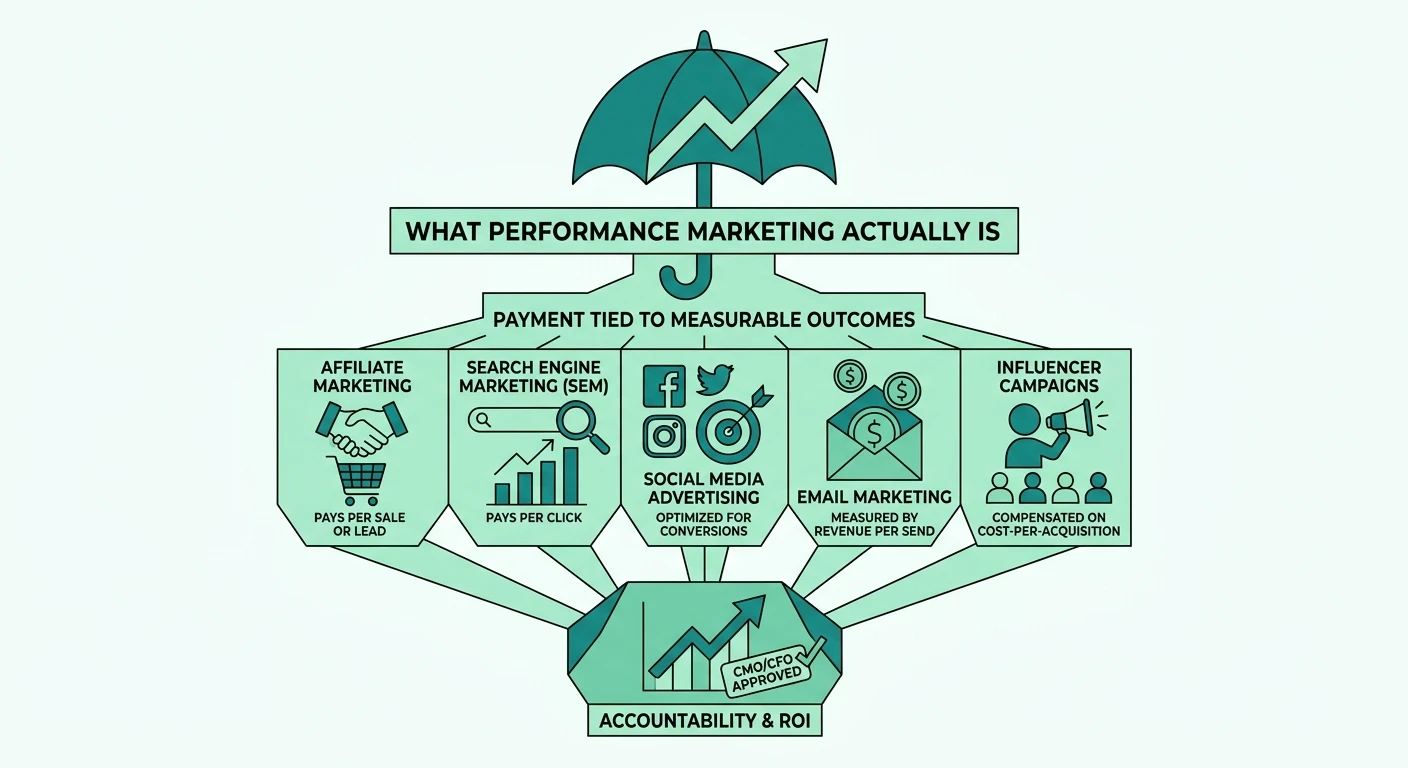
Performance marketing is the umbrella category that includes any digital marketing activity where payment is tied to a measurable outcome rather than an impression or reach metric. Affiliate marketing is the purest form of this model, where advertisers pay only when a sale or lead is generated. But performance marketing also encompasses search engine marketing where payment is per click, social media advertising optimised for conversions, email marketing measured by revenue per send, and increasingly, influencer campaigns compensated on a cost-per-acquisition basis.
The reason performance marketing is growing faster than brand advertising is straightforward: in a world where every marketing dollar is scrutinised for return on investment, the proposition of paying only when something actually happens is irresistible. CMOs and CFOs who cannot justify their traditional advertising spend on measurable outcomes are redirecting budgets toward channels where the accountability is built into the payment model. This is the macro tailwind behind every form of performance marketing, including affiliate.
The Digital Advertising Context
To understand where performance marketing sits, you need to appreciate the scale of the digital advertising market it operates within. Global digital ad spend has crossed USD 740 billion in 2026 — roughly three-quarters of a trillion dollars — and now represents 73% of all global media spending. Traditional media (television, print, outdoor, radio) has been reduced to the minority allocation of marketing budgets, a reversal that would have seemed impossible just fifteen years ago.
Within digital advertising, performance channels are growing faster than awareness channels. US ad spend is projected to grow 9.5% in 2026, with digital continuing to outpace the broader market with double-digit gains. The Interactive Advertising Bureau reports that affiliate marketing alone now represents roughly 12% of total digital performance ad spend in mature markets — a figure that continues to grow as more brands discover that affiliate delivers measurable ROI at scale.
How Performance Marketing Segments
The performance marketing services market breaks down across several service types, each targeting a different point in the customer acquisition funnel. Search engine marketing captures intent at the moment of search, making it the highest-converting paid channel for most categories. Social media advertising reaches audiences based on interests and behaviours, making it effective for discovery and consideration. Affiliate marketing leverages trusted third-party publishers to reach audiences that traditional ads cannot access. Email marketing nurtures existing relationships toward repeat purchase. Mobile advertising reaches consumers in the contexts where they increasingly spend most of their digital time.
By industry, retail and e-commerce are the largest performance marketing spenders, followed by financial services, healthcare, media and entertainment, and travel. Financial services and healthcare are notable for the explosive growth in affiliate specifically — both categories involve significant consumer trust barriers that authentic third-party content can overcome far more effectively than direct brand advertising.
The enterprise versus SME dynamic is also important. Large enterprises use performance marketing primarily for precision targeting and attribution at scale. Small and medium businesses use it because it minimises financial risk — they only spend money when campaigns actually work. This democratisation of effective marketing is one reason why the affiliate channel continues to attract new participants even as it matures.
Key Statistics at a Glance
Performance marketing services market: USD 26.09 Billion (2025)
Projected market (2035): USD 40 Billion
Global digital ad spend: USD 740 Billion (2026)
Digital share of media spend: 73%
US ad spend growth: +9.5% (2026)
Affiliate share of digital performance spend: ~12%
E-commerce sales driven by affiliate: USD 113 Billion (US alone)
Brands using performance-based programs: 80%+
Programmatic advertising share of display ads: 91%
Marketing automation market (2025): USD 47.3 Billion
What Is Driving the Growth
The fundamental driver of performance marketing's growth is the irreversible shift of consumer attention and commerce from offline to online. As more purchasing decisions happen through digital channels, brands need digital marketing infrastructure to reach, persuade, and convert those buyers. Performance marketing channels provide the most cost-efficient way to do this because their payment models align advertiser spend directly with business outcomes.
Artificial intelligence and automation are compressing what used to take teams of analysts days to accomplish into real-time algorithmic processes. Dynamic creative generation, predictive audience modelling, automated bid optimisation, and cross-channel attribution are all now handled by machine learning systems that operate at speeds and scales impossible for human teams. This makes performance marketing more effective and more accessible simultaneously — smaller brands with limited teams can now run sophisticated campaigns that were previously only available to enterprise advertisers with large marketing operations.
The rise of mobile commerce is another critical driver. With 55% of all affiliate traffic now coming from mobile devices, performance marketers who have not optimised their entire funnel for mobile — landing pages, checkout flows, email renders, ad creative — are leaving significant conversion on the table. The brands and affiliates who have built mobile-first experiences are consistently outperforming those who have not.
The Challenges Ahead
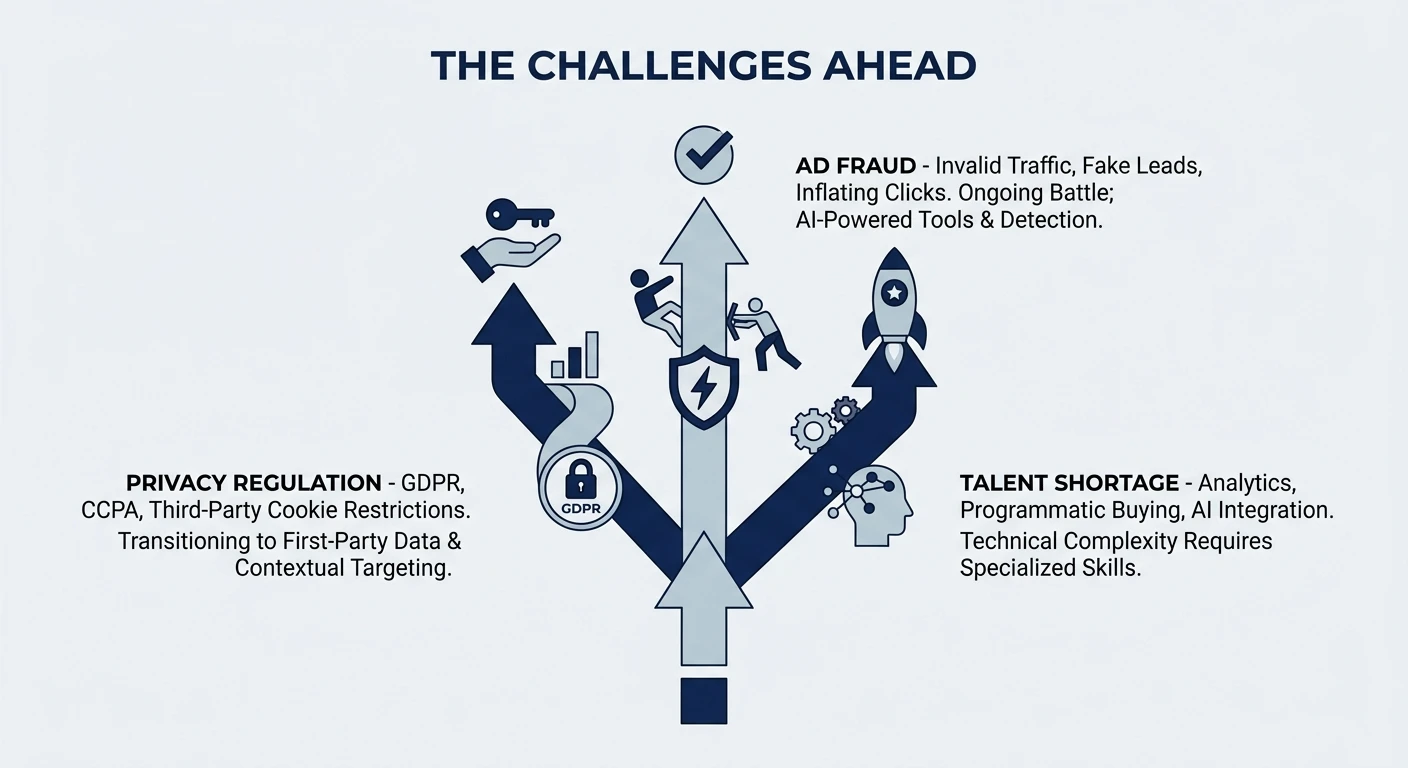
The performance marketing industry faces three major structural challenges heading into the second half of the decade. Privacy regulation is the most immediate. GDPR in Europe, CCPA in California, and an expanding list of regional data privacy laws are restricting the use of third-party cookies and certain tracking mechanisms, making audience targeting less precise and attribution modelling more complex. Marketers are being forced to rebuild their measurement infrastructure around first-party data, contextual targeting, and privacy-compliant attribution — a transition that requires significant technical investment.
Ad fraud and click fraud remain persistent problems across all performance channels. Fraudulent publishers inflate click counts, fake leads consume advertiser budgets, and invalid traffic skews performance data, leading to flawed optimisation decisions. The industry spends hundreds of millions annually on fraud detection, and while AI-powered tools are improving significantly, fraudsters evolve their methods in parallel.
Talent shortages in analytics, programmatic buying, and AI integration continue to create bottlenecks for brands trying to scale their performance marketing operations. The technical complexity of modern performance marketing — which requires fluency in data analytics, platform APIs, attribution modelling, and machine learning — means that skilled practitioners command premium compensation and are in short supply globally.
🌍 Regional Overview
Region | Market Status | Key Driver | Notable Trend |
North America | Largest, most advanced | High digital adoption, strong infrastructure | AI integration, programmatic dominance |
Europe | Second largest | Strong brand investment | GDPR compliance reshaping measurement |
Asia-Pacific | Fastest growing | Mobile commerce explosion | China, India, SEA driving volume |
Latin America | Emerging | Internet expansion, mobile growth | Global brands targeting digitally active consumers |
Middle East and Africa | Early stage | Young, connected populations | Mobile-first markets with high growth potential |
What This Means for Affiliate Marketers
Performance marketing is the industry context within which affiliate marketing operates, and understanding the macro forces shaping it helps affiliate marketers anticipate change and position themselves advantageously. The shift toward performance-based compensation across all digital marketing channels means that the skills affiliate marketers have always used — building audiences, creating content that converts, tracking and optimising performance — are increasingly in demand across the broader marketing industry.
The convergence of affiliate, influencer, and content marketing under the performance marketing umbrella means that the most successful affiliate marketers in 2026 are not operating in a silo. They are building multi-channel presence, layering TikTok and YouTube alongside SEO content and email, and measuring everything with the same rigour that programmatic advertisers apply to their paid campaigns. The USD 40 billion performance marketing market of 2035 will belong disproportionately to those who start building that infrastructure today.
FAQs
The performance marketing market is expected to reach several hundred billion dollars by 2035, driven by increasing digital ad spend and the shift toward measurable, results-based advertising models. Rapid adoption across industries like e-commerce, fintech, and healthcare is accelerating this growth significantly.
The performance marketing market is projected to grow at a compound annual growth rate (CAGR) of approximately 10–15% between 2026 and 2035. This growth is fueled by advancements in AI-driven targeting, affiliate marketing expansion, and greater advertiser demand for ROI-focused campaigns.
Performance marketing is gaining traction because advertisers only pay for measurable outcomes such as clicks, leads, or conversions, making it far more cost-efficient than traditional impression-based advertising. The ability to track real-time data and optimize campaigns instantly gives brands a significant competitive advantage.
Yes, affiliate marketing remains one of the largest and fastest-growing segments within the performance marketing landscape, contributing significantly to overall market revenue. The rise of influencer partnerships and content-driven affiliate programs has expanded this segment considerably heading into 2026 and beyond.
Absolutely, small businesses stand to benefit greatly as performance marketing platforms become more accessible, automated, and affordable through 2035. Emerging tools powered by machine learning and programmatic advertising allow smaller brands to compete effectively with larger players on a pay-for-results basis.