
Most conversations about affiliate marketing focus on the commissions, the programs, and the traffic strategies. Far less attention is paid to the infrastructure that makes it all work — the tracking platforms, partner management systems, attribution tools, fraud detection software, and automation layers that sit beneath every affiliate transaction. This infrastructure is itself a massive market, valued at USD 23.84 billion in 2026 and projected to reach USD 35.70 billion by 2033. Understanding this market helps affiliate marketers make smarter platform choices, anticipate industry direction, and identify where the technology is heading.
📊 Market Snapshot
Metric | Value |
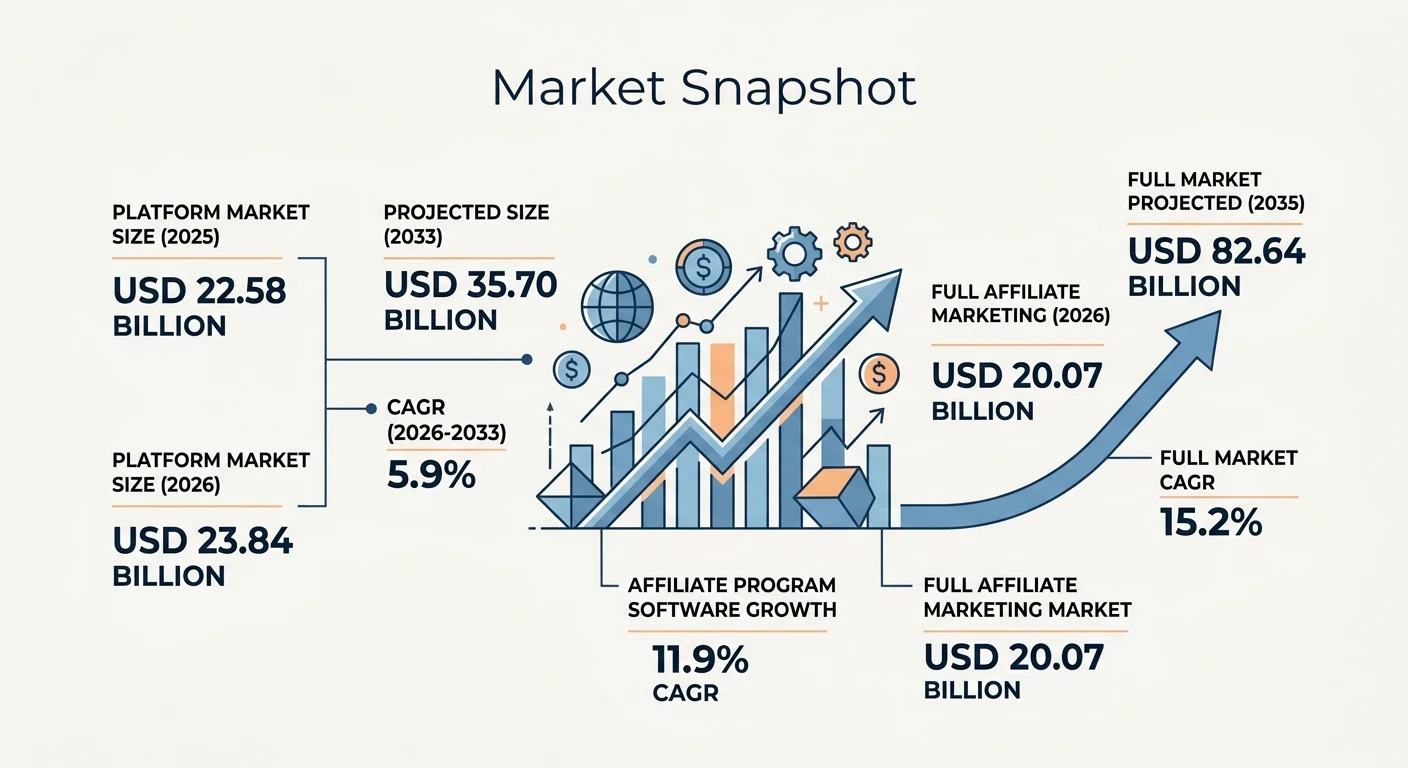
Platform Market Size (2025) | USD 22.58 Billion |
Platform Market Size (2026) | USD 23.84 Billion |
Projected Size (2033) | USD 35.70 Billion |
CAGR (2026–2033) | 5.9% |
Affiliate Program Software Growth | 11.9% CAGR |
Full Affiliate Marketing Market (2026) | USD 20.07 Billion |
Full Market Projected (2035) | USD 82.64 Billion |
Full Market CAGR | 15.2% |
What the Platform Market Actually Covers
The affiliate marketing platform market is the technology layer that powers the entire affiliate industry. It includes the networks where publishers and advertisers find each other, the tracking software that attributes sales to the correct affiliate, the partner management systems that handle contracts and compliance, the anti-fraud tools that filter out invalid traffic, and increasingly the AI-powered systems that optimise campaigns in real time.
This market is distinct from the broader affiliate marketing market in an important way. The USD 20.07 billion figure you see cited most often for the affiliate marketing market refers to the channel spend — what advertisers pay affiliates in commissions. The USD 23.84 billion platform market refers to the infrastructure spend — what brands, agencies, and networks pay for the technology that runs the programs. The fact that the infrastructure market is actually larger than the commission market tells you how seriously brands are investing in building scalable, measurable affiliate programs.
The platform market is growing at 5.9% CAGR through 2033 — slower than the broader affiliate channel growth of 15.2% — because platform infrastructure is more mature. But within it, AI-driven tools, server-to-server tracking, and fraud detection are growing dramatically faster than the overall platform average, as brands prioritise measurement accuracy and security.
The Key Players and What They Do
The affiliate marketing platform ecosystem segments into several distinct layers, each serving a different function. At the network level, players like CJ Affiliate, Rakuten Advertising, and AWIN connect advertisers with publishers at scale. AWIN's acquisition and integration of ShareASale in 2023 created the industry's dominant global network, controlling 30% of global publisher links and making the US market significantly more accessible for international advertisers. This consolidation is continuing across the industry as the economics of scale favour larger, more integrated platforms.
At the technology layer, platforms like Impact, Everflow, and PartnerStack provide the tracking, attribution, and management infrastructure that enterprise brands and agencies need to run sophisticated affiliate programs. Impact is the dominant enterprise platform, offering multi-touch attribution, deep fraud controls, and cross-channel measurement. Everflow is the preferred platform for performance agencies and affiliate networks that manage high volumes of publisher relationships. PartnerStack has become the standard for SaaS companies building affiliate programs, with a publisher marketplace specifically built around software product promotion.
For individual affiliates and smaller publishers, tools like Post Affiliate Pro, Tapfiliate, and Rewardful provide accessible entry points into professional affiliate tracking. The SaaS affiliate platform segment specifically has grown 38% in the past year, driven by the explosion of software companies launching affiliate programs as a customer acquisition channel.
Key Statistics at a Glance
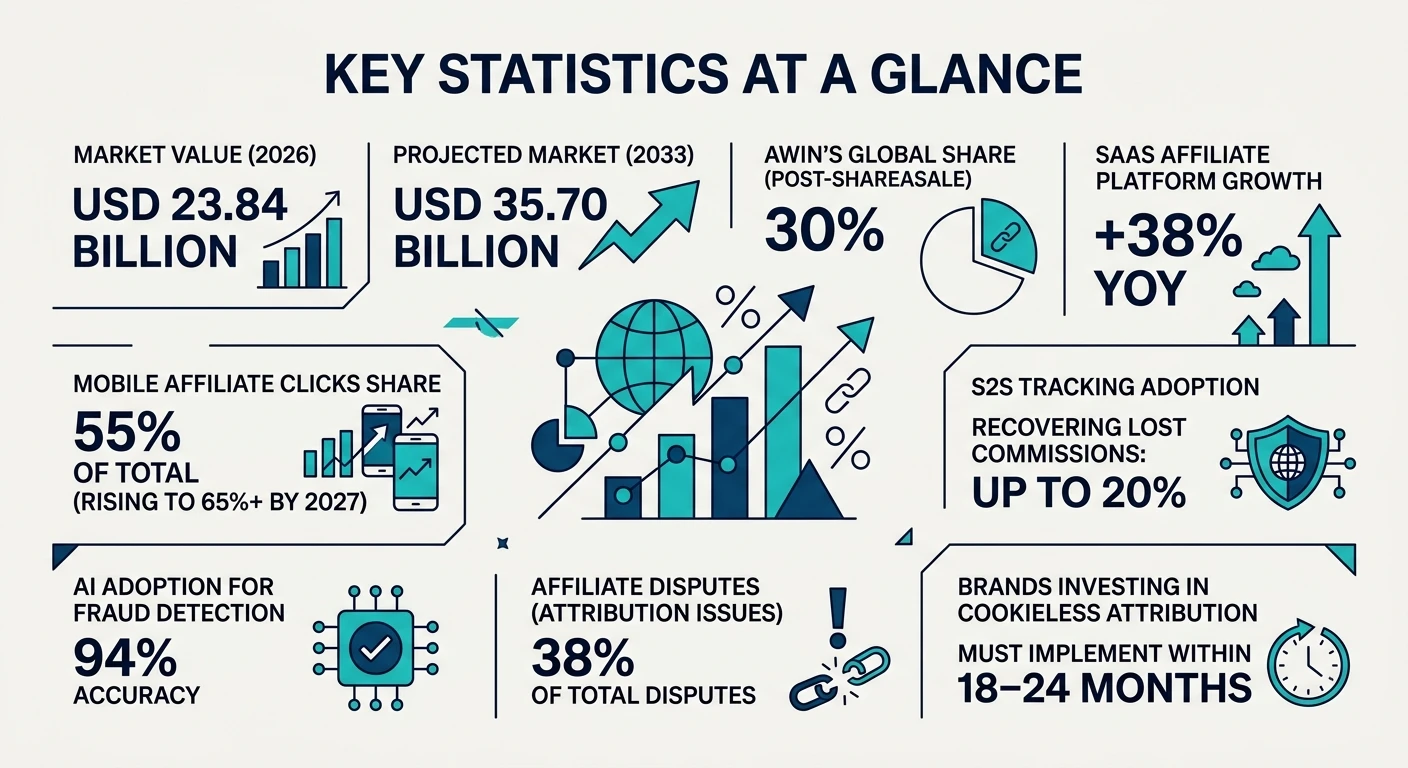
Affiliate platform market value (2026): USD 23.84 Billion
Projected platform market (2033): USD 35.70 Billion
AWIN's share of global publisher links post-ShareASale: 30%
SaaS affiliate platform growth: +38% YoY
Mobile affiliate clicks share: 55% of total (rising to 65%+ by 2027)
S2S tracking adoption recovering lost commissions: up to 20%
AI adoption for fraud detection: 94% accuracy
Affiliate disputes from attribution issues: 38% of total disputes
Brands investing in cookieless attribution: Must implement within 18–24 months
The Technology Trends Reshaping the Platform Market
The most important technology shift happening in the affiliate marketing platform market right now is the migration from cookie-based tracking to server-to-server (S2S) tracking. For decades, affiliate attribution relied on browser cookies — small files placed on a user's device when they clicked an affiliate link, allowing the network to attribute a subsequent purchase back to that affiliate. This system worked reasonably well when cookies were reliable, but the combination of browser privacy restrictions (Safari and Firefox have blocked third-party cookies for years), iOS privacy changes, and the impending elimination of third-party cookies in Chrome has made cookie-based tracking increasingly unreliable.
Server-to-server tracking solves this problem by passing attribution data directly between servers rather than through the user's browser. It is harder to implement but far more accurate — and adoption of S2S tracking has been shown to recover up to 20% of commissions that were previously lost to attribution failures. For affiliate marketers, this means real money: if your program recovers 20% more attributable conversions, your income goes up proportionally without any additional traffic.
AI is the other transformative force in the platform market. Machine learning algorithms now power partner discovery (matching brands with the most relevant publishers in real time), dynamic commission optimisation (adjusting rates based on publisher performance), predictive fraud detection (identifying invalid traffic patterns before payouts are processed), and multi-touch attribution (giving credit to each touchpoint in the customer journey rather than just the last click). Platforms that have invested heavily in AI infrastructure are pulling away from those that have not, and the competitive gap is widening every year.
The Fraud Challenge
Affiliate fraud costs the industry billions annually and represents one of the primary reasons brands underinvest in affiliate programs relative to their actual performance. Bot-generated clicks, cookie stuffing, domain spoofing, and fake leads all drain advertiser budgets and erode trust in the channel. Platform security reports estimate that 8 to 10% of all affiliate clicks involve some form of fraud or invalid traffic.
The platform market's response has been to invest aggressively in detection and prevention technology. AI-powered fraud tools now identify fake engagement with 94% accuracy. Brands using third-party verification platforms reduce their fraud exposure by 67%. The annual spend on fraud detection and verification tools has reached USD 420 million and is growing rapidly. For individual affiliates, the practical implication is straightforward: partner with programs that use sophisticated tracking platforms, and expect increasing scrutiny of traffic quality as the industry matures.
What This Means for Affiliate Marketers
Understanding the platform market helps you make smarter decisions about which programs to join and how to protect your income. Programs built on robust platforms like Impact, Everflow, or PartnerStack are more likely to accurately attribute your commissions, pay reliably, and scale as you grow. Programs running on basic in-house tracking without S2S capabilities are more likely to have attribution gaps that cost you money.
The migration to server-to-server tracking and first-party data strategies also has implications for how you build your affiliate business. Email lists and owned communities are first-party data assets — they allow you to maintain a direct relationship with your audience regardless of what happens to third-party cookies. Affiliates who invest in building these assets now are positioning themselves advantageously for a tracking landscape that will look very different in two to three years.
FAQs
The affiliate marketing platform market is expected to reach multi-billion dollar valuations by 2033, driven by the rapid growth of e-commerce, influencer marketing, and performance-based advertising. Analysts project a strong compound annual growth rate (CAGR) between 2026 and 2033 as brands increasingly shift budgets toward measurable, ROI-driven marketing channels.
The market is anticipated to grow steadily from 2026 to 2033, fueled by advancements in AI-driven analytics, real-time tracking technology, and the expansion of creator economies globally. Increased adoption by SMEs and the rise of mobile commerce are key contributors to this sustained growth trajectory.
Businesses are turning to affiliate marketing platforms because they offer a cost-effective, performance-based model where brands only pay for actual results such as clicks, leads, or sales. The ability to scale campaigns quickly and access diverse publisher networks makes these platforms highly attractive in a competitive digital marketing landscape.
Yes, the affiliate marketing platform market is highly competitive, with key players including CJ Affiliate, ShareASale, Rakuten Advertising, Impact, and PartnerStack dominating the space. New entrants and niche platforms are also emerging, intensifying competition through specialized features and vertical-specific solutions.
Absolutely, small businesses stand to gain significantly from these market trends as platforms increasingly offer flexible pricing models, self-serve dashboards, and easy integrations with popular e-commerce tools. The democratization of affiliate technology means SMEs can now compete alongside larger brands with minimal upfront investment.