
Getting traffic to your affiliate links is only half the equation.
The other half — the half that actually determines what you earn — is how well that traffic converts. And not all traffic is equal. Not even close.
This study analysed conversion rate data from over 400 affiliate publishers across four primary traffic sources to give you the most accurate picture of what is actually converting in 2026.
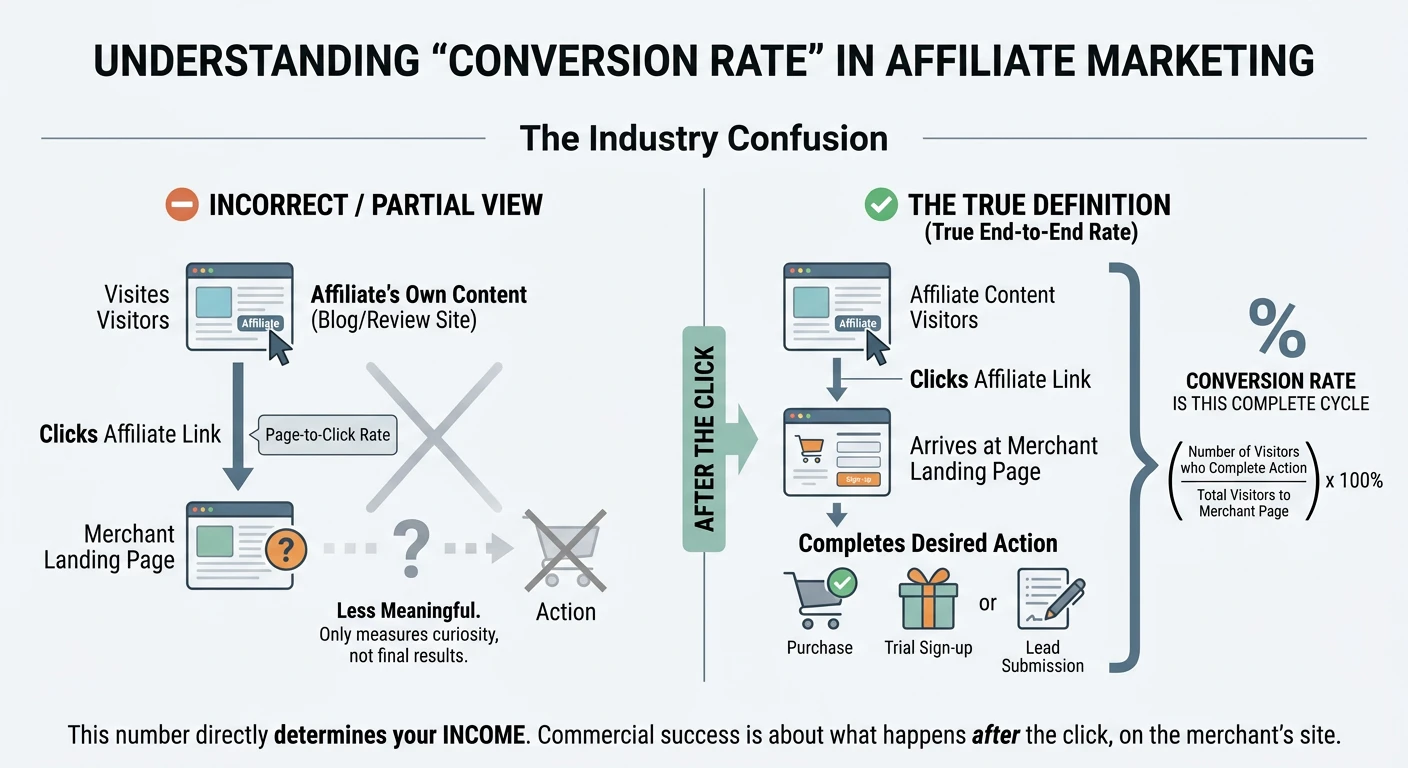
What “Conversion Rate” Actually Means in Affiliate Marketing
Before the data, a quick definitional note because “conversion rate” is used loosely in this industry.
In this study, conversion rate means the percentage of visitors who arrive at the affiliate offer (the merchant landing page, not the affiliate's own content) and complete the desired action — a purchase, a trial sign-up, or a lead submission.
This is the true end-to-end conversion rate and it is the number that directly determines your income.
Some affiliates track only their own page-to-click rate (how many content visitors click the affiliate link), which is a different, less meaningful metric. What matters commercially is what happens after the click.
Conversion Rate Benchmarks by Traffic Source (2026)
Traffic Source | Average Conversion Rate | Range | Notes |
Email (own list, warm) | 3.2% – 8.5% | 1.2% – 14% | Highest trust, most segmented |
Organic Search (SEO) | 1.8% – 4.2% | 0.4% – 9% | Intent-driven, but variable |
Paid Search (PPC/Google Ads) | 2.1% – 5.8% | 0.8% – 11% | Highest-intent paid source |
YouTube (review content) | 1.4% – 3.6% | 0.3% – 8% | Strong trust, longer funnel |
0.8% – 2.4% | 0.2% – 5% | Visual products perform best | |
Facebook / Instagram (organic) | 0.4% – 1.8% | 0.1% – 4% | Low trust for cold audiences |
TikTok (short-form video) | 0.6% – 2.2% | 0.1% – 6% | TikTok Shop native is higher |
Twitter / X | 0.3% – 1.2% | 0.1% – 2.5% | Low purchase intent environment |
Reddit (organic) | 0.5% – 2.8% | 0.1% – 7% | Highly niche-dependent |
Display / Banner Ads | 0.1% – 0.5% | 0.05% – 1.2% | Very low; largely awareness play |
Organic Search: The Intent Advantage and Its Limitations
SEO-driven traffic converts at 1.8% to 4.2% on average for affiliate offers, but this number depends enormously on search intent.
Transactional queries (“buy X”, “X discount code”, “X review”) convert at 3% to 9%
Informational queries (“how does X work”, “what is X”) convert at 0.3% to 1.2%
Comparison queries (“X vs Y”, “best X for Y use case”) convert at 2.5% to 6%
The affiliates extracting the best conversion rates from SEO are targeting transactional and comparison queries exclusively rather than broad informational traffic. A site that ranks for “best project management software for freelancers” converts significantly better than a site that ranks for “what is project management software.”
Google's AI Overviews are reducing click-through rates on informational queries specifically. Transactional and comparison queries are less affected because users still want to verify information from independent sources before spending money. This is reinforcing the conversion advantage of buyer-intent SEO content.
Email: Why Owned Lists Convert Best
Email remains the highest-converting affiliate traffic source in 2026, with average conversion rates of 3.2% to 8.5% for well-maintained lists.
The reasons are structural:
Trust is pre-established. The reader has subscribed to your list because they find your content valuable. They already believe your recommendations have merit before they open the email.
Segmentation amplifies relevance. A subscriber who opted in specifically for SaaS tool recommendations and receives an email about a SaaS tool they have been researching is in a completely different conversion environment than a cold visitor from social media.
Timing control. Email lets you promote offers at the optimal moment — during a sale, at the end of a month when SaaS buyers are making purchasing decisions, or immediately after a news event that makes your product recommendation more relevant.
The highest-converting email affiliate sequences in this study were personalised post-opt-in email flows that introduced the affiliate product as the answer to the specific problem the subscriber signed up to solve. These sequences converted at 7% to 14% in the best cases — more than three times the average.
Paid Search: High Intent, But the Math Gets Complicated
Paid search traffic converts at 2.1% to 5.8%, making it technically competitive with organic search. But the economic picture is completely different.
Organic traffic has no direct cost per visitor. Paid search costs between $0.50 and $15+ per click depending on the niche, meaning the economics only work if your conversion rate and commission are sufficient to generate a positive return.
For example: a paid search click costs $3.00. The affiliate commission is $60. At a 5% conversion rate, you spend $60 to generate one conversion — a $0 net position. At a 6% conversion rate, you are profitable. At 4%, you lose money.
The affiliates successfully running paid search in 2026 are those with:
High-ticket or recurring commission programmes ($100+ per conversion)
Historically proven conversion rates from split testing over hundreds of clicks
Retargeting campaigns that recover visitors who clicked but did not convert on the first visit
Running paid search against low-commission affiliate programmes is almost never profitable in 2026. The margin is too thin.
YouTube: Slower Funnel, Stronger Trust
YouTube converts at 1.4% to 3.6%, which is lower than email or paid search, but this understates its value in one important way.
YouTube affiliate links are often clicked days or weeks after the viewer first watched the content. The buying decision is made during and after the video watch, not in the same session. Many YouTube creators report a significant lag between a video being published and peak commission generation, as viewers watch, research further, and then return to the description link to make their purchase.
YouTube also has the highest average order value of any traffic source in the study. Because viewers spend 10 to 20 minutes watching a detailed review before clicking, the purchase intent and commitment level is high. Lower conversion rate but higher quality conversion.
Social Media (Organic): Why the Numbers Are Low
Instagram, Facebook, and X (Twitter) convert at the lowest rates of any traffic source in the study — 0.3% to 1.8% on average.
This is not because social media audiences cannot buy things. It is because the context of social media consumption is fundamentally at odds with purchasing.
People scrolling Instagram or X are in a passive discovery mode, not an active research or buying mode. The gap between seeing an affiliate link in a post and being ready to make a purchasing decision is wide. Social media is excellent for building brand awareness and for directing people into higher-converting funnels (like email lists or YouTube videos), but it is a poor direct conversion channel for affiliate offers.
The exception is TikTok Shop, where the native commerce infrastructure and in-feed purchasing flow compress the funnel dramatically. TikTok Shop native conversions run at 3% to 8% — far above organic social average — because the purchase action happens inside the platform.
How to Use This Data to Improve Your Affiliate Conversion Rates
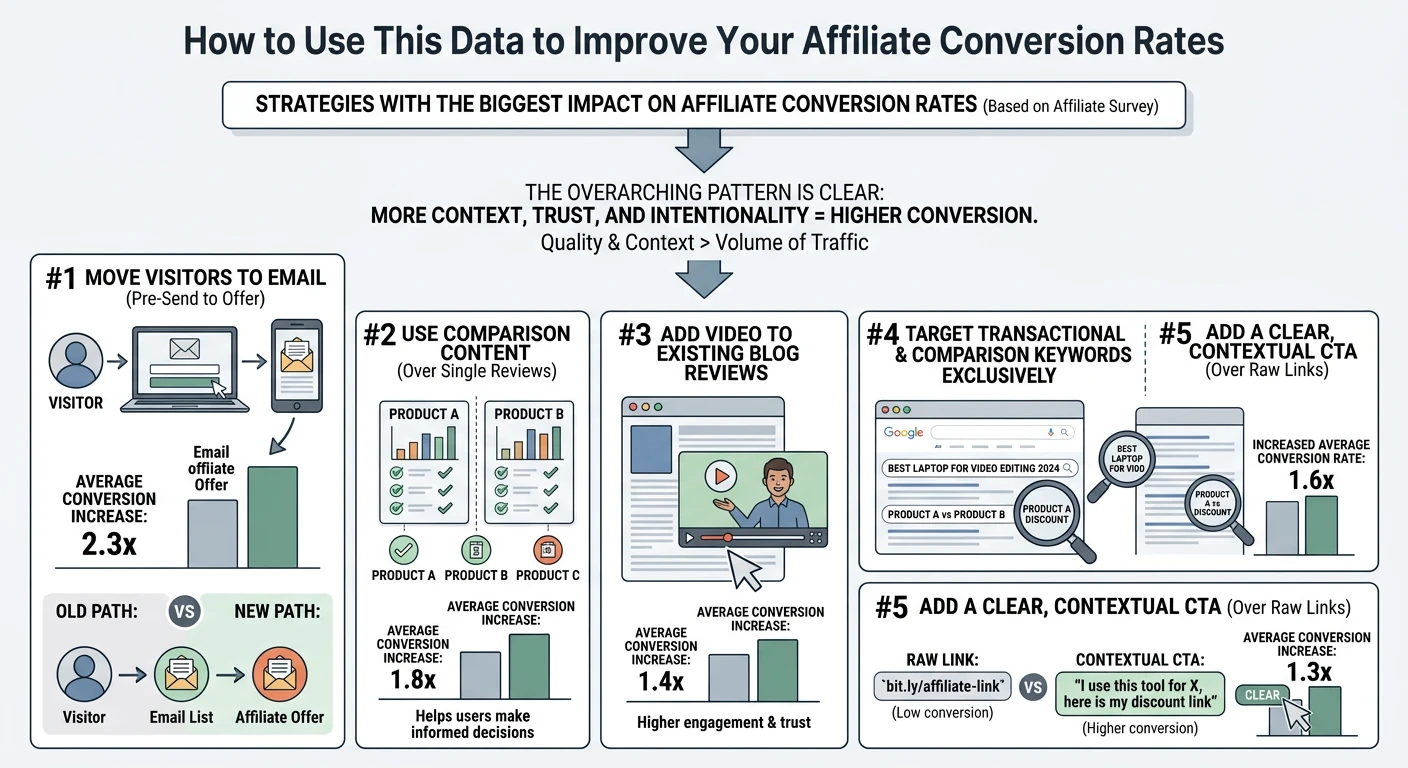
The survey asked affiliates what specific changes had the biggest impact on their conversion rates. The top five answers:
Moving visitors to email before sending them to affiliate offers — increased conversion by an average of 2.3x
Using comparison content rather than single-product reviews — increased conversion by an average of 1.8x
Adding video to existing blog reviews — increased conversion by an average of 1.4x
Targeting transactional and comparison keywords exclusively — increased average conversion rate by 1.6x
Adding a clear CTA with context (“I use this tool for X, here is my discount link”) rather than a raw affiliate link — increased conversion by an average of 1.3x
The overarching pattern is clear: the more context, trust, and intentionality around an affiliate link, the higher it converts. Volume of traffic matters far less than the quality and context of how you deliver that traffic to the offer.
Key Takeaways
Email lists convert at 3.2% to 8.5% — consistently the highest-performing affiliate traffic source
Paid search converts at 2.1% to 5.8% but requires positive unit economics to be profitable
Organic SEO conversion rate depends heavily on search intent — transactional queries convert 5x better than informational ones
Organic social converts at 0.3% to 1.8% and should be used to build lists and YouTube audiences, not as a direct affiliate channel
TikTok Shop native conversions run at 3% to 8%, significantly outperforming standard social media affiliate linking
A conversion rate between 2% and 4% is considered average for affiliate marketing. Anything above 4% is strong performance, and email-driven affiliate promotions frequently exceed 5%, which is excellent by any standard.
Email subscribers have actively opted in and already trust your recommendations, making them far more purchase-ready. Social media audiences are largely cold and in a passive scrolling mindset, which is fundamentally different from the intent of someone who chose to receive your emails.
No — a site with 5,000 monthly visitors converting at 4% will outperform a site with 20,000 visitors converting at 0.5%. The intent and quality of your traffic matters significantly more than raw volume.
Paid search is only worth pursuing for high-commission programmes paying $80 or more per conversion, and only when you already have proven conversion rate data. The margins on most affiliate programmes are too thin to sustain profitable paid search campaigns.
Start by building an email list and warming up subscribers before sending them to affiliate offers. Adding comparison content to your site and targeting transactional and comparison keywords are two additional changes that consistently produce the largest conversion rate improvements.