
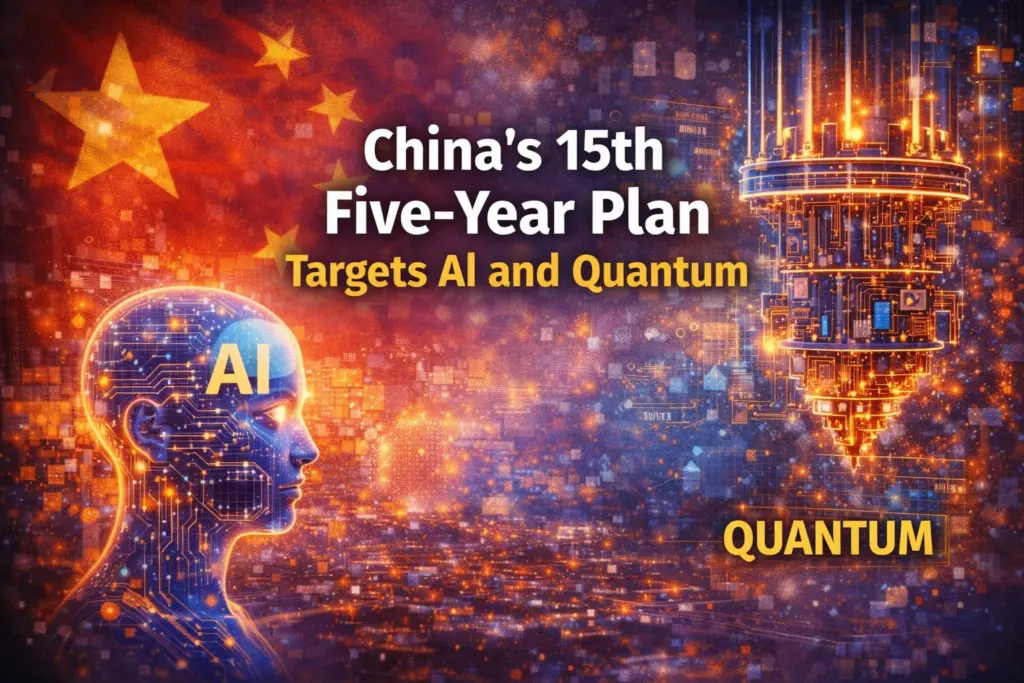
China unveiled its 15th Five-Year Plan on March 5, 2026, and the scale of the country's artificial intelligence ambitions is unlike anything in the plan's previous iterations.
The document mentions AI more than 50 times and introduces a comprehensive “AI+ action plan” designed to integrate artificial intelligence across every major sector of China's economy — manufacturing, healthcare, financial services, agriculture, education, and national defence.
For technology leaders, investors, and AI researchers globally, the plan is a blueprint for how a state-level actor is approaching the industrialisation of intelligence at civilisational scale.
What China's New Five-Year Plan Actually Says About AI
The AI+ action plan is not a vague aspiration document.
It sets concrete investment directives across three layers of the AI stack: foundational research (large model development, transformer architecture research, and reinforcement learning from human feedback), infrastructure (GPU cluster expansion, quantum computing integration, and a national AI compute reserve), and application (sector-specific AI deployment mandates with measurable productivity targets).
The plan explicitly calls for exploring development pathways toward general artificial intelligence — a term that has historically been avoided in official government communications, signalling a meaningful shift in strategic intent.
China has already filed more than 700 generative AI large model products with the Cyberspace Administration of China under its AI governance framework, suggesting the domestic AI ecosystem is far more developed than external observers sometimes assume.
The plan also prioritises talent: a new national AI education pipeline from secondary school through postdoctoral research, designed to produce 10 million AI-capable graduates over the plan period.
Also read about: OpenAI Pentagon Deal Sparks AI Policy Split
Quantum, Robotics & the Global Technology Arms Race
Beyond AI, the Five-Year Plan places quantum computing at the apex of China's technology sovereignty agenda.
Specific targets include scalable quantum computers capable of outperforming classical systems on commercially relevant tasks, and an integrated space-earth quantum communication network for secure data transmission.
Humanoid robotics, 6G telecommunications infrastructure, brain-machine interfaces, and nuclear fusion energy round out a priority technology list that reads less like industrial policy and more like a science fiction roadmap given urgency by geopolitical competition.
For companies operating in AI, semiconductors, or deep technology, the plan creates both competitive pressure and partnership complexity — particularly as US export controls on advanced chips continue to constrain China's access to cutting-edge compute.
The net result is an accelerated bifurcation of the global AI stack into two increasingly incompatible technology ecosystems.
More News To Read: