
Anthropic just confirmed that Claude will embed invisible watermarks into AI-generated text going forward. If your affiliate content pipeline leans on Claude for drafting, product reviews, or coupon pages, here's what actually changes for you.
The Announcement, in Plain Terms
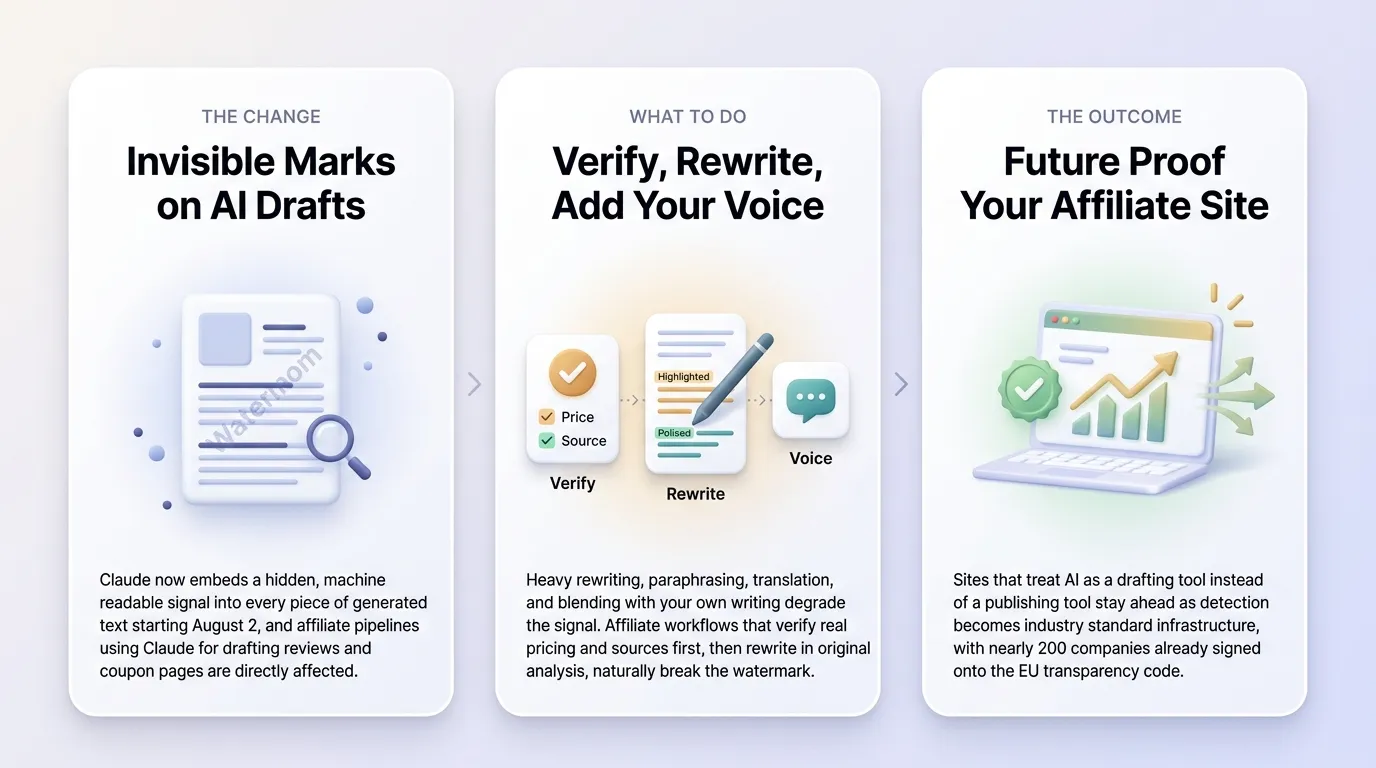
Starting August 2, 2026, new Claude models embed a hidden, machine-readable signal directly into generated text. It's invisible to readers, doesn't affect the writing itself, but can be detected by tools built for that purpose.
Anthropic rolled this out globally to comply with the EU AI Act's Article 50, which requires AI providers to mark their output so it can be identified as machine-generated.
Does This Affect Search Rankings?
Not directly, and this is the question most affiliate marketers actually care about. Google has never confirmed it penalizes AI-assisted content specifically, its stated position has consistently been that it rewards helpful, high-quality content regardless of how it was produced. A watermark doesn't change that policy on its own.
What it does change is the detectability of unedited AI output. If Google, or any platform, eventually incorporates watermark detection into its quality evaluation systems, the gap between genuinely edited, expertise-driven content and lightly-touched AI drafts becomes easier to identify at scale.
That's speculative right now, Google hasn't announced anything like that, but it's a reasonable thing to plan around given the direction the industry is moving.
What Actually Breaks the Signal
Reporting on Anthropic's documentation confirms the watermark weakens or disappears when text is:
Heavily rewritten or restructured
Paraphrased substantially
Translated
Blended extensively with other writing
Too short to carry a reliable signal
For affiliate content specifically, this matters: coupon pages, comparison tables, and short product blurbs built mostly from structured data (pricing, dates, specs) may carry less watermark signal simply because there's less continuous prose to embed it in. Longer-form reviews and editorial content drafted heavily by AI and published with minimal editing carry more risk of being detectable.
Practical Takeaways for Affiliate Sites
Keep doing what already works: verify, then rewrite. The workflow already established across our coupon and review content, verifying real pricing, checking multiple sources, then writing original analysis in your own words, naturally produces content that's substantially transformed from raw AI output. That's good practice for accuracy and E-E-A-T regardless of watermarking, and it happens to also be exactly the kind of editing that degrades a detectable watermark signal.
Be cautious with bulk-generated, lightly-edited content. If any part of the content pipeline is publishing near-unedited AI drafts at volume, especially thin comparison or listicle content, that's the content most likely to carry a clean, detectable signal.
Disclosure is becoming the safer long-term bet. With nearly 200 companies, including Google, Meta, Microsoft, and OpenAI, signed onto the same EU transparency code, AI-content detection is clearly becoming standard industry infrastructure. Sites that are upfront about AI-assisted workflows position themselves better than sites relying on detection never catching up.
Youtube: Anthropic to watermark AI-generated text
Youtube: Claude Will Put Invisible Watermarks On AI Text And Images—And The Internet Isn’t Happy
X: https://www.threads.com/@cnn/post/Db7r0TCD1yt/video-anthropic-said-it-will-add-invisible-watermarks-to-text-generated-by-future/
The Competitive Angle
Google's SynthID has watermarked AI text for a while already. This isn't Anthropic doing something unprecedented, it's the industry converging on the same standard.
For affiliate publishers, the sites that adapt their editorial process now, treating AI as a drafting tool rather than a publishing tool, will be better positioned than sites that don't, regardless of how detection technology evolves from here.
Quick Links: