
I have been collecting and testing ChatGPT prompts for affiliate marketing since early 2023.
Most prompts that circulate online are generic. They produce generic output. Generic output does not rank. Generic output does not convert.
These 25 prompts are different. Each one is built for a specific, revenue-driving affiliate marketing task. I have tested every single one of them on my own sites.
Use them as templates. Customize the [brackets] with your specific product, audience, and context. The more specific your inputs, the better the output.
SECTION 1: Content Strategy Prompts
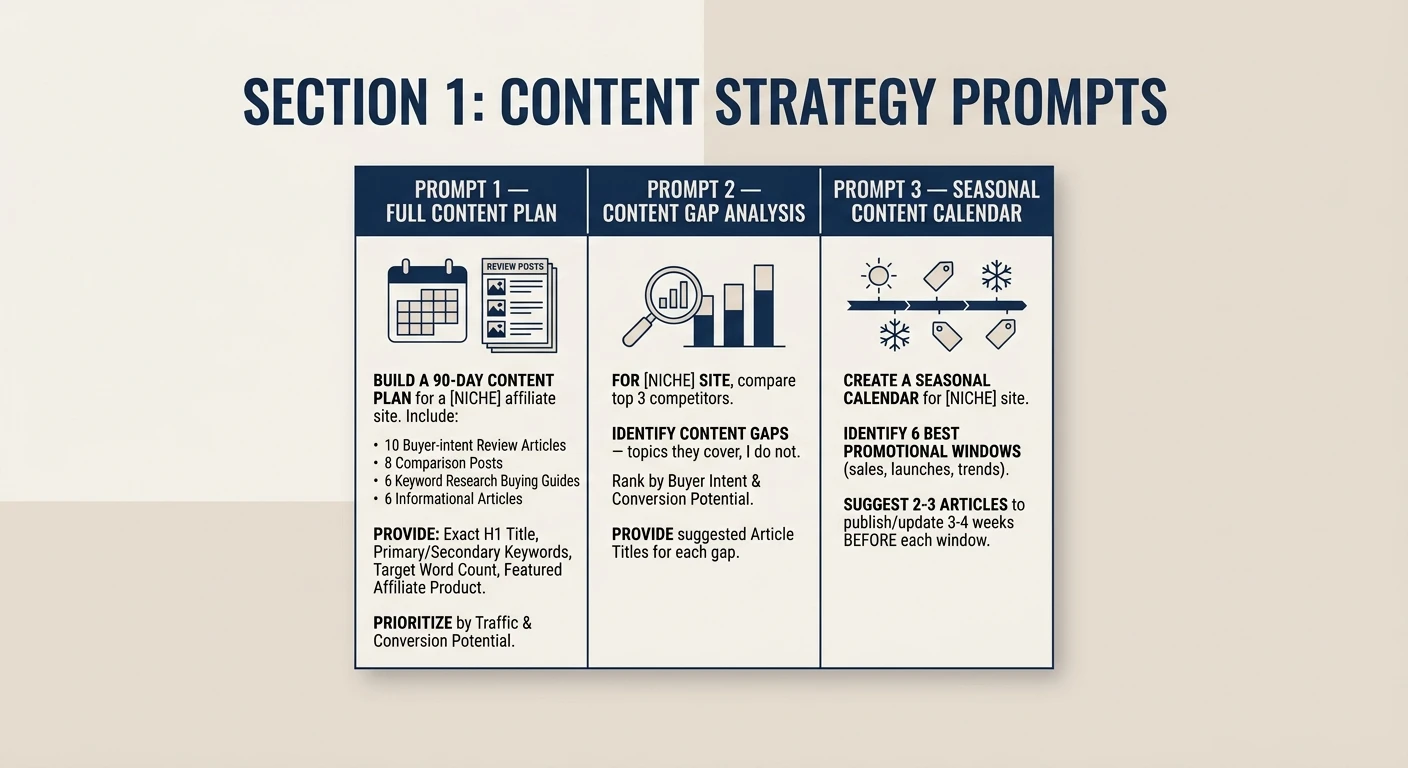
Prompt 1 — Full Content Plan
“Build a 90-day content plan for an affiliate site about [niche]. Include: 10 buyer-intent review articles, 8 comparison posts, 6 keyword research-led buying guides, and 6 informational support articles. For each article, provide: the exact H1 title, primary keyword, secondary keywords, target word count, and the affiliate product to feature. Prioritize by traffic and conversion potential.”
Prompt 2 — Content Gap Analysis
“I have an affiliate site covering [niche]. My top 3 competitors are [competitor 1, 2, 3]. Identify the content gaps — topics they cover that I do not — with the highest buyer intent and conversion potential. Rank them by opportunity and provide suggested article titles for each.”
Prompt 3 — Seasonal Content Calendar
“Create a seasonal content calendar for my [niche] affiliate site. Identify the 6 best promotional windows in the year — sales events, product launch seasons, industry trends — and suggest 2–3 articles I should publish or update 3–4 weeks before each window.”
SECTION 2: Article Writing Prompts
Prompt 4 — Product Review Outline
“Create a detailed review article outline for [product name] targeting [audience]. Include H2 and H3 sections covering: product overview, key features with evaluation criteria, pricing breakdown, pros and cons, comparison with [2 alternatives], ideal user profile, and a final verdict. Make the structure convert readers into buyers.”
Prompt 5 — Comparison Post Introduction
“Write an introduction for a comparison post between [Product A] and [Product B] targeting [audience]. The opening should acknowledge the reader's decision dilemma, establish your testing methodology in 1–2 sentences, and promise a clear verdict. Under 150 words. No hype. Conversational tone.”
Prompt 6 — Feature Evaluation Section
“Write a detailed evaluation of the [specific feature] in [product name] for [audience]. Structure it as: what the feature does → why it matters to this audience → how well [product] executes it → any limitations or workarounds → comparison with how [alternative] handles the same feature.”
Prompt 7 — Pros and Cons
“Write a pros and cons list for [product name] as an affiliate review. Each pro should describe a concrete outcome or benefit for the user, not just a feature. Each con should be specific and genuine — not vague. Minimum 5 pros and 4 cons. Honest tone.”
Prompt 8 — Verdict Section
“Write a verdict section for a review of [product name]. State clearly: who should buy it, who should not, the single biggest reason to choose it over alternatives, and a specific call to action referencing the current [trial/discount/offer]. Be direct. No hedging.”
SECTION 3: SEO and Keyword Prompts
Prompt 9 — Long-Tail Keyword Generator
“Generate 30 long-tail keyword variations for [primary keyword] in the [niche] space. Separate them into: (1) buyer intent — looking to purchase, (2) comparison intent — deciding between options, (3) problem-aware — know the problem but not the solution. Exclude purely informational keywords.”
Prompt 10 — Title Tag Variations
“Write 10 title tag variations for an affiliate review of [product name] targeting the keyword [keyword]. Include the year. Some titles should use brackets with a verdict or proof element (e.g., [2026 Review], [Tested], [Worth It?]). All under 60 characters.”
Prompt 11 — Meta Description
“Write 3 meta description variations for a [product name] review article. Each should: include the primary keyword naturally, highlight one specific benefit or outcome, include a call to action, and be under 155 characters. Make them compelling enough to earn the click.”
Prompt 12 — FAQ Section Generator
“Write 7 FAQ entries for a [product name] affiliate review. Questions should come from: Google's People Also Ask, common buyer objections, pricing questions, comparison questions, and use case questions. Make every answer specific and useful — not generic.”
SECTION 4: Email Marketing Prompts
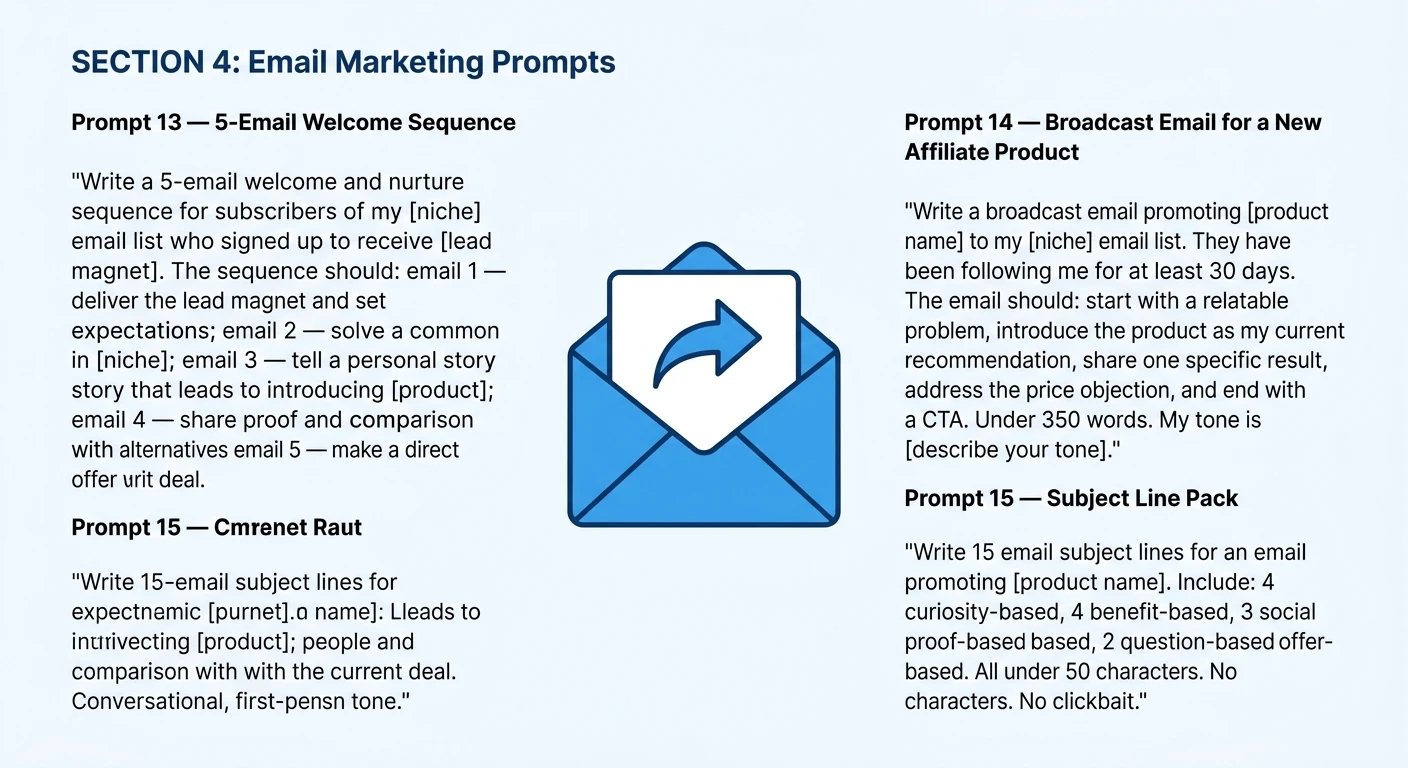
Prompt 13 — 5-Email Welcome Sequence
“Write a 5-email welcome and nurture sequence for subscribers of my [niche] email list who signed up to receive [lead magnet]. The sequence should: email 1 — deliver the lead magnet and set expectations; email 2 — solve a common problem in [niche]; email 3 — tell a personal story that leads to introducing [product]; email 4 — share proof and comparison with alternatives; email 5 — make a direct offer with the current deal. Conversational, first-person tone.”
Prompt 14 — Broadcast Email for a New Affiliate Product
“Write a broadcast email promoting [product name] to my [niche] email list. They have been following me for at least 30 days. The email should: start with a relatable problem, introduce the product as my current recommendation, share one specific result, address the price objection, and end with a CTA. Under 350 words. My tone is [describe your tone].”
Prompt 15 — Subject Line Pack
“Write 15 email subject lines for an email promoting [product name]. Include: 4 curiosity-based, 4 benefit-based, 3 social proof-based, 2 question-based, and 2 direct offer-based. All under 50 characters. No clickbait.”
SECTION 5: Conversion Optimization Prompts
Prompt 16 — CTA Variations
“Write 10 call-to-action button text variations for my affiliate review of [product]. Vary the approach: some urgency-based, some benefit-based, some action-based. Keep each under 6 words.”
Prompt 17 — Objection Handler
“List the 5 most common objections someone has before buying [product name] at [price point]. For each objection, write a 2-3 sentence response that addresses it directly and reassures the reader. The responses should be added as a section in my affiliate review.”
Prompt 18 — Quick Summary Box
“Write a quick summary box for the top of my [product name] review. Include: our rating (out of 5), price, best for (audience), trial availability, our verdict in one sentence, and a CTA. Format it cleanly for a blog post.”
SECTION 6: Research and Analysis Prompts
Prompt 19 — Competitor Content Analysis
“Analyse the following affiliate review of [product] from [competitor URL/paste]. Identify: (1) their main content angle, (2) what they do well, (3) what they are missing that a buyer would want to know, (4) how I can write a better version that serves the reader more completely.”
Prompt 20 — Affiliate Program Research
“Research and compare the affiliate programs for these tools: [list 5 tools]. For each, provide: commission rate, cookie duration, payment methods, minimum payout threshold, whether commissions are recurring, and any notable limitations or requirements for affiliates.”
Prompt 21 — Target Audience Profile
“Create a detailed audience profile for people searching for [product name] reviews. Include: demographics, primary pain points, what they have tried before, their decision criteria, biggest fears about buying, and what would make them trust an affiliate recommendation enough to click.”
SECTION 7: Social and Video Content Prompts
Prompt 22 — YouTube Review Script
“Write a YouTube review script for [product name] targeting [audience]. Length: 8–10 minutes when spoken. Include: 30-second hook, who this video is for, 5 feature walkthroughs with screen description notes, honest pros and cons, pricing breakdown, verdict, and CTA to affiliate link. Timestamp each section.”
Prompt 23 — Twitter/X Thread
“Write a Twitter thread sharing my honest review of [product name] as an affiliate marketer. 8–10 tweets. Open with a bold, attention-grabbing statement. Cover key features, honest cons, who it is for, and end with an affiliate link CTA. Each tweet under 280 characters.”
Prompt 24 — LinkedIn Post for Affiliate Product
“Write a LinkedIn post recommending [product name] to [professional audience]. Start with a personal observation or result. Explain what the product does and why it solved a problem. Include a recommendation with a note about the affiliate relationship. Professional but conversational. Under 300 words.”
SECTION 8: Site Growth and Strategy Prompts
Prompt 25 — Site Monetization Audit
“I have an affiliate site about [niche] with [number] monthly visitors. My current revenue is [amount] per month from [traffic sources]. Analyse my monetization and identify: (1) the 3 highest-opportunity improvements, (2) new affiliate products I should add based on my audience, (3) content types I am missing that would significantly increase conversions, (4) email list strategies I am not currently using. Be specific and prioritise by impact.”
How to Get Better Results From Every Prompt
These prompts are templates. The more specific you make them, the better the output.
Every time you see a bracket, fill it with the most specific information you have. Instead of “audience,” write “SaaS startup founders with 2–10 employees.” Instead of “product,” write the full product name, pricing tier, and the specific angle you want to take.
Also: always review and edit the output. These prompts produce strong first drafts. Your experience, judgment, and personal voice turn those drafts into content that actually ranks and converts.
Conclusion
These 25 prompts cover every stage of the affiliate marketing workflow — from strategy and content creation to email, conversion optimization, and site growth.
Save this article. Bookmark it. Come back to it every time you sit down with ChatGPT for affiliate work.
The prompts are tools. Your strategy, experience, and consistency are what turn those tools into revenue.
FAQs
Can I use these prompt templates with AI tools other than ChatGPT?
Yes, all prompt templates for affiliate marketers work across ChatGPT, Claude, and Gemini. Claude tends to excel with longer content like reviews and email sequences, while ChatGPT performs best for research and strategy prompts.
How specific should my inputs be when using affiliate marketing prompt templates?
Make your inputs as specific as possible, including audience descriptions, product names, tone preferences, and niche context. The more detail you provide, the more tailored and revenue-driving the output will be.
Should I use ChatGPT prompt templates exactly as written or customize them?
Always modify prompt templates to fit your specific situation, as the provided templates are starting points. Adding details about your product, audience, and goals significantly improves relevance and output quality.
How often should affiliate marketers update their ChatGPT prompt templates?
Review your most-used prompt templates every 6 months since AI models update regularly and can change how they respond to certain instructions. Test output quality after each model update and revise your prompts if results have shifted.
Is it possible to share affiliate marketing prompt templates with a virtual assistant or team?
Yes, building a shared prompt library for your team is one of the highest-leverage strategies for maintaining content production consistency. Expand the library over time with additions based on what performs best in your specific niche.