
Artificial intelligence has revolutionized marketing. Businesses now use AI for everything from content creation to customer service.
This comprehensive guide reveals the latest AI marketing statistics, adoption rates, and performance metrics shaping 2026.
AI Marketing Adoption: The Current Landscape
AI marketing tools have moved from experimental to essential. Companies across industries embrace AI-powered solutions rapidly.
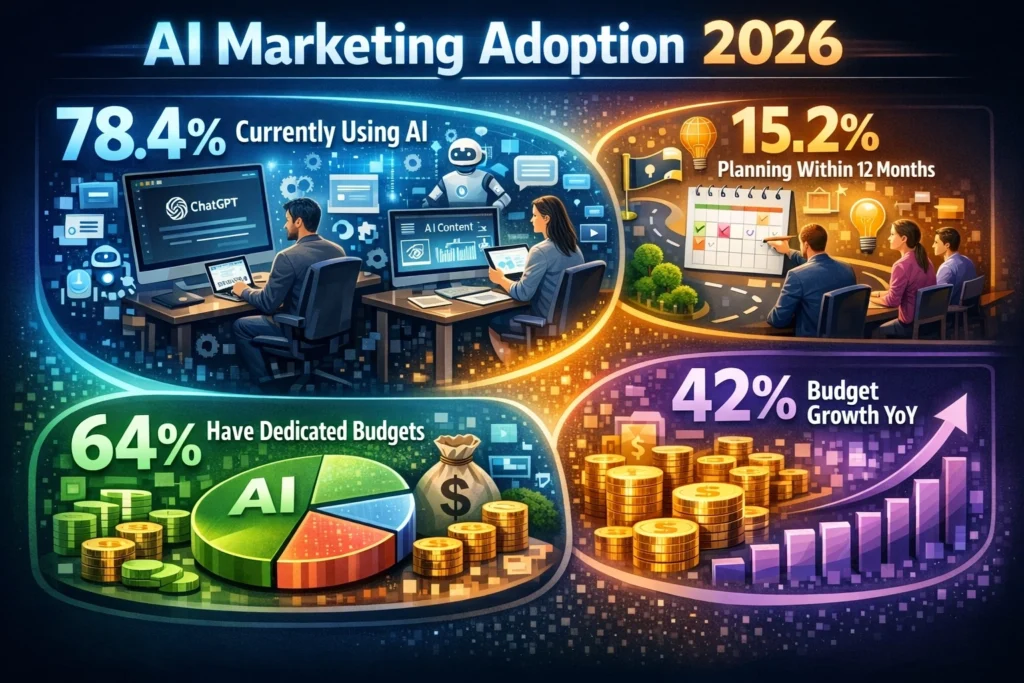
- Percentage of marketers using AI tools (2026): 78.4%
- Marketers planning AI adoption within 12 months: 15.2%
- Companies with dedicated AI marketing budgets: 64%
- Average AI marketing budget increase (YoY): 42%
These numbers show AI has reached mainstream acceptance. Most marketing teams now use at least one AI-powered tool regularly.
Also read about: AI Productivity: Anthropic Data Reveals AI Success at Work
AI Marketing Adoption by Company Size
AI adoption varies significantly based on company size. Larger enterprises lead implementation, but small businesses catch up quickly.
| Company Size | AI Adoption Rate | Average Tools Used | Budget Allocation |
| Enterprise (1000+ employees) | 92.4% | 8.6 tools | $485,000/year |
| Mid-market (100-999 employees) | 81.2% | 5.2 tools | $86,000/year |
| Small business (10-99 employees) | 68.8% | 3.4 tools | $18,500/year |
| Micro business (1-9 employees) | 54.2% | 2.1 tools | $3,800/year |
Enterprise companies use AI most extensively. However, small businesses show the fastest growth rate at 58% year-over-year adoption increase.
Industry-Specific AI Marketing Adoption
Different industries embrace AI marketing at varying speeds. Technology and e-commerce sectors lead adoption.
AI marketing adoption by industry:
- Technology & Software: 94.2%
- E-commerce & Retail: 88.6%
- Financial Services: 84.8%
- Healthcare: 76.4%
- Manufacturing: 71.2%
- Real Estate: 68.8%
- Education: 64.2%
- Non-profit: 48.6%
Technology companies naturally lead AI implementation. E-commerce follows closely due to data-rich environments and direct ROI measurement capabilities.
AI Marketing Tools and Use Cases
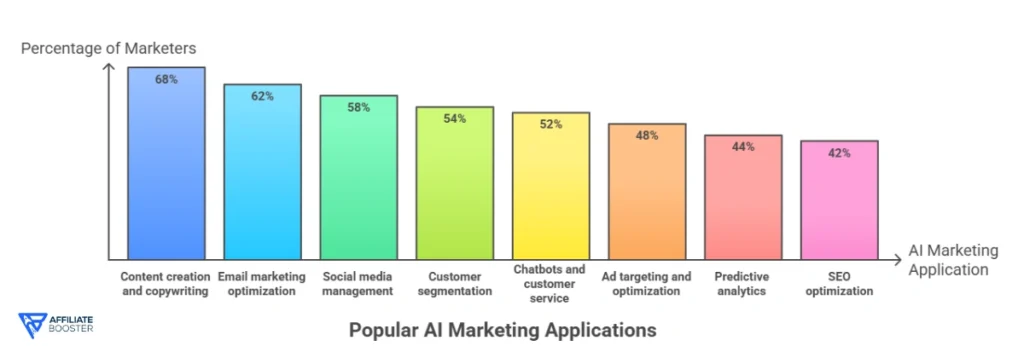
Marketers deploy AI across numerous functions. Each application delivers specific benefits and efficiency gains.
Most Popular AI Marketing Applications
- Content creation and copywriting: 68% of marketers
- Email marketing optimization: 62% of marketers
- Social media management: 58% of marketers
- Customer segmentation: 54% of marketers
- Chatbots and customer service: 52% of marketers
- Ad targeting and optimization: 48% of marketers
- Predictive analytics: 44% of marketers
- SEO optimization: 42% of marketers
Content creation dominates AI marketing usage. Tools like ChatGPT, Claude, and Jasper transform how marketers produce written content.
Also read about: 11 Best SEO Tools Black Friday Deals 2026
AI Tool Categories and Market Leaders
The AI marketing tool landscape has expanded dramatically. Multiple categories serve different marketing needs.
| Tool Category | Market Leader | Adoption Rate | Average Cost/Month |
| Content Creation | ChatGPT/Claude | 64.2% | $45 |
| Email Marketing | Mailchimp AI | 48.6% | $85 |
| Social Media | Hootsuite AI | 42.8% | $95 |
| Analytics | Google Analytics 4 | 72.4% | $0-$150 |
| Chatbots | Intercom | 38.2% | $125 |
| Ad Optimization | Meta Advantage+ | 52.6% | Variable |
| SEO Tools | Surfer SEO | 34.8% | $89 |
ChatGPT leads content creation with over 200 million weekly active users. Google Analytics 4's AI features show highest adoption due to platform dominance.
AI Marketing Performance Statistics
AI tools promise improved results. The data reveals actual performance improvements across key metrics.
Content Creation Efficiency Gains
AI dramatically accelerates content production. Marketers report substantial time savings.
- Average time saved per piece of content: 62%
- Content output increase: 3.8x
- Marketers using AI for first drafts: 74%
- Marketers using AI for final content: 28%
Most marketers use AI for drafting and ideation. Human editing remains standard practice. Only 28% publish AI-generated content without significant human modification.
Content creation time comparison:
| Content Type | Traditional Time | AI-Assisted Time | Time Saved |
| Blog Post (1000 words) | 4.2 hours | 1.8 hours | 57% |
| Social Media Posts (10) | 2.5 hours | 0.8 hours | 68% |
| Email Campaign | 3.8 hours | 1.4 hours | 63% |
| Product Descriptions (50) | 8.5 hours | 2.2 hours | 74% |
| Video Script | 5.2 hours | 2.0 hours | 62% |
Product descriptions show the largest time savings. AI excels at creating variations on similar content types.
Email Marketing Performance Improvements
AI-powered email marketing delivers measurable results. Personalization and send-time optimization boost key metrics.
- Average open rate improvement: 28%
- Click-through rate increase: 34%
- Conversion rate boost: 42%
- Unsubscribe rate reduction: 18%
AI optimizes subject lines, content, and sending times. These improvements compound to significantly better campaign performance.
Email metrics comparison (AI vs. Traditional):
| Metric | Traditional Email | AI-Optimized Email | Improvement |
| Open Rate | 18.2% | 23.3% | +28% |
| Click Rate | 2.4% | 3.2% | +33% |
| Conversion Rate | 1.8% | 2.6% | +44% |
| Revenue per Email | $0.42 | $0.68 | +62% |
Revenue per email shows the most dramatic improvement. Better targeting and personalization drive higher-value conversions.
Social Media Marketing Results
AI tools enhance social media performance. Scheduling, content creation, and engagement optimization all benefit.
- Engagement rate increase with AI: 38%
- Time saved on social media management: 54%
- Improved posting consistency: 67%
- Better audience targeting accuracy: 48%
Consistent posting schedules drive much of the improvement. AI tools ensure regular content flow without manual intervention.
Also read about: Top 100+ Email Marketing Statistics & Facts You Should Know In 2026
AI in Advertising and Paid Media
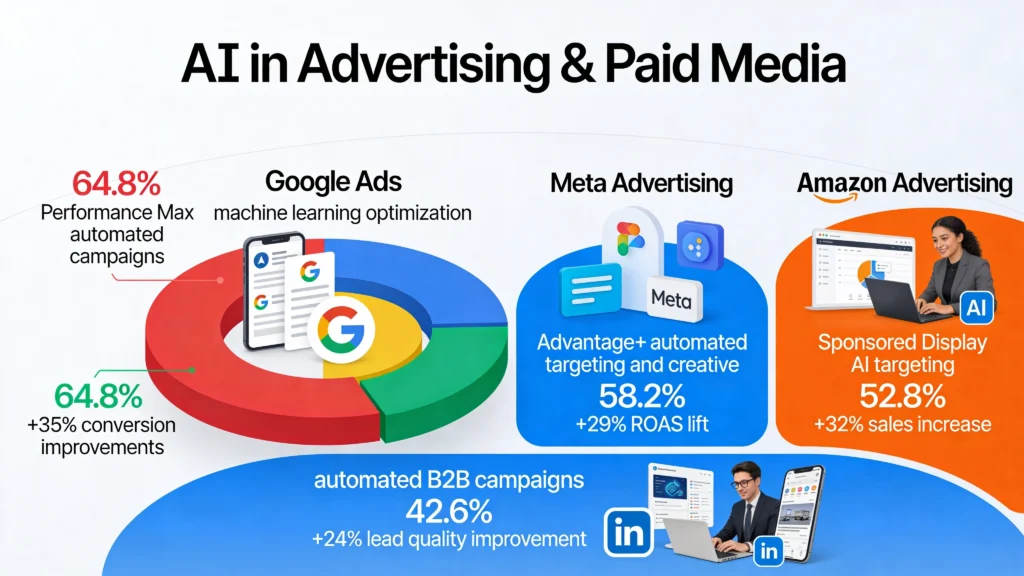
Paid advertising leverages AI extensively. Platforms use machine learning for targeting, bidding, and creative optimization.
Programmatic Advertising Statistics
- Percentage of digital ads using AI: 86.4%
- Programmatic ad spend (2026): $548 billion globally
- AI-driven ad performance improvement: 41%
- Cost per acquisition reduction: 28%
Nearly all digital advertising now incorporates AI. Manual campaign management has become rare in programmatic channels.
Ad Platform AI Features Adoption
Major advertising platforms embed AI features deeply. Marketers increasingly rely on automated optimization.
| Platform | AI Feature | Adoption Rate | Performance Lift |
| Google Ads | Performance Max | 64.8% | +35% conversions |
| Meta | Advantage+ | 58.2% | +29% ROAS |
| Automated Campaigns | 42.6% | +24% lead quality | |
| TikTok | Smart Creative | 38.4% | +48% engagement |
| Amazon | Sponsored Display | 52.8% | +32% sales |
Google's Performance Max shows highest adoption. The fully automated campaigns require minimal manual intervention.
Creative Testing and Optimization
AI enables rapid creative testing. Brands test hundreds of variations simultaneously.
- Average ad variations tested: 28 per campaign
- Time to identify winning creative: 3.2 days
- Creative performance improvement: 52%
- Budget waste reduction: 38%
Traditional A/B testing limited brands to 2-3 variations. AI-powered multivariate testing explores far more possibilities efficiently.
AI Chatbots and Customer Service
AI chatbots transform customer interactions. They handle routine inquiries while freeing human agents for complex issues.
Chatbot Deployment Statistics
- Companies using AI chatbots: 58%
- Customer service queries handled by AI: 42%
- Average chatbot resolution rate: 68%
- Customer satisfaction with chatbots: 72%
Chatbot adoption grows steadily. Customers increasingly accept AI-powered support for straightforward questions.
Chatbot Performance Metrics
AI chatbots deliver 24/7 availability and instant responses. The metrics demonstrate clear value.
| Metric | Human-Only Support | AI Chatbot Support | Improvement |
| Average Response Time | 8.4 minutes | 12 seconds | 98% faster |
| First Contact Resolution | 54% | 68% | +26% |
| Support Cost per Interaction | $8.50 | $0.85 | 90% lower |
| Customer Satisfaction | 78% | 72% | -8% |
Response time improvements are dramatic. However, customer satisfaction slightly favors human agents for complex issues.
Conversational AI ROI
Companies report strong returns on chatbot investments. Cost savings and efficiency gains drive positive ROI.
- Average chatbot implementation cost: $38,000
- Annual operational savings: $125,000
- Payback period: 3.6 months
- Three-year ROI: 485%
Most companies recoup chatbot investments within four months. Ongoing savings accumulate significantly over time.
Personalization and Customer Experience
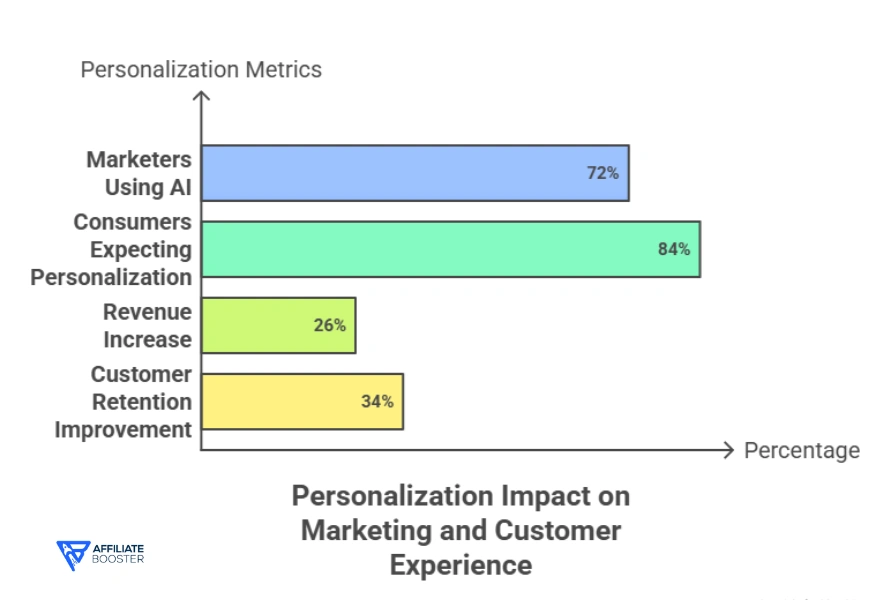
AI enables hyper-personalization at scale. Marketers deliver individualized experiences to millions of customers.
Personalization Statistics
- Marketers using AI for personalization: 72%
- Consumers expecting personalized experiences: 84%
- Revenue increase from personalization: 26%
- Customer retention improvement: 34%
Personalization has shifted from nice-to-have to expected. AI makes it economically feasible at scale.
Personalization Use Cases
AI personalizes numerous customer touchpoints. Each creates more relevant experiences.
Top AI personalization applications:
- Product recommendations: 68% of companies
- Email content customization: 64% of companies
- Website content variation: 56% of companies
- Dynamic pricing: 42% of companies
- Personalized search results: 48% of companies
- Custom landing pages: 38% of companies
Product recommendations show the highest adoption. E-commerce platforms pioneered this application successfully.
Personalization Impact on Conversions
Personalized experiences convert significantly better. The data shows clear correlation between personalization and sales.
| Personalization Level | Conversion Rate | Average Order Value | Customer Lifetime Value |
| None | 1.8% | $86 | $485 |
| Basic (Name, Location) | 2.4% | $94 | $628 |
| Moderate (Behavior) | 3.6% | $108 | $842 |
| Advanced (AI-Driven) | 4.8% | $127 | $1,165 |
Advanced AI-driven personalization nearly triples conversion rates. Customer lifetime value more than doubles compared to non-personalized experiences.
Predictive Analytics and Data Intelligence
AI analyzes massive datasets to predict customer behavior. These insights inform strategic decisions.
Predictive Analytics Adoption
- Marketers using predictive analytics: 46%
- Accuracy of AI predictions: 78%
- Decision-making speed improvement: 5.2x
- Marketing efficiency increase: 38%
Predictive analytics remains less common than other AI applications. However, sophisticated marketers gain significant competitive advantages.
Prediction Use Cases
AI predicts various marketing outcomes. Each prediction type enables proactive optimization.
What marketers predict with AI:
- Customer churn probability: 58%
- Purchase likelihood: 62%
- Lifetime value estimates: 48%
- Content performance: 42%
- Campaign ROI forecasts: 38%
- Optimal pricing: 32%
Purchase likelihood predictions see highest adoption. They enable targeted remarketing and promotional strategies.
Lead Scoring Improvements
AI transforms lead scoring accuracy. Sales teams prioritize the right prospects more effectively.
- Traditional lead scoring accuracy: 52%
- AI-powered lead scoring accuracy: 84%
- Sales cycle reduction: 28%
- Conversion rate improvement: 42%
AI considers hundreds of signals simultaneously. This comprehensive analysis significantly outperforms manual scoring models.
AI Marketing Challenges and Concerns
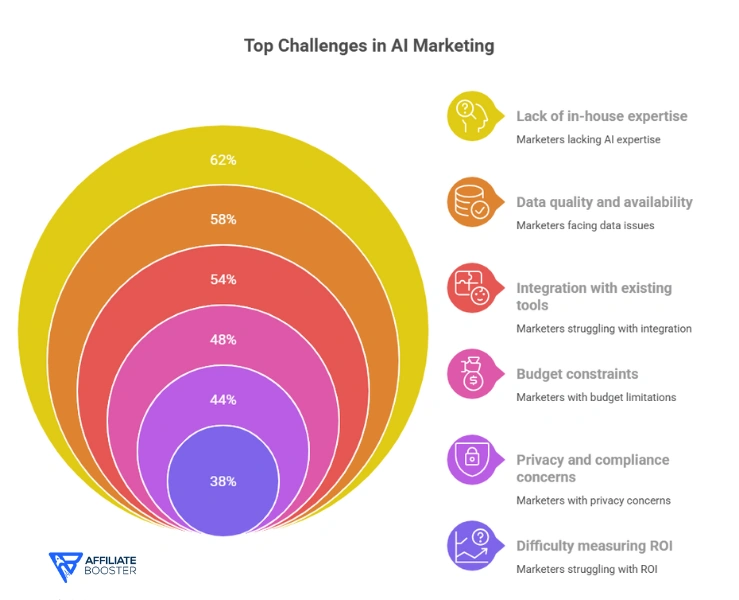
Despite benefits, AI marketing faces obstacles. Understanding challenges helps companies navigate implementation successfully.
Top Challenges in AI Marketing
- Lack of in-house expertise: 62% of marketers
- Data quality and availability: 58% of marketers
- Integration with existing tools: 54% of marketers
- Budget constraints: 48% of marketers
- Privacy and compliance concerns: 44% of marketers
- Difficulty measuring ROI: 38% of marketers
Skills gaps represent the biggest barrier. Many marketing teams lack technical AI expertise.
Skills Gap Statistics
The AI skills shortage affects adoption speed. Companies struggle to find qualified talent.
- Marketers confident in AI skills: 34%
- Companies offering AI training: 48%
- Average training investment per employee: $2,400
- Time to AI proficiency: 4.8 months
Most marketers feel underprepared for AI. Training programs help but require time and investment.
Privacy and Ethical Concerns
AI marketing raises privacy questions. Consumers and regulators demand responsible data usage.
- Consumers concerned about AI personalization: 58%
- Companies with AI ethics guidelines: 42%
- GDPR compliance challenges with AI: 64%
- Transparency in AI decisions: 38% provide it
Privacy concerns create hesitation. Companies must balance personalization benefits with ethical data practices.
AI Marketing Budget and Investment
AI marketing spending increases rapidly. Companies allocate more resources to AI capabilities.
Current AI Marketing Spending
- Average percentage of marketing budget on AI: 18.4%
- Expected AI budget increase (2026): 38%
- Total global AI marketing spend: $128 billion
- Projected spend by 2028: $298 billion
AI marketing investment accelerates. The technology shifts from experimental to core infrastructure.
Budget Allocation by AI Category
Companies distribute AI budgets across multiple categories. Each serves different strategic priorities.
| AI Category | Budget Share | Average Investment | ROI |
| Marketing Automation | 28% | $32,000 | 285% |
| Content Creation Tools | 22% | $18,500 | 420% |
| Analytics & Insights | 18% | $28,000 | 340% |
| Advertising Optimization | 16% | $42,000 | 380% |
| Chatbots & Support | 10% | $24,000 | 485% |
| Other AI Tools | 6% | $8,500 | 180% |
Marketing automation receives the largest budget share. However, chatbots deliver the highest ROI percentage.
Future AI Marketing Trends
AI marketing continues evolving rapidly. Several trends will shape the next few years.
Emerging AI Marketing Technologies
New AI capabilities expand marketing possibilities. These technologies are gaining traction in 2026:
- Generative AI for video creation: 42% adoption
- Voice search optimization: 38% adoption
- AI-powered influencer matching: 34% adoption
- Autonomous marketing campaigns: 28% adoption
- Emotion AI for sentiment analysis: 24% adoption
- AI video personalization: 18% adoption
Video generation AI shows explosive growth. Tools like Sora and Runway enable marketers to create video content at scale.
Projected AI Marketing Growth
Analysts forecast continued strong growth. AI becomes increasingly central to marketing operations.
- Predicted AI marketing adoption (2028): 94%
- Expected automation of routine tasks: 68%
- Jobs transformed by AI: 78% of marketing roles
- New marketing jobs created: 2.4 million globally
AI won't eliminate marketing jobs. Instead, it transforms roles toward strategic and creative work.
Frequently Asked Questions
Also Read:
- Social Media Statistics
- CMS Statistics
- Web Development Statistics
- Crypto Adoption Statistics
- SaaS Statistics
Conclusion
AI has fundamentally transformed marketing in 2026. With 78.4% adoption among marketers, AI tools are now mainstream essentials rather than experimental novelties.
The performance data proves AI's value convincingly. Content production increases 3.8x while email conversions improve 42%. Ad performance gains 41% and lead scoring accuracy jumps to 84%. These aren't marginal improvements—they're game-changing advantages.
Investment follows results. Companies now allocate 18.4% of marketing budgets to AI, with spending growing 38% year-over-year. The global AI marketing market reaches $128 billion in 2026, doubling to $298 billion by 2028.
Challenges remain significant. 62% of marketers lack sufficient AI expertise. Data quality, integration complexity, and privacy concerns create obstacles. However, companies invest heavily in training and infrastructure to overcome these barriers.
The future points toward even deeper AI integration. 94% adoption is projected by 2028 as holdouts embrace the technology. Emerging capabilities like AI video generation and autonomous campaigns expand possibilities further.
AI won't replace human marketers. Instead, it elevates their capabilities. Routine tasks automate, freeing marketers for strategy, creativity, and relationship building. The profession evolves toward higher-value work.
For marketing professionals, the message is clear: AI literacy becomes essential. Those who master AI tools gain competitive advantages in productivity, performance, and career advancement. The AI marketing revolution has arrived, and the statistics prove it's here to stay.
Source: Statista, Survey Monkey