
This is the question that keeps many affiliate marketers up at night.
“If I use ChatGPT or Claude to write my affiliate content, will Google penalize my site?”
I have tested this extensively on my own sites. I have also watched what happened to sites that took the wrong approach.
Here is the honest truth — which is more nuanced than most “AI content is fine” or “AI content will kill your site” articles you have read.
What Google Actually Says About AI Content
Let me start with what Google has officially stated, because a lot of misinformation circulates about this.
Google's official position is clear: they do not penalize content for being AI-generated. They penalize content for being low-quality, unhelpful, or designed to manipulate search rankings rather than serve readers.
The Helpful Content system — updated multiple times through 2024 and 2025 — evaluates content based on:
Does it demonstrate first-hand experience and expertise?
Does it actually help readers accomplish something?
Is it written for people or for search engines?
Does the site have a clear purpose and genuine author expertise?
Notice what is not on that list: “Was it written by AI?”
AI is the method. Helpfulness is the standard.
The Real Risk: Thin, Generic AI Content
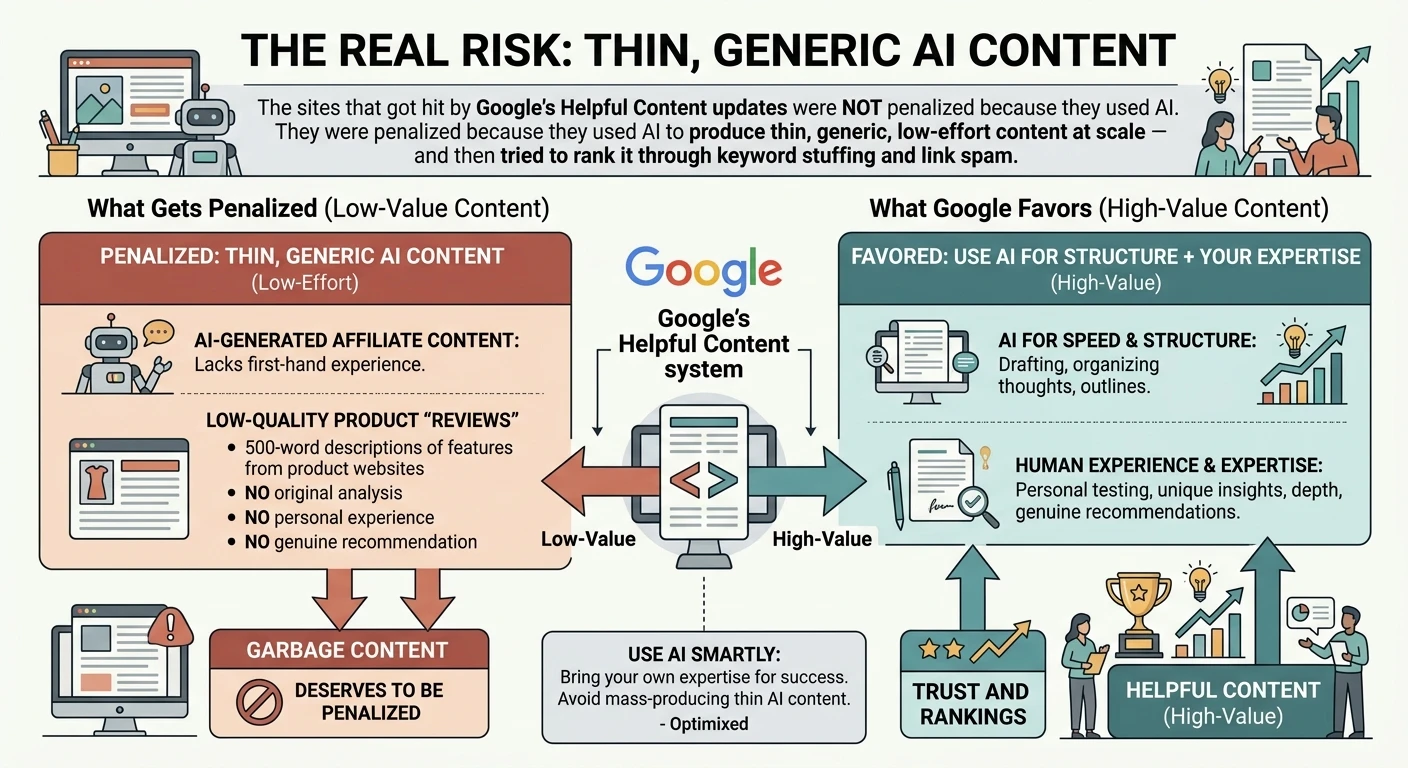
The sites that got hit by Google's Helpful Content updates were not penalized because they used AI.
They were penalized because they used AI to produce thin, generic, low-effort content at scale — and then tried to rank it through keyword stuffing and link spam.
Google's helpful content system specifically targets AI-generated affiliate content that lacks first-hand experience. Use AI for speed and structure. Bring your own expertise for trust and rankings. Optimixed
This is the most accurate framing I have seen.
If you use AI to write 500-word product “reviews” that just describe features from the product website without adding any original analysis, personal experience, or genuine recommendation — you deserve to be penalized. Not because you used AI, but because you produced garbage content.
What About AI Content Detectors?
There are several tools that claim to detect AI-written content — Originality.ai, GPTZero, Copyleaks, and others.
Here is what you need to know about them:
They are unreliable. Even human-written content sometimes gets flagged as AI. AI-written content that is well-edited often passes. These tools have false positive rates that make them unreliable as a quality signal.
More importantly: Google does not use a third-party AI detector to evaluate content. They use a much more sophisticated system that evaluates overall site quality, author expertise signals, content depth, and user behavior metrics.
I have sites with heavily AI-assisted content that rank extremely well. I have also seen sites with “AI-free” content get penalized because the quality was poor.
The detector is not the issue. Quality is.
How to Make AI-Written Affiliate Content Pass Google's Standards
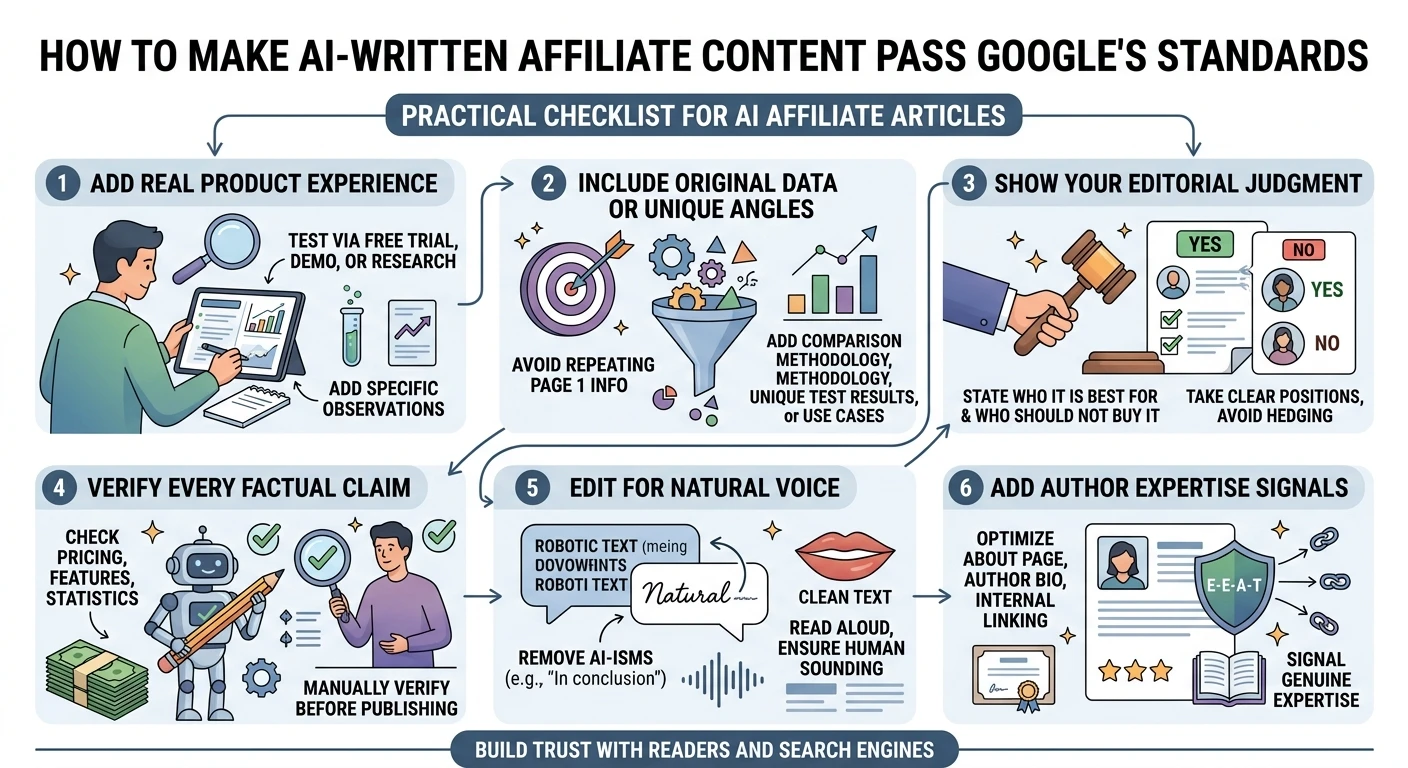
Here is my practical checklist for every AI-written affiliate article before publishing:
1. Add real product experience. Even if you have not personally purchased every product you review, you should have tested it via free trial, demo, or community research. Add specific observations that only someone with direct experience would know.
2. Include original data or unique angles. If your review covers the same information as every other review on page 1 of Google, there is no reason for Google to rank yours. Add something unique — your comparison methodology, an original test result, a specific use case nobody else is covering.
3. Show your editorial judgment. State clearly who the product is best for and who should not buy it. Hedging with “it depends” is a sign of low-expertise content. Expert reviewers take positions.
4. Verify every factual claim. AI hallucinates pricing, features, and statistics. Every single factual claim in your article needs to be manually verified before publication. One wrong pricing figure can destroy the credibility of an entire review.
5. Edit for natural voice. Remove AI-isms. Phrases like “In conclusion, it is important to note that…” or “Firstly, it is worth mentioning that…” are dead giveaways. Read your content aloud. If it sounds like it was written by a robot, edit it until it does not.
6. Add author expertise signals. Your about page, author bio, and internal linking should all signal that the content is written by someone with genuine expertise. These are E-E-A-T signals that Google uses to evaluate your site holistically.
Case Study: What Happened to My AI-Assisted Site
I want to share a real example from my own experience.
In late 2024, I published 30 AI-written affiliate articles on one of my sites. I edited each one but did not add enough original experience — I was trying to publish quickly.
When the Google Helpful Content update hit in early 2025, that site lost about 30% of its traffic. The articles that got hit hardest were the ones where I had done the least editing and added the least original insight.
The articles that maintained or grew their rankings were the ones where I had added:
Specific personal test results
Original comparisons not covered anywhere else
Clear recommendations with concrete reasoning
Same AI tools. Different level of human input. Completely different outcomes.
The Spam Policy Risk: Affiliate Sites Specifically
There is one additional risk specific to affiliate sites that you need to know about.
Google's spam policies include specific language about affiliate content:
They target thin affiliate sites that add little to no original value beyond what the original product website provides.
If your affiliate review is essentially a summary of the product website's marketing copy, that is a spam risk — AI or not.
The test I apply to every review before publishing: “Does this review help a reader make a better decision than they would by just visiting the product website?” If the answer is no, I go back and add more.
Conclusion
Will Google penalize your AI-written affiliate reviews?
Not if they are high quality, genuinely helpful, and demonstrate your expertise.
Yes, if they are thin, generic, and add no value beyond what already exists online.
AI is a tool. Like any tool, the outcome depends on how you use it. Use it to write faster and structure better — then invest your human time into making the content genuinely excellent.
FAQs
Does Google penalize affiliate sites for using AI-written content?
Google does not penalize content based on how it was written. Penalties are triggered by low quality, thin content, or policy violations — not by AI assistance. A well-researched, helpful AI-written review can rank just as well as a human-written one.
How does Google actually detect low-quality AI content in reviews?
Google does not use third-party AI detectors like GPTZero or Originality.ai to flag content. Instead, its systems evaluate helpfulness signals, expertise indicators, and user engagement metrics. Content that lacks depth, firsthand experience, or clear expertise is what typically triggers quality issues.
Is AI-generated affiliate review content safe to publish without disclosure?
Google has no requirement to disclose AI-assisted writing, so there is no ranking risk from skipping disclosure. However, FTC guidelines do require clear disclosure of affiliate relationships regardless of how the content was produced. Some publishers voluntarily disclose AI use as a trust-building practice.
What makes an AI-written product review rank better in Google search results?
Adding firsthand experience, specific test results, and original data significantly strengthens an AI-assisted review. Clear expert recommendations, proper internal linking, and structured formatting also improve ranking potential. The quality and usefulness of the information matters far more than the writing method used.
Can AI-written affiliate reviews appear in Google's AI Overviews or featured snippets?
Yes, AI-written content can and does appear in featured snippets and Google AI Overviews. Google's systems select content based on how clearly and directly it answers a specific query, not based on authorship method. Well-structured, authoritative answers have the same eligibility regardless of how they were created.