

AdSense, Adsterra and Monetag are worth investigating for best low-traffic website ad networks because their published guidance does not impose a universal large-audience entry floor. Journey is an option for sites with qualifying sessions. BidVertiser, AdMaven and PopAds offer more specific alternatives. Approval and earnings are separate questions.
| Best For | Original content sites | Format experiments | Growing editorial sites |
| Traffic Enrty Position | No numerical minimum in general eligibility guidance | States no entry traffic minimum | States no strict minimum |
| Main Caution | Content and policy review | Choose placements carefully | Approval and domain rules apply |



Your website gets a few hundred visits a day, perhaps less. You would like it to cover hosting costs, but most ad-network lists seem to be written for sites that already have a publishing team.
You do not need to wait for a huge audience before researching monetisation. You do need to be realistic about what a small amount of traffic can earn.
The best ad networks for low traffic websites have entry rules you can meet, formats that fit the site and payment terms that make sense at a small scale. A network may accept you today and still take months to produce a worthwhile payout.
This guide compares seven options, explains the important thresholds and includes simple earnings examples so you can decide whether adding ads is worth doing now.
Best low-traffic website ad networks: Quick comparison
Compare the best ad networks for low-traffic websites based on minimum visitor requirements, approval criteria, ad formats, payout thresholds, and earning potential to find the right platform for monetizing your website, even with limited traffic.
Network | Traffic entry position | Best for | Main caution |
|---|---|---|---|
Google AdSense | No numerical minimum in general eligibility guidance | Original content sites | Content and policy review |
Adsterra | States no entry traffic minimum | Format experiments | Choose placements carefully |
Monetag | States no strict minimum | Eligible sites with varied traffic | Approval and domain rules apply |
Journey by Mediavine | 1,000 qualifying sessions in 30 days | Growing editorial sites | Audience country mix matters |
BidVertiser | Check publisher acceptance | CPC Smartlinks | Needs an appropriate click opportunity |
AdMaven | Check product-specific acceptance | Small-balance payment comparison | Confirm the method's terms |
PopAds | Check site acceptance | Deliberate popunder testing | Format may not fit a content site |
A small traffic requirement is only one part of eligibility. The reviews below link to official guidance rather than assigning invented acceptance probabilities.
What counts as a low-traffic website?
There is no single definition across ad networks. A programme may count visitors, sessions, pageviews or revenue, and those measures should not be swapped.
One reader can create several pageviews during a session. A site with 5,000 pageviews does not necessarily have 5,000 different people visiting.
For this guide, low traffic means a site whose audience is still small enough that entry requirements and withdrawal thresholds materially affect the decision to run ads.
Use the exact metric a provider asks for when checking eligibility.
7 Best ad networks for low traffic websites in detail
Explore the 7 best ad networks for low-traffic websites, including their key features, approval requirements, ad formats, payment options, and earning potential to help you choose the right platform for monetizing your website as your audience grows.
1. Google AdSense: Best starting point for original content
AdSense's general eligibility guidance does not state a numerical traffic minimum. It focuses on the site's content, compliance and the publisher's ability to place the required code.
That makes it worth investigating before assuming your site is too small.
Look at the pages as a visitor would. Does each one answer a useful question? Can someone navigate the site without hitting unfinished sections? Low volume is not a reason to submit an incomplete website.
At this stage, keep the proposed ad layout restrained. The purpose is to learn what the audience supports, not to extract the maximum number of placements from every page.
Pros
- No numerical traffic floor in the general requirements.
- A practical first comparison for an editorial site.
Cons
- Acceptance is not automatic.
- Low traffic can still mean very low earnings.
Our verdict: Start with AdSense if your content is ready and you want a conventional advertising setup. Improve the site before adding more ad positions.
2. Adsterra: Best for exploring formats without an entry traffic minimum
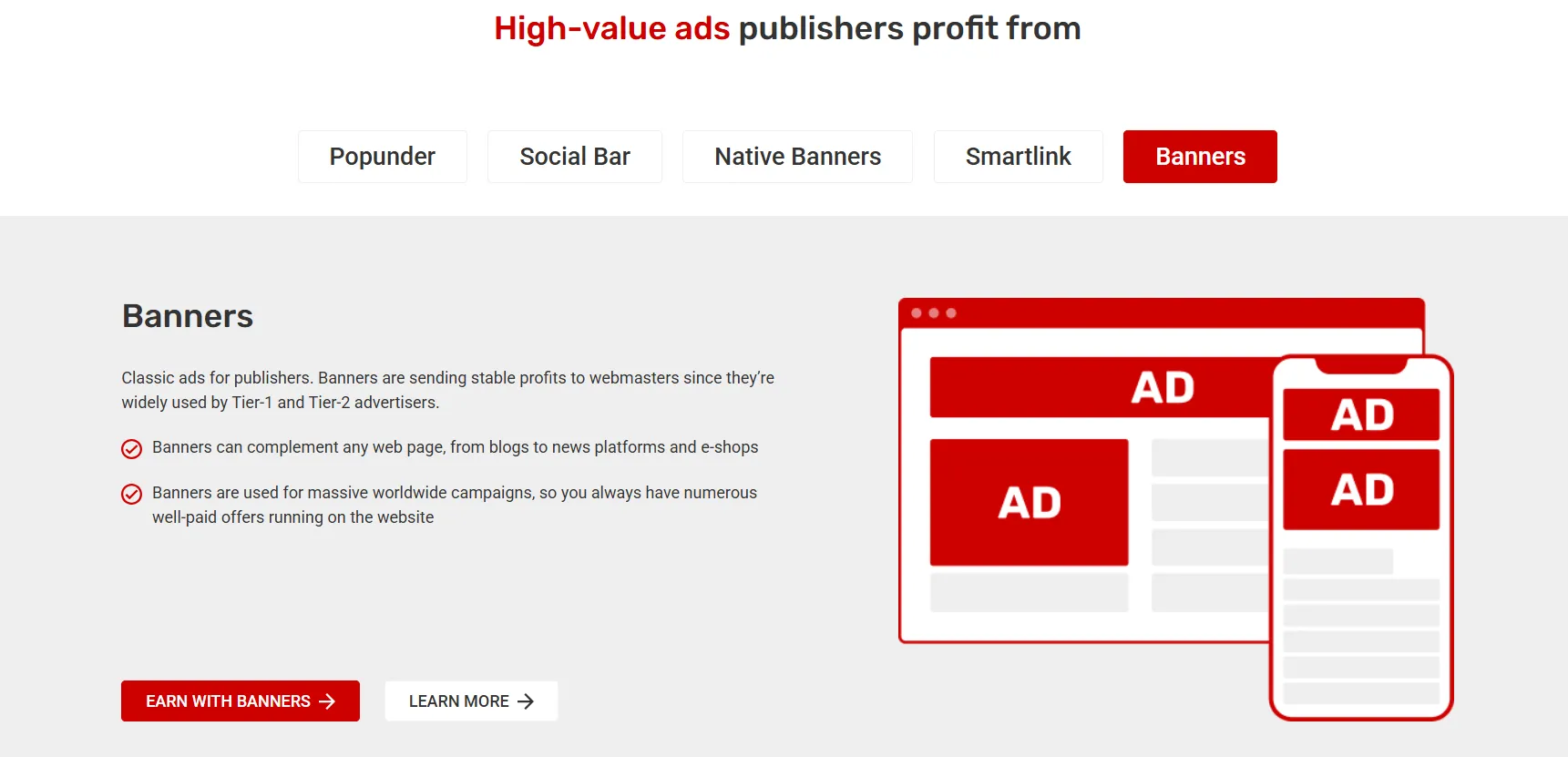
Adsterra explicitly says it does not impose entry traffic limits. Its format selection gives smaller publishers alternatives to a standard banner-only approach.
For low traffic, the most useful test is narrow. Choose one placement and one question: does it produce enough revenue to justify its effect on the page?
Do not draw conclusions from a single strong day. When there are only a few visits, one unusual source or country mix can change the result substantially.
Pros
- Published access without an entry traffic minimum.
- Several advertising approaches to investigate.
Cons
- Some formats can alter the browsing experience significantly.
- A tiny sample makes comparisons unreliable.
Our verdict: Consider Adsterra if one of its formats fits the website naturally. Evaluate a longer, representative period before deciding that a rate is stable.
3. Monetag: Best for eligible sites testing alternative placements
Monetag's FAQ says there is no strict traffic minimum. It also sets approval conditions, including original content, acceptable traffic and a self-hosted domain for website publishers.

Those conditions are more useful than a vague claim that every website qualifies.
Think about the job visitors come to do. A utility page, an entertainment page and a detailed product guide can have different advertising opportunities. Select the placement around that job.
For a small site, avoid changing the whole layout during your first trial. You want to know what the advertising changed.
Pros
- No strict numerical traffic minimum stated.
- A candidate for comparing different placement experiences.
Cons
- Approval and domain conditions still apply.
- Advertising must not get in the way of the page's main purpose.
Our verdict: Shortlist Monetag if your site meets the current rules and you have a clear placement in mind. Check the visitor experience yourself after installation.
4. Journey by Mediavine: Best for a small but qualifying editorial audience
Journey's current application threshold is 1,000 sessions from qualifying Tier 1 countries within a 30-day period. The same page also requires original content and suitable quality and traffic standards.

That makes audience composition part of eligibility. A larger worldwide total may be less relevant than a smaller total from the specified markets.
If you meet the criteria, it is an option to compare without waiting until the site becomes a large publication.
Pros
- A defined route for growing publishers.
- Uses a stated qualifying-session requirement.
Cons
- Worldwide totals alone are insufficient.
- Reaching the threshold does not guarantee approval.
Our verdict: Consider Journey when your analytics match its requirements. If they do not, focus on building a useful audience instead of repeatedly submitting the same application.
5. BidVertiser: Best for a suitable CPC link placement
BidVertiser offers CPC-based Smartlinks. This is worth evaluating when a clearly labelled advertising link fits the visitor's journey.
For low-traffic sites, the value of each genuine interaction matters. That still does not justify hiding the nature of the link or encouraging artificial clicks.
Plan where it will sit and how readers will understand it. Keep it distinct from ordinary navigation, editorial references and download controls.
Pros
- A specific click-based monetisation option.
- Useful to compare where a display banner is not the intended format.
Cons
- A small number of clicks can make revenue uneven.
- It needs a clear and appropriate advertising placement.
Our verdict: Investigate BidVertiser when a labelled link makes sense for the site. Do not redesign the visitor's task merely to create a click opportunity.
6. AdMaven: Best for comparing small-balance payment terms
AdMaven's published table lists no minimum for PayPal withdrawals, but its page contains inconsistent figures for some other methods. Confirm the applicable terms directly.
For low-traffic publishers, that is a cash-flow consideration rather than a reason to expect high earnings.
Start with the format and then check how money reaches you. Ask whether fees, timing or verification make small payments impractical.
Pros
- A published PayPal option worth checking for small balances.
- An alternative for publishers comparing payment flexibility.
Cons
- Some method-specific public information needs clarification.
- Easy withdrawal cannot make an unsuitable format worthwhile.
Our verdict: Consider AdMaven where both the placement and confirmed payment arrangement fit. Resolve uncertainty before treating any advertised minimum as your actual withdrawal rule.
7. PopAds: Best for sites that specifically want popunders
PopAds focuses on popunder advertising. That makes it a specialised choice, rather than a default recommendation for every small blog.
If you want to test popunders, decide in advance what would make the trial unsuccessful. Repeated complaints, a confusing browsing experience or a negligible earnings contribution are good reasons to reconsider.
For a site with only a small audience, keeping returning readers may be more valuable than adding another short-term revenue source.
Pros
- A focused product for a specific format.
- Easy to evaluate as a separate format decision.
Cons
- The experience may not suit readers of an editorial site.
- Small earnings can make the user-experience trade-off difficult to justify.
Our verdict: Test PopAds only when you intentionally want popunders. Choose a conventional in-page alternative when preserving an uninterrupted reading flow is the priority.
How much can a low-traffic website earn?
Use page RPM to make a basic plan. Page RPM is revenue per thousand pageviews, which is different from revenue per thousand individual ad impressions.
Estimated monthly revenue = monthly pageviews ÷ 1,000 × page RPM.
Monthly pageviews | At $2 page RPM | At $5 page RPM | At $10 page RPM |
|---|---|---|---|
1,000 | $2 | $5 | $10 |
5,000 | $10 | $25 | $50 |
10,000 | $20 | $50 | $100 |
These are hypothetical scenarios, not measured network rates or typical earnings claims.
The table answers a useful question: how much difference could a rate improvement make at your current scale? At 1,000 pageviews, moving from a $2 to a $5 page RPM adds $3 a month in this example.
That may not justify hours of extra work. Improving the content, building an email audience or fixing an important page could be a better use of that time.
Which platforms should a low-traffic site treat as later options?
Some programmes have a different starting point. Raptive publishes a minimum of 25,000 monthly pageviews, with additional country and content conditions. Ezoic's general requirement is 250,000 monthly active users, with a selective Incubator route for smaller sites.
Those are different metrics. They should not be copied into a table under one generic “traffic” heading.
Keep future options on your list, but prioritise programmes you can realistically qualify for now. Rejection from an unsuitable programme is not evidence that all advertising is unavailable to you.
How should you test ads on a small website?
Choose a limited placement and record the starting position. Note pageviews, countries, devices and existing revenue.
Then make one meaningful change at a time. If you change the theme, publish a viral article and add a new network together, the earnings report will not isolate the network's effect.
Watch the page as well as the dashboard. Open it on a phone. Follow the main navigation and complete the action a visitor came for.
Keep a trial only when the earnings and user experience justify the work. A small site does not need a complicated ad setup to prove it is a real business.
FAQs: Best Low-Traffic Website Ad Networks
Potentially, if it meets a provider's rules. Visitor counts, sessions and pageviews are different measures, so check the exact requirement. Being accepted does not establish a minimum earnings level.
AdSense, Adsterra and Monetag are worth investigating based on their published entry guidance. The best choice depends on content eligibility, advertising format and payment arrangements.
No. The current requirement concerns sessions from qualifying countries, alongside content and traffic standards. A global total alone does not establish eligibility.
Wait if ads would distract you from growing the site or produce too little value for the work involved. A small, controlled trial can make sense when setup is manageable.
They answer different questions. RPM describes earnings relative to activity. The threshold determines when a balance can become payable. Compare both, along with method availability and fees.
No. Do not create artificial advertising activity or ask others to do it. Build a genuine audience and follow the provider's rules for testing placements.
Quick Links:
Which low-traffic ad network should you try first?: Best Low-Traffic Website Ad Networks
Start with an option whose entry rules fit your site and whose format you are comfortable showing to visitors. AdSense is a practical starting comparison for content; Journey becomes relevant when your audience qualifies.
Use the earnings scenarios to set expectations. If the likely benefit is modest, keep the setup simple and spend most of your time building a website people want to return to.