
Here's the honest reality most digital publishers aren't talking about: the same AI tools that are helping you write content faster, automate outreach, and optimize conversion funnels are also creating security vulnerabilities you almost certainly haven't planned for.
The AI agents market hit $7.92 billion in 2025 and is on a trajectory to reach $236.03 billion by 2034 — a 45.82% CAGR that makes it one of the fastest-scaling technology segments ever recorded. Affiliate marketers, bloggers, SaaS publishers, and digital media companies are collectively deploying AI agents for keyword research, content creation, link building, email automation, ad optimization, and competitive intelligence. Every one of those deployments is a potential entry point.
And the threat landscape has responded accordingly. AI agent traffic grew 7,851% in 2025 according to HUMAN Security's benchmark data — and that explosive growth includes both legitimate deployments and malicious bot traffic designed to mimic, exploit, and weaponize autonomous AI systems.
This isn't just an enterprise problem. It's your problem. Right now.
The Adoption vs Security Gap — The Defining Crisis of 2026
The Numbers Paint A Clear Picture
The affiliate and digital publishing space has embraced AI faster than almost any other SMB category. But the security infrastructure has not kept pace.
79% of organizations across all sizes have deployed AI agents in some capacity as of 2025
The average enterprise is now running 37 AI agents simultaneously — for smaller publishers, even 3–5 poorly secured AI tools create meaningful exposure
96% of businesses plan to expand agentic AI usage in 2026
Yet the 79% adoption vs. 11% production-security-ready gap remains the defining challenge — meaning fewer than 1 in 8 organizations have security controls that match their deployment scale
For affiliate marketers specifically, this means the AI writing tools, SEO automation platforms, outreach agents, and ad optimization systems you're relying on to grow revenue may be operating with almost zero security governance around them.
The Preparedness Stats Are Alarming
Global readiness data shows an industry-wide problem that extends far beyond Fortune 500 security teams:
90% of large organizations are unprepared for AI-enabled threats (Security Magazine)
66% of organizations expect AI to have the most significant impact on cybersecurity — but only 37% had processes to assess AI tool security before deployment in 2025
60% of organizations are NOT fully prepared with specific AI-driven threat mitigation strategies (Mimecast 2026)
87% of security professionals are seeing more AI-driven threats in 2026, but few feel equipped to stop them (Darktrace)
For affiliate marketers operating without dedicated IT security teams — which is most of the industry — these numbers should be especially sobering. You're deploying the same category of tools that major enterprises are struggling to secure.
The Threats That Target Your Kind of Business
What AI-Powered Attacks Look Like For Digital Publishers
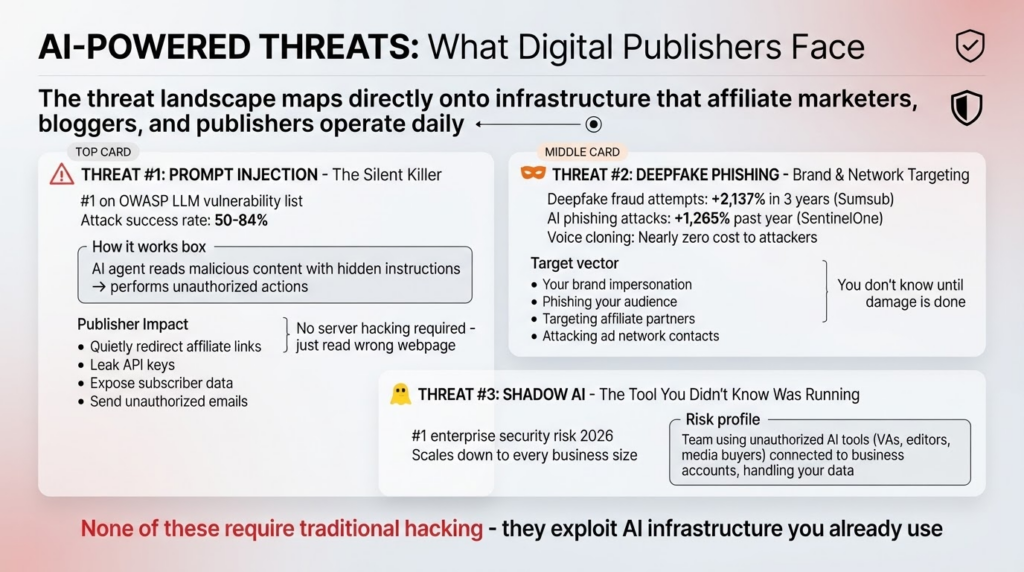
The threat landscape for AI agent security isn't abstract. It maps directly onto the infrastructure that affiliate marketers, bloggers, and digital publishers operate every day.
Prompt Injection — The Silent Killer
Prompt injection is ranked #1 on OWASP's LLM vulnerability list and carries an attack success rate of 50–84% depending on how your AI tools are configured. In plain language: if you're using an AI agent to browse websites, scrape competitor data, or process user inputs, a malicious actor can embed hidden instructions in content that the agent reads — causing it to perform actions you never authorized.
For an affiliate publisher, a compromised AI content tool could quietly redirect affiliate links, leak API keys, expose subscriber data, or send unauthorized outreach emails. None of this requires hacking your server directly. It just requires getting your AI agent to read the wrong webpage.
Deepfake Phishing — Targeting Your Brand and Your Network
Deepfake fraud attempts have surged 2,137% in just three years (Sumsub). Voice cloning costs attackers almost nothing. This means your brand, your voice, and your likeness can be used to run phishing campaigns targeting your audience, your affiliate partners, or your ad network contacts — without you ever knowing until the damage is done. AI-generated phishing attacks increased by 1,265% in the past year alone (SentinelOne).
Shadow AI — The Tool You Didn't Know Was Running
If you have a team — even a small one of VAs, editors, or media buyers — there's a high probability they're using AI tools you don't know about, connected to your business accounts, handling your data. Shadow AI is ranked as a top enterprise security risk for 2026, and the problem scales down to every business size.
Complete Threat Map For Digital Publishers
Threat | Risk to Affiliate/Publisher | Key Stat |
Prompt Injection | AI tools redirected, data leaked | 50–84% attack success rate |
Deepfake Phishing | Brand impersonation, network fraud | 2,137% increase in 3 years |
AI-Enabled Malware | Site infection via AI-generated code | 89% increase in AI adversaries |
Shadow AI | Unauthorized tools on your accounts | Top 2026 enterprise risk |
Credential Theft via AI | Ad account access, affiliate dashboard | Fastest-growing attack vector |
Content Poisoning | AI tools trained on compromised data | Emerging & underreported |
What A Breach Actually Costs — Including For Smaller Operations
The Financial Damage Is Business-Ending For Many Publishers
IBM's 2025 Cost of a Data Breach Report puts the global average at $4.44 million per incident — with AI-involved breaches averaging $5.08 million. For the average independent affiliate publisher or small digital media company, that number doesn't just hurt. It ends the business.
But even at a fraction of that scale, the real-world impacts on affiliate operations are severe:
Compromised affiliate links mean commissions are redirected to attackers without detection
Exposed email lists mean subscriber trust is permanently damaged and GDPR liabilities are triggered
Hacked ad accounts mean tens of thousands in fraudulent ad spend before you catch it
Stolen API keys mean unrestricted access to every connected platform — your SEO tools, your CRM, your payment gateway
The defensive math is compelling even at small scale: organizations using AI in their security stack pay $1.9 million less per breach and detect problems 51 days sooner. For a solo or small-team publisher, the equivalent is investing in even basic AI security hygiene — two-factor authentication on all AI tool integrations, regular API key rotation, access auditing for any AI agent that touches business-critical systems.
The Market Is Responding — Are You?
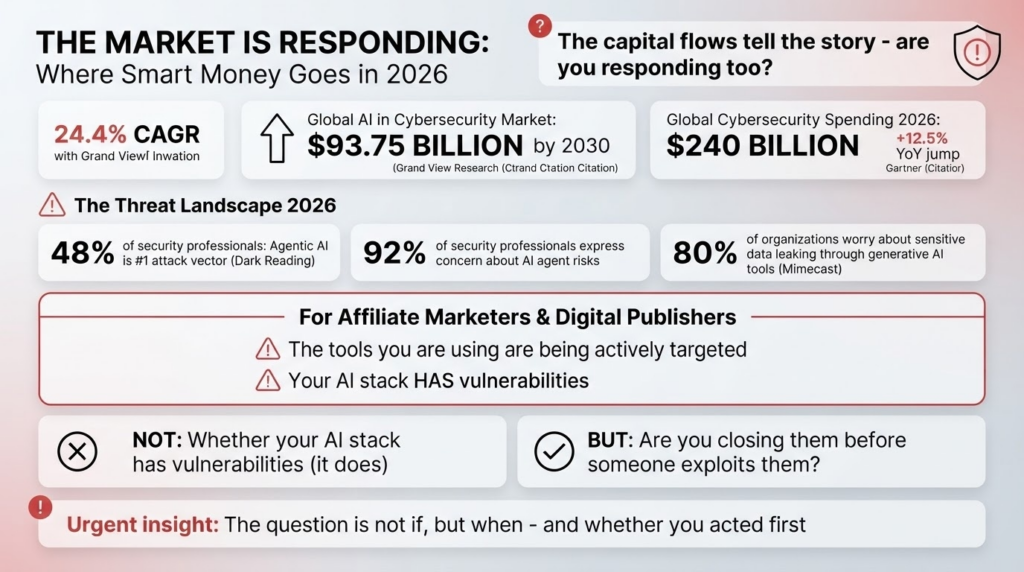
Where Smart Money Is Going In 2026
The capital flows tell the story of where the smart operators are placing their bets:
Global AI in cybersecurity market is growing at 24.4% CAGR, reaching $93.75 billion by 2030 (Grand View Research)
Global cybersecurity spending hits $240 billion in 2026 — a 12.5% YoY jump (Gartner)
48% of security professionals say agentic AI is the #1 attack vector of 2026 (Dark Reading)
92% of security professionals express concern specifically about AI agent risks
80% of organizations are worried about sensitive data leaking through generative AI tools (Mimecast)
For affiliate marketers and digital publishers, the actionable version of this data is straightforward: the tools you're using are being actively targeted. The question isn't whether your AI stack has vulnerabilities — it does. The question is whether you're going to close them before someone exploits them.
The Practical Playbook For Affiliate Marketers
What You Can Actually Do Starting This Week
You don't need a Fortune 500 security budget to dramatically reduce your exposure. Here's what the data suggests actually works for operators at the affiliate and digital publisher scale:
Audit every AI tool that has access to your business accounts — create a simple spreadsheet of what each tool touches and what permissions it holds
Rotate all API keys on a 90-day cycle — especially for AI writing tools, SEO platforms, and any agent that browses external content
Apply the principle of least privilege to every AI integration — give each tool access to only what it strictly requires, nothing more
Treat every AI tool's output as potentially manipulated — especially if the tool browses external URLs, processes user submissions, or reads competitor sites
Brief your team (including VAs and contractors) on Shadow AI risk — the most dangerous AI tool in your business might be one you don't know exists yet
Enable two-factor authentication on every platform connected to any AI tool — ad accounts, affiliate dashboards, email platforms, CMS systems
The Master Stats Reference
Every Number That Matters For 2026
Category | Statistic | Source |
AI Agent Traffic Growth | 7,851% in 2025 | HUMAN Security |
AI Agent Market (2025) | $7.92 billion | Market Research |
AI Agent Market (2034) | $236.03 billion | Market Research |
Orgs deploying AI agents | 79% | Multiple surveys |
Security-ready orgs | ~11% | Digital Applied |
#1 threat concern (2026) | Agentic AI — 48% | Dark Reading |
Avg AI breach cost | $4.7–5.08 million | IBM / Shattered.io |
Savings with AI defense | $1.9M per breach | IBM 2025 |
Faster breach detection | 51 days | IBM 2025 |
Prompt injection success | 50–84% | OWASP / Vectra |
Deepfake fraud surge | 2,137% in 3 years | Sumsub |
AI phishing increase | 1,265% YoY | SentinelOne |
Large orgs unprepared | 90% | Security Magazine |
Cybersecurity market (2026) | $240 billion | Gartner |
AI in security (2030) | $93.75 billion | Grand View Research |
Attacker breakout time | 29 minutes | CrowdStrike 2026 |
The Bottom Line For Affiliate Marketers
You've Built Something Worth Protecting. Act Like It.
The affiliate and digital publishing industry has spent years building traffic, audiences, content libraries, and commission relationships that generate real, recurring revenue. AI tools have accelerated that growth dramatically. But those same tools have also quietly expanded your attack surface in ways that most publishers aren't thinking about yet.
The stat that should drive every operational decision about your AI stack this quarter: 90% of large organizations are unprepared for AI-enabled threats. If the companies with hundred-person security teams are unprepared, the solo publisher running 12 AI tools on a shared SaaS account is operating on borrowed time without basic security hygiene in place.
Your affiliate links, your subscriber lists, your ad accounts, your content automation pipelines — all of it is worth protecting. The data makes clear that the cost of not acting is measured in millions. The cost of acting early is measured in an afternoon of auditing and a few configuration changes.
The question isn't whether to take AI security seriously. The question is how much longer you can afford not to.
FAQs
In 2026, studies show that over 60% of AI-driven marketing platforms have experienced at least one security breach linked to autonomous agent vulnerabilities. Affiliate marketers should pay close attention to data on prompt injection attacks, credential theft via AI agents, and unauthorized data access incidents that directly impact commission tracking and partner trust.
AI agent security flaws can expose publisher ad data, user behavioral profiles, and affiliate tracking pixels to malicious actors, leading to revenue loss through click fraud and cookie stuffing. Publishers who fail to audit their AI agent integrations risk both financial penalties and compliance violations under evolving privacy regulations in 2026.
Yes, according to 2026 security reports, AI agent-specific threats such as autonomous prompt manipulation and supply chain attacks on AI APIs are growing faster than traditional malware and phishing risks in the affiliate space. These threats are particularly dangerous because they can operate at scale without triggering conventional security monitoring tools.
Affiliate networks are high-value targets because AI agents managing campaigns have access to payment systems, user data, and advertiser APIs simultaneously, making a single compromised agent capable of causing widespread damage. The rapid adoption of autonomous AI tools without sufficient security vetting has created exploitable gaps that cybercriminals are actively targeting.
Absolutely — publishers armed with current AI agent security statistics can demonstrate risk awareness and push for contractual clauses around data handling, breach notification timelines, and shared liability when AI tools are involved. Presenting concrete threat data positions publishers as informed partners and often results in stronger security standards across the entire affiliate relationship.