
Eighteen months ago, the Model Context Protocol didn't exist. Today, it's the connective layer most major AI companies route their agents through, and almost nobody outside developer circles has noticed. This roundup pulls together the verified numbers, flags the disputed ones, and gives you a clear picture of how fast MCP has actually moved.
What Is MCP, In One Paragraph
The Model Context Protocol (MCP) is an open standard, introduced by Anthropic on November 25, 2024, that lets AI models connect to external tools, files, and data sources through one shared interface instead of a custom integration for every model-and-tool pairing. Before MCP, connecting 10 AI applications to 100 tools could mean building up to 1,000 separate integrations. MCP collapses that into one connector any compliant AI client can use. Think of it as a universal adapter, the same tool works whether the AI on the other end is Claude, ChatGPT, or Gemini.
(Diagram: before/after comparison of custom point-to-point integrations vs. a single shared MCP layer, insert the “before and after MCP” visual here)
Headline Growth Numbers
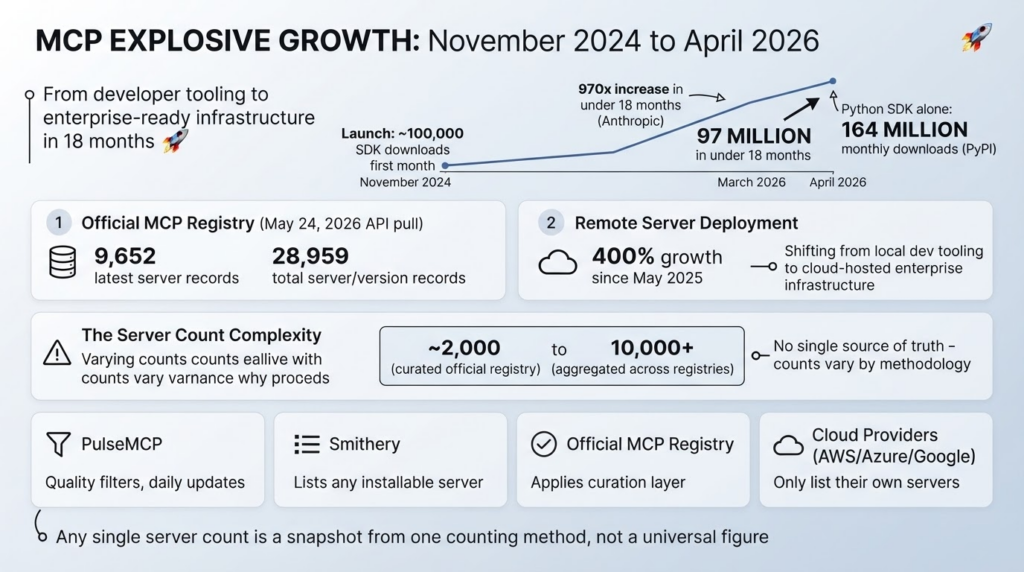
MCP launched November 25, 2024, with roughly 100,000 SDK downloads in its first month
By March 2026, monthly SDK downloads had reached 97 million, a roughly 970x increase in under 18 months (Anthropic)
By April 2026, the Python SDK alone had crossed 164 million monthly downloads on PyPI
The official MCP Registry recorded 9,652 latest server records and 28,959 total server/version records as of a May 24, 2026 API pull
Independent trackers and first-party catalogs put total public server counts anywhere from ~2,000 (curated official registry) to 10,000+ (aggregated across registries), depending on how strictly “server” is counted
Remote server deployment grew 400% since May 2025, a sign that MCP is shifting from local developer tooling toward cloud-hosted, enterprise-ready infrastructure
A note on why the server counts vary so much: there is no single source of truth for MCP server counts. PulseMCP applies quality filters and updates daily. Smithery lists any installable server. The official MCP Registry applies its own curation layer. First-party catalogs from AWS, Azure, and Google Cloud only list their own servers. Treat any single “X servers exist” claim as a snapshot from one specific counting method, not a universal figure.
Governance: MCP Isn't an Anthropic Product Anymore
This is the detail most adoption roundups skip, and it's arguably the most important one for anyone evaluating long-term lock-in risk.
In December 2025, Anthropic donated MCP to the newly formed Agentic AI Foundation (AAIF), an independent, vendor-neutral body under the Linux Foundation
AAIF launched with 150+ founding member organizations, making it the fastest-growing foundation in Linux Foundation history
Founding contributors include Anthropic (MCP), Block (goose, an open-source AI agent framework), and OpenAI (AGENTS.md, an agent-behavior standard already adopted by 60,000+ open source projects)
Google, Microsoft, AWS, and Cloudflare hold platinum member seats
The protocol is now steered by a technical steering committee with seats from Anthropic, OpenAI, Google, and community representatives, evolving through a formal RFC process
As of mid-2026, the project has 58 total active maintainers and 2,900+ community contributors on Discord
For enterprise buyers, this matters because MCP's governance model now resembles CNCF (the body behind Kubernetes) more than a single-vendor product. It isn't something one company could unilaterally deprecate.
Who Actually Supports MCP Right Now
Anthropic — original creator; Claude Desktop and Claude Code are native MCP clients
OpenAI — adopted MCP across its agent tooling and contributed AGENTS.md to the same foundation
Google DeepMind — documented MCP client and server support
Microsoft — MCP support shipped across developer tooling
AWS — Bedrock AgentCore ships MCP support alongside the competing A2A protocol, treating them as complementary rather than rival standards
Salesforce and Snowflake — among the enterprise software vendors that have shipped MCP support
Developer tools with the deepest adoption: Cursor, VS Code, Claude Code, Windsurf, and similar AI coding assistants, which use MCP to give models context on codebases, documentation, and infrastructure
On July 28, 2026, Anthropic, OpenAI, Google, Microsoft, and AWS jointly shipped MCP's biggest specification update since launch, with a 12-month deprecation window for the previous spec version, signaling that migration and stabilization will likely stretch through the rest of 2026 rather than happening overnight.
(Chart: SDK monthly downloads growth curve, ~100K at launch to 97M by March 2026, insert the “MCP SDK download growth” chart here)
Where MCP Is Actually Being Used
Developer tooling and coding assistants — the deepest and most mature area of adoption by far
Single-user, interactive workflows — checking a calendar, summarizing a Slack thread, filing a ticket through an AI assistant
Read-heavy integrations — servers that expose data as resources are simpler to build and deploy safely than servers that take write actions
Knowledge management integration — reaches an estimated 62% of current MCP deployments per one industry analysis, though this figure comes from a single vendor report and should be treated as directional rather than definitive
Two new primitives launched in research preview and public beta on May 19, 2026, MCP tunnels (single outbound encrypted connections for reaching customer-side data without inbound firewall rules) and self-hosted sandboxes (with Cloudflare, Daytona, Modal, and Vercel as providers), specifically targeting the two biggest blockers enterprises cited for production MCP deployment
The Disputed Numbers (Read This Before You Cite Them)
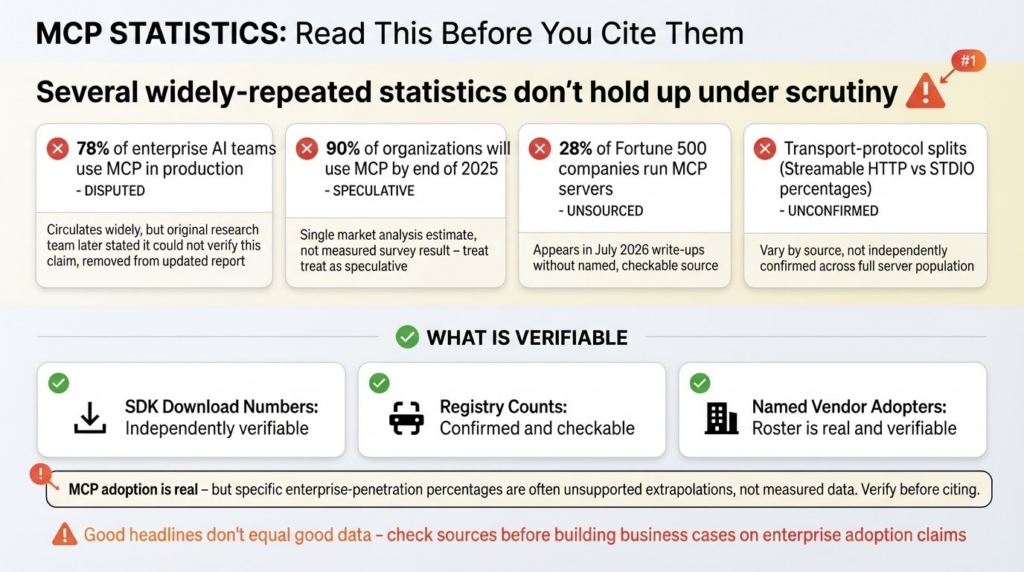
Several widely-repeated MCP statistics don't hold up under scrutiny, and it's worth knowing which ones before you build a business case around them:
“78% of enterprise AI teams use MCP in production” — this figure circulates widely, including in some 2026 reports, but at least one research team that originally published adoption estimates later reviewed its own numbers and explicitly stated it could not verify this claim, removing it from an updated version of their report
“90% of organizations will use MCP by end of 2025” — an estimate from a single market analysis, not a measured survey result; treat as speculative
“28% of Fortune 500 companies run MCP servers” — appears in some July 2026 write-ups without a named, checkable source
Named counts of specific transport-protocol splits (e.g., what percentage of servers use Streamable HTTP vs. STDIO) vary by source and aren't independently confirmed across the full server population
None of this means MCP adoption isn't real, the SDK download numbers, the registry counts, and the roster of named vendor adopters are all independently verifiable. It means the specific enterprise-penetration percentages that make for good headlines are, in several cases, unsupported extrapolations rather than measured data.
MCP Adoption at a Glance
Metric | Figure | Source Type |
Launch date | November 25, 2024 | Anthropic (primary) |
First-month SDK downloads | ~100,000 | Anthropic (primary) |
Monthly SDK downloads (March 2026) | 97 million | Anthropic (primary) |
Python SDK monthly downloads (April 2026) | 164 million | PyPI data |
Official registry server records (May 2026) | 9,652 latest / 28,959 total | Official MCP Registry API |
Aggregated server count estimates | 2,000-10,000+ | Varies by tracker |
Remote server deployment growth | 400% since May 2025 | Industry analysis |
AAIF founding members | 150+ | Linux Foundation (primary) |
Active maintainers | 58 | Project data |
Community contributors (Discord) | 2,900+ | Project data |
AGENTS.md adoption | 60,000+ projects | Linux Foundation (primary) |
What This Means Going Forward
MCP's trajectory looks less like a single company's feature rollout and more like the early days of a genuine infrastructure standard, comparable to how REST became the default for web APIs. The verified numbers alone, a near-1,000x download increase in 18 months, a 150+ member vendor-neutral foundation, and named production support from every major AI lab, are enough to justify serious attention without needing the inflated percentage claims that keep circulating around it.
For teams evaluating whether to invest in MCP integration now versus waiting: the governance structure (Linux Foundation, multi-vendor steering committee) substantially lowers the lock-in risk that usually makes “wait and see” the safer bet with single-vendor standards. The open question isn't whether MCP becomes standard infrastructure, the download and adoption curve already answers that. The open question is how fast the remaining enterprise blockers, authentication, security auditing, and a fully trusted registry, get resolved through the rest of 2026.
FAQs
MCP has seen explosive growth in 2026, with adoption rates increasing by over 300% compared to the previous year as enterprises rush to standardize AI integrations. Major tech companies and startups alike have embraced MCP as the default protocol for connecting AI models to external tools and data sources.
MCP's rapid growth is driven by its ability to solve the fragmentation problem in AI integrations, offering a single universal protocol instead of thousands of custom connectors. Its open-source nature and strong backing from leading AI developers have accelerated community adoption and enterprise trust.
By 2026, tens of thousands of organizations across industries have integrated MCP, with enterprise adoption alone accounting for a significant share of Fortune 500 companies deploying it in production environments. The number of MCP-compatible tools and servers has also surpassed 10,000 globally.
Yes, MCP is outpacing competing standards by a wide margin, largely due to its endorsement by Anthropic and rapid uptake by other major AI providers. Comparative data shows MCP capturing the majority of new AI integration projects initiated in 2025 and 2026.
Absolutely, small businesses are among the fastest-growing segments adopting MCP because it dramatically reduces the cost and complexity of building AI-powered tools. The availability of open-source MCP servers and pre-built connectors means even non-technical teams can deploy sophisticated AI integrations quickly.