
The story of Generative AI in 2026 is not simply one of explosive growth. It is also a story of a gap — between the companies that have truly integrated AI into their operations and the much larger group that has adopted it without yet capturing its value.
Both sides of that story are reflected in the data. Here is the complete picture.
The Numbers That Define GenAI in 2026
Key Metric | Number |
GenAI market size 2025 | $59.01 billion |
Overall AI market 2026 | $390.91 billion |
GenAI CAGR through 2031 | 37.57% |
Companies using AI in at least one function | 88% |
Companies using GenAI specifically | 79% |
Enterprise leaders using GenAI weekly | 82% |
$37 billion | |
GenAI's share of 2025 global VC | 52.7% |
Annual economic value potential | $2.6T–$4.4T |
Companies with no EBIT impact yet | 80%+ |
Companies that have scaled enterprise-wide | 7% |
Section 1: Market Size and Investment
The Size of the Market
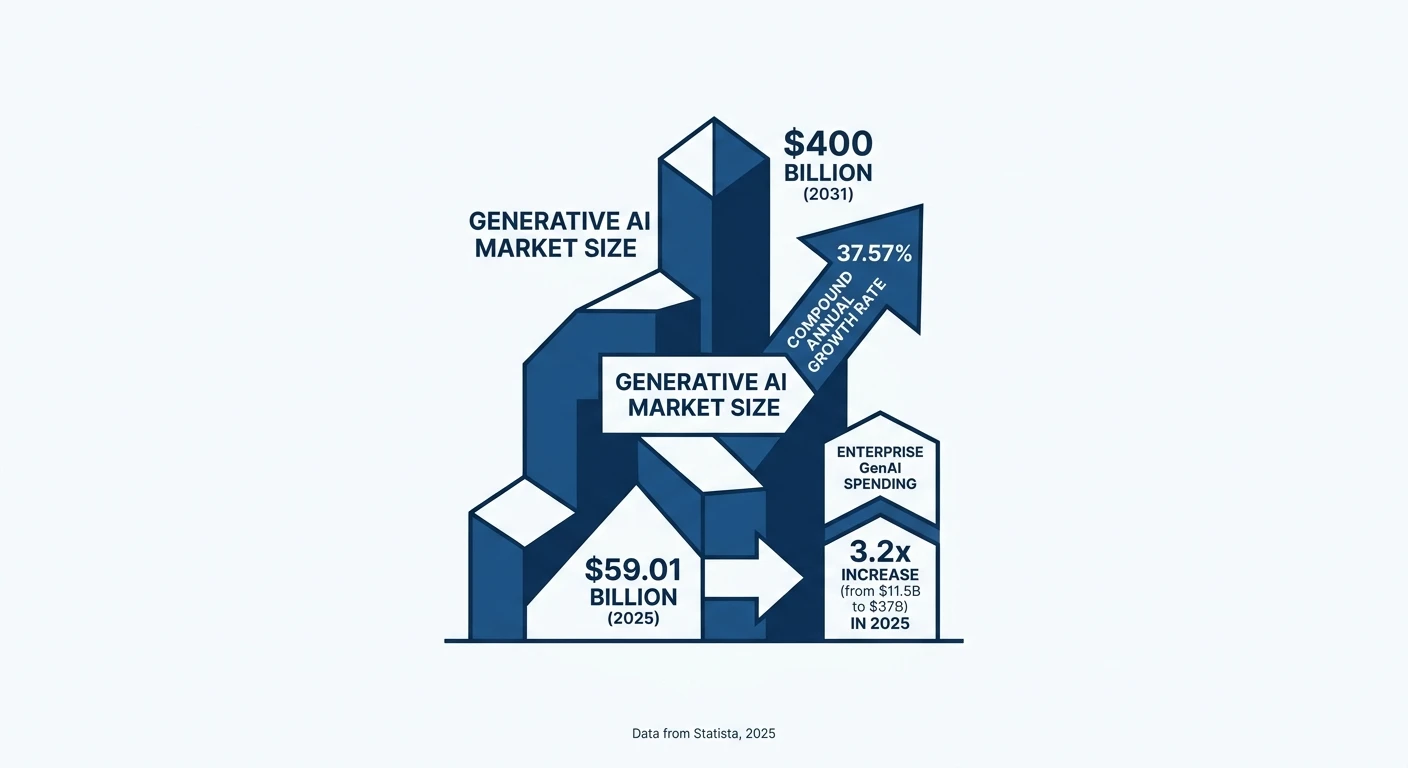
Statista places the global Generative AI market at $59.01 billion in 2025. That number climbs to $400 billion by 2031 at a 37.57% compound annual growth rate. The broader AI market reached $390.91 billion in 2026.
For context on speed: enterprise GenAI spending hit $37 billion in 2025, a 3.2x increase from $11.5 billion the year before. That is not incremental growth. It is a full-scale shift in how enterprises allocate technology budgets.
Investment Is Concentrated and Growing
Funding Metric | 2025 Data |
Total global AI VC | $211 billion |
GenAI VC (11 months) | $87 billion |
AI's share of all VC | 52.7% |
Average late-stage deal size | $1.55 billion |
North America's share | 97% |
Expected total AI spending 2026 | $500 billion+ |
2025 was the first year in history any single technology sector captured more than 50% of all global venture capital. AI did it at 52.7%. The late-stage deal size tripling to $1.55 billion shows capital concentrating into fewer, bigger bets rather than spreading across many startups.
Section 2: Adoption Statistics
Overall Enterprise Adoption
McKinsey's 2025 State of AI report — based on surveys of approximately 2,000 enterprises across 105 countries — is the most comprehensive adoption dataset available.
Key findings:
88% use AI in at least one business function (up from 78% in 2024)
79% specifically use Generative AI
82% of enterprise leaders use GenAI weekly (up from 37% in 2023)
46% use it daily
50% of all organisations now use AI in three or more business functions
Only 7% have achieved enterprise-wide AI scaling
The 82% weekly usage among leaders is striking. In 2023, only 37% used it this frequently. That near-doubling in leadership-level daily usage signals a cultural shift, not just a technology adoption.
The Adoption-Impact Gap
The defining tension of GenAI in 2026: adoption is near-universal, but results are uneven.
Measure | Data |
Organisations using AI | 88% |
Organisations with measurable EBIT impact | 39% |
Organisations with no EBIT impact | 80%+ |
Organisations scaled enterprise-wide | 7% |
Organisations not yet scaling | 66% |
The explanation is in the denominator. Companies deploying GenAI in just one function rarely see enterprise-level financial results. The pattern in the data is consistent: companies deploying across three or more functions are the ones achieving measurable EBIT improvement.
Who's Adopting
Adoption Metric | Figure |
Fortune 500 using OpenAI's GenAI | 93% |
Businesses planning GenAI investment | 92% |
Companies with GenAI APIs by end 2026 | 80%+ (Gartner) |
Workplace apps with AI copilots by 2026 | 80% (IDC) |
Marketers using AI consistently | 65% |
Market researchers using AI | 95% |
LLM adoption in research | Grew 37x in one year |
Global reach: 16.3% of the global population now uses generative AI tools regularly. Developing economies are leading everyday adoption — the top 10 countries by share of regular AI users are all emerging markets.
Section 3: Productivity and Business Impact
What the Research Actually Shows
Multiple independent studies have measured productivity impact from GenAI in real work settings.
Study | Finding |
Accenture (software) | Up to 55% faster development |
Harvard/BCG (consultants) | 25% faster task completion |
MIT/Stanford | 14% overall productivity boost |
GitHub/Microsoft | 55% faster coding |
McKinsey | 3.2x content output per marketer/month |
Harvard Business Review | Up to 56% task time reduction |
Google (UK admin workers) | 122 hours saved per year |
Zendesk | 26% higher CSAT, 34% faster response |
Second Talent | 3.5 hours saved per worker per week |
Economic Value Potential
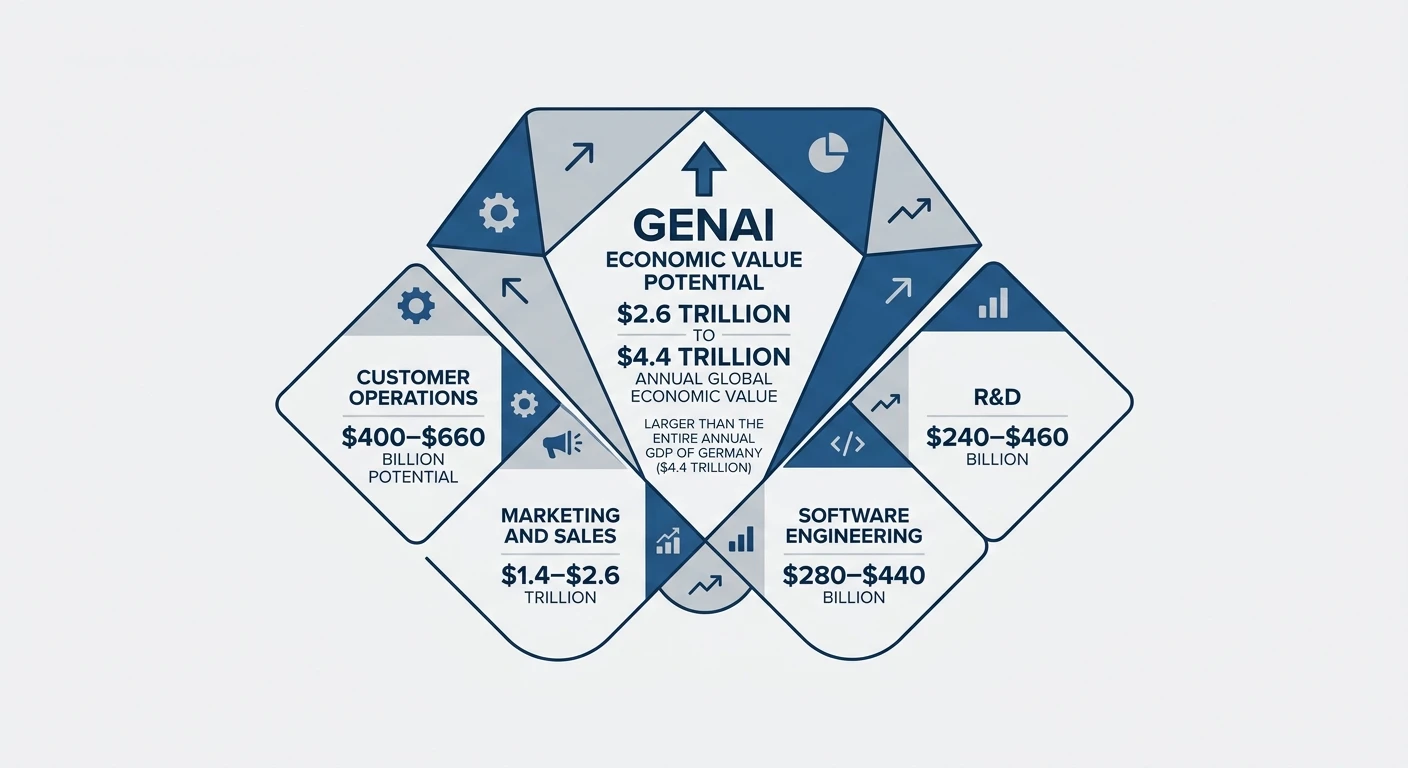
McKinsey estimates GenAI could add $2.6 trillion to $4.4 trillion in annual global economic value. To put that in context, $4.4 trillion would be larger than the entire annual GDP of Germany.
Key economic value projections by function:
Customer operations: $400–$660 billion potential
Marketing and sales: $1.4–$2.6 trillion
Software engineering: $280–$440 billion
R&D: $240–$460 billion
ROI Numbers
Average return per $1 of GenAI investment: $3.70
Companies reporting positive ROI: 75% (OpenAI survey)
93% of companies using ChatGPT plan to expand their use
Companies deploying in 3+ functions: consistently the highest ROI group
Section 4: Workforce and Worker Statistics
How Employees Use GenAI
Use Case | Worker Adoption |
Efficiency and speed | 67% |
Information access | 61% |
Idea generation | 59% |
Quality improvement | 58% |
Email writing | 35% want AI help |
Meeting notes | 33% want AI help |
Weekly and daily usage:
36% use GenAI for work at least monthly
22% use it daily
65% of marketers use it consistently
The Disclosure Problem
Despite high adoption, there is a significant shadow AI issue:
68% of employees don't tell their employer they use ChatGPT at work
32% use it without informing their manager
4.7% have entered confidential company data into public AI tools
Generational Breakdown at Work (US)
Gen Z: 29%
Gen X: 28%
Millennials: 27%
Workplace GenAI adoption is notably even across generations — different from typical technology adoption curves where younger workers lead significantly.
Section 5: Industry-Specific Statistics
Industry | Key 2026 Stat |
Marketing | 65% regular use; 3.2x content output |
Software engineering | 55% faster development |
Customer service | 14% more queries/hour; 26% CSAT improvement |
Healthcare | Drug discovery, diagnostics, documentation |
Financial services | Fraud detection, compliance, risk assessment |
Education | 5.4 million classrooms using AI for lessons |
Legal | Document drafting and contract review expanding |
Market research | 95% of researchers use AI regularly |
Section 6: Future Projections
Projection | When |
GenAI market reaches $400B | 2031 |
Total AI spending $2.52 trillion | 2026 |
75% of companies using GenAI | 2026 |
33% of enterprise software has agentic AI | 2028 |
AI chatbots handle 15–20% of search | 2027 |
AI copilots in 80% of enterprise apps | 2026 |
Conclusion
The data on Generative AI in 2026 presents a technology that has achieved near-universal enterprise adoption, proven productivity gains in controlled deployments, and a massive investment base — while simultaneously being deployed by most companies in a shallow, limited way that has not yet translated to measurable business results at scale.
That gap is also the opportunity. The businesses that bridge it — moving from single-function experiments to enterprise-wide deployment — are the ones consistently reporting the highest returns.
FAQs
The Generative AI market was valued at approximately $59.01 billion in 2025 and is growing at a 37.57% CAGR, with projections targeting $400 billion by 2031. Enterprise GenAI spending alone reached $37 billion in 2025, signaling rapid institutional investment.
79% of organisations now use Generative AI specifically, with 88% using AI in at least one business function. Despite broad usage, only 7% of companies have successfully scaled GenAI enterprise-wide.
Generative AI delivers measurable productivity gains across roles, including developers coding 55% faster, marketers producing 3.2x more content, and the average worker saving 3.5 hours per week. Customer service teams also handle 14% more queries per hour.
Generative AI attracted $87 billion in venture capital in the first 11 months of 2025, contributing to $211 billion in total AI VC funding. This marked the first time any single sector captured more than 50% of all global venture capital.
Over 80% of companies deploying Generative AI report no measurable EBIT impact, largely because most deployments are limited to a single business function. Research shows that companies integrating AI across three or more functions are the ones actually seeing bottom-line financial results.