
The global startup ecosystem entered 2026 with more capital flowing than ever before — and more founders failing than ever before. Global venture funding hit a record $189 billion in February 2026 alone, with AI startups capturing 90% of the total (Crunchbase). Meanwhile, 90% of all startups still fail, and 966 companies shut down annually, representing 25.6% of all tracked ventures (Digital Silk).
Whether you are a founder raising your first round, an investor deploying capital, or a marketer researching the landscape, this article brings together the most current, verified startup statistics for 2026 — covering global funding, failure rates, the India ecosystem, compensation benchmarks, tech stacks, exit data, and emerging sectors like climate tech.
All figures are sourced from Crunchbase, Forbes, Gartner, PIB India, OECD, Statista, Deloitte, DPIIT, Bain & Company, S&P Global, and other authoritative outlets. Data is current as of March 2026.
Top 10 Startup Statistics for 2026 (At a Glance)

# | Statistic | Source |
|---|---|---|
1 | Global VC funding hit $189 B in February 2026, the largest single month ever recorded | Crunchbase |
2 | AI startups raised $171 B in February alone — 90% of all VC investment that month | TechCrunch |
3 | 1,705 unicorns globally as of March 2026, with combined value exceeding $2.7 trillion | BestBrokers |
4 | 90% of startups fail; 80% survive Year 1, but only ~50% survive to Year 5 | DemandSage |
5 | E-commerce startups face an 80% failure rate; SaaS startups see 70% failure within 5 years | Growth List, Purple Path |
6 | Total venture exit value nearly doubled in 2025 to $297.6 B across 1,635 transactions | Forbes |
7 | India has 2,12,283 DPIIT-recognised startups and 120–125 active unicorns | PIB India, MoneyControl |
8 | Worldwide IT spending is projected to reach $6.15 trillion in 2026, up 10.8% YoY | Gartner |
9 | Climate tech funding reached $40.5 B in 2025, up 8% YoY, with nuclear receiving one-fifth of all climate VC | Trellis, Bloomberg |
10 | Companies spend an average of $4,830 per employee on SaaS subscriptions, with 106 apps per organisation | Contrary Research, BetterCloud |
Global Startup Funding Statistics 2026
The venture capital landscape in early 2026 is defined by a single word: AI. Global VC funding surged to $55 billion in January 2026 (Crunchbase) before exploding to a record $189 billion in February, driven almost entirely by massive rounds for OpenAI, Anthropic, and Waymo (TechCrunch). AI-related startups captured $171 billion — or 90% — of February's total.
For context, Q4 2025 saw approximately $141 billion in global VC investment, a 12% quarter-over-quarter increase (Bain & Company). Over the full year 2025, AI startups raised $214.5 billion, representing 79.3% of the global total. The OECD confirms that AI now accounts for 61% ($258.7 billion) of all global VC investment, doubling its 2022 share of 30%.
In the United States, startup funding reached $162.8 billion in H1 2025 alone, while European startups secured $77 billion with a 7% YoY increase (Mean.CEO). Looking at all of 2025, over 3,000 corporations invested in startups globally (Global Venturing), and AI startups attracted approximately $131.5 billion — up roughly 52% — according to Qubit Capital.
What This Means: Capital is no longer evenly distributed across sectors. If your startup does not have an AI angle in 2026, you are competing for roughly 10–20% of the available funding pool. Founders outside of AI need to demonstrate capital efficiency and a clear path to profitability to attract investors.
Startup Failure Rate Statistics 2026
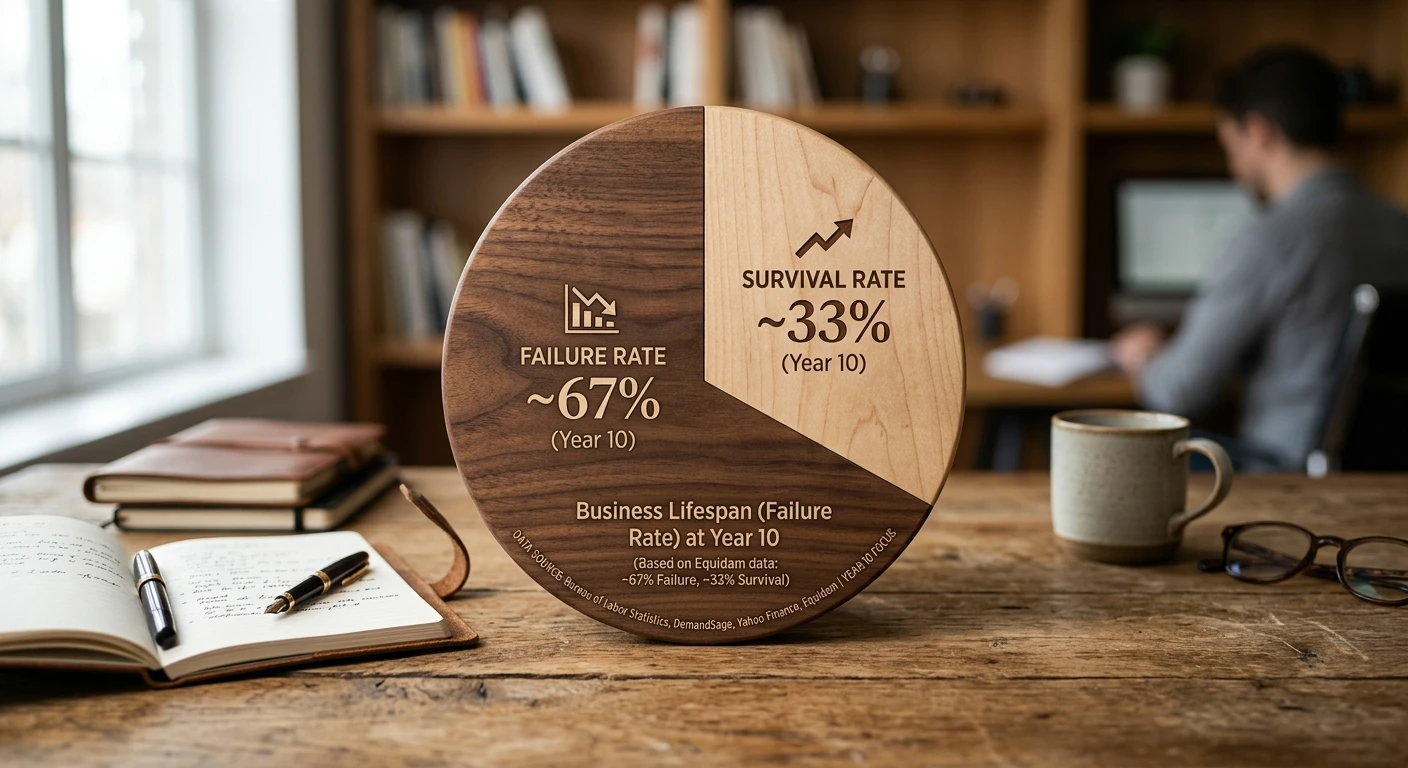
Understanding failure rates by timeline, business model, and sector is critical for any founder or investor. Here are the latest numbers.
Failure Rates by Year
Timeline | Survival Rate | Failure Rate | Source |
|---|---|---|---|
Year 1 | ~80% | ~20% | Bureau of Labor Statistics |
Year 2 | ~67–70% | ~30–33% | DemandSage |
Year 5 | ~50% | ~50% | Yahoo Finance |
Year 10 | ~33% | ~67% | Equidam |
The overall global startup failure rate remains at 90% — meaning only 1 in 10 startups ultimately succeeds in creating a sustainable business (DemandSage, Ideaproof). First-time founders have an 18% success rate, while repeat founders fare only slightly better at 20%.
Failure Rates by Business Model
Business Model | Failure Rate (5-Year) | Key Risk Factor |
|---|---|---|
Subscription / SaaS | ~70% | High churn, competitive moats |
E-Commerce / DTC | ~80% | Thin margins, customer acquisition cost |
Marketplace | ~75% | Chicken-and-egg supply/demand problem |
Ad-Supported / Media | ~85% | Requires massive scale for viability |
Enterprise B2B | ~65% | Long sales cycles, heavy upfront investment |
AI Startups | ~85–90% | Technical complexity, data requirements |
Healthtech | ~80% | Regulatory burden, slow adoption |
SaaS companies specifically face steep odds: 966 annual startup shutdowns tracked by researchers show SaaS firms make up 32% of that count. Only 28% of software startups survive long enough to reach $100 million in revenue, and just 3% reach $1 billion (Digital Silk).
What This Means: One-third of startup failures stem from a lack of product-market fit (DemandSage). Before investing heavily in growth, founders should validate demand with paying customers. The business model you choose at the outset meaningfully influences your odds — enterprise B2B has the highest survival rate, while ad-supported models have the lowest.
The India Startup Ecosystem in 2026
India stands firmly as the world's third-largest startup ecosystem. As of January 31, 2026, a total of 2,12,283 entities have been recognised as startups by DPIIT, with 1,02,054 having at least one woman director or partner (PIB India). The country hosts 120–125 active unicorns with a combined valuation exceeding $350 billion (MoneyControl).
Over the past decade, the Startup India initiative — launched in 2016 — has transformed the landscape. The number of DPIIT-recognised startups has surged from under 500 in 2016 to over 2 lakh in 2026. Key hubs include Bengaluru, Mumbai, Delhi-NCR, Hyderabad, and Pune, with rapidly growing ecosystems in Tier-2 cities like Jaipur, Kochi, and Indore.
India-focused VC funding in 2025 is estimated at $10–12 billion, with fintech, edtech, healthtech, D2C, and SaaS being the dominant funded sectors. Uttar Pradesh alone now has 17,000 active startups and 8 unicorns (LinkedIn/StartupRO).
What This Means: India's startup density is increasing outside of traditional metros. Government initiatives (Fund of Funds, Startup India Seed Fund Scheme, State Startup Rankings) are actively decentralising the ecosystem. Founders outside Bengaluru now have genuine access to incubation, mentorship, and seed capital.
Unicorn Statistics 2026
As of March 2026, 1,705 startups globally have achieved unicorn status — a valuation of $1 billion or more (BestBrokers). In January alone, unicorns collectively added $9.3 billion in funding and $58.5 billion in value (Crunchbase).
Metric | 2026 Figure | Source |
|---|---|---|
Total unicorns worldwide | 1,705 | BestBrokers |
AI unicorns | 498 | Powerdrill / AI Funding Tracker |
Combined AI unicorn valuation | $2.7 trillion | AI Funding Tracker |
India's active unicorns | 120–125 | MoneyControl |
Largest unicorn valuation | $1.25 trillion (SpaceX) | MEXC Exchange |
New unicorns in Q1 2026 | Ongoing; Gamma valued at $2.1 B (Series B) | Tracxn |
The AI sector is minting unicorns faster than the dot-com era. Of the 498 AI unicorns, sectors like autonomous vehicles, foundation models, and AI infrastructure dominate valuations (Fortune).
What This Means: Unicorn status has become more common but also more concentrated. The top 10 unicorns by valuation account for a disproportionate share of total unicorn value. For most founders, the takeaway is that “unicorn” is no longer a rare milestone — but achieving profitability remains rare.
Also read about: AI for Startups: Turning Ideas into Profitable Ventures
Startup Exit & IPO Statistics 2026
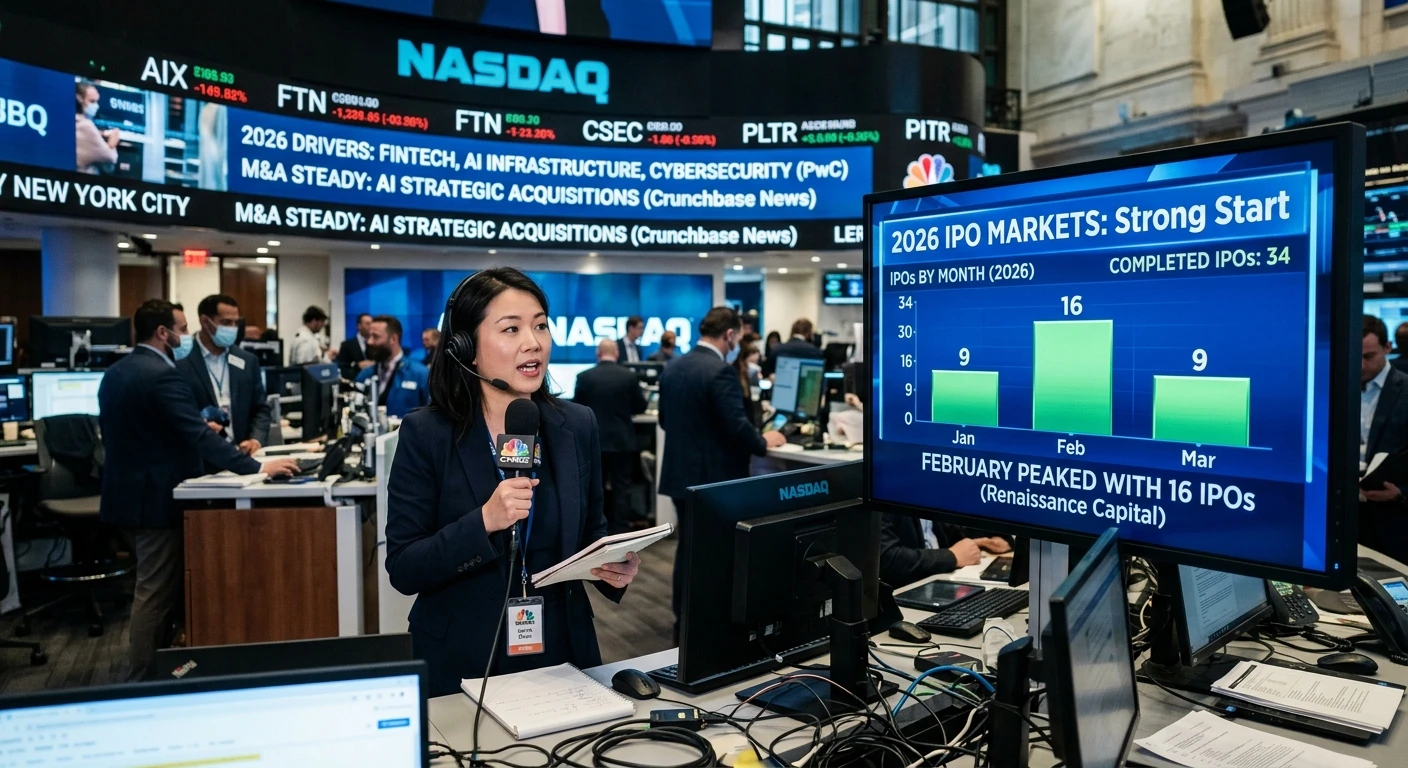
After years of a depressed exit environment, 2025 saw a dramatic rebound. Total venture exit value nearly doubled to $297.6 billion across 1,635 transactions (Forbes). This made 2025 one of the strongest exit years of the decade.
In 2026, 34 IPOs had been completed through March, with February seeing the most activity at 16 IPOs (Renaissance Capital). PwC's Capital Markets Watch identifies fintech, AI infrastructure, and cybersecurity as the sectors most likely to drive IPO activity in 2026. Crunchbase notes that M&A activity is expected to continue at a steady pace, with larger companies making strategic acquisitions, particularly in AI (Crunchbase News).
Scaled fintechs like Stripe, Ramp, and Airwallex represent major potential exits in 2026 (Restive). The EY Global IPO Trends report anticipates that regulatory clarity and stabilised interest rates will support a sustained IPO window throughout the year.
What This Means: The exit market is recovering, but it favours companies with strong unit economics and defensible market positions. Founders should prepare for longer due diligence cycles and lower valuation multiples compared to the 2021 peak. Strategic M&A — not IPOs — remains the most common exit path for startups.
Startup Compensation & Equity Statistics 2026
Compensation at startups varies dramatically by stage, role, and geography. According to Wellfound, the average expected salary for startup employees in 2026 is $126,000 per year, with a range from $58,000 to $265,000. Late-stage startups pay 31–34% more than early-stage companies for senior talent across all functions (Ravio 2026 Compensation Trends Report).
Compensation by Role (Series A, US)
Role | Base Salary Range | Equity Value Range | Source |
|---|---|---|---|
Software Engineer | $155,000 | $460,000 | |
Senior Software Engineer | $200,000 | $218,000 | |
Staff Product Manager | $255,000+ | $400,000+ | |
VP of People | $155,000 | $102,000 | |
Product IC (Series A) | $175,000–$255,000+ | Varies widely | LinkedIn / Steve Bonomo |
The typical startup CEO at seed stage takes home $100,000–$130,000 in salary. Early employees (first 10–20 hires) generally receive 0.5–2% equity, and outside CEOs joining post-founding hold an average of 6–8% at IPO (SaaStr, Founders Network). A CMO at an early-stage startup typically negotiates 2–4% equity, representing up to 25% of the entire option pool (Digital Defynd).
US companies now spend an average of $4,830 per employee on SaaS subscriptions (Contrary Research), while one study places that number even higher at $7,900 per employee — more than companies spend on healthcare (Spendesk). The cost to build a mid-tier SaaS platform has dropped from over $1 million in 2020 to $70,000–$115,000 in 2026 (LinkedIn / Rob Litterst).
What This Means: Equity remains the primary wealth-creation mechanism at startups, but founders are increasingly offering competitive base salaries to compete for talent. The decline in SaaS build costs means new entrants can launch products at a fraction of historical costs — but this also lowers barriers to competition.
Tech Stack & Cloud Spending Statistics 2026

Worldwide IT spending is expected to reach $6.15 trillion in 2026, up 10.8% from 2025 (Gartner). US technology spending specifically is forecast to grow 8.3% to $2.9 trillion (Forrester). AI infrastructure represents the largest growth category, with Gartner forecasting $2.5 trillion in total AI-related spending in 2026, including $1.37 trillion on AI infrastructure and $589 billion on AI services.
The average company now uses 106 SaaS applications, down from 112 in 2023, but the consolidation rate has slowed from 14% to just 5% (BetterCloud). Organisations spend an average of $55.7 million on SaaS annually, an 8% YoY increase (Zylo). 63% of organisations now manage AI spend, with adoption projected to reach 96% by 2026 (FinOps Report via Zylo).
Among the most popular SaaS tools, HubSpot leads average annual spend at $30,903 per buyer, followed by Datadog at $30,809 per buyer (Cledara). The everyday startup stack — Notion, Slack, Linear, Vercel, Stripe, and HubSpot — typically costs $3,000–$8,000 per month for a 10-person team, though founders on Reddit report cutting SaaS bills by $400+ per month by eliminating AI add-on redundancies (r/B2BSaaS).
Big Tech companies collectively plan to spend at least $630 billion on AI in 2026, with Meta projecting $115–135 billion on Llama models and AI ad infrastructure alone (Reuters, Campaign US).
What This Means: The SaaS tool landscape is consolidating at the top — fewer apps, but higher spend per app. Startups that build AI-native features into their products from day one will capture more of the expanding AI budget. For early-stage founders, the collapsing cost of SaaS platforms means you can launch faster, but must differentiate on product quality rather than feature count.
Climate Tech & Deep Tech Statistics 2026
Climate tech investment is finding solid footing. Worldwide climate tech funding reached $40.5 billion in 2025, an 8% increase year-over-year (Trellis). In the United States specifically, total VC investment in climate tech hit $6.6 billion across 304 deals through December 2025 — a 59% jump from 2024 (Inc.).
Nuclear startups received approximately one-fifth of all climate venture funding during the first nine months of 2025 (Bloomberg). AI-integrated climate solutions — including AI-optimised energy grids, carbon capture monitoring, and sustainable agriculture — are attracting the most interest from investors in 2026. J.P. Morgan identifies energy transition infrastructure and clean hydrogen as the highest-growth subsectors.
Deep tech more broadly — spanning quantum computing, advanced materials, robotics, and biotechnology — continues to attract dedicated funds. A recent $174 million European deeptech fund focuses on innovative fueling technologies (Cleantech.com). StartUs Insights tracks over 55,160 climate tech companies and 2,430+ startups alongside 3.3 million+ patents in the space.
What This Means: Climate tech is transitioning from hype-driven funding to execution-driven capital allocation. Investors now demand clear commercialisation pathways and regulatory moats. Founders in this space need to demonstrate technological readiness levels above proof-of-concept to raise meaningful capital in 2026.
Key Trends Shaping Startups in 2026

Several macro trends are reshaping the startup landscape this year.
First, AI is redefining what it means to be a startup. The cost to build software has collapsed by 90% since 2020, but AI also means that large incumbents can iterate faster than ever. The winners will be founders who use AI to create entirely new categories, not just cheaper versions of existing tools.
Second, the “value creation era” has replaced the “growth at all costs era” (Forbes). VC firms are prioritising profitable growth, capital efficiency, and clear paths to exit. This shift rewards enterprise B2B and vertical SaaS founders who can demonstrate net revenue retention above 100%.
Third, the India ecosystem is maturing at unprecedented speed. With 2.12 lakh recognised startups, 120+ unicorns, and government programs supporting Tier-2/3 expansion, India is producing globally competitive companies across fintech, SaaS, D2C, and healthtech.
Fourth, compensation is rising across the board. Late-stage startups pay 31–34% more than early-stage companies, and even seed-stage CEOs are taking home $100K+ salaries. The equity trade-off is becoming less attractive to top talent unless the company can demonstrate a credible path to liquidity.
Fifth, exit markets are recovering. With $297.6 billion in 2025 exit value and a growing 2026 IPO pipeline, the liquidity overhang that plagued 2022–2024 is easing — though valuations remain below peak 2021 multiples.
Frequently Asked Questions
What percentage of startups fail in 2026?
Approximately 90% of startups fail eventually. About 10% fail within the first year, 48.4% within five years, and 65.1% within ten years. Only about 35% of startups survive beyond a decade.
What is the #1 reason startups fail?
No market need is the top reason, accounting for 42% of failures. Startups build products nobody wants. The second biggest reason is running out of cash (29%), followed by not having the right team (23%).
How much money do you need to start a business in 2026?
The average startup costs $40,000, but this varies widely by industry. Online businesses can start with $5,000-$40,000, while restaurants need $375,500 or more. About 78% of startups are self-funded using personal savings.
What industries have the highest startup success rates?
Gaming startups have a 50% success rate, which is relatively high. Consumer goods and pet care/veterinary services show lower failure rates around 54-57%. Fintech (75% failure), construction (73.4% failure), and e-commerce (70% failure) have the highest failure rates.
How much venture capital funding do startups raise?
Global venture funding reached $425 billion in 2025. However, only 0.05% of startups actually raise VC funding. The average seed round is $2.2 million. Less than 1% of startups become unicorns (valued at $1 billion+).
Also Read:
Methodology & Sources
All statistics in this article are verified as of March 2026. Primary data sources include Crunchbase, Forbes, Gartner, PIB India (pib.gov.in), DPIIT (startupindia.gov.in), OECD (oecd.org), Statista, DemandSage, BetterCloud, Zylo, Bain & Company, S&P Global, Forrester, Deloitte, EY, Bloomberg, TechCrunch, BestBrokers, Renaissance Capital, J.P. Morgan, Wellfound, TopStartups.io, Ravio, Founders Network, and community discussions on Reddit (r/B2BSaaS, r/startups) and X.
Where projections are cited, they are attributed to the forecasting organisation and should be treated as estimates, not guarantees. All $ figures are in USD unless noted otherwise. INR figures are converted at the prevailing March 2026 rate where applicable.
Source: Statista, Founder Forum Group